
 Worksheets
1st Semester exam 25 part 2
Total questions: 137
Worksheet time: 3hrs 1mins
Which of the following is NOT true: In a gas the particles ____.
have no cohesion
are farthest apart
have least energy
have no set volume or shape
Which of the following is NOT true, In a solid the particles ____
have least cohesion
have the least energy energy
have definite shape and volume
are in fixed position
higher temperature =
particles have more energy
particles have less energy
130°C
Temperature has nothing to do with particle energy.
At which temperature would the particles of a substance that have the most energy
78°C
24°C
104°C
140°C
____ is the process of a liquid becoming a gas.
Evaporation
Vaporization
Sublimation
Boiling
state of matter-definite volume, but no definite shape
solid
liquid
gas
plasma
Matter in the __ state is a collection of free-moving electrons and ions.
liquid
plasma
gas
solid
___ is a measure of the average kinetic energy of all particles in a substance.
Thermal energy
Heat of vaporization
Boiling Point
Temperature
In order to change the state of any substance, you must
change the energy of the particles
slow down the particles
speed up the particles
Particle speed has nothing to do with state of matter.
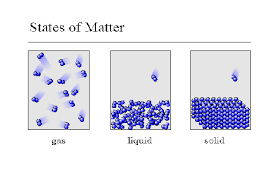
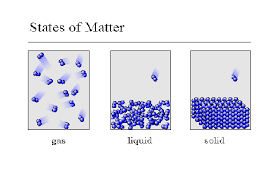
has no definite shape or volume

Freezing shows a state change from
Solid to gas
Liquid to solid
Gas to solid

Boiling shows a state change from
liquid to gas
gas to solid
gas to liquid

Which diagram illustrates a state of matter that has no definite shape, but has a definite volume?
1
2
3

Particles in a ______________________ move quickly and are far apart.
gas
solid
liquid
Solid to Gas
Deposition
Sublimation
Evaporation
The slower the particles in a substance move,
the colder it is.
the warmer it is.
the more energy it has.
Gas to Plasma
Vaporization
Ionization
Sublimation
Particles move relative to each other, but remain in contact with each other.
solid
liquid
gas
What happens to particles when their temperature increases?
The particles move slower
The particles move faster
The particles lose mass
The particles gain mass
The amount of space something takes up is its...
Mass
Volume
Thermal Energy
Temperature
The energy of MOTION is...
chemical energy
radiant energy
potential energy
kinetic energy

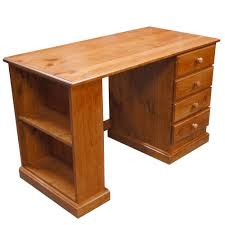
Which state of matter does this picture show?
Solid
Liquid
Gas

What is happening in this picture of this lake freezing?
Molecules are speeding up
Molecules are slowing down
You have a pitcher of water at 100 degrees Celsius and a bathtub filled with water at 70 degrees Celsius. Which one has more kinetic energy?
The pitcher because the water is hotter
Neither, they both have the same amount of kinetic energy.
The bathtub because there are more particles in motion.
When a metal can be pounded into then sheets or molded into shapes, it is ______________.
ductile
malleable
flammable
soluble
The basic building blocks of all matter are ___.
molecules
compounds
mixtures
atoms
Combinations of two or more substances that can be separated by physical means are __.
mixtures
heterogeneous mixtures
homogeneous mixtures
compounds
Conductivity, density, boiling point, and freezing point are all ___ physical properties and can be used to identify a substance.
chemical
physical
characteristic
classified
Mixtures that separate when left standing out are ___.
homogeneous
heterogeneous
solutions
compounds
A ___ describes the ability of a substance to change into a new substance(s).
chemical change
chemical property
physical change
physical property
Matter can be mixtures or ___.
compounds
elements
pure substances
atoms
Which of the following can be indicators of a chemical change? (MR)
change of color
dissolving
change of state
releasing a gas
___ have variable composition and the components retain their characteristic properties. These can be separated by physical means.
Mixtures
Compounds
Elements
Pure Substances
Which of the following are always physical changes? (MR)
reacting with another substance
change of state
burning
dissolving
A metal that can be shaped or pulled into wire, is _____.
ductile
malleable
flammable
soluble
The solute is the substance that something is dissolved in. The solution is mostly made of solute.
True
False
___ changes make new products with different characteristics from the ingredients.
Physical
Chemical
Mixture
Compound
___ are made from atoms of 2 or more elements, joined chemically.
Homogeneous mixtures
Heterogeneous mixtures
Compounds
Elements
A ___ mixture has the same composition throughout. Its components are indistinguishable.
solution
colloid
homogeneous
heterogeneous
Substances with high viscosity move more slowly than those with low viscosity.
True
False
Which of the following are chemical properties? (MR)
electrical conductivity
pH
magnetism
reactivity
hardness
A ____ change does not change the identity of the substances participating in the change.
physical
homogeneous
chemical
heterogeneous
A ___ mixture has components that can be distinguished one from another.
homogeneous
chemical
heterogeneous
physical

This image shows a(n)
atom
compound
element
mixture
A property of matter that measures a substance's ability to dissolve in a solvent is ___.
ductility
solubility
malleability
thermal conductivity
A ___ change alters the identity of the substances involved.
physical
chemical
mixture
pure substance
Properties that do not depend on the quantity of the sample are ___. They can be used to identify an unknown substance.
chemical
characteristic
physical
categorical
In Kool-Aid, the solvent is the water. The solutes are the flavoring and sugar.
True
False
___ have a fixed composition and cannot be separated into simpler substances by physical means.
Heterogeneous
Homogeneous
Pure Substances
Mixtures
The characteristic properties of different samples of the same ___ will not vary.
mixture
pure substance
physical change
chemical change
Two types of a pure substance are ___. (MR)
homogeneous
heterogeneous
elements
compounds
mixtures
The ___ states that matter cannot be created or destroyed, only transformed and transferred.
Law of Conservation of Dynamics
Law of Conservation of Mass
Theory of Conservation of Dynamics
Theory of Conservation of Mass

An element is.....
...made up of lots of atoms
... is more than one kind of atom
...made up of one kind of atom
.... made of one atom

Why is water not an element?
It is made of hydrogen and carbon atoms
It is made of oxygen and hydrogen atoms
It is made of oxygen atoms
It is made of hydrogen atoms
It is a combination of two or more substances in which each substance maintains its physical property.
Solution
Mixture
Solubility


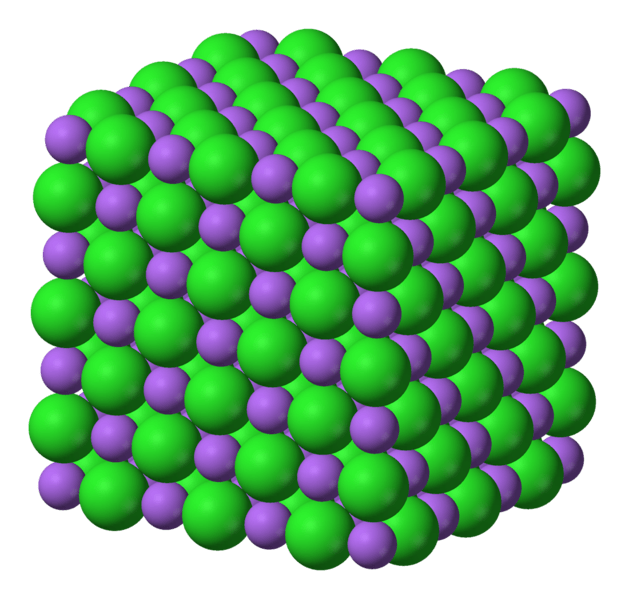
This image shows a(n)
atom
compound
element
mixture
How are Mixtures made?
Chemically
Physically
Physically and Chemically
Found in Nature
chlorine gas, Cl2, is an example of a(n)
element
compound
mixture
bronze, an alloy of many different metals, is an example of a( n)
element
compound
mixture
gold, Au, is an example of a(n)
element
compound
mixture
Milk is an example of
a hetergeneous mixture
a solution
a colloid
a suspension
Particles in a colloid are large enough to scatter a beam of light as it passes through. This is known as the
Law of Conservation of Mass
The Theory of Kinetic Motion
The Tyndall Effect
The Universal Law of Gravitation
If I combined 50g of baking soda with 30mL of lemon juice in a chemical reaction, what should the mass of the products be?
20 g
50 g
80 g
None of these
Which of the following is not a way to physically separate a mixture?
distillation
magnetic attraction
solubility
electrolysis
One difference between a suspension and colloid is that
in a colloid the particles will settle out over time
in a suspension beams of light will be scattered
a colloid is a homogeneous mixture
that particles in a colloid will never settle out if left standing

This image shows a(n)
atom
compound
element
mixture
Which of the following is NOT an example of pure substance
table salt
concrete
sulfur
sugar
What is the smallest part of an element that will still maintain all the element's properties?
A. atom
B. proton
C. electron.
D. quark
What is the name of the electrons in the outermost energy level?
ions
isotopes
quarks
valence electrons
How are elements arranged in the Periodic Table?
by atomic mass
by atomic number
by the number of neutrons
What does the atomic number of an element represent?
The number of protons + the number of neutrons
The number of protons + electrons
the number of electrons
the number of protons
Which subatomic particle has a positive charge?
What is the name of the most reactive group on the on the Periodic Table of Elements?
Noble Gases
Transition Metals
Alkaline Earth Metals
Alkali Metals
What is the name of the group of elements that have a full outer shell of electrons and, therefore, are unreactive.
Halogens
Lanthanides
Alkali Earth metals
Noble Gases

What is the atomic number of Silver?
47
61
108
155
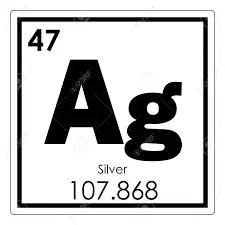
How many protons, neutrons, electrons are in a neutral atom of Silver
p-47, n- 47, e - 47
p- 47, n- 61, e- 47
p- 47, n- 108, e- 47
p- 108, n- 155, e-47
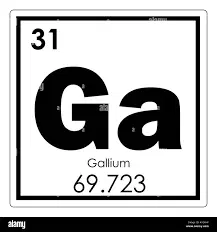
What is the atomic number of Gallium?
70
39
31
101
How many protons, neutrons, and electrons are in a neutral atom of Gallium?
p- 31, n-39, e-31
p- 69, n- 31, e- 131
p- 31, n- 70, e- 31
p- 31, n- 70, e- 31
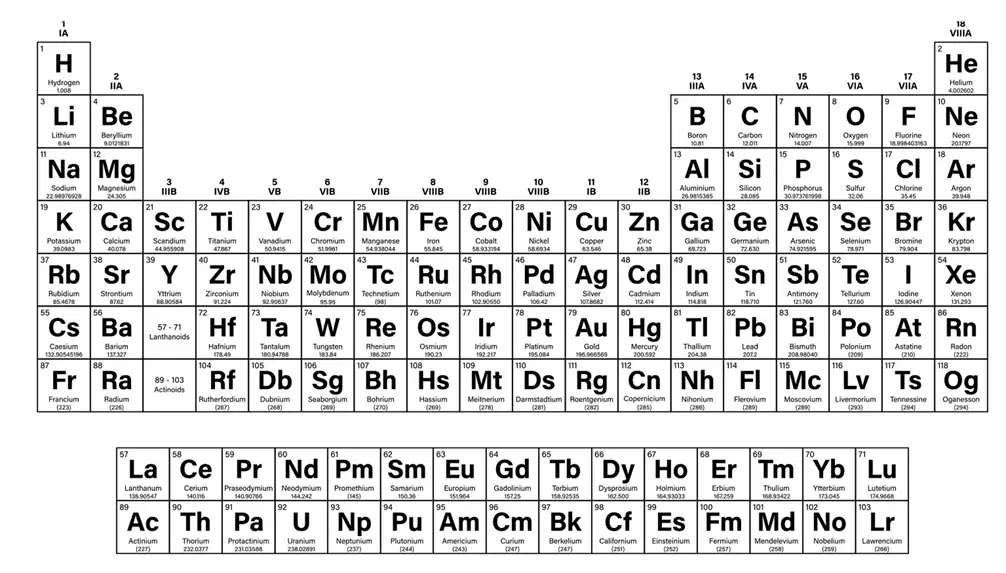
In what group are the Halogens found?
Group 17
What do the different periods tell us about an element on the periodic table?
The number of valance electrons
The number of energy levels
the atomic mass
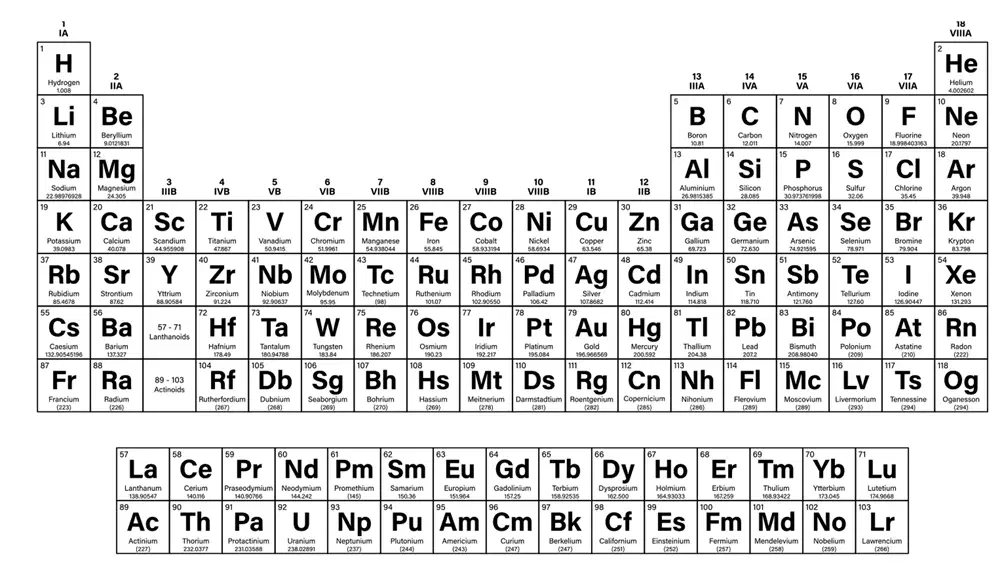
What is the name for the elements in Groups 3 - 12 ?
What is the name of the group of elements that have characteristics of both metals and nonmetals?
Transition metals
Inner Transition metals
Metalloids
Alkali Metals
Which element has properties most similar to Phosphorus (P)?
Silicon (Si)
Selenium (Se)
Argon (Ar)
Nitrogen (N)
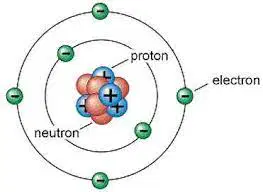
Who is credited with coming up the idea that electrons traveled in fixed orbits, or energy levels, around the nucleus?
John Dalton
J.J. Thomson
Ernest Rutherford
Niels Bohr

This is the name of the model of the atom that is most widely accepted today. It states that the locations of electrons is impossible to predict, but the areas where they are moving can be predicted.
the plum - pudding model
the Bohr Model
the planetary model
the electron cloud model
The most reactive element in period 4 is ____.
Krypton (#36)
Bromine (#35)
Calcium (#20)
Potassium (#19)
If an isotope of Carbon, Carbon - 12, has 6 protons. How many protons does Carbon - 14 have?
7
8
13
6
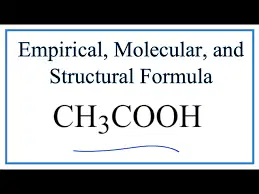
How many elements are found in the chemical formula shown below?
What is the average atomic mass of Tin (#50)?
119
50
69
169
Carbon has 6 protons, 6 neutrons and 6 electrons. What would you call a Carbon atom with 6 protons, 8 neutrons and 6 electrons?
an ion
an isotope
Which of the following sub atomic particle is the smallest and least massive?
A vertical column on the periodic table is called a/an _____.
energy level
A horizontal row on the periodic table is called a/an _____.
Fluorine (#9) has ____ valence electrons.
7
9
17
1
Barium (#56) has ____ valence electrons.
6
2
56
1
How many protons, neutrons, and electrons does a neutral atom of Chlorine (#17) have?
17, 18, 17
17, 35, 17
17, 52, 35
35, 17, 18
What is the atomic number of Calcium (Ca)?
40
20
60
4
Which group (or family) from the periodic table have a full outer electron shell and are, therefore, unreactive with other elements on the periodic table?
Group 18
Noble gases
Group 1
Alkali Metals
Group 17
Halogens
Group 2
Alkaline Earth Metal
Which group (or family) from the periodic table have a 1 electron in their outermost energy level and are, therefore, highly reactive with some other elements on the periodic table?
Group 18
Noble gases
Group 1
Alkali Metals
Group 17
Halogens
Group 2
Alkaline Earth Metal
Which group (or family) from the periodic table have a 7 electrons in their outermost energy level and are, therefore, highly reactive with some other elements on the periodic table?
Group 18
Noble gases
Group 1
Alkali Metals
Group 17
Halogens
Group 2
Alkaline Earth Metal
How many energy levels would a neutral atom of Calcium (Ca #20) have?
four
two
forty
twenty
What is the ratio of Carbon (C) to Hydrogen (H)i in C3H6O.
6:3
2:1
1:2
3:1
Which one of the following categories would best identify U, Uranium (#92)?
Which one of the following categories would best identify I, Iodine (#53)?
Which one of the following categories would best identify Si, Silicon (#14)?
Which one of the following categories would best identify Cr, Chromium (#24)?
nonmetal
transition metal
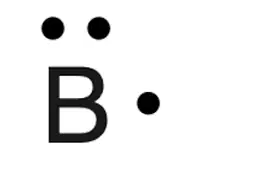
What do the dots around the symbol for Boron represent?
The number of electrons in the outer most energy level
the number of protons in the nucleus
the number of neutrons in the nucleus
the total number of electrons in the atom
What are ways in which scientists DO NOT test their ideas.
writing articles for scientific journals
performing experiments
sitting around developing theories
How does a scientific law differ from a scientific theory?
a theory in science is just an educated guess. A law in science has been proven to be true
a scientifc law states what will happen in certain conditions. A theory describes how certain things happen

How does the density of wood compare to the density of liquid water? And what does this mean?
They are both so close that it really doesn't mean anything.
Liquid water is more dense than wood. Wood will float in water.
Liquid water is more dense than wood. Wood will sink in water.
Liquid water is less dense than wood. Wood will sink in water.
You can't really tell from this chart.

A 113 -gram sample of an unknown material has a volume equal to 10 cm3. Based on its density and using this chart, the material could be ______.
aluminum
steel
lead
There isn't enough information to tell.
What do we call a "testable explanation" in science?
review
theory
hypothesis
scientific law
Mr. McKee’s class wanted to find out whether their plants would grow better with fertilizer or without. They would do a(n) _______ to attempt to answer this question.
observational study
controlled experiment
‘Tested variable’ is another term for ________ variable
flexible
controlled
independent
dependent
Match the type of observation with the statement: The density of the substance is 1.4 g/cm3
quantitative
qualitative
Match the type of observation with the statement: The liquid smelled like rotten eggs.
quantitative
qualitative
Match the type of observation with the statement: The distance the object rolled was 152 cm.
quantitative
qualitative
Match the type of observation with the statement: The distance the object rolled was 152 cm.
quantitative
qualitative
direct evidence
indirect evidence
In our photosynthesis lab with the Elodea plant in the solution of bromothymol blue. Placing 100 ml of solution in the baggie is an an example of
independent variable
dependent variable
controlled variable
control group
In our photosynthesis lab with the Elodea plant in the solution of bromothymol blue. The location of the bag in the light vs the dark is an example of
independent variable
dependent variable
controlled variable
control group
In our photosynthesis lab with the Elodea plant in the solution of bromothymol blue. The color of the solution after 24 hours is an example of
independent variable
dependent variable
controlled variable
control group
When conducting a controlled an experiment, a group of subjects that gets placed "under normal conditions" is called the _________
independent variable
dependent variable
controlled variable
control group

