
 Worksheets
PMA 2 Review
Total questions: 51
Worksheet time: 47mins
Why were the Anti-Federalists against the ratification of the new constitution ?
There was no inclusion of a Bill of rights.
They feared that the states would have too much power.
There were no separation powers amongst the branches.
They wanted the federal government to have the most power
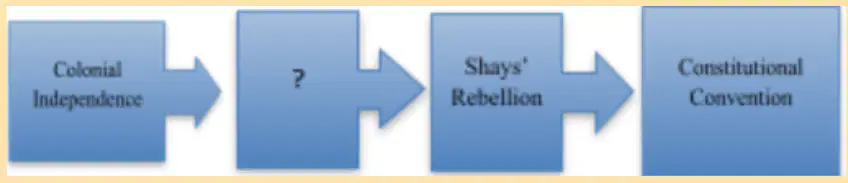
The diagram below shows steps leading to a historical event.
Boston Tea Party
Oath of Allegiance
Articles of Confederation
Declaration of Independence
Which weakness of the Articles of Confederation led to Shays’s Rebellion?
The national government lacked central leadership.
The national government lacked a national court system.
The national government had no authority to raise an army.
The national government lacked the power to regulate trade.
How did the U.S. Constitution solve a problem created by the Articles of Confederation?
It avoided the issue of states’ rights.
The Constitution gave more power to the national government.
It allowed the states to elect representatives.
It prevented the amendment of federal laws
Which statement best describes the intent of the Preamble?
List the rights belonging to the citizens.
Protect the rights belonging to states.
Limit the power of the new central government.
Establish the goals and purposes of the new government.
Which part of the Preamble tells where the government gets its power?
“To provided for the common defense”
“Promote the general welfare”
“Insure domestic tranquility”
“We the people”

Which principle is reflected in the image?
Rule of law
Separation of powers
Checks and balances
Federalism
How does the U.S. Constitution reflect the concept of Limited Government?
The government has three branches
The central and state government share power
The role of the government is to protect the rights of citizens
The branches have the authority to limit each other
Which statement best defines ‘due process’ of law?
People’s guaranteed rights can only be taken away in a severe emergency
Decisions affecting citizens are made by a jury of other citizens
Procedures used to enforce the law are just, fair, and reasonable
Government decisions affecting individuals are made privately
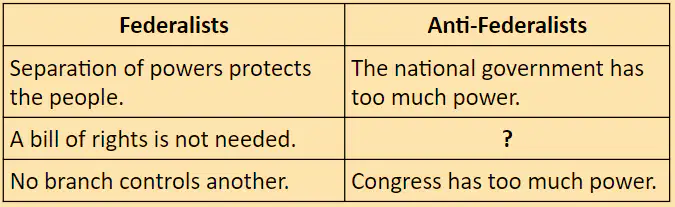
Which of the following statements completes the table?
The state government needs less power.
The federal government needs more power.
A king is needed to control the rights of the people.
A bill of rights is needed to protect the rights of the people.
Which of the following statements would best describe the Federalists’ view towards the ratification of the new constitution?
The new constitution would take too much power away from states.
The new constitution needed a Bill of Rights to protect the rights of the people.
The new constitution’s system of checks and balances would not be enough protection.
The new constitution’s system of separation of powers would be enough to protect the people's rights.
“The accumulation of all powers, legislative, executive, and judiciary, in the same hands, whether of one, a few, or many, and whether hereditary, self-appointed, or elective, may justly be pronounced the very definition of tyranny.”
Based on the quote, which principle does Madison describe?
Due Process
Rule of Law
Checks and Balances
Separation of Powers
Government decisions should be made open to the public.
Transparency
Equality
Due Process
Accountability
Which example illustrates the system of checks and balances?
The Supreme Court enforces an executive order.
Congress Override Presidential Veto
The President confirms the Supreme Court Justices
The Legislative branch pardons or forgives a crime.
The promise from the Preamble that describes our military is ___.
provide for the common defense
insure domestic tranquility
form a more perfect union
secure the blessings of liberty
"The U.S. Supreme Court declares a law created by Congress unconstitutional."
Which constitutional principle of limited government is illustrated?
individual rights
checks and balances
separation of powers
Legislative Branch

Which constitutional principle is shown in the table above?
Rule of law
Popular sovereignty
Separation of powers
Checks and Balances
"The Senate must confirm all nominations send by the President to the Supreme Court."
Which constitutional Principle does this illustrate?
Rule Of Law
Separation of Powers
Checks and Balance
Popular sovereignty
Which Role? - The President ordered the Army to invade the country of Sri Lanka.
Commander in Chief
Chief Executive
Legislative Leader
Party Leader
What is the job of the executive branch?
enforce the laws
elect the president
make the laws
count votes
Which type of law is used to help solve disputes between people or organizations?
Civil
Constitutional
Criminal
Military
What is the oldest written code of laws?
Code of Justinian
Code of Hammurabi
Napoleonic Code
Common law
What is the source of this law?
What is the purpose of an administrative agency in the Executive Branch?
Create legislation
make decisions about the military
make regulations
make decisions on judicial cases
Which option below best describes the power of judicial review?
The power of the legislative branch to interpret a law or a previous court decision
The power of the lower courts to interpret the constitution
The power of the president to decide if a law or a previous court decision is unconstitutional
The power of the supreme court to decide if a law or a previous court decision is unconstitutional

What is the next step in the lawmaking process?
The bill is voted on by citizens.
The bill is debated in a committee.
The bill goes to the U.S. President's desk for approval.
The bill is introduced in the U.S. House of Representatives
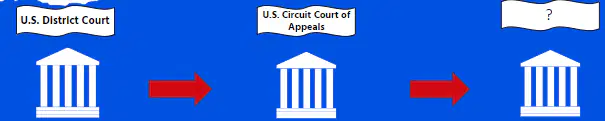
If a case went from the US District Court to the US Circuit Court of Appeals, what would the next stop be?
Trial Court
County Court
U.S. Supreme Court
Florida Supreme Court
In which of the following would federal courts have jurisdiction?
Violation of state laws
Disputes between two states
Disputes between two citizens
violation of local laws


Which court completes the diagram?
U.S. Supreme Court
Florida District Court
Court of Veteran Appeals
Florida Supreme Court
__________ means asking a higher court to review a lower court's decision for error.
Appeal
Trial
Evidence
Witness

Which statement describes a similarity between the Florida Constitution and the U.S. Constitution?
neither protects individual rights
both include an amendment process
neither provides for a chief executive
both include a nine member Supreme Court
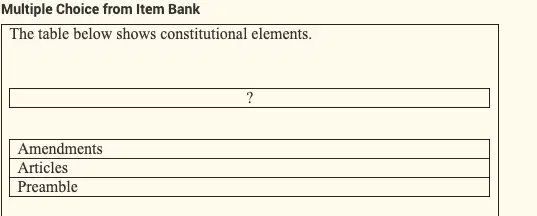
Which title completes this table?
Florida and County Government
Florida and U.S. Government
City and County Government
City and U.S. Government

What conclusion can be drawn from the headline?
Citizens can be involved in policy making through their representatives.
Citizens can be directly involved in policy making.
Only elected officials may change constitutions.
Only elected officials make policy.

Which feature completes the Venn diagram?
created property taxes
established a zoning board
required a balanced budget
guaranteed individual freedoms
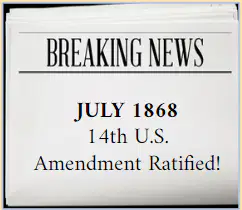
Based on the headline, what happened before the event presented in the image?
Two-thirds of each house of Congress voted to support the amendment.
The president rejected the amendment after Congress voted to support it.
Three-fourths of each house of Congress voted to support the amendment.
The president forwarded the amendment to the states after Congress voted to support it.
How is ratifying amendments to Florida’s constitution different from the U.S. Constitution?
Voters ratify amendments to the U.S. Constitution.
Voters ratify amendments to the Florida constitution.
¾ of state legislatures are necessary to ratify an amendment.
⅔ of both houses of Congress are necessary to propose an amendment.
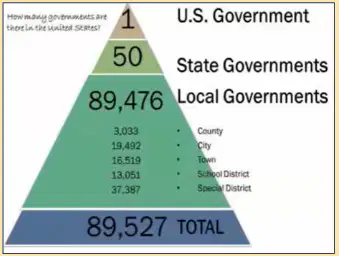
Which of the following is best represented by the image?
Checks and Balances
Eminent Domain
Federalism
Three Branches
“The powers delegated by the proposed Constitution to the federal government are few and defined. Those which are to remain in the State governments are numerous and indefinite.” James Madison, Federalist 45, 1788
What is the type of power given to the state and local governments?
Concurrent
Delegated
Enumerated
Reserved

What is the next step in the lawmaking process?
The bill is voted on by citizens.
The bill is debated in a committee.
The bill goes to the U.S. President's desk for approval.
The bill is introduced in the U.S. House of Representatives
A bill must be approved by ___?____ in order for it to progress in the lawmaking process.
all justices
both houses
the Supreme Court
the Senate president
Which service would be provided by a local government?
Granting teacher certificates
Receiving/delivering mail
Minting quarters and other coins
Providing county fire departments
After careful analysis, it has been confirmed that Florida is in danger of having a record budget deficit since their spending is set to far exceed tax revenue.
Who is responsible for resolving the issue?
The mayor of Orlando
The governor of Florida
The President of the United States
The governor of Wyoming
The passage below is from a speech by President George W. Bush on March 19, 2003.
On my orders, coalition forces began striking selected targets of military importance to undermine Saddam Hussein's ability to wage war. These are the opening stages of a broad and concerted campaign.
What constitutional power justifies the actions described in the passage?
Chief Legislator
Chief Regulator
Negotiator-in-Chief
Commander-in-Chief
The division of power between the federal government and state governments is called
checks and balances
popular sovereignty
separation of powers
federalism
Powers that the federal government shares with state governments are called
reserved
implied
concurrent
delegated
Powers of the Federal Government that are stated in the Constitution
delegated
reserved
implied
concurrent
Which laws are passed by the Florida legislature?
acts
statutes
charters
ordinances
A Presidential Appointment is how the President appoints government officials. Appointments are approved, or rejected, by the ________________.
House of Representative
Senate
Supreme Court
Administrative Agencies.
All tax bills should be originated in the ______________.
House of Representative
Senate
Supreme Court
Administrative Agencies
What is the term for the idea that those who govern must follow the laws, meaning no one is above the law?
rule of law
elastic clause
separation of powers
veto power

