
 Worksheets
Photosynthesis and Cellular Respiration Review
Total questions: 20
Worksheet time: 10mins
Name
Class
Date
1.
Where does Photosynthesis takes place inside the plant cell?
a)
Chloroplast
b)
Nucleus
c)
Mitochondria
d)
Ribosome
2.
Where does a plant get the energy necessary to drive the chemical reaction in photosynthesis?
a)
from the oxygen in the air
b)
from the sunlight
c)
from glucose
d)
from carbon dioxide
3.

What are the reactant's of Photosynthesis?
a)
Carbon Dioxide
b)
Glucose
c)
Water
d)
Oxygen
4.
What is another name for autotrophs?
a)
Consumers
b)
Producers
c)
Animals
d)
Fungi
5.
What is the name of the molecule that plants make and use as food?
a)
Glucose
b)
Carbon Dioxide
c)
Oxygen
d)
Water
6.
What do all living things need to survive and where does it come from?
a)
energy, glucose
b)
energy, sunlight
c)
glucose, sunlight
d)
oxygen, atompshere
7.

What is the correct flow of energy according to the Energy Chain provided?
a)
Option 1
b)
Option 2
c)
Option 3
d)
Option 4
8.

Use the equation for photosynthesis to help you respond to the following questions:
Where do autotrophs get the needed carbon and hydrogen atoms to produce glucose during photosynthesis?
a)
carbon from water; hydrogen from water
b)
carbon from air; hydrogen from water
c)
carbon from water; hydrogen from air
d)
carbon from air; hydrogen from air
9.
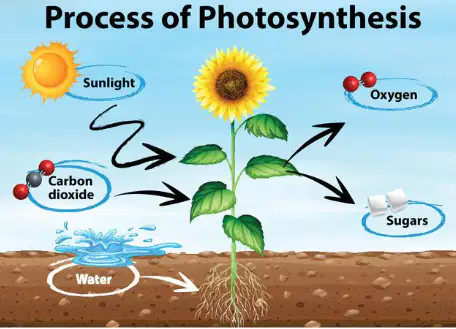
According to the diagram provided, what are the products of photosynthesis?
a)
glucose (sugar)
b)
sunlight
c)
oxygen
d)
carbon dioxide
10.
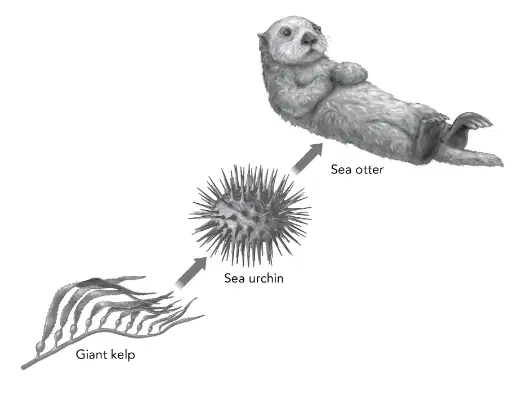
In the image below, which are autotrophs?
a)
Kelp
b)
Sea Urchin
c)
Sea Otter
d)
They are all autotrophs
11.
An organism that cannot make their own food and eats other plants or animals for energy and nutrients.
a)
Heterotroph
b)
Autotroph
12.

If a Venus flytrap plant releases 600 molecules of oxygen (O2 ), how many molecules of glucose did the Venus flytrap create?
a)
50
b)
100
c)
300
d)
600
13.
Where does cellular respiration take place?
a)
Chloroplast
b)
Nucleus
c)
Mitochondria
d)
Ribosome
14.
What is the purpose of cellular respiration?
a)
To produce energy for cells.
b)
To break down glucose.
c)
To provide organisms with oxygen.
d)
To produce glucose for the cells.
15.
A series of chemical reactions that break down glucose to produce ATP.
a)
Photosynthesis
b)
Cellular Respiration
c)
Glycolysis
d)
Transpiration
16.

What are the products of cellular respiration?
a)
Energy (ATP)
b)
Oxygen
c)
Carbon Dioxide
d)
Water
17.
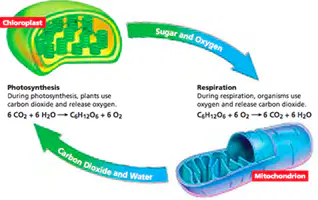
What is the relationship between photosynthesis and respiration?
a)
They are exactly the same
b)
They each use the others' waste products
c)
They each use the others' sugar
d)
There is no relationship
18.

What are the raw materials (reactants) of cellular respiration?
a)
Glucose
b)
Oxygen
c)
Water
d)
Carbon Dioxide
19.
Max has a group of goldfish in his tank at home. He notices that they are struggling a bit. Max wants to increase their rate of cellular respiration because he thinks that it would help them to survive. Which of the following actions would potentially increase the rate of cellular respiration in the goldfish?
a)
reducing the amount of food placed in the tank
b)
increasing the amount of carbon dioxide in the tank
c)
ncreasing the amount of oxygen in the tank
d)
reducing the amount of sunlight that hits the tank
20.
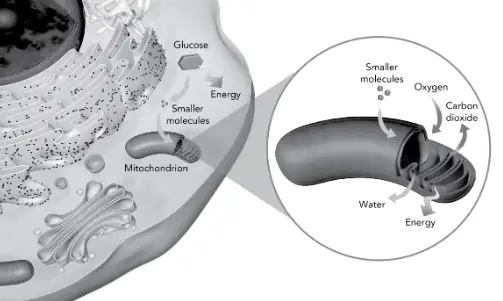
Cellular respiration takes place in two stages, each of which takes place in a different part of the cell. Which stage and where is glucose broken down into smaller molecules to produce energy.
a)
Stage 1in the cytoplasm
b)
Stage 1 in the mitochindria
c)
Stage 2 in the cytoplasm
d)
Stage 2 in the mitochondria
100 %

