wayground logo

Free Printable Worksheets

Font size

S
M
L
XL
Worksheets

Unit 4 Review - Triangle Congruence

Total questions: 58

Worksheet time: 1hrs 13mins

Name
Class
Date
1.

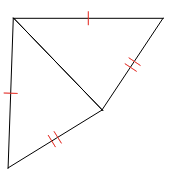
Including the Reflexive Property, state whether the triangles are congruent and why.

a)

no, not enough information

b)

yes, SAS

c)

yes, ASA

d)

yes, HL

2.

Including Vertical Angles are Congruent, state whether the triangles are congruent and why.

a)

yes, AAS

b)

yes, SAS

c)

yes, ASA

d)

no, not enough information

3.
State if the triangles are congruent and why.
a)
AAS
b)
SAS
c)
ASA
d)
SSS
4.
State if the triangles are congruent and why.
a)
Not congruent
b)
AAS
c)
SSS
d)
ASA
5.
State if the triangles are congruent and why.
a)
AAS
b)
ASA
c)
Not congruent
d)
SSS
6.

Using the fact that Vertical Angles are congruent, state whether the triangles are congruent and why.

a)

yes, ASA

b)

yes, AAS

c)

yes, SAS

d)

Not congruent, not enough information.

7.

Including the Reflexive Property, which theorem proves the triangles are congruent.

a)

ASA

b)

SSS

c)

SAS

d)

AAS

8.

Using the fact that Vertical Angles are congruent, state whether the triangles are congruent and if so, why.

a)

yes by HL

b)

yes, by SAS

c)

No, not congruent there is no AAA theorem

d)

yes, by AAS

9.

Using the Reflexive Property, which theorem proves that the triangles are congruent.

a)

SAS

b)

AAS

c)

ASA

d)

HL

10.

Using the fact that vertical angles are congruent, which theorem proves the triangles are congruent.

a)

SAS

b)

ASA

c)

AAS

d)

HL

11.
Can the triangles be proven congruent?  If so, how?
a)
ASA
b)
AAS
c)
SAS
d)
Cannot be proven congruent
12.
Can the triangles be proven congruent?  If so, how?
a)
ASA
b)
AAS
c)
SAS
d)
Cannot be proven congruent
13.
Can the triangles be proven congruent?  If so, how?
a)
ASA
b)
AAS
c)
SAS
d)
Cannot be proven congruent
14.
Can the triangles be proven congruent?  If so, how?
a)
ASA
b)
AAS
c)
SAS
d)
Cannot be proven congruent
15.
Can the triangles be proven congruent?  If so, how?
a)
ASA
b)
AAS
c)
SAS
d)
Cannot be proven congruent
16.
Can the triangles be proven congruent?  If so, how?
a)
ASA
b)
Cannot be proven congruent
c)
SAS
d)
SSS
17.
State if the triangles are congruent and why.
a)
Not congruent
b)
SAS
c)
ASA
d)
HL
18.
Is Angle-Angle-Angle (AAA), a valid rule for proving triangles congruent?
a)
No
b)
Sometimes
c)
Yes
d)
N/A
19.
Which property is shown below?
__________________________
7n = 21 then n = 3
a)
Division Property
b)
Sorcery
c)
Reduction of Multiples
d)
Distributive Property
20.
If y/4 = 5, then y = 20
a)
Multiplication Property of Equality
b)
Division Property of Equality
c)
Addition Property of Equality
d)
Subtraction Property of Equality
21.

If 3x + 4x - 5 = 10, then 7x - 5 = 10

a)

Addition Property of Equality

b)

Combine Like Terms or Simplify

c)

Subtraction Property of Equality

d)

Transitive Property of Equality

22.
Which property is shown below?
__________________________
4(x+6) = 4x + 4(6)
a)
Reflexive
b)
Distributive
c)
Transitive
d)
Substitution
23.

What property of equality is shown below?

25 + d = 36

25 + d - 25 = 36 - 25

a)

addition property of equality

b)

subtraction property of equality

c)

division property of equality

d)

multiplication property of equality

24.

What property of equality is shown below?

y - 12 = 30

y -12 + 12 = 30 +12

a)

addition property of equality

b)

subtraction property of equality

c)

multiplication property of equality

d)

division property of equality

25.
For any number a, a = a.
a)
Transitive Property         
               
b)
Reflexive Property             
c)
Symmetric Property           
d)
Substitution Property
26.
For any numbers a and b, if a = b, then b = a.
a)
Transitive Property         
b)
Reflexive Property 
c)
Symmetric Property   
d)
Substitution Property
27.
Name the property described:
∠B≅∠B
a)
Reflexive
b)
Symmetric
c)
Transitive
d)
Addition
28.
Name the property described:
If PQ = RS then RS = PQ
a)
Reflexive
b)
Symmetric
c)
Transitive
d)
Addition
29.

The statement if   AB  CD\overline{AB}\ \cong\ \overline{CD} , then   CD  AB\overline{CD}\ \cong\ \overline{AB}   demonstrates which property of congruence?

a)

Symmetric Property

b)

Reflexive Property

c)

Transitive Property

d)

Identity Property

30.
If DB bisects ∠ABC, then ∠ABD = ∠CBD.
a)
Definition of Congruent Angles
b)
Angle Bisector divides an angle into two congruent angles
c)
Angle Addition Postulate
d)
Definition of Right Angle
31.
If B is the midpoint of AC, then AB ≅ BC.
a)
Definition of Congruent Segments
b)
Midpoint divides a segment into two congruent segments
c)
Vertical Angles Theorem
d)
Angle Bisector divides an angle into two congruent angles.
32.
Step 2 is what
a)

Substitution property

b)
Multiplication property of equality
c)
Division property of equality
d)
Distributive Property
33.
What is step 4
a)

Substitution property

b)
Addition property of equality
c)
Subtraction property of equality
d)

Simplify

34.
What is reason 2?
a)
Addition Property of Equality
b)
Subtraction Property of Equality
c)
Multiplication Property of Equality
d)
Division Property of Equality
35.
What is always the 1st statement in reason column of a proof?
a)
Prove
b)
Given
c)
Reason
d)
Statement
36.
What is reason 1?
a)
Subtraction Property of Equality
b)
Transitive Property of Equality
c)
Given
d)
Prove
37.
What is reason 2?
a)
Given
b)
Addition Property of Equality
c)
Subtraction Property of Equality
d)
Substitution Property of Equality
38.
Simplify the expression with the distributive property
6(x + 3)
a)
6x + 3
b)
6x + 18
c)
x + 3
d)
9x
39.
What is statement #1?
a)
BC≅DC
b)
AC≅EC
c)
BC≅DC, AC≅EC
d)
∆BCA≅∆DCE
40.
What is statement #2?
a)
∠ABC≅∠EDC
b)
∠BCA≅∠DCE
c)
BC≅CD
d)
∠E≅∠A
41.
What is reason #3?
a)
SAS
b)
ASA
c)
SSS
d)
AAS
42.

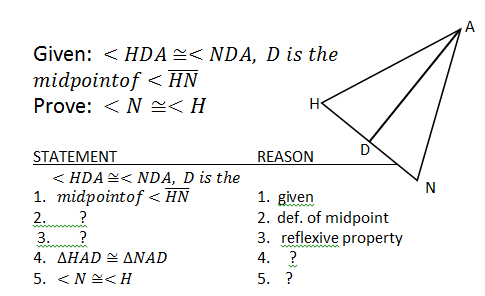
What is the "statement" for step 3 of the proof?

a)

HA=HA

b)

HA=AH

c)

MA=AM

d)

MA=MA

43.
Use the congruence statement to find the missing part of the statement
a)
WV
b)
WU
c)
VU
d)
WB
44.

What is #4 Statement?

a)

∠MNL ≌ ∠ONP

b)

MN ≌ ON

c)

N ≌ N

d)

MO ≌ OM

45.

What is #3 Reason?

a)

Same Line

b)

Perpendicular Lines

c)

Segment Bisector

d)

Reflexive Property

46.

What is #3 Reason?

a)

Alternate Exterior Angles

b)

Alternate Interior Angles

c)

Vertical Angles

d)

Angle Bisector

47.
What is the "statement" for step 2 of the proof?
a)
AD=AD
b)
AD=DA
c)
HD=DN
d)
HA = AN
48.
What is the justification (reason)?
a)
reflexive property
b)
definition of segment bisect
c)
definition of a midpoint
d)
substitution property
49.

Use the congruency statement to answer the following:  < F = ___

a)

< H

b)

< I

c)

< G

d)

not congruent to another angle

50.
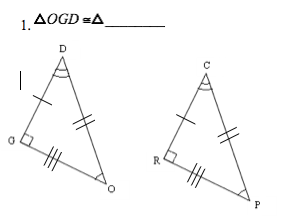
Complete the congruence statement.
a)

ΔCRP\Delta CRP

b)

ΔPCR\Delta PCR

c)

ΔRPC\Delta RPC

d)

ΔPRC\Delta PRC

51.

∆ABC ≅ ∆XYZ, which is true?

a)

AB ≅ XY

b)

AB ≅ YX

c)

AB ≅ XZ

d)

BC ≅ CB

52.
a)
A
b)
B
c)
C
d)
D
53.
∆JIK ≅
a)
∆TRS
b)
∆RST
c)
∆STR
d)
∆TSR
54.
∆ISR ≅
a)
∆TRS
b)
∆RST
c)
∆STR
d)
∆TSR
55.

If ∆AIG ≅ ∆QOW, WQ ≅?

a)

AI

b)

GI

c)

AG

56.

Given the diagram, which of the following is true?

a)

∆XSF ≅ ∆XTG

b)

∆SXF ≅ ∆GXT

c)

∆FXS≅ ∆XGT

d)

∆FXS ≅ ∆GXT

57.

Complete the statement.

a)

ΔDEF\Delta DEF

b)

ΔFDE\Delta FDE

c)

ΔEDF\Delta EDF

d)

ΔFED\Delta FED

58.

Complete the statement.

a)

ΔGEF\Delta GEF

b)

ΔFGE\Delta FGE

c)

ΔEFG\Delta EFG

d)

ΔEGF\Delta EGF