wayground logo

Free Printable Worksheets

Font size

S
M
L
XL
Worksheets

CHS EOC Review: Features of Functions & Evaluating

Total questions: 55

Worksheet time: 3hrs 45mins

Name
Class
Date
1.

Identify the minimum and the domain of the function y = -2(x+1)2 + 4

a)

Max: 4, Domain: All Real Numbers

b)

Min: -4, Domain: All Real Numbers

c)

Max: 2, Domain: All real numbers when x is greater than 4

d)

Min: -2, Domain: All real numbers when x is less than 4

2.

What is the range in inequality notation?

a)

( -4 , 4 )

b)

[ 1 , -3 )

c)

-4 < x < 4

d)

1 ≥ y > -3

3.
For the function {(0,1), (1,-3), (2,-4), (-4,1)}, write the domain and range.
a)
D: {1, -3, -4,}
R: {0, 1, 2, -4}
b)
D:{-4, 0, 1, 2}
R:{-4, -3, 1}
c)
D:{0, 1, 2, 3, 4}
R:{1, -3, -4}
4.
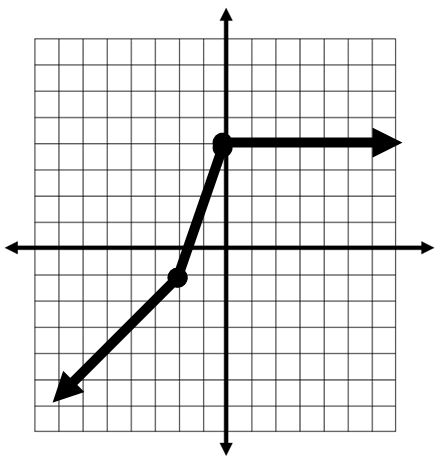
List the types of intervals that the graph demonstrates in order.
a)
decreasing, constant, increasing, constant
b)
increasing, decreasing, constant
c)
increasing, constant, increasing, constant
d)
increasing, constant, decreasing, constant
5.
Determine the interval in which this function is DECREASING.
a)
(-3, ∞)
b)
(-3, ∞)
c)
(-∞, -4)
d)
(-∞, -3)
6.
Determine the interval in which this function is INCREASING.
a)
(-4, ∞)
b)
(-3, ∞)
c)
(∞, -3)
d)
(-∞, -4)
7.

What is the correct end behavior?

a)

As x → - ∞, f(x) → ∞

As x → ∞, f(x) → ∞

b)

As x → - ∞, f(x) → - ∞

As x → ∞, f(x) → ∞

c)

As x → - ∞, f(x) → ∞

As x → ∞, f(x) → - ∞

d)

As x → - ∞, f(x) → - ∞

As x → ∞, f(x) → - ∞

8.

What is the range of the graph?

a)

y ≥ -1.225

b)

y ≥ -4.25

c)

All Real Numbers ℝ

d)

y ≤ -4.25

9.

What is the y-intercept of the graph?

a)

(-2,5)

b)

(1,0)

c)

(0,1)

d)

(-3.104, 0)

10.

If f(x) = x2 + 4x - 7, find f(-3).

(a)  

11.

If f(x) = 3x + 8, find f(-6).

(a)  

12.

f(-5) =

(a)  

13.

What is the interval of increase?

a)

( - \infty  , -2)

b)

(-2, \infty  )

c)

( - \infty  , -3)

d)

(-3, \infty  )

14.

What is the range?

a)

( - \infty  , \infty  )

b)

[-6, 0]

c)

( - \infty  , -2]

d)

[-2, \infty  )

15.

What is the domain, in interval notation?

a)

[-4, 5]

b)

( - \infty  , \infty  )

c)

[-3. 4]

d)

( \infty  , - \infty  )

16.

When is the function decreasing?

a)

(30, 55)

b)

(40, 60]

c)

(15, 40)

d)

(60, -40)

17.
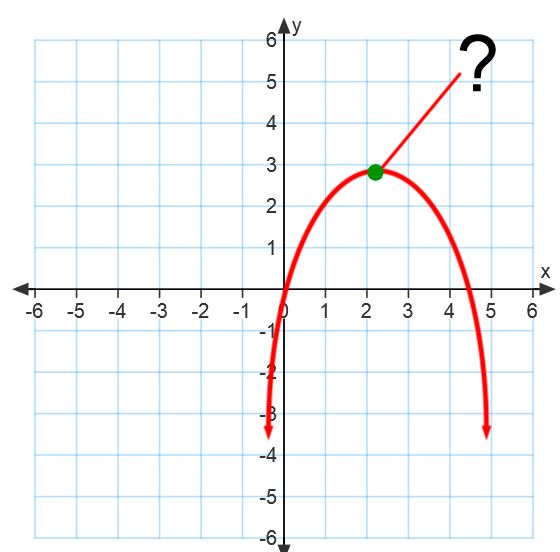
What is the green dot on the parabola called?
a)
maximum
b)
minumum
c)
roots
d)
zeros
18.

What best describes the increasing/decreasing of the graph?

a)

decreasing, increasing

b)

decreasing, increasing, decreasing

c)

increasing, decreasing, increasing

d)

increasing, decreasing

19.

The lowest point of a graph is called the _________________.

a)

minimum

b)

maximum

c)

x-intercept

d)

y-intercept

20.

The point (-5.25, 0) represents ___________.

a)

a maximum

b)

a minimum

c)

a y-intercept

d)

an x-intercept

21.

What is the correct end behavior?

a)

As x → - ∞, f(x) → ∞

As x → ∞, f(x) → ∞

b)

As x → - ∞, f(x) → - ∞

As x → ∞, f(x) → ∞

c)

As x → - ∞, f(x) → ∞

As x → ∞, f(x) → - ∞

d)

As x → - ∞, f(x) → - ∞

As x → ∞, f(x) → - ∞

22.

Which ordered pair could represent a y-intercept?

a)

(-1, 0)

b)

(2, 4)

c)

(0,4)

d)

(-2, 4)

23.
a)

F

b)

G

c)

H

d)

J

24.
a)

A

b)

B

c)

C

d)

D

25.
a)

F

b)

G

c)

H

d)

J

26.
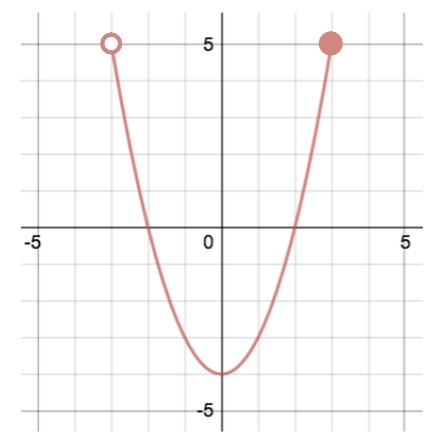
What is the domain?
a)
-3 < y ≤ 3
b)
-4 ≤ y ≤ 5
c)
-4 ≤ x ≤ 5
d)
-3 < x ≤ 3
27.
What is the range of the graph?
a)
-7 ≤ x < 5
b)
-3 ≤ x < 1
c)
-3 ≤ y < 1
d)
-7 ≤ y < 5
28.
Which of the following relations represents y as a function of x?
I. {(1, 4), (2, 5), (3, 6)}
II. {(1, 4), (2, 4), (3, 4)}
III. {(1, 4), (2, 4), (1, 3)}
IV. {(1, 4), (1, 2), (1, 3)}
a)
I, II, and III only
b)
II and IV only
c)
III and IV only
d)
I and II only
29.

Which dashed line is an asymptote for the graph?

a)

line q

b)

line r

c)

line s

d)

line t

30.

Which inequality represents the domain of the graph shown?

a)
b)
c)
d)
31.
What is the RANGE of this graph?
a)
-7<x<5
b)
-7≤x<5
c)
-3<x<1
d)
-3≤x<1
32.

What is the range of the function above?

a)

All real numbers greater than 0

b)

All real numbers

c)

All real numbers greater than or equal to 0

d)

All real numbers less than 0

33.
If f(x) = -3x2 + 5x, what is the value of f(-1)?
a)
2
b)
-2
c)
-8
d)
8
34.
Which set of ordered pairs does not represent y as a function of x?
a)
(-2, 4)  (0, 0)  (2, 4)
b)
(5, 7)  (2, 7)  (-3, 7)
c)
(-2, 2)  (0, 0)  (-2, 4)
d)
(1, 2)  (2, 3)  (3, 4)
35.
a)
A
b)
B
c)
C
d)
D
36.
a)
F
b)
G
c)
H
d)
J
37.
a)
F.
b)
G.
c)
H.
d)
J.
38.
What test can you use on a graph to tell if a relation is a function?
a)
vertical line test
b)
horizontal line test
c)
diagonal line test
d)
parallel line test
39.
How do you tell if a relation is a function?
a)
the x and y values are the same
b)
the y values never repeat
c)
the x and y values are opposites
d)
the x values never repeat
40.
Evaluate f(x)=-2x+13   for f(10)
a)
-7
b)
1
c)
-8
d)
7
41.
What is the value of f(0)?
a)
-2
b)
2
c)
4
d)
0
42.

Identify the parent function of the graph.

a)

Quadratic

b)

Rational

c)

Absolute Value

d)

Cubic

43.
What is the name of this parent function?
a)
Quadratic Function
b)
Square Root Function
c)
Exponential Function
d)
Absolute Value Function 
44.
What is the y-intercept?
a)
(0,7)
b)
(0, 0)
c)
(0,1)
d)
(0, 2)
45.

Rate of change also means

a)

Slope

b)

y-intercept

c)

Zerox-s

d)

Direct Variation

46.

Consider the pictured piecewise defined function. Which of the following are true? Select all that apply. Consider each grid represents 1 unit.

a)

f(1)=12f\left(1\right)=\frac{1}{2}  

b)

f(1)=12f\left(1\right)=-\frac{1}{2}  

c)

f(2)=1f\left(-2\right)=-1  

d)

f(2)=112f\left(-2\right)=1\frac{1}{2}

e)

f(0)=0f\left(0\right)=0  

47.

What is the RANGE of the function?

a)

All Real Numbers

b)

y ≤ 4

c)

y < 4

d)

0 < y < 4

48.
Which of these is NOT the same
a)
Range
b)
Input
c)
Dependent Value
d)
Y-Value
49.
All of the x values or inputs are called what?
a)
Domain
b)
Range
c)
Relation
d)
Function
50.
a)
A
b)
B
c)
C
d)
D
51.
a)
A
b)
B
c)
C
d)
D
52.

a)

Domain: All real numbers greater than or equal to 0 and less than or equal to 100

Range: All real numbers greater than or equal to 0 and less than or equal to 50

b)

Domain: {−2}

Range: {100}

c)

Domain: All real numbers greater than or equal to 0 and less than or equal to 50

Range: All real numbers greater than or equal to 0 and less than or equal to 100

d)

Domain: {100}

Range: {−2}

53.
a)
Function
b)
Not a Function
54.
a)
Function
b)
Not a Function
55.
a)
Function
b)
Not a Function