
 Worksheets
Volcano Hunters Unit Assessment
Total questions: 38
Worksheet time: 19mins
Name
Class
Date
1.
FULL Student ID Number
4 lines
2.
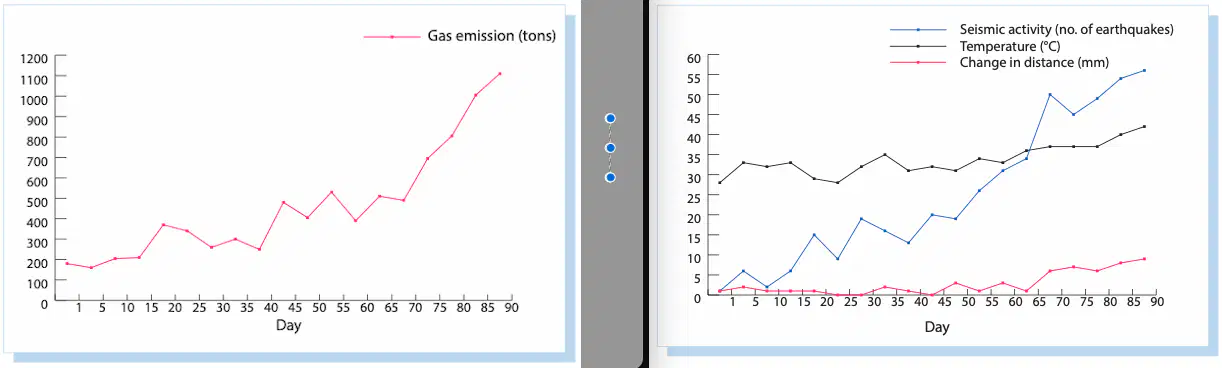
The US Geological Survey uses a nationwide volcano alert system to categorize volcanoes into 4 warning levels- Normal, Advisory, Watch, and Warning. They are used to notify the public about the likelihood of an eruption.
Scientists are monitoring a stratovolcano that is currently labeled with a WATCH warning level. Their data from the past 3 months is shown in the photos.
The team must decide whether to change the current warning level. What should they do?
a)
They should raise the warning level to Warning. The data shows that the volcanic activity is increasing.
b)
They should lower the warning level to Advisory. The data shows that the volcanic activity is decreasing.
3.
When rain, snow, water, wind, or chemicals break down rock into smaller pieces
a)
Law of Horizontality
b)
Geology
c)
Weathering
4.
Little pieces of rock and dirt that are broken off by weathering
a)
Weathering
b)
Sediment
c)
Erosion
5.
This cycle describes the processes and conditions that cause rock to change type
a)
Sediment
b)
Rock Cycle
c)
Erosion
6.
When sediments are moved by wind, rain, water, or other processes
a)
Law of Horizontality
b)
Rock Cycle
c)
Erosion
7.
When sediments are deposited in a new location.
a)
Geology
b)
Deposition
c)
Index Fossil
8.
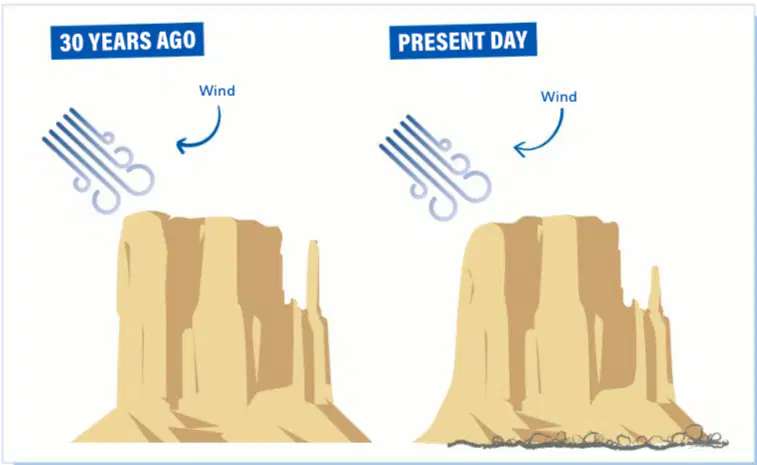
What processes caused the sandstone butte to change over time?
a)
Heating and Pressure
b)
Weathering and Erosion
9.
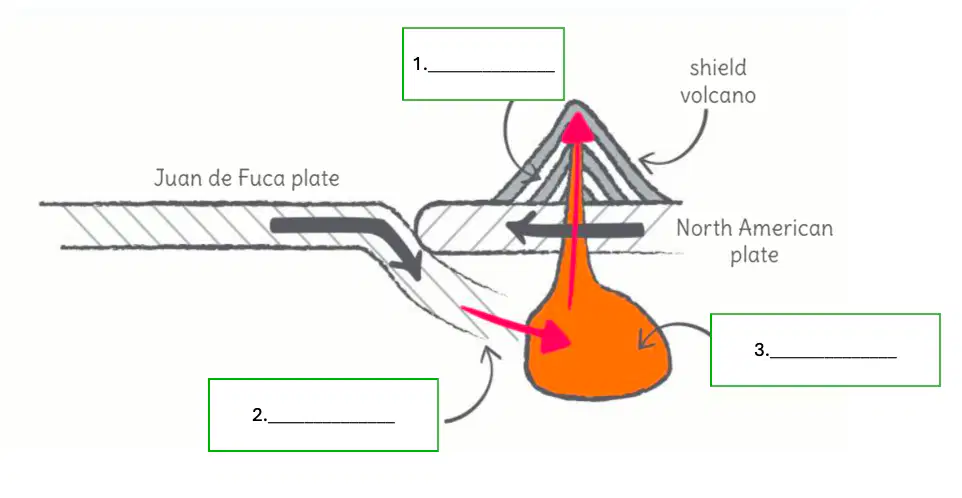
This image shows a subduction zone at a convergent plate boundary. Describe what is going on at location 1.
a)
Layers of magma cooling to form a volcano
b)
Material from the crust is cooling as it slips down into the mantle
10.
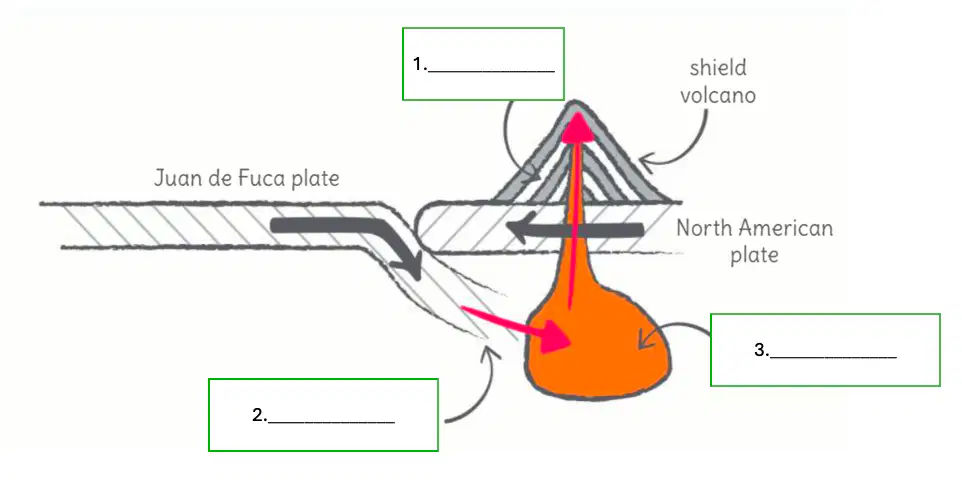
This image shows a subduction zone at a convergent plate boundary. Describe what is going on at location 2.
a)
A magma chamber is forming from pressurized magma trapped between plates
b)
Material from the crust is cooling as it slips down into the mantle
11.
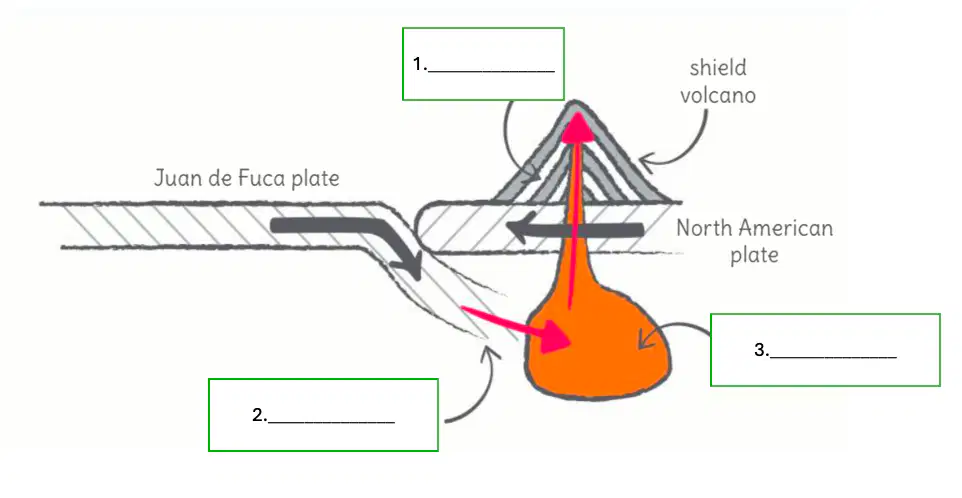
This image shows a subduction zone at a convergent plate boundary. Describe what is going on at location 3.
a)
Material from the crust is cooling as it slips down into the mantle
b)
A magma chamber is forming from pressurized magma trapped between plates
12.
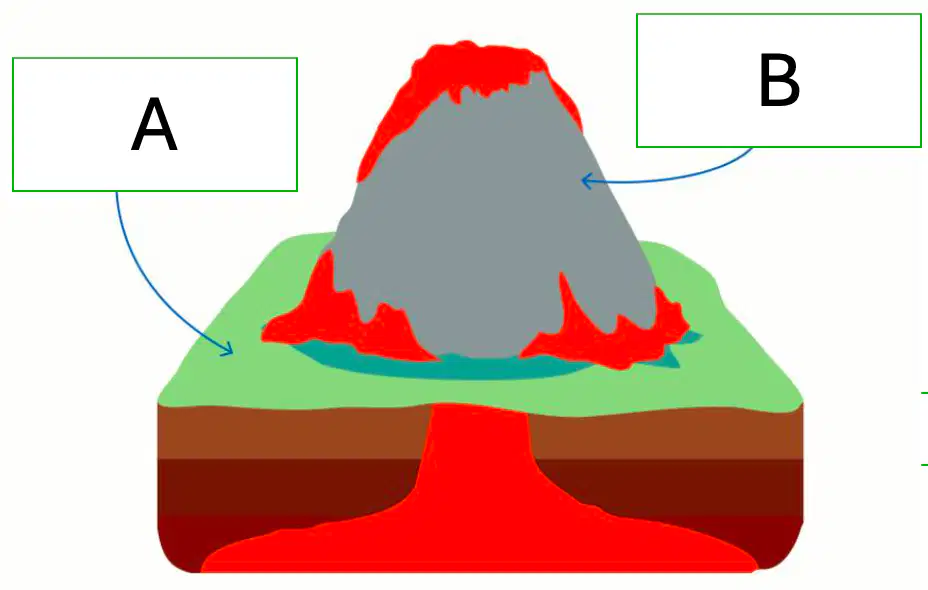
A team of scientists found sedimentary and igneous rocks near a volcano. At which locations did they likely find the igneous and sedimentary rocks?
a)
A- Igneous, B- Sedimentary
b)
A- Sedimentary, B- Igneous
13.
This type of rock is formed when lava cools and hardens
a)
igneous
b)
metamorphic
14.
This type of rock is formed when heat and pressure change the structure of an existing rock
a)
sedimentary
b)
metamorphic
15.
This type of rock is formed when sediment is cemented and compacted over time
a)
igneous
b)
sedimentary
16.
What two things are required to change a rock into metamorphic rock?
a)
time and distance
b)
heat and pressure
17.
True or False: All rocks must go through all the steps of the rock cycle in the same order
a)
True
b)
False
18.
What is the term for magma that has reached the surface of the Earth?
a)
lava
b)
glass
19.
How could sedimentary rock become igneous rock?
a)
It would have to melt into magma, then cool into igneous rock
b)
It would need to weather into sediments, then be pressed into igneous rock
20.
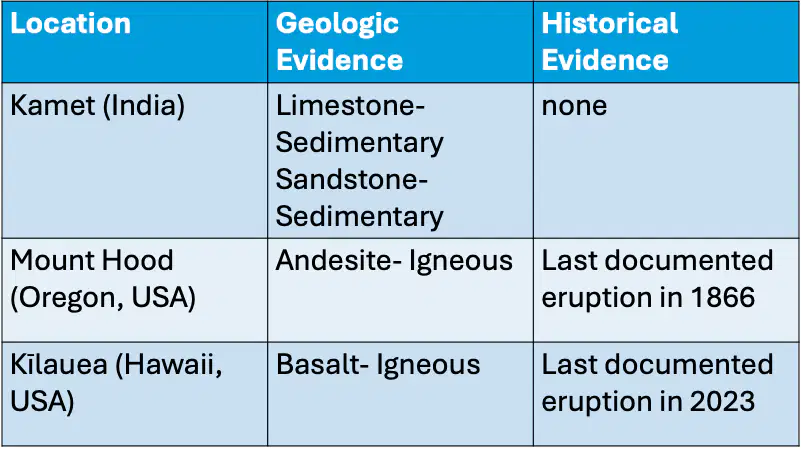
Based on the evidence from the chart, which of these locations would you consider volcanic? Select all that apply
a)
Kamet
b)
Mount Hood
c)
Kīlauea
21.
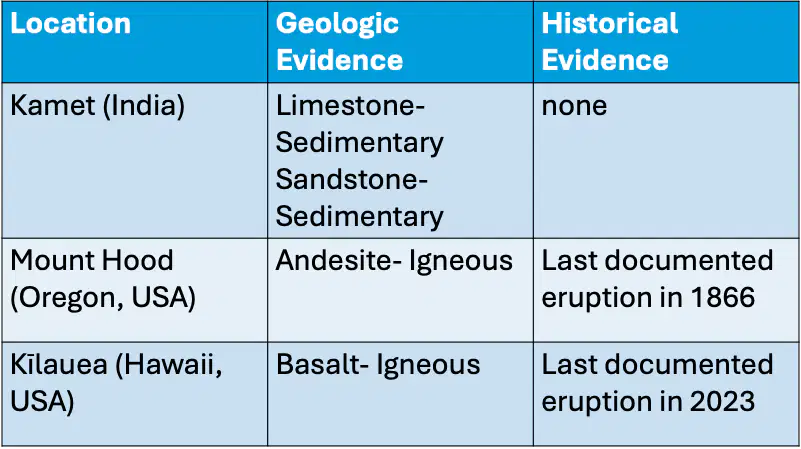
Based on the evidence from the chart, which of these locations would you consider to be at the greatest risk for residents?
a)
Mount Hood
b)
Kīlauea
22.
Viscosity refers to.....
a)
a measure of the temperature of a fluid.
b)
a measure of how easily a liquid flows (the resistance to flow of a fluid)
23.
Which list of materials is in order from lowest viscosity to highest viscosity?
a)
Peanut butter, olive oil, milk
b)
Milk, olive oil, peanut butter
24.
Which pair of terms would make the best match to fill the blanks in the following sentence?
Gases escape more easily from a ______________ viscosity magma; that is why eruptions are more violent from volcanoes that are supplied by ____________ viscosity magma.
a)
Low, high
b)
High, high
25.
The explosivity of a volcano is most closely related to what two factors?
a)
gas content and temperature
b)
gas content and viscosity
26.
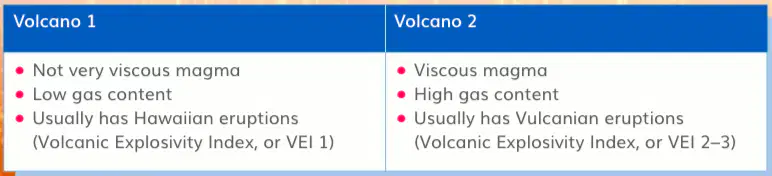
Analyze and interpret the patterns in the data and determine which of these volcanoes is likely to be more dangerous, and why.
a)
Volcano 2- It has Vulcanian eruptions which are the only eruptions that can be dangerous
b)
Volcano 2- it has high viscosity and gas content, making it explosive
27.
What is tephra?
a)
rock fragments and particles ejected by a volcanic eruption
b)
a mass of rocks and water pouring into the ocean
28.
T/F- The high the explosivity of a volcano, the more tephra that is released
a)
True
b)
False
29.
If viscosity of magma is increased, the explosivity of a volcano ___________.
a)
Decreases
b)
Increases
30.
If gas content of magma is increased, the explosivity of a volcano ___________.
a)
Decreases
b)
Increases
31.
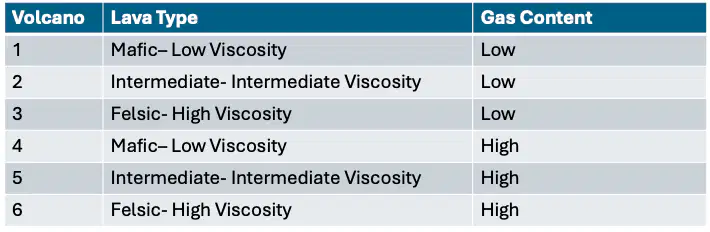
Which volcano is most likely to be the most explosive?
a)
Volcano 1
b)
Volcano 3
c)
Volcano 6
32.
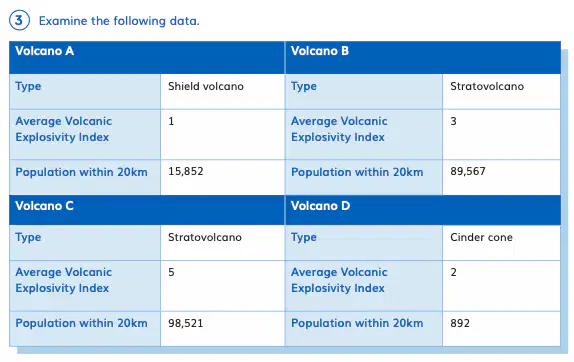
Examine the following data. Which volcano would pose the biggest threat if erupted?
a)
Volcano C
b)
Volcano D
33.
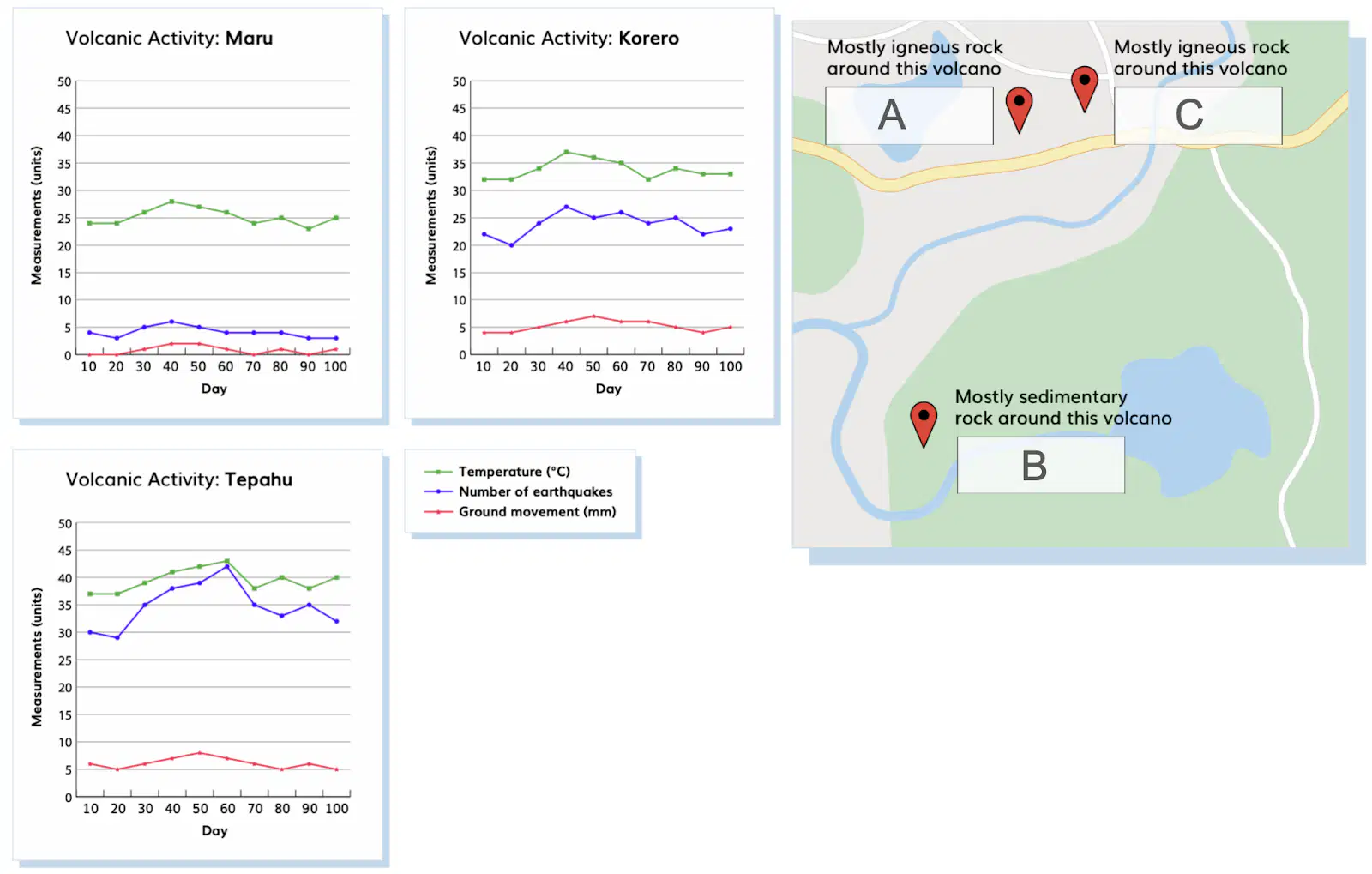
Scientists are collecting data on three volcanoes found in the same region. The data the scientists collect on the volcanoes is shown in the graphs.
Which pin is most likely to show the location of the volcano Maru? Use data from the graphs to help you decide.
a)
A
b)
B
c)
C
34.
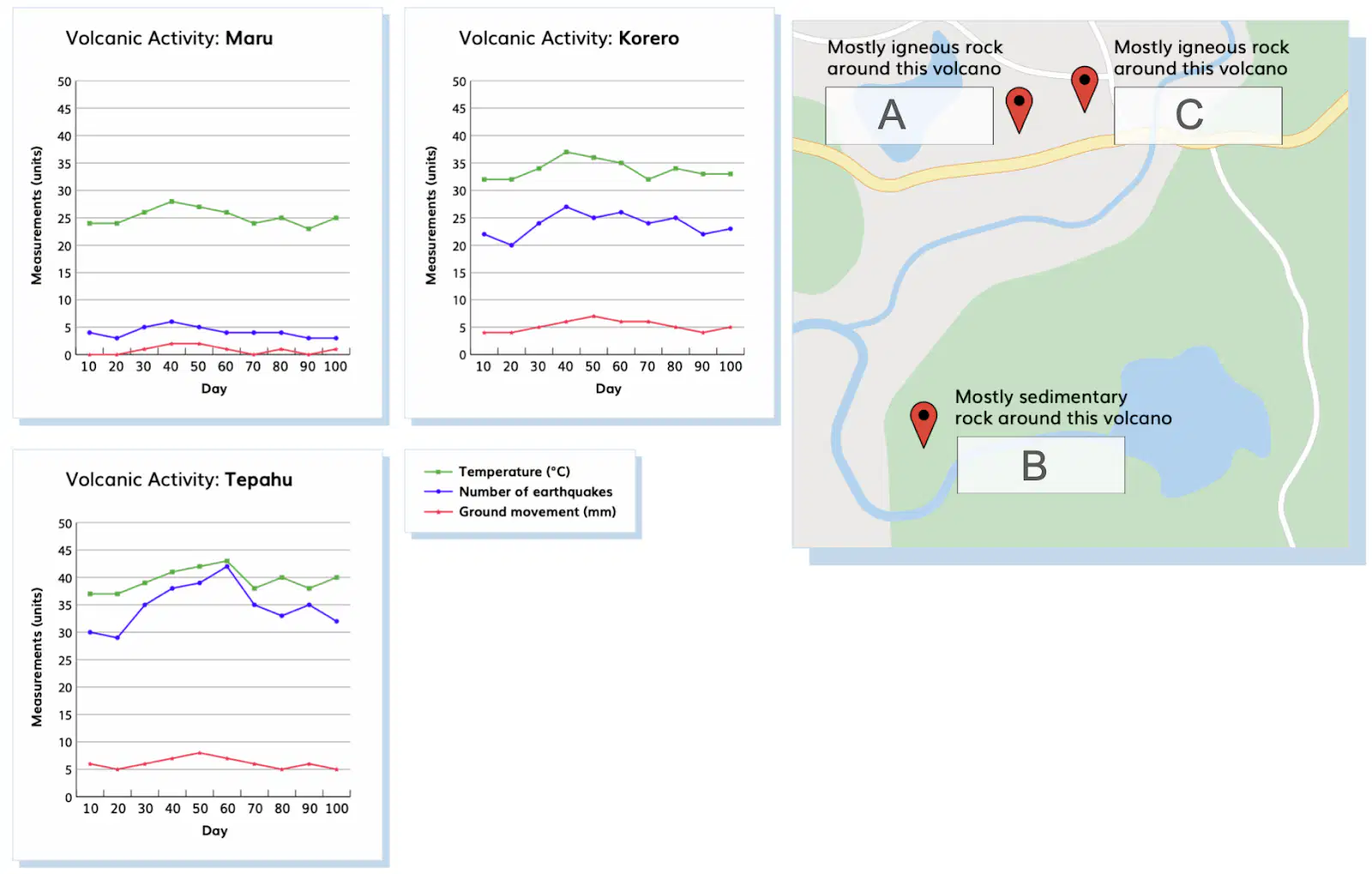
Scientists are collecting data on three volcanoes found in the same region. The data the scientists collect on the volcanoes is shown in the graphs.
Complete the statement below. Use the information from the graphs and map to help you.
[Maru / Korero / Tepahu] is probably closest to the plate boundaries. We know this because the data for this volcano showed the highest number of earthquakes.
a)
Korero
b)
Tepahu
35.

Scientists are collecting data on three volcanoes found in the same region. The data the scientists collect on the volcanoes is shown in the graphs.
The scientists identify patterns to determine when the volcanoes were most volatile over the past three months.
When was Tepahu most volatile?
a)
Days 30-40
b)
Days 50-60
36.

Evaluate the volcano monitoring data from 3 regions below. Which of the following regions is MOST likely to have an eruption soon? Why?
a)
Region B because the GPS movement is higher than the temperature
b)
Region A because all data points are increasing, and are higher than Regions B an C
37.

Evaluate the volcano monitoring data from 3 regions below. Which of the following regions is LEAST likely to have an eruption soon? Why?
a)
Region C because all data points are decreasing or remaining stable
b)
Region B because the GPS movement is higher than the temperature
38.

Evaluate the historic volcano monitoring data below. Which volcano do you think should be closely monitored for a dangerous eruption, and why?
a)
Fernandina, because it is a shield volcano and had no eruptions in 1981
b)
Kelut, because it has a high VEI and are population nearby
100 %

