
 Worksheets
Earth's Layers and Plate Tectonics
Total questions: 35
Worksheet time: 26mins
Name
Class
Date
1.
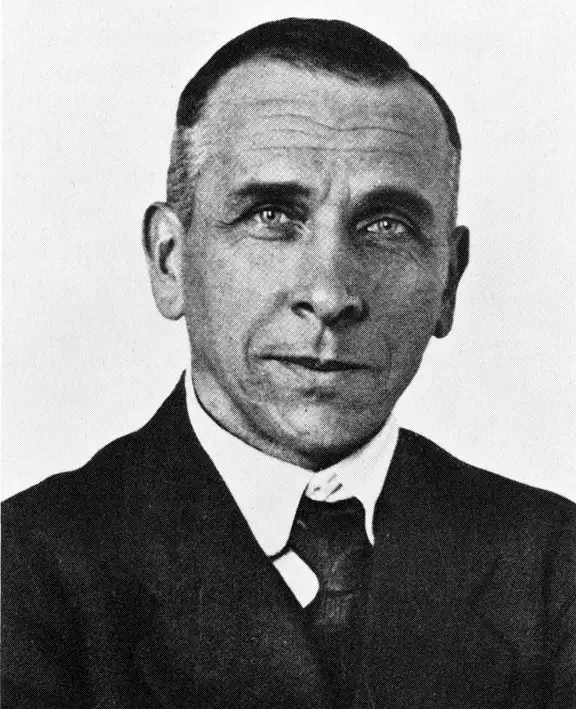
Who is the person credited with developing the theory of continental drift?
a)
Harry Hess
b)
Galileo Galilei
c)
Alfred Wegener
d)
Sir issac Newton
2.
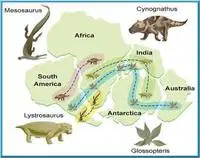
What evidence used by Alfred Wegener to support the idea of supercontinent is represented by this map?
a)
fossil evidence
b)
glacial evidence
c)
similar rock layer evidence
3.
The land mass where all of the continents were once together in one large continent is called ________________.
a)
Laurasia.
b)
Pangaea.
c)
Eurasia.
d)
Gondwana.
4.
What are the three types of Evidence that supports Alfred Wegener's Theory?
a)
Fossils, Fish, and Land
b)
Sedimentary, Magma, and Climate
c)
Fossils, Land forms, and Climate
d)
Climate, Land forms, and Metamorphic rock
5.
Originally the Continental drift theory was not well received by other scientist. Why?
a)
There was a competing theory at the time that was more believable.
b)
There was no data showing the continents ever moved.
c)
The scientists did not know the force responsible for moving the continents.
d)
The scientist presenting the data was unreliable.
6.
Who came up with the theory of seafloor spreading?
a)
Harry Hess
b)
Alfred Wegener
c)
Harry Wegener
7.
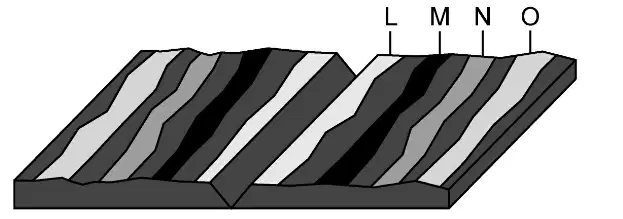
Where would the oldest rock be found?
a)
L
b)
M
c)
N
d)
O
8.
How have scientists been able to infer the internal structure of Earth without being able to directly observe inside the Earth?
a)
Scientists analyze how seismic waves move throughout Earth's interior.
b)
Scientists make educated guesses about Earth's internal structure based on previous hypothesis.
c)
Scientists use satellite radar and sonar technologies to map Earth's internal layers.
d)
Scientists study different types of rocks from many different locations on Earth's surface.
9.
The deeper into Earth you go the...
a)
greater the pressure
b)
less pressure
c)
pressure remains the same
10.
As depth increases, the temperature of Earth's layers
a)
increases
b)
decreases
c)
remains constant
11.
List the Earth's layers in order (outer to inner).
a)
crust, inner core, outer core, mantle
b)
inner core, outer core, crust, mantle
c)
mantle, outer core, inner core, crust
d)
crust, mantle, outer core, inner core
12.
What are the two types of crust?
a)
continental and oceanic
b)
ocean and upper
c)
lower and upper
d)
pizza and subway
13.
What is the thinnest layer of the Earth?
a)
mantle
b)
inner core
c)
crust
d)
outer core
14.
The thickest layer of the earth is the
a)
crust
b)
mantle
c)
inner core
d)
outer core
15.
The solid, outer layer of the Earth that consists of the crust and the rigid upper part of the mantle
a)
Lithosphere
b)
Mesosphere
c)
Mantle
d)
Crust
16.
Which layer of Earth is characterized by rock that is plastic, or soft enough to flow?
a)
asthenosphere
b)
crust
c)
lithosphere
d)
inner core
17.
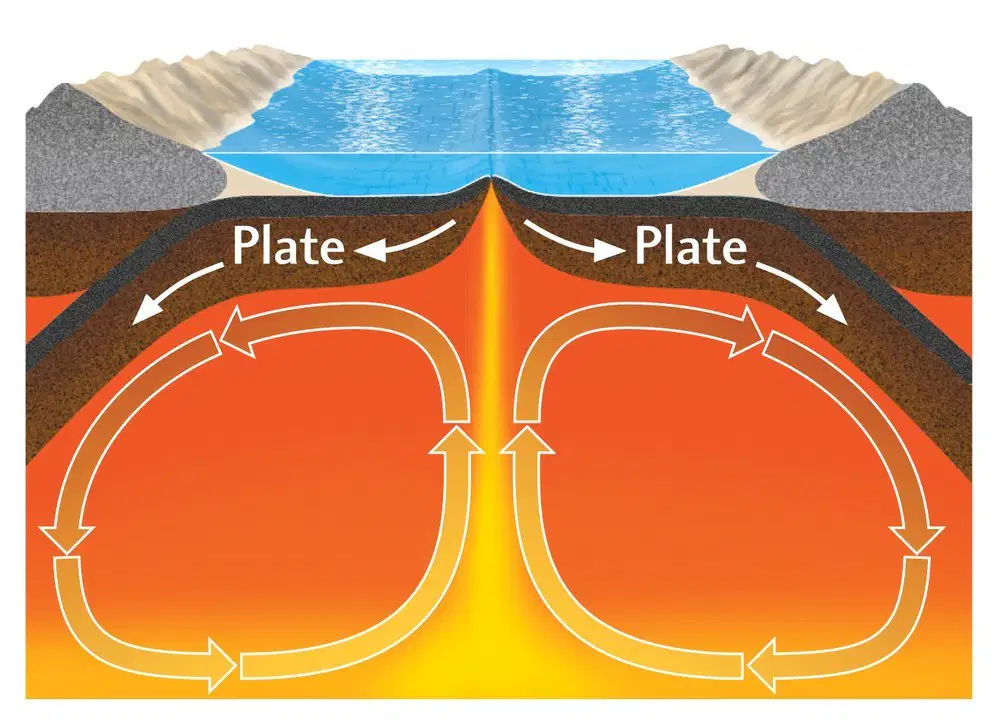
Most geologists think that the movement of Earth’s plates is caused by _______
a)
convection
b)
continental drift.
c)
subduction.
d)
conduction.
18.
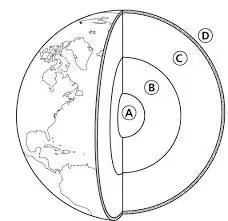
Which layer is at letter A?
a)
crust
b)
outer core
c)
mantle
d)
inner core
19.
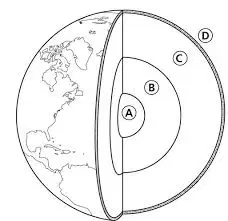
Which layer is at letter D?
a)
crust
b)
mantle
c)
outer core
d)
inner core
20.
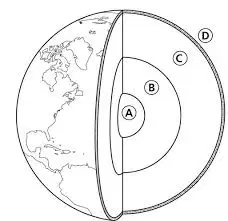
Which layer is at letter C?
a)
crust
b)
mantle
c)
outer core
d)
inner core
21.
The upper mantle and crust combine to create the lithosphere. This is a rigid layer broken into chunks called ________?
a)
Fault Ranges
b)
Tectonic Plates
c)
Traverse Plates
d)
Mountain Ranges
22.
What happens when an oceanic plate (plate carrying ocean) collides with a continental plate (plate carrying land)?
a)
The oceanic plate will subduct
b)
The continental plate will subduct
c)
A rift valley will form in the continental plate
d)
an oceanic ridge will form at the oceanic plate
23.
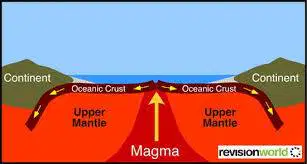
New oceanic crust (sea floor) is created at this boundary.
a)
Divergent Oceanic
b)
Divergent Continental
c)
Convergent Oceanic
d)
Transform
24.
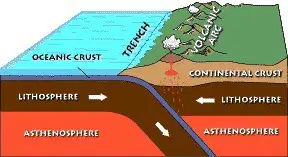
Oceanic crust (sea floor) is destroyed at this boundary.
a)
Convergent Oceanic
b)
Divergent Oceanic
c)
Convergent Continental-Continental
d)
Divergent Continental
25.
The process where oceanic crust slides under another plate and is melted is called ___________.
a)
seafloor spreading
b)
subduction
c)
continental drift
d)
recycling
26.
What features occur near every subduction zone?
a)
Volcanic Mountains, Volcanic Islands, and Trenches
b)
Rift Valleys, and Mid Ocean Ridges
c)
Mountains, Volcanoes, and Rift Valleys
d)
Mid Ocean Ridges and Trenches
27.
A divergent boundary on land creates what feature?
a)
Mid Ocean Ridge
b)
Rift Valley
c)
Subduction Zone
d)
Deep Ocean Trench
28.
A divergent boundary in the ocean creates what feature?
a)
Mid Ocean Ridge
b)
Rift Valley
c)
Deep Ocean Trench
d)
Subduction Zone
29.
When two continental plates converge (collide) what type of crustal feature is formed?
a)
Mid Ocean Ridge
b)
Subduction Zone
c)
Rift Valley
d)
Mountains
30.
Two plates slide past each other at what boundary?
a)
Covergent
b)
Divergent
c)
Transform
31.
Two plates spread or move apart at what boundary?
a)
Convergent
b)
Divergent
c)
Transform
32.
Two plates come together or collide at what boundary?
a)
Convergent
b)
Divergent
c)
Transform
33.
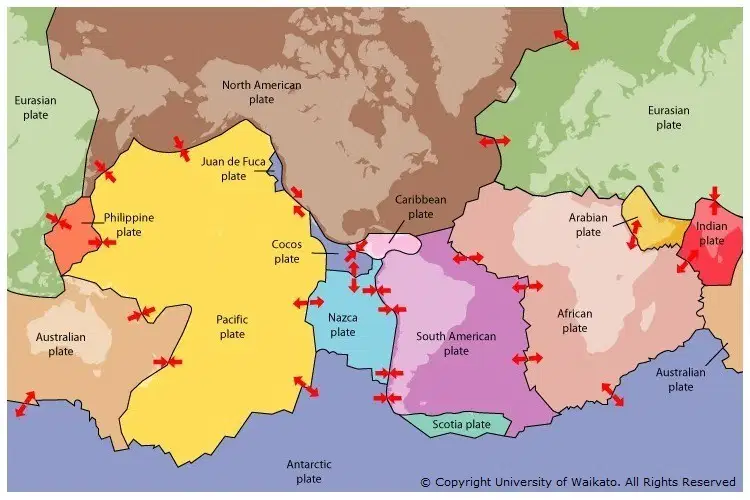
What type of plate boundary is occurring between the Juan de fuca and North American plates?
a)
convergent
b)
divergent
c)
transform
34.
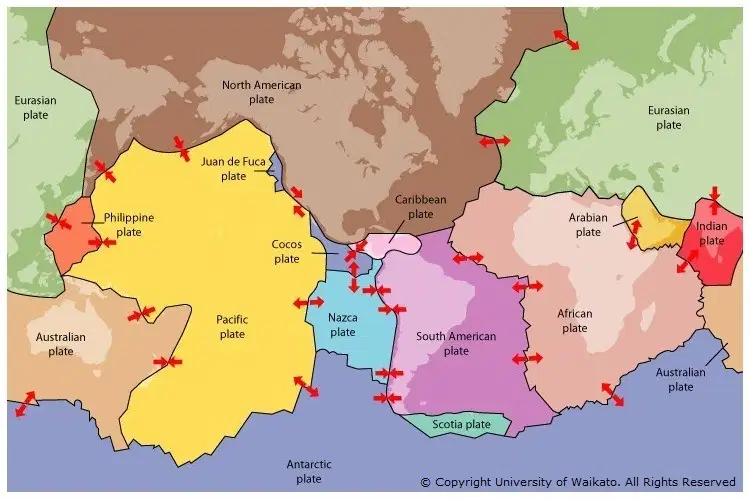
What type of plate boundary is occurring between Pacific and Nazca?
a)
convergent
b)
divergent
c)
trandform
35.
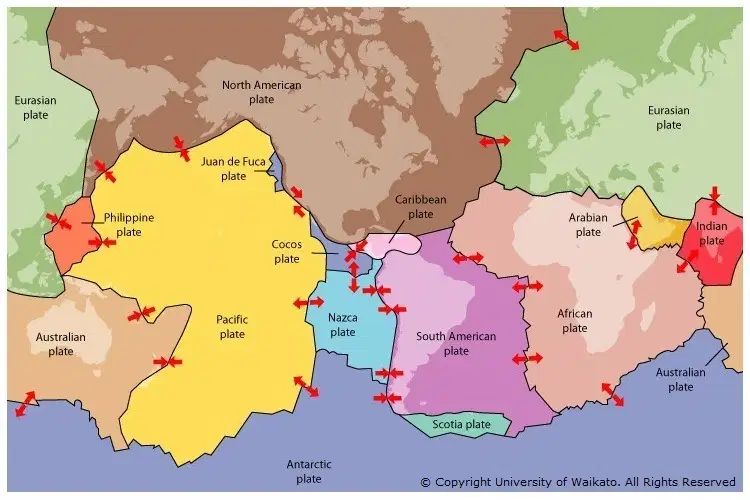
Identify the type of boundary between the Pacific Plate and the North American Plate.
a)
divergent
b)
convergent
c)
transform
100 %

