
 Worksheets
Chapter 6 Plate Tectonics (R)-2024
Total questions: 38
Worksheet time: 19mins
Name
Class
Date
1.
1. a long line of sea floor mountains where new ocean crust is formed by volcanic activity along a divergent boundary.
a)
mid-ocean ridge
b)
Asthenosphere
c)
continental drift
d)
convection current
e)
convergent boundary
2.
2. the layer of Earth made up of the crust and the rigid rock of the upper mantle.
a)
lithosphere
b)
Asthenosphere
c)
continental drift
d)
convection current
e)
convergent boundary
3.
3. a boundary along which two tectonic plates push together.
a)
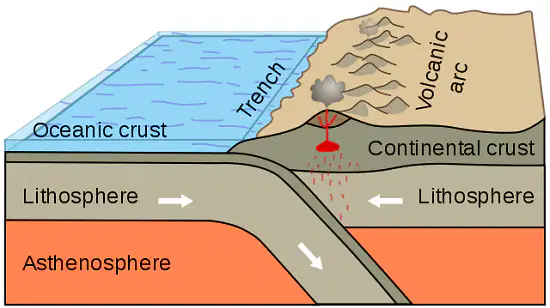
convergent boundary
b)
Asthenosphere
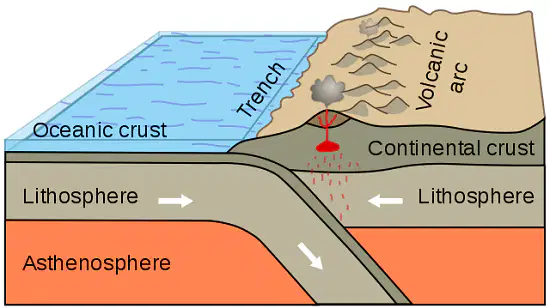
c)
continental drift
d)
convection current
e)
crust
4.
4. a deep valley formed as tectonic plates move apart, such as along a mid-ocean ridge
a)
rift valley
b)
Asthenosphere
c)
continental drift
d)
convection current
e)
convergent boundary
5.
5. a boundary along which two plates scrape past each other.
a)
transform boundary
b)
Asthenosphere
c)
continental drift
d)
convection current
e)
convergent boundary
6.
6. the layer in Earth's upper mantle directly UNDER the lithosphere
a)
Asthenosphere
b)
continental drift
c)
convection current
d)
convergent boundary
e)
crust
7.
7. a circulation pattern in which material is heated and rises in one area, then cools and sinks in another area.
a)
convection current
b)
Asthenosphere
c)
continental drift
d)
convergent boundary
e)
crust
8.
8. the layer of Earth between Earth's outer core and crust; the thickest layer
a)
mantle
b)
Asthenosphere
c)
continental drift
d)
convection current
e)
convergent boundary
9.
9. one of the large moving pieces into which Earth's lithosphere is broken and which commonly carry both oceanic and continental crust.
a)
tectonic plate
b)
Asthenosphere
c)
continental drift
d)
convection current
e)
convergent boundary
10.
10. a boundary along which two tectonic plates move apart.
a)
divergent boundary
b)
Asthenosphere
c)
continental drift
d)
convection current
e)
convergent boundary
11.
11. the process by which an oceanic tectonic plate sinks under another plate
a)
subduction
b)
Asthenosphere
c)
continental drift
d)
convection current
e)
convergent boundary
12.
12. a theory stating that Earth's lithosphere is broken into huge plates that move and change in size over time.
a)
theory of plate tectonics
b)
Asthenosphere
c)
continental drift
d)
convection current
e)
convergent boundary
13.
13. an area where a column of HOT material rises from deep within a planet's mantle.
a)
hot spot
b)
Asthenosphere
c)
continental drift
d)
convection current
e)
convergent boundary
14.
14. the hypothesis that Earth's continents move on Earth's surface
a)
continental drift
b)
Asthenosphere
c)
convection current
d)
convergent boundary
e)
crust
15.
15. a hypothetical supercontinent that once included all the landmasses on Earth.
a)
Pangea
b)
Asthenosphere
c)
continental drift
d)
convection current
e)
convergent boundary
16.
16. a switch in the direction of Earth's magnetic field so that the magnetic north pole becomes the magnetic south pole.
a)
magnetic reversal
b)
Asthenosphere
c)
continental drift
d)
convection current
e)
convergent boundary
17.
17. a solid sphere of metal, mainly nickel and iron, at Earth's center.
a)
inner core
b)
Asthenosphere
c)
continental drift
d)
convection current
e)
convergent boundary
18.
18. the thin layer of molten metal, mainly nickel and iron, that surrounds Earth's inner core.
a)
outer core
b)
Asthenosphere
c)
continental drift
d)
convection current
e)
convergent boundary
19.
19. the thin layer of rock above Earth's mantle
a)
crust
b)
Asthenosphere
c)
continental drift
d)
convection current
e)
convergent boundary
20.
20. the transfer of energy from place to place by the motion of heated gas or liquid; in Earth's mantle, convection is thought to transfer energy by the motion of solid rock, which when under great heat and pressure can move like a liquid.
a)
convection
b)
Asthenosphere
c)
continental drift
d)
convergent boundary
e)
crust
21.
21. a boundary along which two plates carrying continental crust push together
a)
continental-continental collision
b)
Asthenosphere
c)
continental drift
d)
convergent boundary
e)
crust
22.
22. a boundary along which a plate carrying oceanic crust sinks beneath a plate with continental crust.
a)
oceanic-continental subduction
b)
Asthenosphere
c)
continental drift
d)
continental-continental collision
e)
convergent boundary
23.
23. a boundary along which a plate carrying oceanic crust sinks beneath another plate with oceanic crust
a)
oceanic-oceanic subduction
b)
Asthenosphere
c)
continental drift
d)
continental-continental collision
e)
convergent boundary
24.
1. What are the Earth's layers from the center to the surface?
a)
inner core, outer core, crust, mantle
b)
crust, mantle, outer core, inner core
c)
crust, outer core, mantle, inner core
d)
inner core, outer core, mantle, crust
25.
2. Which of these could best be used to model Earth's layers?
a)
a hard-boiled egg
b)
an eggshell
c)
a peach pit
d)
the skin of a peach
26.
3. A tectonic plate is a slab of Earth's
a)
asthenosphere and inner core
b)
lithosphere and asthenosphere
c)
crust and lithosphere
d)
molten mantle and outer core
27.
4. Which of these did Wegener use to support his theory of continental drift?
a)
similar rocks and similar fossils on different continents
b)
sea-floor spreading and similar rocks on different continents
c)
convection currents in the asthenosphere and sea-floor spreading
d)
fossils from ancient organisms and convection currents in the asthenosphere
28.
5. Studies of the ocean floor support plate tectonics because oceanic crust
a)
is younger at the ridge and older near the trench
b)
is younger at a trench and older near a ridge
c)
is much older than continental crust
d)
is about the same age as Pangea
29.
6. Scientists think that the main driving force of plate tectonics is
a)
ridge push
b)
slab pull
c)
convection in the lithosphere
d)
convection in the asthenosphere
30.
7. Which of the following is also known as a spreading center?
a)
transform boundary
b)
divergent boundary
c)
convergent boundary
d)
convection boundary
31.
8. At a mid-ocean ridge, the pattern formed by magnetic minerals.
a)
is the same on either side of the ridge
b)
is randomly arranged at the ridge
c)
is older along mid-ocean ridges and younger near ocean trenches
d)
shows that hot spots in Earth's mantle cause volcanoes to form
32.
9. At transform boundaries, two plates
a)
pull away from each other
b)
push against each other
c)
scrape past each other
d)
do not move in any direction
33.
10. The Alps are forming as a result of the European and African plates pushing against each other. This is an example of
a)
oceanic-oceanic subduction
b)
oceanic-continental collision
c)
oceanic-continental subduction
d)
continental-continental collision
34.
11. How are the plates moving?
a)
away from each other
b)
together
c)
scraping past each other
35.

16. What type of plate boundary is this?
a)
Convergent
b)
Divergent
c)
Transform
36.

17. What type of plate boundary is this?
a)
Convergent
b)
Divergent
c)
Transform
37.
18. What type of plate boundary is this?
a)
Convergent
b)
Divergent
c)
Transform
38.
Which type of plate boundary is most likely to produce earthquakes as plates slide past each other?
a)
Subduction zone
b)
Convergent boundary
c)
Divergent boundary
d)
Transform boundary
100 %

