
 Worksheets
1st Semester Final: 7th Grade
Total questions: 125
Worksheet time: 5hrs 57mins
To navigate across open ocean, the Chinese invented a device based on
alchemy
astrology
magnets
gravity
Compared to a Roman-style arch, what was the advantage of the Chinese segmental arch?
It could use more material.
It could be wider and flatter.
It could have a higher center.
It could stop flowing water.
All over China by the 700s, the popularity of one drink led to the opening of
wine bars.
tea houses.
beer cellars.
coffee houses.
When the Chinese already had iron, why did they develop a way to make steel?
Steel is stronger than iron.
Steel is weaker than iron.
Steel is easier to make than iron.
Steel is more available than iron.
Why did Chinese alchemists warn people to stay away from the powder they made with saltpeter?
It might be poisonous.
It had a secret formula.
It was likely to explode.
It could be turned into gold.
Which Chinese invention led to a reduction in the use of crossbows, swords, and spears in warfare?
steel
compass
telegraph
gunpowder
How did the Chinese first use rockets?
to explore space
to send up fireworks
to construct long bridges
to move junks across the sea
Which invention did the Chinese use when making game cards in the 9th century?
porcelain
static type
segmental arches
woodblock printing
Why did many ancient Chinese steam the clothing of someone who was sick?
to lower the person's temperature
to warn others to stay at a distance
to prevent the spread of infection
to keep the sickroom smelling sweet
To inoculate a person against smallpox, Chinese doctors rubbed a powder into the skin. How did the powder work?
It signaled the immune system to fight the disease.
It increased the appetite so people would stay strong.
It helped the patient to sleep longer and more soundly.
It closed the openings through which germs enter the body.
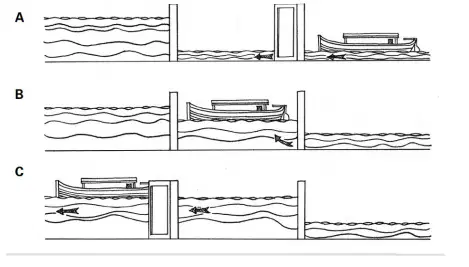
What Chinese invention is shown in the diagram?
Canal Lock
Steam Boat
Aqueduct
Irrigation Canal
Suppose four Chinese emperors are in the same dynasty. Which statement must be true about them?
They were born in the same region
They are members of the same family
They belong to the same political party
They use the same style of government
The Chinese invention that helped people navigate ships at sea was the
paddlewheel boat.
compass.
segmental arch bridge.
canal lock
Which Chinese invention is still used for recording and transmitting the written word?
gunpowder
paper
porcelain
steel
What invention helped the Chinese develop a printing industry?
tea
steel
rocket technology
woodblock printing
What is movable type?
a block of wood carved with characters that are then printed
separate blocks for individual characters that are used for printing
a roll of paper with an adhesive attached to its backside
paper made from rags of silkworm fabric imported from Italy
Movable type changed printing by making written materials
ore expensive.
more difficult to produce.
unnecessary.
more available.
What popular beverage did the Chinese develop that is made by pouring boiling water over dried leaves?
coffee
tea
hot cocoa
fruit juice
The Chinese invented a type of fine pottery called
clay
porcelain
quartz
marble
What Chinese invention changed the type of weapons people used in war?
the crossbow
the sword
gunpowder
steel
What Chinese invention was an improvement for telling time?
the hourglass
the mechanical clock
the sundial
the magnetic compass
Why did the Chinese develop a way to inoculate people?
to disinfect germs in clothing
to prevent the spread of disease
to encourage them to drink tea
to help people learn to use mechanical clocks
Why does inoculation help prevent disease?
It kills disease-causing germs on medical instruments.
It stimulates a person's immune system to fight a particular disease.
It makes a person want to eat more to stay healthy.
It creates a smoke that kills disease-causing germs.
Which invention developed by the Chinese is still used to help people find direction?
astrolabe
compass
paddlewheel
abacus
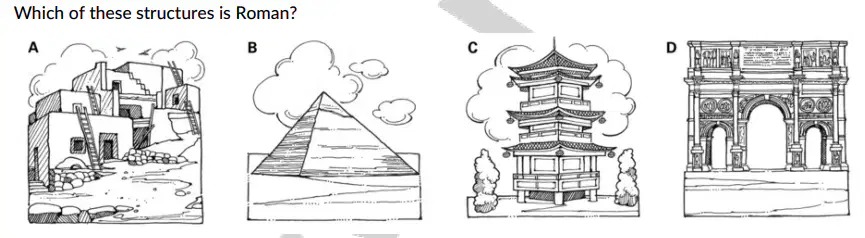
Which of these structures is Roman?
A
B
C
D
The Romans built aqueducts to carry
armies.
merchants.
ships.
water.
Which engineering feat connected the city of Rome with territory throughout the empire?
canals
roads
ships
runners
Which languages are most closely related to Latin?
Greek and Turkish
Polish and Russian
French and Spanish
German and Danish
Which feature of American democracy comes from the Romans?
All people are born equal.
Leaders are elected directly by the people.
Government is based on a written constitution.
Citizens have certain rights and responsibilities.
Who was at the top of the feudal system?
serfs
knights
Kings
Lords
Peasants
Who was below kings in the feudal system?
serfs
knights
Kings
lords
Peasants
Who was below lords in the feudal system?
serfs
knights
Kings
lords
Peasants
Who was at the bottom of the feudal system?
knights
Kings
lords
peasants
One of the biggest causes of disease in medieval towns was
unsanitary conditions.
poison in community wells.
refusal to use herbal medicines.
lack of care by family members.
Community life in western Europe during the Middle Ages centered on
the school
the theater
the church
the town hall
Which of the following is a main reason why the clergy were recorders and advisers to kings?
They could read and write
They were honest and wise
They owned most of the land
They made all the people obey
What was one human activity that contributed to the spread of the bubonic plague?
Bathing too often
Trading with Asia
Eating rotten food
Keeping mice as pets
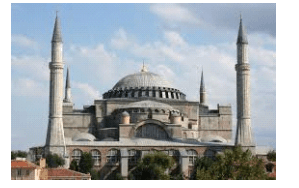
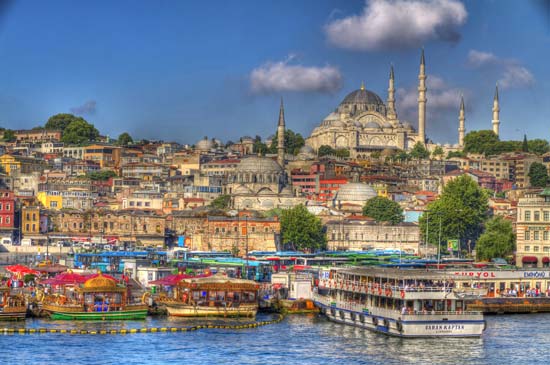

How did the Bubonic Plague arrive in Italy?
on trade ships
on the Silk Road
on the trans-Saharan trade route
on camels

Which of these might you see in a work of Islamic art?
thirsty camels
herds of goats
geometric designs and patterns
smiling children
For Muslims, praying five times a day is an act that emphasizes
fairness.
courage.
kindness.
discipline.
Why do mosques all over the world have fresh, flowing water?
as a symbol of an oasis
for drinking during a fast
for washing before prayer
as a way to understand God
Mecca and Rome
London and Jerusalem
Constantinople and Medina


Define: Qur’an القرآن
Things Muslims did that never made it into the scriptures.
Islamic religion in which people worship Allah.
A place of worship.
Islam's primary sacred text, regarded by Muslims as the direct words of Allah.
Islam's primary sacred text, regarded by Muslims as the direct words of Allah.
Qur’an القرآن
A follower of Islam, means "one who has submitted".
Muslim مسلم
A Muslim place of worship.
Mosque مسجد
The most sacred temple of Islam, located at Mecca.
Ka’aba كعبة
Arabic word for God.
Allah الله
The _____________ is in the center of Mecca and it holds the black stone. It is where millions of Muslims make a religious journey to each year.
Medina
Mosque
Quran
Kaaba
What are the basic practices of Islam called?
Four Noble Truths
Five Pillars
Eightfold path
Three Wise Sayings
What type of religion is Islam?
Polytheistic
Agnostic
Monotheistic
Spiritualist
How many times a day should Muslims to do the ritual of prayer?
3
1
2
5
How did West Africans preserve their history before writing was introduced?
Booksellers made marks with sharp sticks on wet clay.
Painters made a long series of paintings like a comic strip.
Foreign visitors kept the only record of events in the region.
Poet-musicians memorized the stories and passed them down.
Which term best describes a job of a griot?
trading goods
carving masks
curing diseases
keeping records
How did traditional West African folktales come to the Americas?
Traders sold them.
Enslaved people brought them.
Explorers discovered them.
Missionaries wrote them down.
The trans-Saharan trade increased after about 300 C.E. as a result of the
growth of cities
discovery of salt
population increase
introduction of camels
In which language were most of the earliest books written in West Africa?
Latin
Arabic
Mande
Egyptian
What is the best title for the list: balafon, ngoni, kora.
Styles of West African Folktales
Dances in West African Rituals
West African Musical Instruments
West African Traditional Ceremonies
Sculptures from the ancient Nok culture were formed from
terra-cotta
gold plate
iron and brass
rare wood
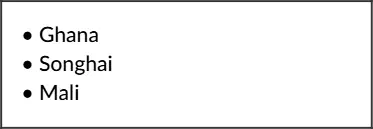
What is the best title for this list? • Ghana • Songhai • Mali
A. Trading Cities of the Sahara
B. Tribes Who Ruled the Desert
C. Early Kingdoms of West Africa
D. Animal Gods of the Niger Valley
Few large settlements developed in the Sahara because it was too
dry
hilly
large
rocky
Which product of West Africa was most important in the trade across the Sahara?
oil
gold
timber
clothing
Mali controlled the _____________ Routes

Judaism
Canal locks
Griots, as storytellers, were responsible for teaching their peoples' (a) to the children in the community.
Muhammad
Great religious and political leader
Muslim
Follower of the Islam religion
5 Pillars of Islam
Basic acts of worship Muslims must follow
Qur'an
Sacred book of Islam
Monotheistic
Belief in 1 God - Islam and Christianity
How did Ghana become wealthy and powerful?
By taxing all goods coming in and out of the Empire
By converting everyone to Islam
By traveling along the Niger River
By conquering other empires

What was mainly traded for gold in early West African trans-Saharan trade?
Iron
Salt
Slaves
Ivory


Worshipers of Islam must face ______ when they pray.
Medina
Jerusalem
Mecca
Cairo
Rome is located on the land near which Sea?
Italy
Mediterranean
Meringue
Tiber
Which continent is Rome located on
Africa
Asia
Europe
North America
The Romans built _____________ and some are still used today to connect the growing Roman Empire.
cars
columns
roads
ships

The following is a picture of the _______________ found in Rome, Italy.
Colosseum
Parthenon
Statue of Liberty
White House
Roman architects decorated their buildings with beautiful artwork such as tiles pictures called __________________, sculptures and paintings.
aqueducts
arches
columns
mosaics
a pipe or raised channel built to carry water over a long distance
aqueduct
Constantine
decline
empire


What does this image have to do with cultural influences from Rome?
It was built using concrete
It was built by a Roman
Its architecture was inspired by Rome
It was built to honor the Roman gods
Choose the correct name for the building in the image.
Pantheon
Colosseum
Vatican

Pantheon

Colosseum

Forum

Parthenon

Which Roman structure is shown here?
Colosseum
Pantheon
Parthenon
Aqueduct

Type of art in Ancient Rome that uses small glass tiles to create a picture.
Kite
Hieroglyphics
Mosaics
Arch

Applying tint to plaster to paint an image into a wall is known as a _______
Fresco
Mural
Mosaic
Landscape

Which river runs through Egypt?
Tigris
Euphrates
Nile
Mississippi

Egypt is in this continent.
Asia
Africa
Europe
America
Click on Rome, Italy

What sea is #1?
Mediterranean Sea
Adriatic Sea
Gulf of Mexico
Red Sea

Look at the map. What is the name of the location circled?
Spain
Great Britain
The Italian Peninsula
The Byzantine Peninsula

Look at the map. To which city is the arrow pointing?
Italy
Rome
Constantinople
Mecca
Symptoms of the plague
vomiting
fever
buboe
spasms
The plague followed this important trade route into Europe.
Silk Road
Spice Road
Salt Road
Trans-African Trade
Where did the Bubonic Plague originate?
Northern Europe
South Africa
Central Asia
Middle East
Approximately what percentage of the population of Europe was lost because of the Black Death?
1/2
1/3
1/4
1/8
How did the Plague arrive in Italy?
on trade ships
on the Silk Road
on the trans-Saharan trade route
on camels
The plague was spread by which of the following?
rats/ animals
humans
fleas
rain water
Does the Black Plague still exist today?
No - it has been eradicated.
Yes - and it can be cured with modern anti-biotics.
Yes - but only in China & Mongolia.
Yes - and there still isn't a cure.
What is the Silk Road?
A road that leads to the emperor's home in China
A road that is paved with pieces of silk
It wasn't a road. It was what they called the Mongol Empire.
A series of trade routes through Asia and Europe
The Black Death Killed millions of people worldwide.
true
false
Why was there a need for feudalism after the fall of Rome?
There was disorder and danger.
There was no monarch.
There was not enough land.
All the answers are correct.
If you lived in the Middle Ages, your social class was determined by
birth
wealth
religion
education

The building of Gothic Cathedrals sometimes required what architectural system be used so that walls could be supported?
Post and Lintel system
Flying Butresses
Round arch
Stained glass windows


The dominant diagonal structural component in this image is a ______?
Flying buttress
Buttress
Pier
Window

What kind of windows were used in a Gothic Cathedral?
stained glass
tinted
unbreakable
plastic
Monotheism is the belief in...
several gods
one god
What is a Feudal System?
It is a system invented by the Europeans of writing.
A political and social order.
It is a water system used by the Romans.
It is a sound system used at a party.

Identify this feature of a cathedral.
flying buttress
stained glass
gargoyle
arches

Define FEUDALISM

What was the correct order of the stages before becoming a knight?
Squire, Page, Knight
Page, Squire, Knight
Knight, Page Squire
Page, Knight, Squire

Which vocab. word is the best match for this image?
Feudalism
Reconquista
Heresy
Chivalry
Label the feudal pyramid
serf
King
peasant

