
 Worksheets
Shields Custom Gravity Notes Questions
Total questions: 11
Worksheet time: 6mins
Name
Class
Date
1.
Period, First Name, Last Name
Example: 5 Jenna Smith
4 lines
2.
What keeps the planets in their continuous orbit around the sun?
a)
magnitism
b)
gravity
c)
rotation
d)
revolution
3.
The sun has more mass than any planet. What does this tell you?
a)
The sun has less gravity than the planets.
b)
The sun has more gravity than the planets.
c)
The sun and the planets have the same amount of gravity.
4.
If the solar system lost the Sun, what would happen to the planets?
a)
The planets would continue on the same elliptical path
b)
The planets would explode.
c)
The planets would travel on a different path.
d)
The planets would stop moving.
5.
To be able to accurately predict when a comet will collide with a planet, it is necessary to understand
a)
the formation of comets
b)
the attraction of opposite poles of a magnet
c)
the gravitational attraction that exists between all bodies
d)
the composition of the earths atmosphere
6.
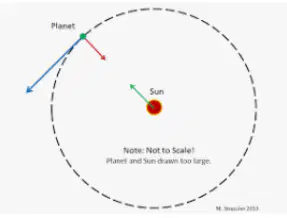
What force causes a planet to travel along a curved path instead of moving in a straight line as shown in the diagram?
a)
Electromagnetic attraction between the sun and the planet
b)
Gravitational attraction between the planet and its neighboring planet
c)
Gravitational attraction between the sun and that planet
d)
Electromagnetic attraction between the planet and its neighboring planet
7.
This girl is showing how the Earth stays on a path around the sun. What part of the demonstration represents gravity?
a)
The path
b)
her hand
c)
the string
d)
the ball
8.
What keeps the planets from moving in straight lines throughout the galaxy.
a)
potential energy
b)
inertia
c)
gravity
d)
light energy
9.
What is true about the movement of asteroids, comets, planets, the Oort cloud, and the Kuiper belt?
a)
They all orbit the sun
b)
composition
c)
they all move at the same speed
d)
they all move in perfect circles
10.
Solids made of rock and ice with very elliptical orbits that originate beyond the orbit of Neptune and release gas and dust in a bright display that can last weeks when they pass.
a)
Asteroid
b)
Comet
c)
Meteors
d)
Kuiper Belt
11.
What is the order of the objects in the solar system?
a)
Sun, Jovian planets, asteroid belt, terrestrial planets, Kuiper Belt, Oort Cloud
b)
Sun, terrestrial planets, asteroid belt, Jovian planets, Kuiper belt, Oort Cloud
c)
Sun, terrestrial planets, asteroid belt, Jovian planets, Oort Cloud, Kuiper Belt
100 %

