

wayground logo

Free Printable Worksheets

NEW

Font size

S
M
L
XL
Worksheets

APES Unit 1

Total questions: 54

Worksheet time: 33mins

Name
Class
Date
1.
Compared with a population with low genetic diversity, a genetically diverse population is more likely to include individuals that
a)
are distributed over a large range
b)
vary greatly by age
c)
vary greatly by appearance and behavior
d)
each carry a large number of genes
2.
Which of the following is most likely to give an individual a larger range of tolerance than other members of its population?
a)
spending more time in extremely hot and cold conditions
b)
having a relatively large number of offspring
c)
genetic similarity to the rest of the population
d)
genetic differences from the rest of the population
3.
Of the following pairs of ecosystems, which has the highest net primary productivity?
a)
swamps and estuaries
b)
woodland and agricultural land
c)
savannas and coniferous forests
d)
open ocean and tundra
4.
One species benefits from its relationship with another species for whom the relationship does no harm or good. This relationship is best described as
a)
commensalism
b)
parasitism
c)
ecological succession
d)
mutualism
5.
Members of a species in a defined area
a)
Ecosystem
b)
community
c)
biodiversity
d)
population
6.
Series of steps in which organisms transfer energy by eating and being eaten
a)
foodweb
b)
consumer
c)
food chain
d)
omnivore
7.
All the organisms in a particular location, including their nonliving environment
a)
ecosystem
b)
carnivore
c)
niche
d)
population
8.
What does fungi do to dead plants and animals?
a)
Leave them there
b)
Decompose them
c)
Wait for other animals to eat them
d)
Move away
9.
What may happen if the snowshoe hare was removed from the food web pictured?
a)
The insects in the habitat would increase.
b)
The shrew population would decrease due to being only hawk food source.
c)
The willow tree population would decrease.
d)
Foxes would dies due to no food source. 
10.
In the energy pyramid here, how much of the energy in the producers gets passed to the herbivores?
a)
10%
b)
20%
c)
80%
d)
90%
11.
Which of the following leads to a decrease in biodiversity?
a)
protection of ecosystems
b)
pollution control
c)
selective cutting
d)
introduction of exotic or invasive species
12.
A carbon "sink" is best described as:
a)
a reservoir that readily releases carbon to another reservoir
b)
a carbon reservoir that stores more carbon that it is releasing
c)
something that causes carbon to leak out to the atmosphere
d)
a carbon reservoir that is releasing more carbon than it is taking in
13.
Nitrogen fixation processes nitrogen from which of the following sources?
a)
lightning
b)
fertilizers
c)
dead plants
d)
atmosphere
14.
Nitrogen makes up _____ percent of the atmosphere.
a)
66%
b)
78%
c)
90%
15.
In the food web shown, the snail would be considered...
a)
primary consumer
b)
secondary consumer
c)
tertiary consumer
d)
producer
16.
Which biome, because of its climate and amount of rainfall, has the largest number of species of plants and animals?
a)
Tundra
b)
Rainforest
c)
Desert
d)
Pineforest
17.
The diagram below shows the cycling of nutrients in an ecosystem.
The removal of which of the following groups would cause an immediate decrease in the amount of energy flowing through the system?
a)
Producers
b)
Consumers
c)
Decomposers
d)
Inorganic nutrients
18.
What is the term for each step in the transfer of energy and matter within a biological community?
a)
energy path
b)
food web
c)
trophic level
d)
food pyramid
19.
What does a food web represent?
a)
All connections of energy flow throughout all organisms in a habitat.
b)
The specific ways that mutualism is carried out.
c)
A single pathway or energy flow between organisms. 
d)
How carnivores get their food. 
20.
What does the graph represent?
a)
Emigration
b)
Exponential growth
c)
Immigration
d)
Logistic Growth
21.
Which limiting factor is independent of the number of individuals in a population?
a)
competition
b)
parasitism/disease
c)
stress
d)
natural disasters
22.

What point on the graph represents the carrying capacity?

a)

A

b)

B

c)

C

d)

D

23.

A population is...

a)

All members of one species in one area

b)

All members of all species that live in one area

c)

All of the living and nonliving things in an area

d)

None of these

24.
Which factor is a density-dependent limiting factor on the population of a species?
a)
seasonal variation
b)
natural disasters
c)
unusual weather
d)
predation
25.

What is happening at the 'A' on the graph?

a)

the population overshoots above the carrying capacity

b)

the population stops growing

c)

growth begins to slow down due to limited resources

d)

growth is speeding up due to an abundance of resources
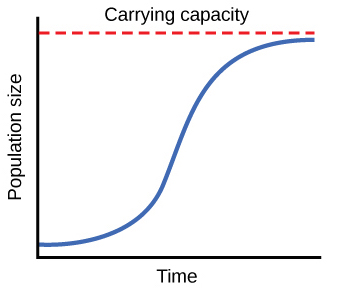
26.
To measure population density, you must divide the number of individuals living in a defined space by the
a)
area of the space
b)
birth and death rates
c)
carrying capacity
d)
height of the space
27.
The sea otter is a(n) ___________ that influences the survival of many other species in its ecosystem.
a)
Cute furry creature
b)
endangered species
c)
keystone species
d)
important animal
28.
__________ growth shows growth of a population under environmental constraints (carrying capacity-K) that sets a maximum population size 
a)
logistic
b)
exponential
c)
niche
d)
uniform
29.
Represents the biotic potential of the species
a)
A
b)
B
c)
D
d)
E
30.

Population increases at a constant rate over time.

a)

Exponential Growth

b)

Logistic Growth

c)

Stable Growth

d)

Strategic Growth

31.
All of the living things in an area
a)
organism
b)
population
c)
community
d)
ecosystem
32.

What is the main factor that differentiates the biomes?

a)

different planets

b)

different animals

c)

different climates

d)

different latitudes and longitudes

33.

According to this graph, the warmest months in the Bay Area's chaparral are

a)

January/February

b)

August/September

c)

November/December

d)

warm climate year-round

34.

According to this graph, the most rainfall occurs in the Bay Area's chaparral during

a)

January/February

b)

August/September

c)

November/December

d)

rainy climate year-round

35.

What is an anthrome?

a)

an ant hill

b)

a biome

c)

a human-altered biome

d)

shelter

36.

Individuals will use shared resources in their own self-interest rather than in keeping with the common good, thereby depleting the resources. This is known as

a)

Self centeredness

b)

Commonwealth sharing

c)

Tragedy of the Commons

d)

Public resource commons

37.

Which of the following would be an example of Tragedy of the Commons?

a)

Overfishing in a private pond.

b)

Clearcutting in a National Forest

c)

Spraying pesticides on a farm.

d)

Overfishing the oceans.

38.

A relationship in which two different organisms live in close association with each other

a)

interspecific competition

b)

Mutualism

c)

Symbiosis

d)

Commensalism

39.

Dropping leaves in the fall is a characteristic of which type of biome?

a)

Temperate Deciduous

Forest

b)

Tropical Rainforest

c)

Desert

d)

Chaparral

40.

Dropping leaves in the fall is a characteristic of which type of biome?

a)

Temperate Deciduous

Forest

b)

Tropical Rainforest

c)

Desert

d)

Chaparral

41.

Biome with many species of cacti, reptiles, and very little rainfall.

a)

Temperate Rainforest

b)

Desert

c)

Tropical Rainforest

d)

Tundra

42.

Type of biome which is located near the equator; receives a lot of rainfall; temperatures warm all year.

a)

Desert

b)

Temperate Rainforest

c)

Tropical Rainforest

d)

Taiga

43.

Which biome is characterized by extremely low temperatures and very little rainfall?

a)

Tundra

b)

Grasslands

c)

Savannah

d)

Temperate rainforest

44.

Which biome has the largest diversity of animals and plants?

a)

Taiga

b)

Deciduous Rainforest

c)

Tropical Rainforest

d)

Desert

45.

The most important abiotic features when studying biomes are:

a)

Food and Water

b)

Water and Sunlight

c)

Temperature and Oxygen

d)

Water and Temperature

46.

Which of the following is considered to be a BIOTIC factor?

a)

Rock

b)

Tree

c)

Temperature

d)

Weather

47.

Which of the following is considered to be abiotic?

a)

Sunlight

b)

Salamander

c)

Moss

d)

Lichen

48.

If the rate of deforestation is less than the annual growth of the forest, then the forest removal is unsustainable.  True or false

a)

True

b)

False

49.

Choose the true statement.

a)

volcanoes and wildfires both enrich the soil

b)

wildfires and flooding both produce dangerous smoke

c)

tornadoes and hurricanes both form over land

50.

Fire require 3 things. Which of the following is not required to creat fire?

a)

Heat

b)

Oxygen

c)

Fuel

d)

Light

51.

Which is not a benefits of water in terms of control fire?

a)

Reduce heat

b)

Dampens fuel

c)

Block Oxygen

d)

Planting tree

52.

Fire burn downslope in the day and upslope at night.

a)

True

b)

False

53.

Fires tend to burn less intensely at night because of...?

a)

Humidity

b)

Darkness

c)

The amount of oxygen

d)

Run out of fuel

54.

The easiest piece of the fire triangle to control is fuel

a)

True

b)

False
