
 Worksheets
eye and camera review
Total questions: 25
Worksheet time: 16mins

#3 Refers to the circular structure that surrounds the pupil and regulates the amount of light entering the eye.
Cornea
Pupil
Retina
Iris

#1 Refers to the clear tissue that covers the front of the eye
Retina
Cornea
Pupil
Iris

#2 refers to
optic nerve
cornea
iris
pupil

#7 Refers to the part of the eye that carried visual information from the eyeball to the brain
lens
optic nerve
retina
sclera

# 5 refers to the layer of receptor cells at the back of the eye in which the image is focused
Retina
Lens
Optic Nerve
Lens
The white part of the eye made of a tough material
lens
sclera
retina
optic nerve
The colorful part of the eye, controls light going into the pupil
lens
iris
sclera
retina
gel substance that gives the eye shape
optic nerve
iris
vitreous humor
retina


What is the function of sensor in a digital camera?
stops the light hitting it.
detects light falling on it.
adjusts the amount of light that enters into camera.
What happens to the light that passes through cornea?
it gets reflected.
it gets shattered.
it gets refracted.
why pupil gets smaller in bright light?
to get as much light as possible.
to prevent damaged to eye due to bright light.
to make sure light gets refracted.
The image formed on the retina is _____________
upside
upside down
rotated at 90 degrees angle.
Which part of the camera focuses light?
sensor
shutter
lens
What is the function of cone cells?
to detect colours in dim light.
to detect secondary colours in dim light.
to detect colours in bright light.
What are the three primary colours?
red, purple, yellow
red, green, blue
red, yellow, black
Which one of the following is true both for human eye and digital camera?
the sensor detects light.
the aperture controls the amount of light that enters.
the lens focuses the light.
Which one of the following is not true for human eye?
the picture that forms on retina is upside down.
the pupil size changes due change in amount of light.
the iris is the transparent part of the eye.

What can you use to see all the different colors in white light?
A flashlight
A shadow
A camera
A prism
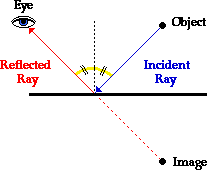
What is the angle of reflection equal to?
The angle of refraction
The angle of incidence
The angle of absorption
The angle of light

What is it called when light bends as it moves from one substance to another?
Absorption
Reflection
Refraction
Incidence
When light passes from air to water, what happens to the speed of the light?
speeds up
slows down
stays the same
The type of mirror used in reflector in automobile lights is
Plane mirror
Concave mirror
Convex mirror
None of the above
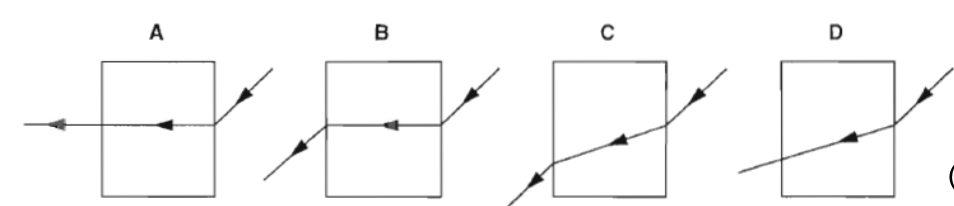
A ray of light travels from air into a glass block.
Which diagram correctly shows the path of the ray through the glass block?
A
B
C
D

