wayground logo

Free Printable Worksheets

Font size

S
M
L
XL
Worksheets

Chapter 4 and 5 Review

Total questions: 164

Worksheet time: 6hrs 59mins

Name
Class
Date
1.

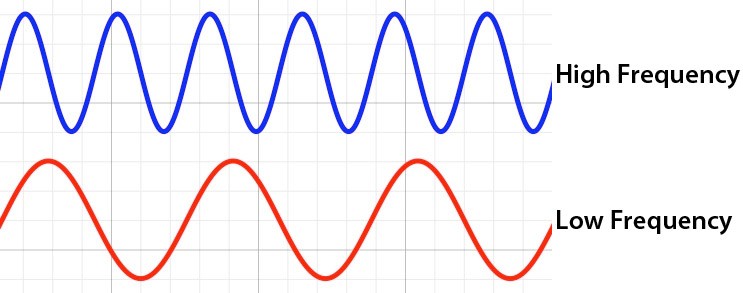
A wave with a large wavelength will have...

a)

Low Frequency & Low Energy

b)

High Frequency & High Energy

c)

High Frequency & Low Energy

d)

Low Frequency & High Energy

2.

Which has the LONGEST wavelength and therefore the lowest frequency/energy? These waves are used in broadcasting, wifi, and texting.

a)

Gamma rays

b)

Visible light

c)

Radio waves

d)

Infrared rays

3.

How much of the electromagnetic spectrum is made up of visible light?

a)

A small portion of it

b)

Most of it

c)

All of it

d)

None of it

4.

Which has the SHORTEST wavelength and therefore the highest frequency/most energy? Hint: These waves are also used in cancer treatments.

a)

Gamma Rays

b)

Radio Waves

c)

Ultraviolet Rays

d)

X-rays

5.

A wave has a frequency of 5 hz and a wave length of 5 m. What is the wave speed (velocity)?

a)

25 m/s

b)

1 m/s

c)

10 m/s

d)

0 m/s

6.
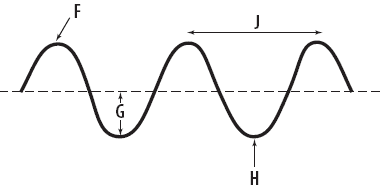
Which letter is a crest?
a)
F
b)
G
c)
H
d)
J
7.
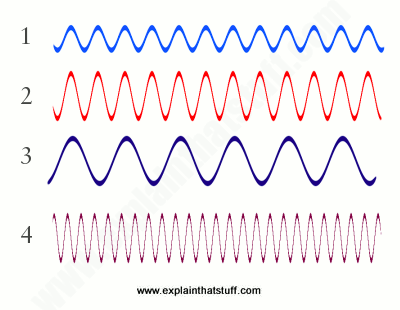
Which wave has the highest frequency?
a)
1
b)
2
c)
3
d)
4
8.
Frequency is
a)
Amount of time it takes for one wavelength
b)
How many wavelengths are completed in one second
c)
Distance between two crests or two troughs
d)
Amount of energy in a wave
9.
Frequency is measured in
a)
Newtons
b)
Joules
c)
Hertz
d)
Decibels
10.

What is the wavelength of a 2.99 Hz wave?

a)

1.00 x 10^8 m

b)

5.99 x 10^9 m

c)

9.97 x 10^8 m

d)

1.00 m

11.

What is the frequency of a 6.9 x 10^-13 m wave?

a)

2.07 x 10^19 Hz

b)

0.434 x 10^-5 Hz

c)

2.30 x 10^-21 Hz

d)

4.35 x 10^20 Hz

12.

What is the frequency of a 2.60 m wave?

a)

1.15 Hz

b)

4.00 x 10^-8 Hz

c)

8.67 x 10^-8 Hz

d)

1.15 x 10^8 Hz

13.
What is a photon?
a)
When radiation burst through electric waves
b)
The emission of electrons from a metal caused by light striking the metal
c)
The rate at which a waves energy flows through a given unit of area.
d)
packets of electromagnetic energy
14.

Which of the following colors of light have the highest energy

a)

red

b)

orange

c)

green

d)

violet

15.
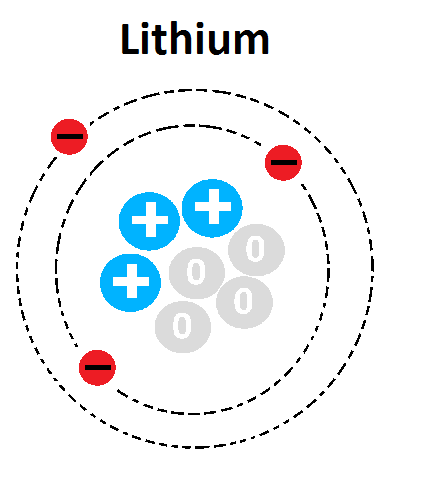
What is the name of this element?
a)
Helium
b)
Hydrogen
c)
Argon
d)
Silver
16.
What is the mass number of this atom?
a)
1
b)
3
c)
4
d)
7
17.
What is the atomic number of this atom?
a)
2
b)
4
c)
6
d)
none of the above
18.
How many valence electrons?
a)
2
b)
3
c)
5
d)
10
19.
What's a valence electron?
a)
electrons in the second energy level
b)
electrons in the outermost energy level
c)
the atomic number
d)
electrons in the first level
20.

On the periodic table, Periods are

a)

Horizontal rows

b)

Vertical columns

21.

Which Bohr model represents Neon?

a)
b)
c)
d)
22.
What does the nucleus of an atom contain?
a)
Electrons and neutrons
b)
Protons and neutrons
c)
Neutrinos and positrons
d)
Electrons and megatrons
23.

This atom has an atomic number of ​ (a)   .

This atom has a mass number of ​ (b)   .

This atom has an atomic mass of ​ (c)   .

This atom has ​ (d)   valence electrons.

Choose from the below words
8
16
15.999
6
24
2
12
10
3
24.

Match the following

a)

Alkali Metals

1.

1 valence electron and very reactive

b)

Alkaline Earth Metals

2.

2 valence electrons and very reactive

c)

Halogens

3.

7 valence electrons & highly reactive

d)

Noble Gases

4.

8 valence and completely unreactive

25.

Which number represents the atomic mass?

a)

HE

b)

4.0026

c)

2

d)

4

26.

How many Neutrons are in Neon

a)

10

b)

21

c)

20

d)

30

27.
What is the charge of an atom that has lost one electron?
a)
-1
b)
-2
c)
+1
d)
+2
28.

How many total electrons does O-2 (an oxide ion) have?

a)

8

b)

10

c)

6

d)

18

29.

How many total electrons does Mg+2 (a magnesium ion) have?

a)

10

b)

12

c)

14

d)

22

30.

How many electrons can go in the first energy level?

a)

2

b)

8

c)

18

d)

32

31.
How many electrons should Potassium have around its Lewis dot model?
a)
1
b)
2
c)
7
d)
8
32.
This is a correct dot diagram for fluorine (F)
a)
true
b)
false
33.
This is a correct dot diagram for magnesium (Mg)
a)
true
b)
false
34.

Which pair of elements has the most similar properties?

a)

Be and B

b)

O and S

c)

H and Hg

d)

Na and F

35.

How many electrons can the first energy level hold?

a)

1

b)

2

c)

8

d)

Unlimited

36.

Choose the correct electron configuration for Beryllium (Be).

a)

1s1

b)

1s2 2s2

c)

1s2 2s2 2p1

37.

Choose the correct electron configuration for Chlorine (Cl).

a)

1s2 2s2 2p1

b)

1s2 2s2 2p6 3s2

c)

1s2 2s2 2p6 3s2 3p5

38.
What is the noble gas configuration for beryllium?
a)
[He]1s2
b)
[He]2s2
c)
[Li]2s1
d)
[Li]2s2
39.
What is the noble gas configuration for boron?
a)
[He]1s22s2
b)

[He]2s2p2

c)

[He]2s2p1

d)

[Li]2s2p1

40.

Match the elements with their electron configuration! (3 minutes)

a)

1s2 2s2p3

1.

Nitrogen, N

b)

1s2 2s2p6 3s2p3

2.

Phosphorus, P

c)

1s2

3.

Helium, He

d)

1s2 2s2p6 3s2p6

4.

Argon, Ar

e)

1s2 2s2p6 3s2p6 d54s2

5.

Manganese, Mn

41.

Each orbital can hold how many electrons?

a)

5

b)

4

c)

8

d)

2

42.
How many electrons can the first energy level hold?
a)
1
b)
2
c)
8
d)
0
43.

Which area on the periodic table represents the electrons in the "d" sublevel?

a)

representative elements

b)

columns 3-8

c)

rare earth elements

d)

transition elements

44.

Which of the following is not a correct designation for a sublevel?

a)

zz

b)

p

c)

d

d)

f

45.
There are 4 different types of subshells (orbitals) s,p,d,f.
a)
true
b)
false
46.
Which periodic table family could have electrons filling orbitals in the s-block?
a)
Alkaine Earth 
b)
Halogens
c)
Noble Gases
d)
Transition Metals
47.

How many electrons can a p orbital hold?

a)

6

b)

10

c)

8

d)

14

48.
[Ne]3s23p5 is the noble gas configuration for which element?
a)
chlorine
b)
fluorine
c)
sulfur
d)
aluminum
49.

What is the symbol of that atom that matches this electron configuration?
1s22s2p63s2p6d104s2

(a)  

50.
Electrons occupy orbitals of lowest energy first is part of what electron configuration rule?
a)
Hund’s Rule
b)
Aufbau Principle
c)
Pauli Exclusion Principle
51.
Electrons are paired based on their spin directions, clockwise and counterclockwise, is what electron configuration rule?
a)
Hund’s Rule
b)
Aufbau Principle
c)
Pauli Exclusion Principle
52.
Which orbital shows a violation of Hund's Rule?
a)
A
b)
B
c)
C
d)
D
53.
Which orbital shows a violation of the Pauli Exclusion Principle?
a)
A
b)
B
c)
C
d)
D
54.
Which orbital shows a violation of the Aufbau Principle?
a)
A
b)
B
c)
C
d)
D
55.
Which element is pictured?
a)
neon
b)
fluorine
c)
magnesium
d)
argon
56.

What is the noble gas notation for V?

a)

[Ar] 4s2p2

b)

[Kr] 3d34s2

c)

[Ar] 4s2 4d3

d)

[Ar] 3d34s2

57.

What is the missing piece?

1s2 2s2 ___ 3s1

a)

2p6

b)

2p4

c)

3p6

d)

3s2

58.

What are the missing pieces?

1s2 2s2 2p6 ___ 3p6 4s2 ___ 4p2

a)

3s2 , 4d10

b)

2p4 , 3d10

c)

3p6 , 3d10

d)

3s2 , 3d10

59.

[He]2s2p4 is the noble gas configuration for which element?

(a)  

60.

Which of the following correctly lists the sublevels below in decreasing order of their energy?

4p, 3d, 4s and 3s

a)

4p > 3d > 4s > 3s

b)

4s > 3d > 4p > 3s

c)

3d > 4s > 4p > 3s

d)

3s > 4s >3d > 4p

61.
Which guideline, Hund’s rule or the Pauli exclusion principle, is violated in the following orbital diagrams?
a)
Hund's
b)
Aufbau's
c)
Pauli's Exclusive
62.
All orbitals of equal energy are occupied by one electron before any single orbital is occupied by a second electron.
a)
Aufbau principle
b)
Pauli exclusion principle
c)
Hund’s rule
d)
Core Notation
63.

What is the noble gas configuration for Cobalt?

(a)  

64.

What is the electron configuration of Tungsten?

(a)  

65.

2 rows beneath the main periodic table

a)

Lanthanide

b)

Lanthanide and Actinide

c)

Lanthanide and Hydrogen

d)

Actinide and Hydrogen

66.

What is the periodic law?

a)

Elements have numbers

b)

Elements have specific names

c)

Elements are organized based on families

d)

Elements are organized based on atomic masses

67.

What did Dmitri invent?

a)

Children

b)

Periodic Table

c)

Russian currency

d)

Calculator

68.

True or False:

Mendeleev was the only person working on organizing elements into a table.

a)

True

b)

False

69.

True or False:


Mendeleev left blank spaces on the periodic table to be filled by elements that he predicted would later be discovered.

a)

True

b)

False

70.

Who arranged the known elements into horizontal rows of increasing atomic mass leaving gaps for as yet undiscovered elements?

a)

Mendeleev

b)

Meyer

c)

Newlands

d)

Moseley

71.

How many valence electrons does Mercury have?

(a)  

72.

How many valence electrons does Silver have?

(a)  

73.

Who suggested that the physical and chemical properties were related to the atomic number, rather than atomic mass?

a)

Meyer

b)

Mendeleev

c)

Moseley

d)

Newlands

74.

Whose Periodic Table of Elements was the most accurate?

a)

Newlands'

b)

Mendeleev's

c)

Meyer's

d)

Moseley's

75.
What was Dmitri Mendeleev's greatest contribution to the history of the periodic table?
a)
He arranged all of the known elements by their atomic number
b)
He realised that there was a pattern of reactivity which repeated every 8 elements
c)
He predicted the existence (and properties) of new elements
d)
He identified the "law of triads" which became the groups
76.

On the periodic table, the horizontal rows are called

a)

Periods

b)

Groups

c)

Elements

d)

Compounds

77.

On the periodic table, the vertical columns are called

a)

Periods

b)

Groups

c)

Elements

d)

Compounds

78.

Elements in group 2 are called

a)

Alkali Metals

b)

Alkaline Earth Metals

c)

Transition Metals

d)

Halogens

79.

Elements in group 3-12 are called

a)

Alkali Metals

b)

Alkaline Earth Metals

c)

Transition Metals

d)

Halogens

80.

Elements in group 17 are called

a)

Alkali Metals

b)

Alkaline Earth Metals

c)

Transition Metals

d)

Halogens

81.

Elements in group 18 are called

a)

Alkali Metals

b)

Alkaline Earth Metals

c)

Transition Metals

d)

Noble Gases

82.

Halogens tend to form which ionic charge?

a)

+1

b)

+2

c)

-1

d)

-2

83.

Noble gases are extremely reactive

a)

True

b)

False

84.

Hydrogen would be best classified as

a)

Metal

b)

Non-metal

c)

Noble gas

d)

Alkali metal

85.

What type of elements fall along the "staircase"

a)

Metalloids

b)

Metals

c)

Non-metals

d)

Noble gases

86.

Neon is colorless, a poor conductor of heat and is not able to be stretched. How would it be classified?

a)

Nonmetal

b)

Metalloid

c)

Metal

d)

None of the above

87.

What is the electron configuration for Nickel.

(a)  

88.

Manganese is shiny, conducts heat and electricity, and can be hammered into thin sheets. What is is?

a)

Nonmetal

b)

Metal

c)

Metalloid

d)

None of the above

89.

This word is used to describe a substance that breaks apart easily and is weak and fragile

a)

Conductivity

b)

Ductile

c)

Malleable

d)

Brittle

90.

Use your Periodic Table to help you. Boron would be classified as a...

a)

Metal

b)

Nonmetal

c)

Metalloid

91.
Which element is a metalloid?
a)
Titanium
b)
Selenium
c)
Potassium
d)
Polonium
92.
A student is given a sample of an unknown substance. He is asked to determine if it is classified as a metal, a metalloid, or a nonmetal. He discovered that the unknown element conducted some heat and electricity, had a shiny luster, and broke easily. This element is most likely a 
a)
metal
b)
nonmetal
c)
metalloid
d)
cannot be determined
93.
Anytime you see the word SEMICONDUCTOR - what substance do you have?
a)
Metal
b)
Nonmetal
c)
Metalloid
94.

How many Metalloids are on the Periodic Table?

a)

7

b)

6

c)

92

d)

31

95.

A mixture of metals is called an (a)   .

96.

Which of these was NOT a conductor?

a)

sulfur

b)

magnesium

c)

zinc

d)

aluminum

97.

Which elements are colored red?

a)

nonmetals

b)

metals

c)

metalloids

98.
Which is an electron?
a)
A
b)
B
c)
C
99.

How many valence electrons does Tin (Sn) have?

(a)  

100.

How many valence electrons does Lithium (Li) have?

a)

8

b)

1

c)

5

d)

2

101.

How many valence electrons does Bromine (Br) have?

a)

5

b)

6

c)

7

d)

8

102.

Which statement is a valid conclusion based on the information?

a)

Saturntonium is nonreactive

b)

Saturntonium has properties unlike any other element

c)

Saturntonium is very reactive

d)

Saturntonium has properties most similar to period 7 metals

103.

What information from the table could help the student identify the element?

a)

Protons

b)

Neutrons

c)

Atomic mass

d)

Valence electrons

104.

How many valence electrons are present? 1s22s22p4

a)

2

b)

4

c)

6

d)

8

105.

How many valence electrons are present?

1s22s22p63s23p63d104s2

a)

2

b)

8

c)

12

d)

8

106.

Where are the valence electrons located?

1s22s22p63s2p3

a)

2s22p6

b)

1s22s2

c)

2p63s2

d)

3s2p3

107.
Which of these elements has the greatest atomic radius? 
a)
H
b)
N
c)
Cl
d)
Cs
108.
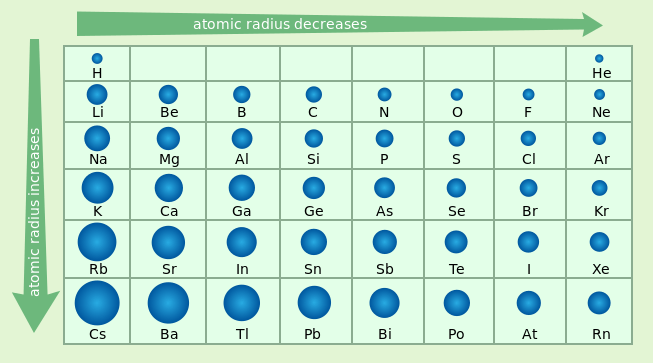
The Periodic Table of the Elements is useful for revealing patterns and trends in the elements. Which statement accurately describes a pattern in the size of atomic radii in the Periodic Table of the Elements?
a)
Atomic radii decrease from left to right across a period and decrease from top to bottom in a group.
b)
Atomic radii increase from left to right across a period and increase from top to bottom in a group.
c)
Atomic radii decrease from left to right across a period and increase from top to bottom in a group.
d)
Atomic radii increase from left to right across a period and decrease from top to bottom in a group.
109.
The ionization potential of an element is the amount of energy required to remove an electron from an isolated atom or molecule. According to the periodic table, which of the following indicates the correct decreasing order of ionization energy?
a)
Li > Na > K > Cs
b)
Na > K > Li > Cs
c)
Li > K > Na > Cs 
d)
Cs > K > Na > Li 
110.
Which of these elements has an electron structure most similar to that of element X?
a)
1
b)
2
c)
3
d)
4
111.
What is the family name of this group of elements? 
a)
Alkali metals 
b)
Halogens 
c)
Noble Gases 
d)
Alkali Earth Metals 
112.
Which element has 2 valence electrons? 
a)
cesium (Cs) 
b)
magnesium (Mg)
c)
boron (B)
d)
argon (Ar) 
113.
Which atom has the largest atomic radius?
a)
potassium
b)
rubidium 
c)
francium
d)
cesium
114.
Which of the following will have a lower ionization energy than Scandium (Sc)?
a)
Helium (He)
b)
Titanium (Ti)
c)
Calcium (Ca)
d)
Magnesium (Mg)
115.
The atom with the largest atomic radius in Group 18 is - 
a)
Ar
b)
He
c)
Kr
d)
Rn
116.
Which periodic group has the smallest atomic radius?
a)
Alkali metals
b)
Halogens
c)
Noble Gases
d)
Transition metals
117.
Atomic radius generally increases as we move __________.  
a)
down a group and from right to left across a period 
b)
up a group and from left to right across a period 
c)
down a group and from left to right across a period 
d)
up a group and from right to left across a period 
118.
Which one has the largest radius?
a)
Lithium (Li, atomic #3)
b)
Boron (B, atomic #5)
c)
Neon (Ne, atomic #10)
d)
Nitrogen (N, atomic #7)
119.
Define electron affinity.
a)
The energy it takes to add an electron to an atom.
b)
The energy it takes to remove an electron from an atom.
120.
Elements closer to the noble gases have stronger attraction for electrons.
a)
True
b)
False
121.

Which of the following is correct about general trends regarding electron affinity?

a)

Electron affinity increases down a group and decreases across a period.

b)

Electron affinity increases from bottom to top and decreases from left to right.

c)

Electron affinity increases from bottom to top and increases from left to right.

d)

Electron affinity decreases from bottom to top and increases from left to right in a period

122.

Which of the given atoms has the lowest electron affinity?

a)

Sr

b)

Be

c)

Ca

d)

Ra

123.

When the atomic radius increases, electron affinity

a)

Decreases

b)

Increases

c)

Neutral

d)

No effect

124.

Which of the following has the least electron affinity?

a)

oxygen

b)

potassium

c)

fluorine

d)

nitrogen

125.

Which of the following has the most electron affinity?

a)

nitrogen

b)

phosphorus

c)

arsenic

d)

lithium

126.
Atomic Radius is...
a)
the relative size of the atom's nucleus
b)
the relative size of the atom's electron cloud
c)
the energy required to shield the outer electrons from the nucleus
d)
a measure of the ability of an atom to attract electrons
127.
As you move down the periodic table atoms get bigger.  This is because ____________.
a)
The atoms have more mass.
b)
The atoms have more protons.
c)
The atoms have more energy levels
d)
The atoms have more nuetrons
128.
As you move across the periodic table atoms tend to get smaller because, ______________.
a)
the atoms have more mass.
b)
the atoms have less mass
c)
the atoms have more protons.
d)
the atoms have less electrons.
129.
Which atom has the largest atomic radius?
a)
potassium
b)
rubidium 
c)
francium
d)
cesium
130.
Which of the following will have a lower ionization energy than Scandium (Sc)?
a)
Helium (He)
b)
Titanium (Ti)
c)
Calcium (Ca)
d)
Magnesium (Mg)
131.
Which of these elements has an electron structure most similar to that of element X?
a)
1
b)
2
c)
3
d)
4
132.

Which element is found in group 2, period 6?

a)

Oxygen (O)

b)

Barium (Ba)

c)

Selenium (Se)

d)

Carbon (C)

133.

Name this group: These metals contain familiar metals such as gold, iron, and copper.

a)
b)
c)
d)
134.

Find these groups: Locate Lanthanides and Actinides.

a)
b)
c)
d)
135.
Which of the following atomic symbols for bromine is written correctly?
a)
bR
b)
BR
c)
Br
d)
br
136.

the positively charged subatomic particle contained in the nucleus of an atom

a)

proton

b)

neutron

c)

electron

d)

matter

137.

Which color on the image of the periodic table corresponds with the metalloids.

a)

bright yellow

b)

gold

c)

teal

d)

light blue

138.

Where, within the atom, are electrons found?

a)

Electron cloud

b)

nucleus

c)

floating in the space

d)

atoms don't have electrons

139.

How many electrons can be found on the 3rd ring?

a)

Up to 1

b)

Up to 2

c)

Up to 8

d)

Up to 16

140.

Lithium is in the 2nd PERIOD so it has _______ electron orbitals (shells).

a)

1

b)

2

c)

3

d)

4

141.

Oxygen is in the 16th group so it has _________ valence electrons.

a)

16

b)

6

c)

8

d)

3

142.

Is Silicon (Si) a metal, nonmetal, or metalloid?

a)

metal

b)

nonmetal

c)

metalloid

143.

How many valence electrons does Cesium have?

(a)  

144.

What factors influence the ionization energy of an atom?

a)

Temperature, pressure, and volume of the atom

b)

Atomic mass, atomic number, and electron configuration

c)

Number of protons in the nucleus, number of neutrons in the atom, and number of electrons in the outer shell

d)

Nuclear charge, distance of the outermost electron from the nucleus, and shielding effect of inner electrons

145.

The ionization energy of Na is larger than Cs because...

a)

Na has a greater effective nuclear charge

b)

Na has fewer energy levels and less shielding

c)

Cs has a greater effective nuclear charge than Na

d)

Cs has more valence electrons than Na

146.

Which atom has the smallest metallic character?

a)

O

b)

Ba

c)

Co

d)

K

147.

Which of these has a greater electron affinity?

a)

Si

b)

Cl

148.

Which of these has a greater need for electrons?

a)

Ca

b)

Ba

149.

As you move down a group, electron affinity

a)

increases

b)

decreases

150.

As you move left to right across a period, electron affinity

a)

increases

b)

decreases

151.
A cation is a ____ ion.
a)
negative
b)
positive
c)
neutral
d)
ficticious
152.
So far, we have learned that the elements are arranged in the periodic table according to their atomic number and that there is a rough correlation between the arrangement of the elements and their electron configuration. We will further explore the trends of the periodic table in this section.
Why do elements in the same family (or group) generally have similar properties?
a)
They have the same number of valence electrons, therefore react the same way
b)
Elements in the same family have different numbers of valence electrons, therefore we do not know how they react.
153.

Why is iodine larger than bromine?

a)

iodine has a greater number of electrons than bromine

b)

iodine has a greater number of protons than bromine

c)

iodine has more occupied energy levels and greater shielding than bromine

d)

iodine has more neutrons than bromine

e)

iodine has more valence electrons than bromine

154.
The more protons there are, the  ____ .
a)
Weaker the pull
b)
Smaller the electrons
c)
Stronger the pull
d)
The bigger the electrons
155.
Which of the following will have a larger radius than Zinc?
a)
Gallium
b)
Aluminum
c)
Magnesium
d)
Strontium
156.

Which atom has the leaset ability to attract electrons in a compound?

a)

S

b)

O

c)

Cl

d)

F

157.

Which element has the greatest electronegativity?

a)

I

b)

Br

c)

Cl

d)

F

158.

Which atom has the greatest ability to attract electrons in a compound (electronegativity)?

a)

As

b)

Se

c)

Ga

d)

Ge

159.

Which of the following would be most similar to Phosphorus? (select all that apply)

a)

Nitrogen

b)

Sulfur

c)

Silicon

d)

Germanium

e)

Antimony

160.

Which of the following factors will affect ionization energy:

a)

Atomic radius

b)

Effective nuclear charge

c)

Shielding effect

d)

All of the above

161.
After the atom is ionised, it then requires more energy to remove a second electron because the second electron experiences less shielding from the nucleus.
a)
True
b)
False
c)
Not sure
162.
Of the elements Ca, Be, Ba, and Sr, which has the largest atomic radius?
a)
Be
b)
Ba
c)
Ca
d)
Sr
163.

Put the following in order of increasing ionization energy: Sodium (Na), Oxygen (O), Boron (B)
a)
Sodium, Boron, Oxygen
b)
Oxygen, Boron, Sodium
c)
Sodium, Oxygen, Boron
d)
Oxygen, Sodium, Boron
164.

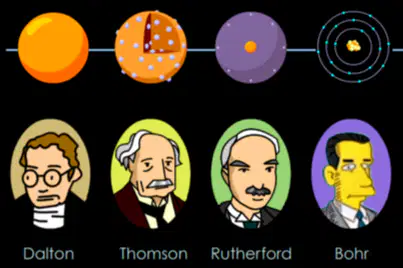
Why has our model of the atom changed over time?

a)

Scientists are becoming better at guessing models as time passes

b)

Increased spiritual prayer and revelation has given us this data

c)

new data has become available through experiments and observation

d)

Popular social media influencers on YouTube and Instagram are informing the public