
 Worksheets
BIO 322 Final Exam Review
Total questions: 33
Worksheet time: 26mins
Cecilia, 32/F, has come to the clinic complaining of swollen lymph nodes in her groin area. After asking for further history she admits to also having a painless sore on her inner labia that she was embarrassed to discuss. She confesses that she had unprotected sex with her new boyfriend after he promised her he was STD free. She takes OCP and was sure it would be fine. What is her most likely diagnosis?
Chlamydia
Candidiasis
Syphilis
Gonorrhea
If Cecilia in the previous question were to leave her syphilis untreated, which of the below conditions would she possibly develop if it moves into the tertiary phase?
Gummas
Chancre
Condyloma lata
A rash on her hands and feet
Martha is 24 and has gone to the doctor with complaints of pain when she urinates and frequent urination. After a series of tests, she is diagnosed with interstitial cystitis. Which of these would NOT you see in her UA?
Hematuria
Anti-proliferative factor
Nitrates
All of these would be present in her UA
Greg is a 72 year old man who has been diagnosed with overflow incontinence. Which of these is the most likely cause of his issues?
BPH
Weakened Pelvic Floor Muscles
Parkinson's Disease
MS
Andre went to the doctor complaining of joint pain, stomach issues, and spending a long time on the toilet when he needs to go to the bathroom. He is diagnosed with a parathyroid gland tumor causing hyperparathyroidism. Which of the below types of kidney stone would he need to be on the lookout for?
Struvite Stones
Uric Acid stones
Calcium Oxalate Stones
None of these
Mandy is a 12 year old girl whose mother brought her into urgent care. Mandy's eyes appear swollen, her urine is cola-colored, and she is running a fever. In her medical history, the admitting doctor notices that Mandy's medical history indicates that she had strep throat about 3 weeks ago. Which of the below is accurate regarding her current condition?
She likely has pre-renal azotemia
She likely has post-renal azotemia
She likely has intra-renal azotemia
BUN:Cr
>15:1
BUN:Cr
<15:1
Male, 59 years old, divorced & unemployed was admitted to an acute medical ward at the hospital presenting with general malaise, a grossly distended abdomen that had a positive fluid wave test, swollen ankles, and jaundice. Which of the below would you find on his LFT (liver function tests) if it was alcoholic cirrhosis? (check all that apply)
1 < AST:ALT < 2
AST:ALT > 2
AST:ALT < 1
Increased Bilirubin
Decreased Bilirubin
A 54 years old male presented to our clinic with a history of Type 2 DM, hypercholesterolemia and overweight. His chief complaint is a constant dull pain in his abdomen and low energy levels.
He is afebrile with normal HR but hypertensive. His LFT showed increased bilirubin, and an AST:ALT ratio 84:215. An ultrasound demonstrated a fatty liver.
Which of the below is his most likely diagnosis?
Viral hepatitis
Non-alcoholic steatohepatitis (NASH)
Alcoholic Hepatitis
Alcoholic Cirrhosis
A 39-year-old female patient presented with pain in abdomen on examination, patient was conscious, oriented, and demonstrated mild tremors. Per-abdomen examination showed distension of abdomen . Kayser-Fleischer rings were present in both eyes. Past history revealed later when the case was diagnosed as having cirrhosis. An endoscopic examination showed esophageal varices; with liver biopsy and increased serum copper levels resulted in a diagnosis.
Which of the below would you also say about her disease?
It is related to an unhealthy diet and lack of exercise
It is related to excessive alcohol consumption
It is caused by a virus she likely contracted through a blood transfusion
It is autosomal recessive
A 39-year-old female patient presented with pain in abdomen on examination, patient was conscious, oriented, and demonstrated mild tremors. Per-abdomen examination showed distension of abdomen . Kayser-Fleischer rings were present in both eyes. Past history revealed later when the case was diagnosed as having cirrhosis. An endoscopic examination showed esophageal varices; with liver biopsy and increased serum copper levels resulted in a diagnosis.
Which of the below would you also say about her disease?
AST:ALT < 1
AST:ALT > 2
1 < AST:ALT < 2
A patient has been recently diagnosed with fibrosis of the liver but no history of alcohol use. Which of the below would NOT be accurate to tell them?
It could be a result of diabetes or a sedentary lifestyle
This can lead to cirrhosis which can significantly increase your chances of developing HCC (hepatocellular carcinoma)
This could be caused by untreated viral hepatitis
He has ballooning degeneration and Mallory bodies.
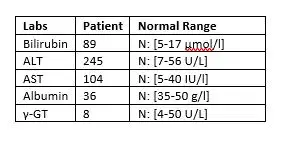
James is a 40y/o IV drug user and alcoholic. He is in your ER angry and combative because the staff has not yet given him any medications to help with his pain due to multiple drug seeking behaviors. He is complaining of abdominal pain and vomiting and is demanding dilaudid or fentanyl. You see his labs and understand that he does have a serious condition. Which of the below is the legitimate reason for James' discomfort?
Alcoholic Cirrhosis
Non-alcoholic Cirrhosis
Alcoholic Hepatitis
Hepatitis A
Hepatitis B
A patient undergoing perimenopause would expect to see which of the following? (check all that apply)
Decreased LH
Decreased FSH
Increased FSH
Increased LH
A new nurse is examining the hormone labs from a suspected PCOS patient. Aside from hyperinsulinemia, which of these do you also expect to be elevated?
FSH
LH
Estrogen
Testosterone
_____ is the term referring to unusually heavy and/or long menstrual periods which could cause ____?
Menorrhagia; Macrocytic Normochromic Anemia
Menorrhagia; Microcytic Hypochromic Anemia
Metrorrhagia; Macrocytic Normochromic Anemia
Metrorrhagia; Microcytic Hypochromic Anemia
______ is a condition in which the female has hormonal responding uterine tissue outside of the uterus.
Endometriosis
Leiomyoma
Adenomyosis
Salpingitis
Maria, a 40-year-old woman, presents to the clinic with complaints of heavy menstrual bleeding, pelvic pressure, and frequent urination over the past six months. She denies any significant medical history but mentions that her periods have become increasingly heavy and prolonged. On pelvic examination, her uterus is noted to be enlarged, and an ultrasound reveals multiple well-defined, solid masses within the myometrium that do not appear to respond to hormones.
Leiomyoma
Endometriosis
Pelvic Inflammatory Disease
Follicular Cyst
Sarah, a 25-year-old woman, presents to the clinic with complaints of excessive facial hair growth over the past year. She also reports recent difficulty losing weight despite efforts to maintain a healthy diet and exercise regimen. She has no significant medical history, and her physical examination reveals mild hirsutism. An ultrasound shows the presence of multiple small cysts on both ovaries. Her blood tests reveal elevated levels of testosterone, and other thyroid function tests and prolactin levels are normal.
Based on the criteria for the diagnosis of Polycystic Ovary Syndrome (PCOS), which of the following statements best applies to Sarah's case?
At least one of the criteria are met
At least two of the criteria are met
At least three of the criteria are met
None of the criteria are met
Intraductal papillomas of the breast are benign lesions with an incidence of approximately 2-3%. They result from abnormal proliferation of the epithelial cells lining the breast ducts.
Two types of intraductal papillomas are generally distinguished. The central type develops near the nipple. They are usually solitary and often arise in the years nearing menopause. On the other hand, the peripheral type are often multiple papillomas arising at the peripheral ducts, and are usually found in younger women. The peripheral type are associated with a higher risk of malignancy.
Given this information- which category do you think peripheral intraductal papillomas fall under?
Proliferative
Non-proliferative
If a patient is looking for a longest lasting pharmacological treatment for his GERD you would tell him:
Take two Tums every night
Take a PPI
Antibiotic
A 52-year-old man is referred to your practice for a history of gastroesophageal reflux disease (GERD). The patient reports a long history of heartburn symptoms, dating back at least 5 years. His symptoms were responsive to over the counter remedies including antacid tablets and liquids, but eventually became such a regular occurrence that he sought medical care from his primary care physician. He was initially prescribed an H2 blocker, which was incompletely effective, so he was started on proton pump inhibitor therapy. He currently takes 20mg of omeprazole daily which is effective, but notes that if he misses a dose, he sometimes experiences heartburn. He denies dysphagia, nausea or vomiting, blood in his stool, or unintentional weight loss. He has no other chronic medical conditions and takes no other medications. He is a nonsmoker who drinks alcohol in moderation, and has no family history of gastrointestinal cancer. Paperwork from the referring physician states that the reason for consultation is: “screening for Barrett’s esophagus.”
Which of the below would be an accurate statement to tell him (Check all that apply):
He may wish to get tested for a hiatal hernia
The Barret's esophagus is reversible if you can control the GERD
Sleeping flat on his back will reduce his symptoms of GERD
The Barret's esophagus is a form of cancer
Alix is 64 and has come into the clinic complaining of abdominal and stomach pain approximately 1-2 hours after eating. Given this information, where is the most likely location of his ulcer?
Esophagus
Stomach
Duodenum
Alix from the previous question tests positive for H. pylori and he is prescribed antibiotics and an H2 histamine blocker. He decides not to take his medicines and chooses to depend only on meditation and yoga to decrease his stress. A month later he is back at the clinic with complaints of increased pain in his abdomen, fever, and weight loss but feeling full all the time. Which of the below do you suspect may be a complication of his ulcer? (Check all that may apply)
Diverticulitis
Gastric cancer
Perforation
Peritonitis
A 38-year-old male was referred to the clinic. For the last 18 months prior, he had been treated as having irritable bowel syndrome (IBS) in another GI clinic. The diagnosis of IBS was made on clinical basis as he gave a history of recurrent episodes of abdominal bloating, vague abdominal pains and diarrhea, alternating with constipation. Otherwise, his appetite was good. There was some weight loss but no history of gastrointestinal bleeding. Since he was was a new patient, fresh blood tests were ordered. The blood tests came back normal except for positive for anti-gliadin antibodies and increased PT indicating that he did not have IBS, but a different GI problem.
Given his blood tests, what are possible complications from lack of treatment of his actual disease? (Pick all that apply)
Anemia
Osteoporosis
esophageal cancer
Flattening of the intestinal villi
Fistula
5 y/o girl from rural WA was admitted for treatment of glioblastoma of the brain. Over a period of approximately 18 months, she was treated as both an inpatient and outpatient with multiple courses of intensive chemotherapy, tumour resection, radiotherapy and immunotherapy. Treatment was complicated by extended hospital admissions requiring multiple courses of broad-spectrum antibiotics.
Most recently she has been brought to your ED for diarrhea. While the cancer did not spread, she most recently was given Ciproflaxin, and antibiotic, to treat a Klebsiella pneumoniae infection. Cultures have revealed the klebsiella has cleared up, but she is still experiencing the diarrhea.
What is the most likely cause of her diarrhea?
Sorbitol
Ulcerative Colitis
The glioblastoma
The Ciproflaxin
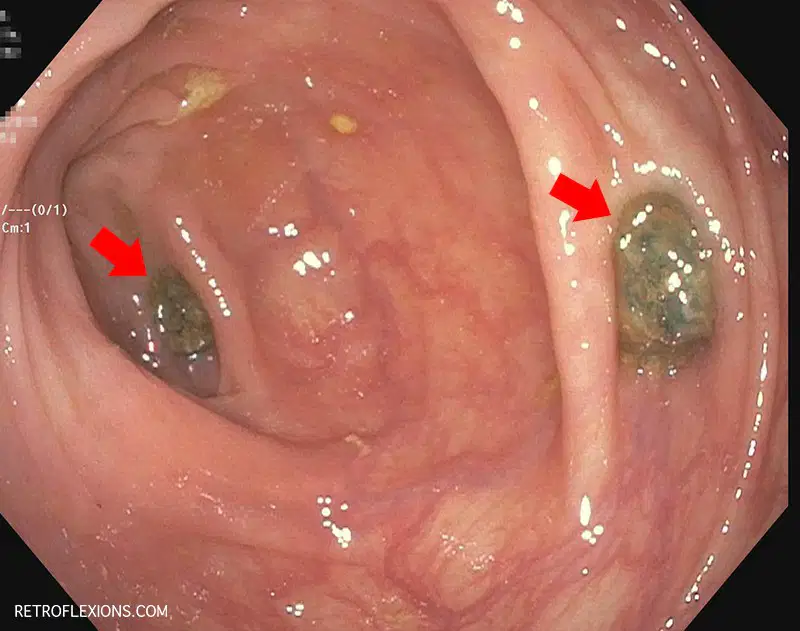
Shannon is a 68 year old woman who has complaints of lower left quadrant pain. She is a professional gamer who spends most of her days drinking Mountain Dew, eating pizza and cheetos, and playing Apex Legends on her Twitch channel. She states that she has been suffering from constipation and occasional fevers. Her CBC comes back with elevated WBC, but all other counts are normal. A colonoscopy reveals the image here which means you should tell her that:
She has Barret's esophagus and she should start taking a PPI
She has diverticulitis and she needs to add both soluble and insoluble fiber to her diet.
She has Celiac disease and she needs to avoid foods containing gluten
She has colon cancer and she needs to see a doctor for tumor resection
Continuous lesions and pseudo polyps affecting primarily the sigmoid colon is seen in what condition?
Gastritis
Ulcerative Colitis
Crohn's Disease
Diverticulitis
The term that pertains to feces with undigested lipids is called?
Steatorrhea
Melena
Hematemesis
Dysphagia
If a patient has Murphy's Sign, N/V, leukocytosis and RUQ pain but no jaundice they likely have:
Cholelithiasis
Cholecystis
Choledocolithiasis
Cholangitis
Pancreatitis
If a patient has clay colored stools, increased ALT and AST, increased total bilirubin, is febrile and has RUQ pain:
Cholelithiasis
Cholecystis
Choledocolithiasis
Cholangitis
Pancreatitis
If a patient is post-partum and has RUQ pain that comes and goes with fatty meals and is negative for leukocytosis, and N/V
Cholelithiasis
Cholecystis
Choledocolithiasis
Cholangitis
Pancreatitis
If a patient is post-partum and has RUQ pain and is positive for jaundice, N/V, has clay colored stools, but is negative for leukocytosis
Cholelithiasis
Cholecystis
Choledocolithiasis
Cholangitis
Pancreatitis
What are the common symptoms of chlamydia?
Fever and headache
Nausea and vomiting
Rash and sore throat
Pain during urination, abnormal discharge, and pelvic pain

