wayground logo

Free Printable Worksheets

Font size

S
M
L
XL
Worksheets

Adv. Geometry Midterm Review

Total questions: 100

Worksheet time: 16hrs 7mins

Name
Class
Date
1.

Find the midpoint of the line segment with endpoints (-2,0) & (9,-1).

a)

(1, 3)

b)

(3.5, -.5)

c)

(-.5, 3.5)

d)

(6, -.5)

2.
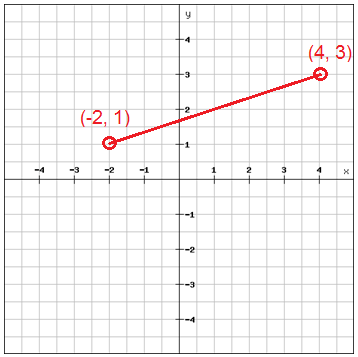
Find the y-coordinate of the midpoint of the line
a)
1
b)
2
c)
-2
d)
3
3.
Point M with coordinates (3,4) is the midpoint of the line AB and A has the point (-1,6). What is the point of B?
a)
(1,5)
b)
(2,10)
c)
(7,2)
d)
(1,2)
4.

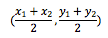
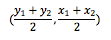
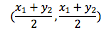
Which of the following is the correct midpoint formula given two endpoints (x1, y1) and (x2, y2)?
a)
b)
c)
d)
5.
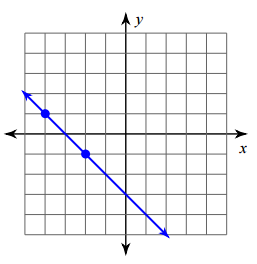
Find the slope of the line.
a)
-2
b)
2
c)
-1
d)
1
6.
Find the slope of the line.
a)
Undefined
b)
0
c)
1/1
d)
-1/1
7.
Find the distance between the points (4, 3) and (0, 6).
a)
3
b)
4
c)
5
d)
7
8.
A plane is named by...
a)
Any 1 point on the plane.
b)
Any 3 collinear points on the plane or a lowercase script letter.
c)
Any 3 non-collinear points on the plane or an uppercase script letter.
d)
All points on the plane that aren't part of a line.
9.
An example of 2 non-collinear points.
a)
D, E
b)
C, B
c)
M, E
d)
F, B
10.
Two lines intersect at a ....
a)
angle
b)
point
c)
line
d)
intersection
11.
A plane containing point A.
a)
Plane DEA
b)
Plane k
c)
Plane CDF
d)
Plane F
12.
Name the Image. 
a)
Ray
b)
Point
c)
Line
d)
Line segment
13.
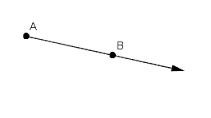
What is the name of this ray?
a)
Ray AB
b)
Ray BA
c)
Ray ABC
d)
Ray AC
14.

What geometric term could be represented a floor?

a)

point

b)

line

c)

plane

d)

arc

15.
What are the arrows pointing to?
a)
Ray
b)
Endpoints
c)
Midpoint
d)
Vertex
16.
What is this Symbol called?
a)
Congruent
b)
Equal
c)
Parallel Lines
d)
Angle
17.

Write the statement below as a conditional statement.


Vertical Angles are congruent

a)

Two angles are vertical if and only if they are congruent.

b)

If two angles are congruent, then they are Vertical.

c)

If two angles are Vertical, then they are congruent.

18.

Write the converse of the conditional statement below.


If two angles are vertical, then they are congruent.

a)

Two angles are vertical if and only if they are congruent.

b)

If two angles are congruent, then they are Vertical.

c)

If two angles are Vertical, then they are congruent.

19.

In order for a statement to be biconditional, both the conditional and converse statements need to be ____.

a)

true

b)

false

20.

When writing a biconditional statement, we use the phrase ___ between the hypothesis and conclusion.

a)

if

b)

then

c)

if and only if

d)

always

21.
Given, "If angles are congruent, then the measures of the angles are equal." Identify the inverse.
a)
If the measures of the angles are equal, then the angles are congruent.
b)
"If angles are not congruent, then the measures of the angles are not equal."
c)
If the measures of the angles are not equal, then the angles are not congruent.
d)
If the angles are not congruent, then the measure of the angles are equal.
22.

How are these angles related?

a)

Corresponding angles

b)

Alternate interior angles

c)

Alternate exterior angles

d)

Same side interior angles

23.

How are these angles related?

a)

Corresponding angles

b)

Alternate interior angles

c)

Alternate exterior angles

d)

Same side interior angles

24.

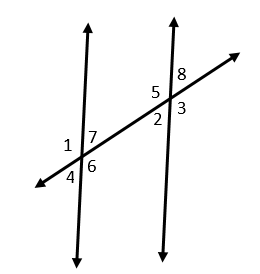
Given the two parallel lines cut by a transversal.

What is the vertical angle to  4\angle4  ?

a)

2\angle2  

b)

6\angle6  

c)

8\angle8  

d)

7\angle7  

25.

Supplementary angles add up to...

a)

45 degrees

b)

90 degrees

c)

180 degrees

d)

360 degrees

26.

Find m6.Find\ m\angle6.  

a)

45

b)

60

c)

90

d)

120

27.

Given m1m\angle1  is 105°, what is the  m4?m\angle4?  


a)

85°85\degree  

b)

105°105\degree  

c)

115°115\degree  

d)

180°180\degree  

28.

Find the m1.Find\ the\ m\angle1.  

(a)  

29.

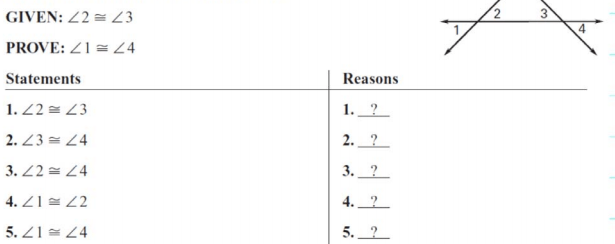
Supply the second reason.

a)

Linear Pair Postulate

b)

Alternate Interior Angles Theorem

c)

Vertical Angles Theorem

d)

Corresponding Angles Postulate

30.

Supply the third reason.

a)

Vertical Angle Theorem

b)

Corresponding Angles Postulate

c)

Alternate Interior Angles Postulate

d)

Same Side Interior Angles Theorem

31.
Which property justifies the next step?
a)
Definition of linear pair
b)
Definition of supplementary angles
c)
Congruent supplements thm
d)
Linear pair postulate
32.
What is the reason?
a)
Transitive 
b)
Substitution
c)
Middle Man
d)
Replacing 
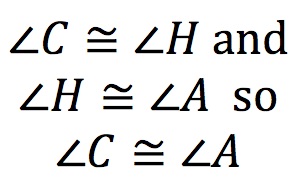
33.

3) What is the reason for statement 2?

a)

Given

b)

Vertical Angle Theorem

c)

Corresponding Angles Postulate

d)

Alternate Interior Angles Theorem

34.

4) What is the reason for Statement 3

a)

Corresponding Angles Postulate

b)

Angles that form a Linear Pair that sums 180°

c)

Same-side Interior Angles Theorem

d)

Vertical Angles Theorem

35.

What special angle pair is shown?

a)

Consecutive Exterior

b)

Vertical

c)

Alternate Interior

d)

Alternate Exterior

36.

What is the equation used to solve for the variable?

a)

5x + 3 = 9x -33

b)

5x + 9x = 180

c)

5x + 3 + 9x - 33 = 180

d)

180 = 9x - 33

37.

What is the equation used to solve for the variable?

a)

6x + 11x = -47 - 2

b)

17x - 49 = 180

c)

11x - 47 - 6x - 2 = 180

d)

11x - 47 = 6x - 2

38.

Solve for the variable x.

a)

44

b)

11

c)

4

d)

176

39.
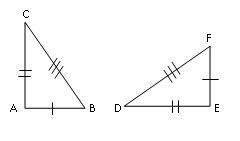
Name the postulate, if possible, that makes the triangles congruent.
a)
SSS
b)
SAS
c)
ASA
d)
Not Possible
40.
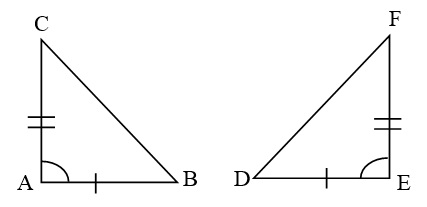
Name the postulate, if possible, that makes the triangles congruent.
a)
SSS
b)
SAS
c)
ASA
d)
AAS
41.
Name the postulate, if possible, that makes the triangles congruent.
a)
SAS
b)
ASA
c)
AAS
d)
Not Possible
42.
Name the postulate, if possible, that makes the triangles congruent.
a)
SAS
b)
ASA
c)
AAS
d)
Not Possible
43.
Name the postulate, if possible, that makes the triangles congruent.
a)
SSS
b)
SAS
c)
ASA
d)
AAS
44.
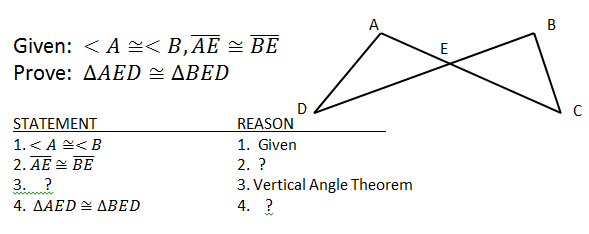
Fill in the missing pieces of the proof.
a)
Transitive Property, SAS(Side-Angle-Side)
b)
Reflexive Property, SAS(Side-Angle-Side)
c)
Reflexive Property, Vertical Angles Thm.
d)
Transitive Property, SSS(Side-Side-Side)
45.

Which of the following is true by reflexive property?

a)
b)
c)
d)
46.
What is the "reason" for step 5 of the proof?
a)
Angle Bisector Theorem
b)
Reflexive property
c)
CPCTC Theorem
d)
Proof
47.
Determine if the triangles are congruent, if "yes" state the theorem.
a)
yes, SAS
b)
not congruent
c)
yes, ASA
d)
yes, AAS
48.
What is the "statement" for step 3 of the proof? 
a)
∡EDA≅∡DCB
b)
∡AED≅∡BEC
c)
DE=CE
d)
∡AED≅∡CED
49.
If DA bisects IE, then
a)
ID=ED
b)
IA=EA
c)
<IDA=<EDA
d)
<IAD and <EAD are right angles
50.
What is the justification?
a)
Symmetric Prop.
b)
Angle addition postulate
c)
Reflexive Prop
d)
Transitive Prop.
51.
Which is the correct reason for statement 1 in the proof?
a)
Definition of Congruent Angles
b)
Substitution
c)
Transitive Property
d)
Given
52.
If M is the midpoint of AB, then AM = MB
a)
Addition POE
b)
Def. of Midpoint 
c)
Reflexive POE
d)
Symmetric
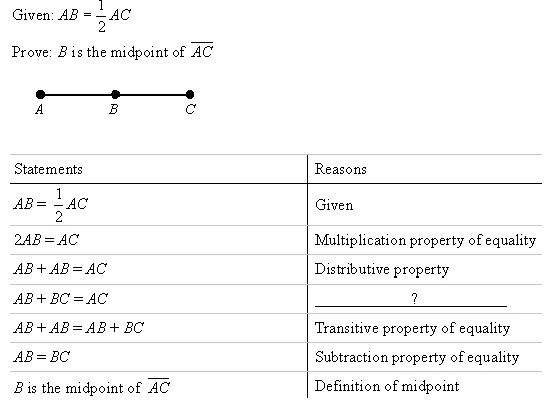
53.
What is the missing statement in the proof?
a)
Addition p.o.e
b)
Segment Addition Postulate
c)
Substitution p.o.e
d)
Transitive p.o.e
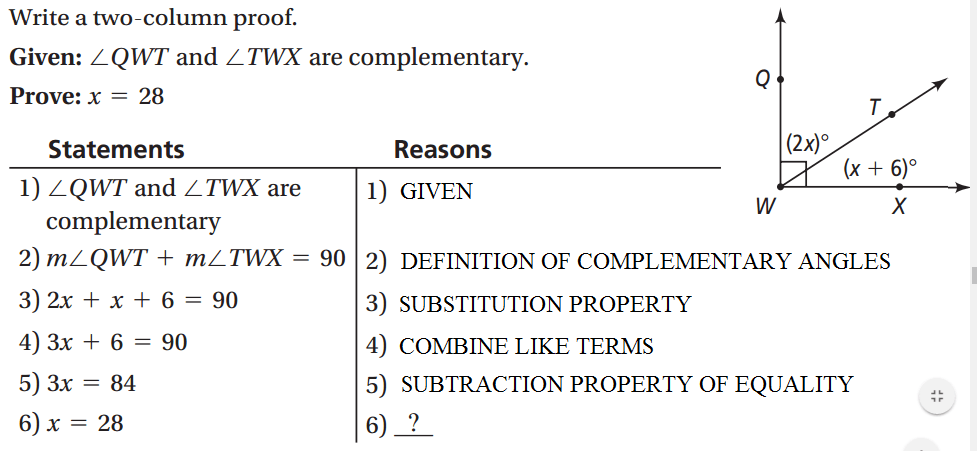
54.

What is the REASON for Statement #6?

a)

Addition Property of Equality

b)

Subtraction Property of Equality

c)

Multiplication Property of Equality

d)

Division Property of Equality

55.
If Z is the centroid, what type of segments are drawn?
a)
angle bisectors
b)
perpendicular bisectors
c)
altitudes
d)
medians
56.
Based on the markings, segment DE represents the...
a)
perpendicular bisector
b)
altitude 
c)
angle bisector
d)
meidan
57.
Given:  m<PXR=2a+10, If segment PX is the altitude find the value of "a".
a)
50
b)
17
c)
40
d)
35
58.
The figure is an example of a(n) ...
a)
angle bisector
b)
perpendicular bisector
c)
median
d)
midsegment
59.
Given 
∠BAN ≅ ∠NAC
BR = RC.
Segment AR is a(n)....
a)
Perpendicular Bisector
b)
Altitude
c)
Angle Bisector
d)
Median
60.
Define: INCENTER OF A TRIANGLE
a)
the intersection point of the three angle bisectors of a triangle 
b)
when three or more lines intersect at a single point 
c)
the intersection point of the three perpendicular bisectors of a triangle 
d)
the point of intersection of three or more lines 
61.
Which point is equidistant from the vertices?
a)
Circumcenter
b)
Incenter
c)
Neither
d)
Bilateral
62.
Which point is equidistant from the sides?
a)
Circumcenter
b)
Incenter
c)
Neither
d)
Bilateral
63.
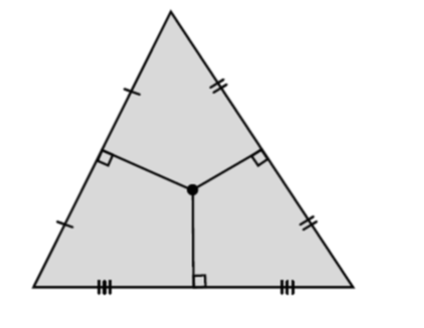
Name the point of concurrency shown.
a)
Circumcenter
b)
Incenter
c)
Supercenter
d)
Neither
64.
Given:  AG = 10, find the length of BG.
a)
10
b)
20
c)
5
d)
30
65.
Find the length of TU
a)
15
b)
12
c)
26
d)
13
66.
HK and JK are angle bisectors of the triangle. Find the distance from K to side GJ.
a)
50
b)
16
c)
21
d)
not enough information
67.
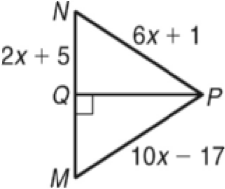
1.  PQ  is the perpendicular bisector of MN. What is QN?
a)
7
b)
14
c)
10.5
d)
28
68.
1.  Point Z is the circumcenter of ΔRST. What is TZ?
a)
3
b)
5
c)
4
d)
6
69.
Do the following side lengths form a triangle?
2 inches, 2 inches, 4 inches
a)
Yes
b)
No
70.
Can the following side measures form a triangle?
  4 cm, 7 cm, 10 cm 
a)
Yes
b)
No
71.
9. Which of these lengths CANNOT represent the sides of a triangle?
a)
32, 34, 60
b)
28, 30, 58
c)
13, 20, 27
d)
2, 4, 5
72.
In triangle ABC, the length of side AB is 10 inches and the length of side BC is 17 inches.  Which of the following could be the length of side AC?
a)
16 inches
b)
5 inches
c)
32 inches
d)
29 inches
73.
List the side measures in order, shortest to longest.
a)
QM, QP, MP
b)
MQ, MP, QP
c)
MP, MQ, QP
74.
Identify the smallest angle.
a)
∠A
b)
∠B
c)
∠C
75.

Describe the transformation: (x, y) --> (x + 2, y - 3) 

a)

Translation:

slide 2 up, 3 left

b)

Reflection:

slide 2 right, 3 up

c)

Translation: slide 2 right, 3 down

d)

Reflection:

slide 3 left, 2 down

76.

The transformation that moves a shape like a slide is called a ______________.

a)

translation

b)

reflection

c)

rotation

d)

transformation

77.

What is the arrow notation for shape that is translated 6 units right and 5 units up?

a)
(x, y) --> (x - 6, y + 5)
b)
(x, y) --> (x + 6, y + 5)
c)
(x, y) --> (x + 5, y - 6)
d)

(x, y) --> (x + 5, y + 6)

78.

The solid-lined shape is the pre-image and the dashed-lined shape is the image.  What is the arrow notation for this translation?

a)
(x, y) --> (x - 7, y + 4)
b)
(x, y) --> (x + 7, y - 4)
c)
(x, y) --> (x + 4, y - 7)
d)

(x, y) --> (x - 4, y + 7)

79.

Reflect the point T(2, - 4) over the y-axis.

a)

T' (-4, 2)

b)

T' (-2, 4)

c)

T' (-2, -4)

d)

T' (2, 4)

80.

Reflect G (6, -3) over the line x-axis.

a)

G' (6, 3)

b)

G' (-6, -3)

c)

G' (-3, 6)

d)

G' (3, -6)

81.

Reflecting a shape is like ___________ a shape over the line of symmetry.

a)

flipping

b)

turning

c)

sliding

d)

dilating

82.

∆BCD contains the points: B(2, 3), C(2, 1), D(5, 1). If the triangle is reflected across the x-axis, what will B' be?

a)

B' (2, -3)

b)

B' (-2, 3)

c)

B' (-2, -3)

d)

B' (2, 3)

83.
How many degrees was the figure rotated?
a)
90 degrees counterclockwise 
b)
180 degrees
c)
90 degrees clockwise
84.
If you were to rotate ABCD 180°  about the origin, what would the coordinate of A' be?
a)
(-5, 5)
b)
(-3, -5)
c)
(-5, 3)
d)
(-3, 3)
85.
Triangle A is rotated 270° counterclockwise with the origin as the center of rotation to create a new figure. Which rule describes rotating 270° counterclockwise?
a)
(x,y)→(y, -x) 
b)
(x,y)→(x,y)
c)
(x,y)→(-y,x)
d)
(x,y)→(-x,-y)
86.
How many degrees was the figure rotated?
a)
90 degrees counterclockwise 
b)
180 degrees
c)
270 counterclockwise 
d)
90 degrees clockwise
87.

Which is true about the scale factor when a figure is enlarged?

a)

The scale factor is zero.

b)

The scale factor is 1.

c)

The scale factor is larger than 1.

d)

The scale factor is smaller than 1.

88.

Triangle PQR is similar to triangle DEF shown. Which describes the relationship between the corresponding sides of the two triangles?

a)
b)
c)
d)
89.

Which of the following is the algebraic representation for a dilation?

a)

(x, y) → (x, 3y)

b)

(x, y) → (3x, 3y)

c)

(x, y) → (x, y - 3)

d)

(x, y) → (.5x, .4y)

90.

If a dilation has the rule
(x,y)(2.5x,2.5y)(x,y)→(2.5x,2.5y)  what is the scale factor?


(a)  

91.

If the triangle ABC is dilated using a scale factor of k=2, what will be the coordinates of A' after the transformation?(Click the picture to zoom in on it)

a)

A'(1.5, -1.5)

b)

A' (-6, 6)

92.
Which of the following alphabet has vertical line of symmetry?
a)
B
b)
E
c)
V
d)
S
93.
Say 'TRUE' or 'FALSE'
Reflection changes the length of line segment
a)
TRUE
b)
FALSE
94.

Symmetrical?

a)

Is symmetrical

b)

not symmetrical

95.
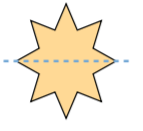
How many lines of symmetry does this shape have?
a)
1
b)
2
c)
4
d)
6
96.

How can we determine if a figure has point symmetry?

a)

If it appears unchanged when turned upside down (rotated 180 degrees).

b)

If a reflected image appears created by a line that intersects the middle of the figure.

97.
Determine the slope and y-intercept from the following equation:   2y = 3x + 6
a)
m: 2/3   b:  (0,3) 
b)
m: 3/2   b:  (0,3) 
c)
m:  4  b:  (0,3/2)
d)
m: 1/5   b:  (0,5) 
98.
Slopes of perpendicular lines are...
a)
opposite reciprocals.
b)
opposites.
c)
identical.
d)
always 7.
99.
What is the equation of a line that is perpendicular to the line
y = 3x - 6 and passes through the point (15,5).
a)
y = -3x + 10
b)
y= 1/3x +10
c)
y = -1/3x +10
d)
y = 3x -15
100.
y = -2/3x + 2
y = 3/2x + 9
These lines are...
a)
Parallel
b)
Perpendicular
c)
Neither