
 Worksheets
Cellular Respiration and Photosynthesis
Total questions: 29
Worksheet time: 15mins
Which of the following is the correct equation for aerobic cellular respiration?
6CO2 + 6H2O ⟶ C6H12O6 + 6O2 + ATP
6O2 + C6H12O6 ⟶ 6H2O + 6CO2 + ATP
C6H12O6 + 6H2O ⟶ 6CO2 + 6O2 + ATP
6O2 + 6H2O ⟶ C6H12O6 + 6CO2 + ATP
The goal of cellular respiration is to:
make water
make ATP
make glucose
make oxygen
What stage of cellular respiration produces the most number of ATP?
Glycolysis
Krebs cycle
Electron transfer chain
anaerobic respiration
What is true of NAD in cellular respiration?
NAD carries the oxygen needed to break down the glucose molecules into the cell.
NAD is used to directly break apart the glucose molecules.
NAD carries and transfers electrons and H+ ions.
NAD carries excess carbon dioxide out of the cell.
Several molecules are produced as a result of glycolysis.
What is the net production of ATP, pyruvate, and NADH when one molecule of glucose undergoes glycolysis?
2 ATP, 2 NADH, and 2 pyruvate
4 ATP, 1 NADH, 2 pyruvate
4 ATP, 2 NADH, and 4 pyruvate
2 ATP, 1 NADH, and 1 pyruvate
In what part of the cell does glycolysis take place?
Cytoplasm
Mitochondria
Chloroplast
Nucleus
Which of the following statements is true regarding glycolysis?
Glycolysis can occur without the presence of oxygen
Glycolysis takes place in the mitochondria of a cell
Glycolysis is the final step in aerobic respiration
Glycolysis produces a net of 1 ATP, 1 NADH, and 2 pyruvate
After glycolysis, pyruvate is oxidized to produce carbon dioxide, NADH, and a molecule that contains 2 of the 3 carbons from the pyruvate.
Which product of pyruvate oxidation enters the Krebs cycle?
Carbon dioxide
Acetyl-CoA
NADH
Glucose
In what part of the cell does the Krebs cycle take place?
Cytosol
Matrix of the mitochondria
Cristae of mitochondria
Outer membrane of mitochondria
Which of the following molecules are products of the Krebs cycle?
NAD+ and FAD
NADH and FADH2
NAD+ and FADH2
NADH and FAD
The electron transport chain (ETC) is one part in oxidative phosphorylation, which is the last step in cellular respiration.
Which of the following is true of the ETC?
The movement of H+ ions across the inner membrane of the mitochondria drives the transfer of electrons down the ETC.
The movement of electrons down the ETC drives the formation of a H+ gradient.
The movement of H+ ions through ATP synthase drives the transfer of electrons down the ETC.
The movement of electrons down the ETC drives the movement of ADP and phosphate through ATP synthase.
In what part of the cell does the electron transport chain take place?
Cytosol
Matrix of the mitochondria
Cristae of mitochondria
Outer membrane of mitochondria
Chemiosmosis is a part of oxidative phosphorylation, the final step in cellular respiration.
Which of the following is true regarding chemiosmosis?
The energy from a proton gradient is used to make ATP
Chemiosmosis regenerates electron carriers like NADH and FADH2
ATP synthesis creates a proton gradient that causes electron flow through an electron transport chain (ETC).
A temperature gradient drives ATP synthesis.
Gwen is investigating how exercise affects the rate at which she can squeeze a ball. After several minutes, she begins to experience muscle soreness and fatigue. She knows that this means her muscles are beginning to run out of oxygen.
Which process is likely causing the soreness in her muscle cells?
Lactic acid fermentation
Photosynthesis
Ethanol fermentation
Krebs cycle
Photosynthesis can be divided into two steps: the light-dependent reactions and the Calvin cycle.
Which of the following correctly describes the overall process of the light-dependent reactions?
During the light-dependent reactions, carbon fixation occurs
The light-dependent reactions occur in the stroma of choloroplasts
Light energy is converted into chemical energy in the form of ATP and NADPH
ATP and NADPH are used to make carbohydrates
Where does photosynthesis take place? (a)
Where in the chloroplast does the light dependent phase occur?
Stroma
Thylakoid membrane
Grana
Cytosol
The light-dependent reactions of photosynthesis take energy from sunlight and convert it into stored chemical energy.
Which compounds are produced in the light-dependent reactions?
ADP and NADPH
ADP and NADP+
ATP and NADPH
ATP and NADP+
What are the products of the light independent phase of photosynthesis? (select all)
Rubisco enzyme
Glucose
Oxygen
Carbon dioxide
Rubisco is:
a pigment which captures light energy
a membrane protein used to transport electrons
an enzyme which catalyzes carbon fixation
a simple glucose monomer produced in the calvin cycle
What is carbon fixation?
The joining of inorganic carbon atoms into an organic molecule
Taking carbon gas and fixing it to a solid
Correcting an error in the carbon atom
Being obsessed with carbon
Which of the following best describes how the light-dependent reactions and Calvin cycle function together?
The Calvin cycle uses ATP and NADPH generated by the light reactions to synthesize carbohydrates.
The Calvin cycle uses ATP and NADPH generated by the light reactions to break down carbohydrates.
The Calvin cycle generates ATP and NADPH to excite electrons during the light reactions.
The Calvin cycle produces ATP and NADPH to drive the formation of an electrochemical gradient during the light reactions.

The flat disk-like structures inside the chloroplast are called (a)

Stacks of thylakoids are called (a)
Which of the following is the correct equation for photosynthesis? (a)
What can the glucose made during photosynthesis be used for?
Cellular respiration
Synthesis of other organic compounds
Osmosis
Stored as starch for later
Photosynthesis
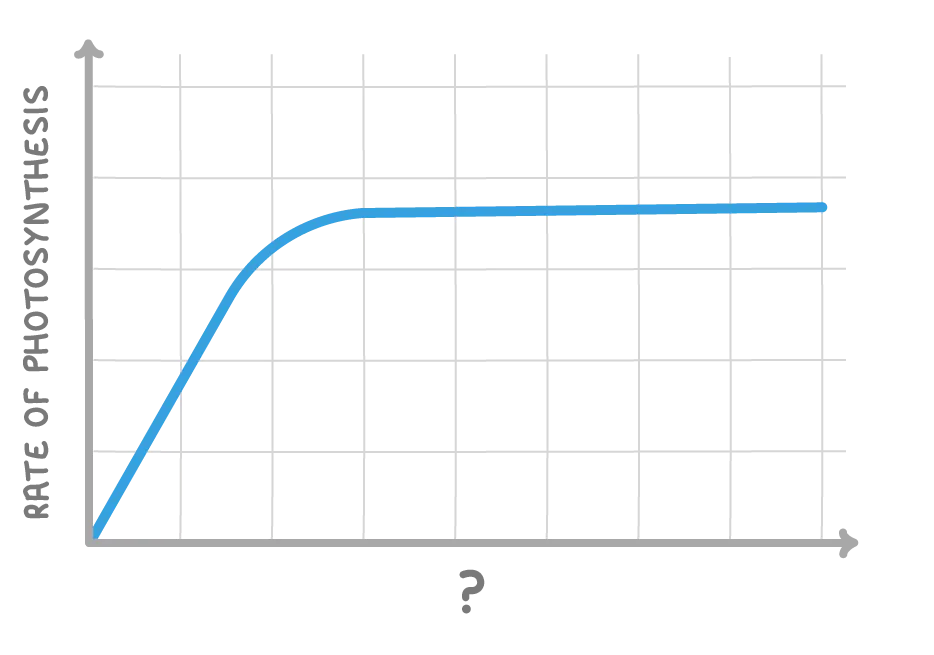
Given the shape of the graph above, which variable(s) could be on the x axis?
(Select all that apply)
Light intensity
Temperature
Carbon dioxide concentration
Oxygen concentration
The Calvin cycle is considered light-independent because it can occur in darkness. However, most often the Calvin cycle takes place in sunlight.
Which of the following likely explains why?
The enzymes involved in the Calvin cycle are unable to bind substrates in the dark.
Sunlight is important in activating carbon fixation in the Calvin cycle.
The Calvin cycle requires ATP and NADPH, which require sunlight to be produced.
RuBP regeneration requires sunlight in order to occur and continue the Calvin cycle.

