
 Worksheets
IM3 Fall 2023 Exam Review (Units 1 & 2)
Total questions: 75
Worksheet time: 6hrs 58mins
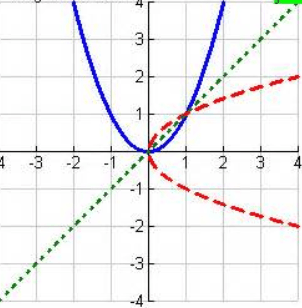
Are the blue and red graphs inverse functions?
Yes, the functions reflect over y = x
No, they do not reflect over the x - axis.
No way to tell from a graph

What is the inverse of the given relation? {(1, 2) (3, 8) (-3, 6)}
(1, 2) (3, 8) (-3, 6)
(1, 2) (8, 3) (-3, 6)
(-1, -2) (-3, -8) (3, -6)
(2, 1) (8, 3) (6, -3)

Which is the inverse of the table?


f(x) = 3x − 5

What is the inverse of the function 3x+3
9x
3x−3
x+1
3x+3
Find the inverse for f(x)=x2−1
−x+1
2x+1
x+1
x+1
Find the inverse of f(x)=x+8
f−1(x)=x2+8
f−1(x)=x2−8
f−1(x)=(x+8)2
f−1(x)=(x−8)2
Which is the inverse of the table?

Which graph is the inverse of the graph shown?


(1,3)(2,4)(6,8)
f(x) = 1/4x - 7


Is this function invertible? In other words will its inverse also be a function?
No
Yes
No way to tell

Is this function invertible? In other words will its inverse also be a function?
Yes
No
No way to tell
Match the following functions to their inverses
f(x)=2x−7
f−1(x)=2x+7
f(x)=7x+2
f−1(x)=7x−2
f(x)=x−7+2
f−1(x)=(x−2)2+7
f(x)=(x+2)2−7
f−1(x)=x+7−2


To which intervals could we restrict the domain of f(x) to make it an invertible function? Choose all answers that apply.
-4 ≤ x < 0
0 < x ≤ 4
4 ≤ x < 8
none of the above

To which intervals could we restrict the domain of f(x) to make it an invertible function? Choose all answers that apply.
-1 < x < 1
-2 < x < 0
0 < x < 1
none of the above

To which intervals could we restrict the domain of f(x) to make it an invertible function? Choose all answers that apply.
0 ≤ x ≤ 4
-2 ≤ x ≤ 2
0 ≤ x ≤ 2
none of the above
log381
3 log24
log3(1/9) =
Evaluate the following logarithm:
log55
1
0
-1
1/2
2-4 = 1/16
log232 = 5
5x = 17


Expand
log2 (2y8x3)
2+3log2x−log2y
4+3log2x−log2y
3log2x−log2y
3log2x−3log2y
Condense 15 log5a +3 log5b
15log5ab
log5(a15b3)
log5(b15a3)
45log5(ab)
Condense into a single log:
log315
log34
log3100
log341
Write equation in exponential form.
log3271=−3
−33 = 271
2713=−3
3271=−3
3−3=271


Describe domain of the function shown: y=log2(x+1)
(-∞,∞)
(-1,∞)
(-1,3)
(∞, -1)

Use the graph to help!
Range: y>0
Range: y>1
Range: y>0
Range: y>0


What's the corresponding graph of


What's the corresponding graph of


f(x)=log5(x+4) - 2
Describe the transformation
translation 4 units to the right, 2 units down
translation 4 units to the left, 2 units down
translation 4 units to the up, 2 units right
translation 4 units to the up, 2 units left
Rewrite the following exponent as a logarithm e4=x .
ex=4
lne=4
lnx=4
log4=e
Rewrite the logarithmic equation in exponential form ln3=x .
x=0
e3=x
x=31
ex=3

Solve
-1/3
-3
-1
3
7e(3x-5) = 49
Simplify the following: e5⋅e7
e12
e2
e7
e−2
Condense: 3lnx + 8lny
ln(y8x3)
ln(x3y8)
24ln(xy)
11ln(xy)
Heather invested $8,000 in a 4-year Certificate of Deposit (CD) that pays 4.1% interest compounded annually. What is the value of the CD at the end of the 4 years?
$9,394.92
$9,312.00
$1394.00
$1312.00
Zach's parents put $1,500 in his bank account for college tuition. At an interest rate of 8.25% compounded semi-annually, what will be the balance after 18 years?
$6,273.50
$6,314.08
$6,385.72
$6,427.94
Emily would like to buy some new furniture for her home. She decides to buy the furniture on credit with 9.5% interest compounded quarterly. If she spent $7,400, how much total will she have paid after 8 years?
$15,415.94
$15,683.28
$15,927.56
$16,109.05
What is the FIRST step to solving this equation?
−5⋅104x=60
take the LOG of both sides
add 5 to both sides
divide by -5 on both sides
divide by 4 on both sides
In order to cancel out the 10power in an equation, you would need to take the ___________ of both sides.
LOG
LN
e
divide by 10
In order to cancel out the epower in an equation, you would need to take the ___________ of both sides.
LOG
LN
e
divide by e
What is the FIRST step in solving this equation?
4⋅102x=40,000
divide by 4
divide by 10
subtract 4
take the LN of both sides
10x=39
Solve for x. Round your answer to the nearest tenth, if needed.
10x+6−2=8
Solve for x. Round your answer to the nearest tenth, if needed.
−3×10x−10=−3
Solve for x. Round your answer to the nearest tenth, if needed.
ex=32
Solve for x. Round your answer to the nearest tenth, if needed.
ex+8=28
Solve for x. Round your answer to the nearest tenth, if needed.

