
NEW
Font size
 Worksheets
PES - EMS, Light, Vision
Total questions: 42
Worksheet time: 26mins

Which has the LONGEST wavelength and therefore the lowest frequency/energy? These waves are used in broadcasting, wifi, and texting.
Gamma rays
Visible light
Radio waves
Infrared rays

Which electromagnetic waves are used in devices such as heat lamps and TV remote controls?
Ultraviolet rays
Infrared Rays
Microwaves

How much of the electromagnetic spectrum is made up of visible light?
A small portion of it
Most of it
All of it
None of it

Which section of the electromagnetic spectrum is the ONLY part humans can see?
X-Rays
Gamma Rays
Visible Light
Ultraviolet Rays

Which electromagnetic waves are used by doctors to detect broken bones inside your body?
X-Rays
Gamma Rays
Ultraviolet Rays
Infrared Rays
Which has the SHORTEST wavelength and therefore the highest frequency/most energy? Hint: These waves are also used in cancer treatments.
Gamma Rays
Radio Waves
Ultraviolet Rays
X-rays

What high energy waves are given off by radioactive materials?
Gamma Rays
Microwaves
Ultraviolet Rays
Radio Waves

Which wave has a low frequency, a long wavelength, and low energy?
A
B
Not enough information to determine

Which wave has a high frequency, a short wavelength, and high energy?
A
B
Not enough information to determine


The number of waves that pass a given point every second
Frequency
Wavelength
Energy
Electromagnetic Spectrum
The distance between the crests of two waves
Frequency
Wavelength
Energy
Electromagnetic Spectrum
Broad range of radiation that carries energy as waves
Frequency
Wavelength
Energy
Electromagnetic Spectrum
Which of the following best explains why ultraviolet rays can cause sunburn but visible light from a light bulb does not damage skin?
Ultraviolet rays come before the light rays in the electromagnetic spectrum, which means anything before visible light automatically causes cancer.
Ultraviolet rays have lower frequencies than visible light rays and thus have higher energy than light rays from a light bulb.
Ultraviolet rays have higher frequency than visible light rays and thus have more energy than light rays from a light bulb.
Ultraviolet rays have higher frequencies than visible light rays and thus have less energy than light rays from a light bulb.
On the electromagnetic spectrum, radio waves are found on the end of the spectrum considered to possess a low amount of energy. Which statement most accurately describes the wavelength/frequency relationship present in radio waves?
Radio waves possess both low frequencies and small wavelengths.
Radio waves possess both high frequencies and large wavelengths.
Radio waves possess high frequencies and small wavelengths.
Radio waves possess low frequencies and large wavelengths.

Describe the waves the arrow is pointing at.
long wavelength / low energy
long wavelength / high energy
short wavelength / low energy
short wavelength / high energy

Red
Gamma
Microwave
Visible
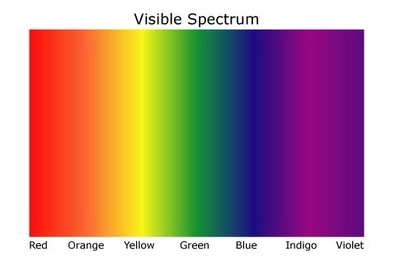
What color of light has the longest wavelength?
red
green
yellow
violet
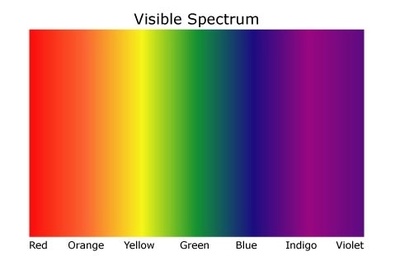
What color of light has the shortest wavelength?
red
indigo
yellow
violet

Why does this apple look red?
The apple reflects red light and absorbs all other colors
The apple absorbs red light and reflects all other colors
The apple reflects all the light shinning on it
The apple is red because we see that color.

If a ray of light has a wavelength of 580 nanometers, what shade of visible light does it produce?
red
orange
green
yellow


A concave lens has an inward curved shape. It refracts light outward from the lens. They light rays spread apart as they exit the lens. Which represents a concave lens?
A
B
A and B
neither A or B

If you were to accidentally scratch the outermost part of your eye, which part would you damage?
The cornea
The lens
The retina
The pupil
What is the retina?
the back part of the eye where the image is formed
the front part of the eye that is clear
the black part that light goes through
the colored part

