
Font size
 Worksheets
Review for semester test 2023 Part 1
Total questions: 86
Worksheet time: 4hrs 0mins
Evelyn, Henry, and Aiden are in a chemistry class. Their teacher asked them to identify a compound from the following options. Which one did they choose?
Co
He
CO
H
Which of the following answer choices is NOT an example of a compound ?
Aluminum oxide (Al2O3)
Oxygen Gas (O2)
Sulfate (SO2)
Silicon dioxide (SiO2)

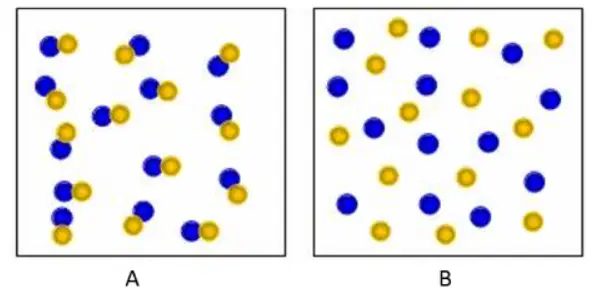
Which diagram represents a pure substance? Choose the BEST answer and reasoning.
Diagram A is a pure substance, because it is a compound and cannot be separated by physical means.
Diagram A is a pure substance, because it is more evenly spread out.
Diagram B is a pure substance, because it is more evenly spread out.
Diagram B is a pure substance, because it is a compound and cannot be separated by physical means.
A physical change (a)
A chemical change (a)
A student mixes yellow powder with water. Which observation would prove a CHEMICAL change occurred?
The powder DISSOLVED in the water
The water turned the COLOR yellow
The bag's TEMPERATURE changed
The STATE OF MATTER changed
Which of the following options provides evidence of a CHEMICAL change?
Wood is burned releasing ash and smoke
Rocks separate when soil is sifted
Boiling water bubbles when heated
Salt dissolves in water

A white tablet is dropped into water. The water becomes cloudy and bubbles are produced. What type of change has occurred?
Physical change
Chemical change
No change

Water is boiling on a stove, producing steam. What conclusion can you make about the change that is occurring?
Boiling water bubbles indicate a chemical change
Steam indicates a state of matter change
Heat indicates a chemical change
The clear color indicates a chemical change
When mixing milk and vinegar, a white, chunky, solid substance is formed. What has occurred?
Physical change: state of matter
Chemical change: precipitate
Physical change: freezing
Chemical change: rust
What is a solute?
A solute is a substance that is not dissolved in a solvent.
A solute is a substance that forms a solid in a solution.
A solute is a substance that evaporates when mixed with a solvent.
A solute is a substance that is dissolved in a solvent to form a solution.
What is a solvent?
A solvent is a substance that dissolves a solute, resulting in a solution.
A solvent is a substance that separates a solute, resulting in a solution.
A solvent is a substance that solidifies a solute, resulting in a solution.
A solvent is a substance that evaporates a solute, resulting in a solution.
How does temperature affect the solubility of a solute in a solvent?
Increasing temperature increases the solubility of a solute in a solvent.
Decreasing temperature increases the solubility of a solute in a solvent.
Increasing temperature decreases the solubility of a solute in a solvent.
Temperature has no effect on the solubility of a solute in a solvent.
What factors can affect the rate of dissolution of a solute in a solvent? (Pick 2)
Color and taste
Temperature and surface area
Smell and viscosity
Agitation and concentration
What is the concentration of a solution?
The concentration of a solution is the amount of solute present in a given amount of solvent or solution.
The concentration of a solution is the amount of solute present in a given amount of solvent only.
The concentration of a solution is the amount of solvent present in a given amount of solute or solution.
The concentration of a solution is the amount of solute present in a given amount of solution only.
Match the following images with the correct factor of chemical reaction.

Temperature

Surface Area

Concentration

Agitation
Label these parts of the hot chocolate process!
Solute
Solvent
Solution
Match the following terms:
Increasing agitation
Mechanically increases number of solute/solvent interactions to increase rate of dissolution
Crushing solute
Increases surface area of solute to interact with solvent to increase the rate of dissolution
Temperature increase
Increases kinetic energy of solute and solvent particles to increase rate of dissolution
Why does the rate of dissolving increase as the temperature increases?
The solute molecules move faster at higher temperatures
The solute particles become smaller at higher temperatures
The solvent molecules become slower at higher temperatures
What is the effect of agitation on the rate of dissolving?
What is the effect of agitation on the rate of dissolving?
It decreases the rate of dissolving
It has no effect on the rate of dissolving
It increases the rate of dissolving
It changes the color of the solute
Why does a solute with a larger surface area dissolve faster?
It has more solute surface area in contact with the solvent
It has fewer solute particles in contact with the solvent
It has a higher temperature compared to other solutes
It has a different color compared to other solutes

What is the difference in dissolving time between a sugar cube and a teaspoon of granular sugar?
The sugar cube dissolves faster
The teaspoon of granular sugar dissolves faster
Both dissolve at the same rate
The dissolving time depends on the temperature of the solvent
Joe set up an experiment to determine if the temperature of the solvent has an affect on the rate of dissolution. Identify the trial that will dissolve the quickest.
John has three cups of sugar particles. Cup 1 has large sugar particles, Cup 2 has medium-sized particles, and Cup 3 has small sugar particles. If John pours each cup in water, which cup of sugar particles will dissolve the fastest?
Cup 1 will dissolve the fastest.
Cup 2 will dissolve the fastest.
Cup 3 will dissolve the fastest.
They will dissolve at the same rate.

What is the speed of the object at 10 km?
1.1 km/hr
15 km/hr
.909 km/hr
12 km/hr

What is the average speed of the object at 20 seconds?
1.2 m/sec
.2 m/sec
5 m/sec
4 m/sec

What is the average speed of this object at 2 hours?
.333 mi/hr
6 mi/hr
3 mi/hr
2 mi/hr

What is the average speed at 6 hours?
9 km/hr
.5 km/hr
3 km/hr
2 km/hr
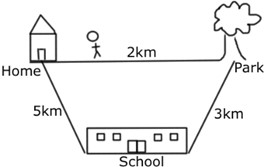
Jerry walked from home to school, then from the school to the park. What is his total displacement?
2 km
5 km
8 km
10 km

The ball below moved from position 1, to position 2, and then finally to position 3. What is the distance travelled by the ball?
3 meters
4 meters
7 meters
10 meters

From the figure, what is the displacement?
20 meters
25 meters
15 meters
25 meters NE

Tommy started at Position A, then traveled home at Position B and finally on to the tree at Position C. What is Tommy's total displacement traveled?
3 m
4 m
5 m
7 m
Which of the following is an example of a balanced force?
An airplane taking off.
Kicking a football.
A car slowing down.
A car waiting at a red light.

Two horses pull in opposite directions, but together move in the direction shown. Which of the following best describes the forces being applied in this situation?
The forces are balanced, and the net force is zero
The forces are unbalanced, and the force of Horse 1 is greater
The forces are unbalanced, and the force of Horse 2 is greater
The forces are balanced, and the force of Horse 1 is greater

A box and forces are shown below. A box rests motionless on the ground. One student is pushing the box to the right with a force of 2 Newtons. The other student is pushing to the left with a force of 5 Newtons. In which direction and with what type of speed will the box move?
It will move left at a constant speed
It will move left at an increasing speed
It will move right at a constant speed
It will move right at an increasing speed

Two students apply force to a box at rest on the floor. What is the total amount of force in Newtons acting on the box and in which direction?
10 N Let
10 N Right
70 N Left
70 N Right

Warm air rises and the cool air sinks demonstrates this type of heat transfer.
Conduction
Convection
Radiation

This is the transfer of thermal energy through "space".
conduction
radiation
convection
spaceship
Thermal energy transfer will stop when ....
the solid turns into a liquid
both objects are the same temperature
a liquid turns into a solid
when the temperatures change places

The transfer of energy through molecules in direct contact is ...
Heat
Conduction
Convection
Radiation
Which sentence explains why a cold metal spoon placed in a pot of boiling water becomes hot?
Thermal energy is transferred from the spoon to the water by conduction
Thermal energy is transferred from the water to the spoon by conduction.
Thermal energy in the water is transformed into kinetic energy in the spoon by convection.
Thermal energy in the spoon is transformed into kinetic energy in the water by convection.

What theory states that the continents were once part of a super continent called Pangaea and have moved slowly to their current locations over hundreds of millions of years.
Oceanic wandering
Land-form Evidence
Continental Drift
Fossil Distribution
What was Wegener’s continental drift idea?
The continents have moved slowly apart to their current locations.
The continents have always been located at their current locations.
The continents are moving slowly together from their current locations.
None of these

What is occurring in this picture?
*(Hint)* This occurs at divergent plate boundaries
Subduction
An Earthquake
A mountain is being formed
Seafloor spreading


What would you most likely find at a convergent boundary between two pieces of continental crust? (C-C Conv)
Volcano
Mountain
Rift
Island Arc
What would you most likely find at a convergent boundary between an oceanic and continental plate? (O-C Conv)
Trenches and Mountains
Trenches and Volcanoes
Trenches and Mid-Ocean Ridges
Mid-Ocean Ridges and Rift Valleys
What would you be most likely find at a divergent boundary between two pieces of oceanic crust? (O-O Div)
Rift Valley
Mid-Ocean Ridge
Island Arc
Deep Ocean Trench
What would you most likely find at a divergent boundary between two pieces of continental crust? (C-C Div)
Mid-Ocean Ridge
Mountain
Rift Valley
Island Arc

The process where heavier oceanic crust slides under another plate and is melted is called ___________.
seafloor spreading
subduction
continental drift
recycling
Which diagram shows a plate boundary that is typical for the formation of volcanoes?


New oceanic crust (sea floor) is created at this boundary.
Oceanic-Oceanic Divergent
Continental- Continental Divergent
Oceanic- Oceanic Convergent
Transform
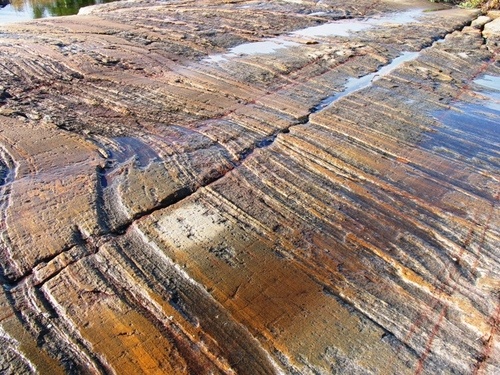
This landform can occur at a divergent plate boundary.
ocean trench
mid-ocean ridge
tall mountains
transform fault

What would be the most likely way this coastline would change over time?
A fire could destroy the vegetation
The waves could erode the beach
The beach would grow due to deposition
The beach will disappear due to plate tectonics
New oceanic crust (sea floor) is created at this boundary.
Divergent Oceanic
Divergent Continental
Convergent Oceanic
Transform


The diagram shows the surface and below-ground features near a home. What occurs when humans pour used engine oil into a pit in the ground for disposal?
A The oil seeps through the soil but stops before it reaches the groundwater.
B The oil-,creates a barrier between the water table and the ground water.
C The oil seeps through the soil until it leaks into the groundwater.
The oil remains sealed in the small pit and does not affect the groundwater
The use of pesticides and fertilizers is carefully monitored because of the effect they can have on the environment. Which of the following is a possible negative effect of the use of these chemical on the environment?
A These chemicals are expensive to produce.
B Storage space for these chemicals is limited
C Runoff carries these chemicals into lakes and streams.
D These chemicals cannot be purchased in large bulk.

The map shows the main streams and rivers near City A and City B, as well as the nearby factories and farmland. The arrows in the diagram show the direction of water flow. City A gets its water from the Sunset River and City B gets its water from the Moth Lake. Also shown are locations X, Y, and Z, where river-water samples are collected. You live in City B and your water source is the nearby lake. Which of the following would have the LEAST impact on the quality of your water source?
A use of motorboats on the lake
B poor sewage treatment by City A
C dumping of industrial wastes into the river at Factory 3
D dumping of industrial wastes into the river at Factory 1
When fertilizers enter surface water, they cause problems in the watershed by -
A clogging narrow streams and preventing water from flowing properly.
B increasing the amount of nutrients available to fish in lakes and streams.
C causing rapid algal growth that decrease oxygen levels and choke aquatic life.
D raising the water level in nearby rivers to levels leading to flooding.
An area experiences a long period of drought forcing towns to pump out almost all of the water held in aquifers. What is the most likely result of this over pumping?
A Stability of underground rock layers will be weakened.
B Rainfall levels will increase and fill the aquifer
C Excessive growth of plants will occur in local lakes.
D A dead zone will be created in the watershed.

A student builds a model to show how pollutants move through an ecosystem. In plastic tub, the student places a layer of small marbles, covers it with a thick cloth, and then adds a layer of sand. The student then sprinkles red powdered paint on top of the soil. When the student sprays water onto the model, red color appears in the cloth and in the water in the layer of marbles. Which part of the model represents pollutants introduced by humans?
A The marbles
B The thick cloth
C Red powdered paint
D Layer of sand
Rapid growth of algae in a pond is often the result of -
A loss of habitat due to commercial building.
B excess nutrients from fertilizer runoff.
C flooding that causes water levels to rise.
D clogged river tributaries entering a lake.

The picture shows how a buried storage tank could leak gasoline into the environment. The most serious result of this accident is most likely the contamination of the —
A atmosphere
B soil
C groundwater
D bedrock

The investigation shown in the picture models what happens when rain falls on bare soil and on soil covered with vegetation, as is found in the ' Texas Piney Woods.
What conclusion could you draw form this investigation?
A. Very little erosion occurs on bare soil.
B. Large amounts of water are absorbed into bare soil.
C. Very little erosion occurs on soil covered with vegetation.
D. Very little water is absorbed into soil covered with vegetation
A hurricane hits a coastal prairie and destroys the habitat. Years later there is an appearance of small plants with rapidly spreading roots on newly formed coastal sand dunes. This vegetation describes—
a microhabitat
primary succession
secondary succession
biodiversity

The diagrams show an ecosystem during different stages of ecological succession. In which order will these stages occur, from earliest to latest?
A B C D
4, 2, 1, 3
1, 2, 3, 4
3, 1, 4, 2
2, 4, 3, 1

Which ecological process is illustrated in this sequence of pictures?
biological evolution
ecological succession
biodiversity
precipitation
. Which of the following is an example of primary succession?
A.lichens growing on rocks following a volcanic eruption
B.grasses growing after a forest fire
C.oak trees replacing pine trees in a forest
D. non-native species introduced into a climax community
A coastal area that once supported a thriving fishing industry is overfished. The number of species found living in the marine ecosystem decreases. Which of these activities is most likely to INCREASE the natural biodiversity in the area?
building artificial reefs and limiting fishing activity
introducing non-active species to fill unoccupied habitats and banning fishing
building artificial reefs and increasing fishing activity
eliminating non-active species and encouraging fishing for large predatory fish
Phytoplankton are microscopic floating plants that live on the surface of our oceans. Which of these human activities is most likely to cause the excessive growth of phytoplankton in the world’s oceans?
The use of chemical fertilizers (which promote plant growth) that are carried by runoff into rivers
The logging of old-growth forests, which results in erosion
The spraying of chemical herbicides that reduce carbon dioxide in the air
The mining of fossil fuels, which requires digging underground tunnels
Some areas of an ocean are known as dead zones. These zones form when excess organic material decomposes. This increased decomposition uses up the oxygen from the water. Which human activity IS MOST AFFECTED by the increasing number of dead zones in the ocean?
Offshore oil drilling, because water in dead zones is toxic
Commercial fishing, because fish cannot survive without oxygen
Commercial shipping, because dead zones change the course of ocean currents
Sand mining, because oxygen is not available to form the sands on ocean beaches

What happens when a fertilizer runoff happens?
Fish get bigger.
The water becomes very clear.
Farmers clean the water
Algae grow rapidly

F
G
H
J

F
G
H
J

