wayground logo

Free Printable Worksheets

Font size

S
M
L
XL
Worksheets

Space Test Review

Total questions: 61

Worksheet time: 40mins

Name
Class
Date
1.
The definition of eclipse is:
a)
The planets line up
b)
The Sun, Earth and Mars line up
c)
The Sun, Earth and Moon line up
d)
The Earth, Moon and Venus line up 
2.

We do NOT have a lunar eclipse each month because...

a)

The tilt of the moon's orbit is at 5 degrees

b)

The moon is too small

c)

The moon's orbital distance changes

d)

All choices

3.
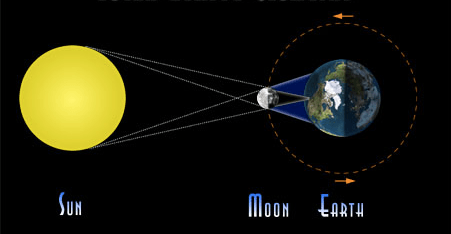
Which type of eclipse is shown in this picture?
a)
Solar Eclipse
b)
Orbit
c)
Lunar Eclipse
d)
Total Eclipse
4.
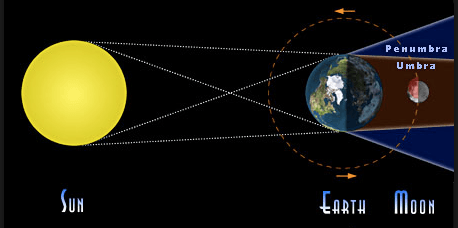
Which type of eclipse is shown in the diagram?
a)
Solar Eclipse
b)
Lunar Eclipse
c)
Total Eclipse
d)
Partial Eclipse
5.
Tides are the cycle of rising and falling ocean water that repeats automatically every
a)
24 hours
b)
12.5 hours
c)
25 hours
d)
6.25 hours
6.
Differences in the moon's and sun's pull on different sides of the Earth cause _________.
a)
gravity
b)
lunar phases
c)
tides
d)
dabbing
7.

Which body has the greater effect on Earth's tides?

a)

Sun

b)

Saturn

c)

Moon

d)

Venus

8.

What is a difference between spring and neap tides?

a)

Spring tides occur when the earth and sun are IN LINE with the new or full moon.

b)

Spring tides occur when moon in 3rd or 1st quarter phases

c)

Spring tides are LOWER than neap tides

d)

Spring tides occur in Spring and neap tides can occur in any season

9.
What type of tides would this arrangement of earth-moon-sun create?
a)
neap tide
b)
spring tide
c)
new moon tide
d)
full moon tide
10.

The diagram below shows the alignment of the sun, the moon, and Earth. In which locations are neap tides taking place?

a)

1 and 2

b)

1 and 3

c)

2 and 4

d)

3 and 4

11.

Which statement is true?

a)

The galaxies are moving toward us.

b)

The galaxies are moving away from us.

c)

The universe remains static or unchanged in motion.

d)

None of the above

12.

Which elements are most

abundant in the visible

universe?

a)

Helium and Carbon

b)

Carbon and Oxygen

c)

Hydrogen and Oxygen

d)

Hydrogen and Helium

13.
Galaxies that are redshifted are:
a)
actually blue.
b)
really far away.
c)
invisible.
d)
moving away from us.
14.
The universe is expanding!  This means that:
a)
all of the galaxies are spreading out.
b)
the universe must have started from a single point.
c)
the universe is cooling down.
d)
all of the above.
15.

The Cosmic Background Radiation is:

a)

the remaining energy from the big bang.

b)

incredibly hot.

c)

visible to the human eye.

d)

only located in certain places in the universe.

16.
Light waves that are stretched out by objects moving apart:
a)
have a shorter wavelength.
b)
travel faster than the speed of light.
c)
are invisible.
d)
appear more red.
17.
The universe is ____________ years old.
a)
8.13 billion
b)

13.8 billion

c)
1.83 billion
d)
381 million
18.
If a star is being observed from Earth and it's light has shifted towards the blue side of the electromagnetic spectrum it would be...
a)
Moving towards the Earth
b)
Moving away from the Earth
c)
This is a trick question that cannot be answered
d)
It isn't a star, it is a very large blueberry.
19.

Most scientists believe the Big Bang Theory explains which of the following questions?

a)

How our planets and moons formed

b)

How our universe began

c)

How the sun turns hydrogen into helium

d)

How fast light travels through space

20.

An infinitely small, infinitely dense, and infinitely hot point that is believed to have existed before the big bang.

a)

Singularity

b)

Antimatter

c)

Little bang

d)

condensation nuclei

21.

A light wave with a higher frequency is going to...

a)

have a lower wavelength

b)

appear red

c)

have a higher wavelength

d)

Move much slower

22.

What is the center of our Solar System?

a)

Earth

b)

the moon

c)

the sun

23.

How many planets are in our Solar System?

a)

7

b)

8

c)

9

24.

The inner planets (Mercury, Venus, Earth, and Mars) are made of--

a)

rocks

b)

gas

c)

helium

25.

The outer planets (Jupiter, Saturn, Uranus, Neptune) are made of --

a)

gas

b)

rocks

c)

water

26.
The fourth planet is
a)
Venus
b)
Earth
c)
Mars
d)
Jupiter
27.
Neptune comes after
a)
Jupiter
b)
Saturn
c)
Uranus
d)
Neptune
28.
The planet that has the most rings
a)
Jupiter
b)
Neptune
c)
Uranus
d)
Saturn
29.

T/F: the sun is the biggest star in our galaxy

a)

True, that is why we have the only solar system

b)

False, there are much bigger stars than our sun

30.

Where does the moon get its light from?

a)

The moon makes its own light

b)

The moon gets light from Earth

c)

The Moon gets light from the sun

d)

None of the above

31.
From a New moon to Full moon, what happens to the amount of light we see?
a)
It increases
b)
It decreases
c)
Nothing changes
32.
When the amount of light we see from the moon appears to be shrinking, it is 
a)
Waxing
b)
Waning
c)
Gibbous
d)
Crescent
33.
Name the moon phase
a)
waning crescent
b)
waxing crescent
c)
waning gibbous
d)
waxing gibbous
34.
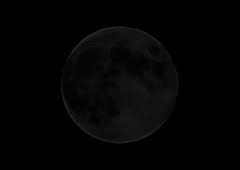
Name the moon phase
a)
First Quarter
b)
Last Quarter
c)
New Moon
d)
Full Moon
35.
When the moon is in between the earth and the sun it is a
a)
New Moon
b)
Full Moon
c)
First Quarter
d)
Third Quarter
36.
Waxing means...
a)
Growing
b)
Dying
c)
Losing light
d)
Moving
37.
Name the phase of the moon for letter a
a)
First Quarter
b)
Last Quarter
c)
Waxing Gibbous
d)
Waning Gibbous
38.
How much time passes between a New and Full moon?
a)
3-4 Days
b)
7 Days
c)
14 Days
d)
29 Days
39.

Ganymede is the largest ___ in the solar system and orbits Jupiter.

a)

moon

b)

planet

c)

dwarf planet

d)

asteroid

40.

Click all that is true about Jupiter.

a)

has 79 moons

b)

largest planet in our solar system

c)

atmosphere is made mostly of nitrogen

d)

named after Roman sky god

41.

Which planet has the most moons in our solar system?

a)

Mercury

b)

Jupiter

c)

Earth

d)

Saturn

42.

Which of the following are galaxy types?

a)

Spiral

b)

Elliptical

c)

Spherical

d)

Irregular

43.

Stars are born in clouds of stellar dust called _______________.

a)

nebulas

b)

galaxies

c)

planets

d)

supernovas

44.

What is the most abundant element found in nebulas?

a)

Helium

b)

Carbon

c)

Oxygen

d)

Hydrogen

45.

What is the first stage of every star?

a)

protostar

b)

main sequence

c)

blue giant

d)

white dwarf

46.
Place these objects in order from smallest to largest.
a)
Planets, solar system, universe, galaxy
b)
Solar system, planets, galaxy, universe
c)
Planets, solar system, galaxy, universe
d)
Galaxy, solar system, planets, universe
47.
What type of galaxy is this?
a)
Spiral
b)
Elliptical
c)
Irregular 
d)
Irrational
48.
What type of galaxy is this?
a)
Spiral
b)
Elliptical
c)
Irregular
d)
Irrational
49.
The Nebular Theory is:
a)
A theory on how the Milky Way galaxy was formed
b)
A theory on how the universe was formed
c)
A theory on how the solar system will be destroyed
d)
A theory on how the solar system was formed
50.
A nebula is:
a)
A cloud of ice
b)
A cloud of dust and gas
c)
A cloud of just gas
d)
A cloud of just dust
51.
The most abundant gases in a nebula are:
a)
Hydrogen & Oxygen
b)
Nitrogen & Oxygen
c)
Hydrogen & Helium
d)
Oxygen & Helium
52.
A nebula starts to collapse because of:
a)
A nearby star shining it's light
b)
A passing spaceship
c)
A passing comet
d)
Gravity
53.
As a nebula collapses it also begins:
a)
Expand
b)
Rotate
c)
Shake
d)
Turn to ice
54.
A nebula collapses down into a disk known called:
a)
A compact disk
b)
An irregular cloud
c)
An accretion disk
d)
An circular disk
55.
What forms in the very center of the accretion disk?
a)

A protostar

b)
A planet
c)
A protoplanet
d)
A planetesimal
56.
What is forming in the accretion disk away from the center?
a)
Light
b)
Protostars
c)
Planetesimals
d)
Hydrogen
57.
The planetesimals keep:
a)
Colliding and breaking apart
b)
Colliding and sticking together
c)
Colliding and bouncing around
d)
Breaking down into smaller pieces
58.
What caused the lighter elements to leave the terrestrial planets?
a)
Gravity from the Gas Giants
b)
Nothing, the lighter elements stayed
c)
Gravity from the Sun
d)
Heat from the Sun
59.

How long ago did these nebular processes start?

a)

4.6 years ago

b)

4.6 million years ago

c)

5.6 billion years ago

d)

4.6 billion years ago

60.
Intense pressure in the protosun (protostar) caused:
a)
Fire in the Sun to start
b)
Helium to break down into Hydrogen
c)
Nuclear Fusion to start
d)
Nuclear Fusion to end
61.
What two objects do scientists study to learn about the formation of the solar system?
a)
Comets & Asteroids
b)
Comets & Exoplanets
c)
Exoplanets & Asteroids
d)
Asteroids & Distant Stars