wayground logo

Free Printable Worksheets

Font size

S
M
L
XL
Worksheets

Study Guide: 1st 9 weeks 8th grae

Total questions: 220

Worksheet time: 7hrs 54mins
Name
Class
Date
1.
At higher temperatures
a)
particles in an object have less energy
b)
particles in an object move faster
c)
a gas contracts
2.
A gas
a)
has a definite shape but no definite volume
b)
has a definite volume but no definite shape
c)
has fast-moving particles
3.
Freezing
a)
Solid to gas
b)
Liquid to solid
c)
Gas to solid
d)
Liquid to gas
4.
Boiling
a)
liquid to gas
b)
gas to solid
c)
gas to liquid
d)
solid to liquid
5.
Which state of matter has tightly packed molecules?
a)
solid
b)
liquid
c)
gas
6.
Which state of matter has a definite shape?
a)
solid
b)
liquid
c)
gas
7.
What is happening when my ice cream changes from a solid to a liquid?
a)
freezing
b)
melting
c)
burning
d)
evaporation
8.
Define a liquid.
a)
Indefinite shape, indefinite volume
b)
Definite shape, definite volume
c)
Found in stars
d)
Definite volume, indefinite shape
9.
The state of matter that has no definite size or shape is
a)
Solid
b)
Liquid
c)
Gas
10.
Particles (molecules) in a ______________________ have more energy than the other states of matter.
a)
gas
b)
solid
c)
liquid
11.
Particles of a liquid
a)
are tightly packed together and stay in a fixed position.
b)
have no viscosity.
c)
decrease in volume with increasing temperature.
d)
are free to move around one another but still touch.
12.
What term describes a solid changing to a gas?
a)
Deposition
b)
Sublimation
c)
Evaporation
d)
Freezing
13.
Particles (molecules) in a ______________________ have more energy than the other states of matter.
a)
gas
b)
solid
c)
liquid
14.
What is condensation?
a)
gas to solid
b)
gas to liquid
c)
liquid to solid 
d)
solid to liquid 
15.
The speed of the molecules determines the _____.
a)
volume
b)
density
c)
pressure
d)
temperature
16.
Which has a greater distance between particles?
a)
Solid
b)
Liquid
17.
The slower the particles in a substance move,
a)
the colder it is.
b)
the warmer it is.
c)
the more energy it has.
d)
the less energy it has.
18.
Thermal energy is...
a)
heat energy.
b)
the energy of motion
c)
energy of nuclear processes.
d)
an indication of physical change.
19.
A chemical change
a)
doesn't really change much.
b)
creates a new substance
c)
is a change in the state of matter
20.
A physical change is...
a)
a change that doesn't change the identity
b)
a change that makes something new.
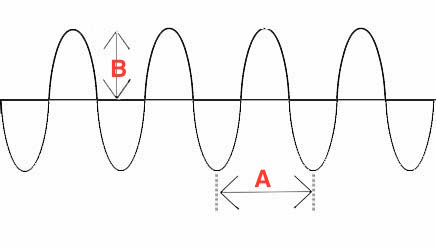
c)
a chemical reaction
21.

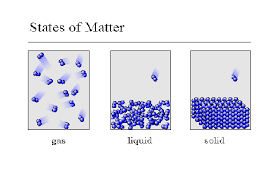
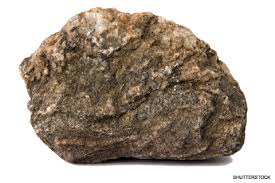
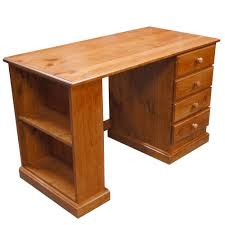
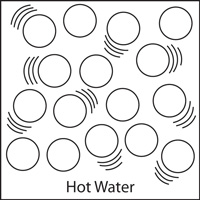
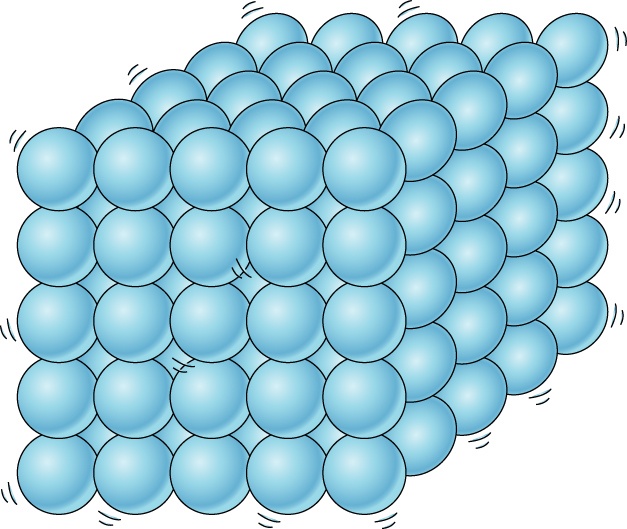
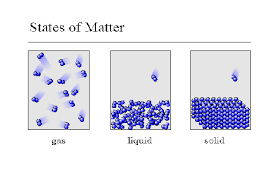
What state of matter?

a)

Solid

b)

Liquid

c)

Gas

d)

Plasma!!!

22.

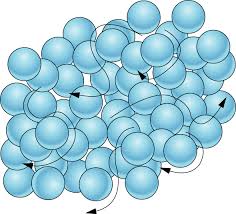
What state of matter?

a)

Solid

b)

Liquid

c)

Gas

23.

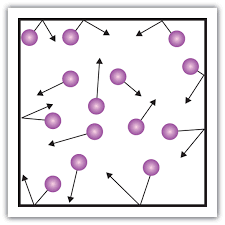
What state of matter?

a)

Solid

b)

Liquid

c)

Gas

24.
a)
Gases do not move in straight line
b)
Most of the volume of gas is empty space
c)
Gas particles are not in constant random motion
d)
Gas particles attract each other
25.

Which states of matter are fluid?

a)

gases and liquids

b)

liquids and solids

c)

gases only

d)

liquids only

26.

1. Kinetic refers to _______________

a)

Force

b)

Energy

c)

Motion

d)

Acceleration

27.
Liquid has a definite ___________, but a variable _____________.
a)
shape, volume
b)
mass, area
c)
smell, taste
d)
volume, shape
28.
Which of the following states of matter has the lowest kinetic energy? 
a)
solid
b)
liquid 
c)
gas
29.
To make a solid become a liquid, you must increase its________________.
a)
mass
b)
density
c)
kinetic energy
d)
potential energy
30.
What line segment represents only the solid state?
a)
A-B
b)
B-C
c)
C-D
d)
D-E
31.
Which segment represents the heat of fusion?
a)
A-B
b)
B-C
c)
C-D
d)
D-E
32.
In which segment is the kinetic energy remaining constant?
a)
A-B
b)
B-C
c)
C-D
d)
E-F
33.
Which process takes the longest to occur?
a)
melting
b)
boiling
c)
freezing
d)
heating the solid
34.
What state(s) of matter are present at D-E?
a)
Solid-liquid
b)
Liquid
c)
Liquid-gas
d)
Gas-Solid
35.
Between which points is the temperature of the substance increasing?
a)
A-B only. 
b)
A-B, C-D, E-F
c)
B-C only. 
d)
B-C, D-E
36.
This type of graph is called a:
a)
Phase diagram
b)
Heating curve
c)
State of matter
d)
Temperature chart
37.
If a solid block of wood has a volume of 10 cm3 and a mass of 40 grams, what is its density?
a)
40 grams
b)
4 cm3
c)
4 g/cm3
d)
40 g/cm3
38.
If you have a block of ice that has a mass of 500 grams, how many grams of water will you have when the ice melts?
a)
400 grams
b)
500 grams
c)
200 grams
d)
600 grams
39.
If you completely dissolve a powder into water, this is an example of a ___________change.
a)
chemical
b)
physical
40.
A change in the physical properties of a substance,  which is usually reversible 
a)
Chemical Change
b)
Physical Change
c)
Mass
d)
Conservation of Matter
41.
A chemical reaction involving the rearrangement of the atoms of one or more substances
a)
Physical Change
b)
Chemical Change 
c)
Physical Science
d)
Conservation of Matter
42.
The quantity of matter determined from a substance's weight 
a)
Mass
b)
Density 
c)
Gas
d)
Volume 
43.
A chemical substance composed of tow or more atoms of elements 
a)
Compound 
b)
Solution 
c)
Suspension 
d)
Precipitate 
44.
The parts of a homogeneous mixture are   __________ throughout. 
a)
Same 
b)
Different 
c)
Neutral 
d)
Suspended 
45.
___________ is a combination of substances that can be physically separated. 
a)
Colloid 
b)
Mixture 
c)
Suspension 
d)
Compound 
46.
A mixture in which 2 liquids are mixed so evenly that it is not possible to see the separate particles 
a)
Solute 
b)
Solution
c)
Solvent 
d)
Suspension 
47.
A pure substance can be either an element or a ______________. 
a)
single substance
b)
hot mess 
c)
Complex 
d)
compound 
48.
Gold is an example of a(n)
a)
Element 
b)
Compound 
c)
Nugget 
49.
A heterogeneous mixture
a)
Is not uniform 
b)
Is uniform 
50.
Two substances physically combined and that appears the same throughout is classified as
a)
A homogeneous mixture
b)
A heterogeneous mixture
c)
An element
d)
  A compound
51.
A chemical change always results in the formation of a:
a)
explosion
b)
big mess
c)
new substance
d)
new state of matter
52.
Is salt (NaCI) a compound or a element
a)
Compound
b)
element
53.
Which of the following is not a compound?
a)
HCl
b)
Cl
c)
NaCl
d)
CO2
54.
a)

element

b)

compound

c)

mixture of elements

d)

mixture of compounds

e)

mixture of elements and compounds
55.
a)

element

b)

compound

c)

mixture of elements

d)

mixture of compounds

e)

mixture of elements and compounds
56.
a)

element

b)

compound

c)

mixture of elements

d)

mixture of compounds

e)

mixture of elements and compounds

57.
a)
Longitdinal Wave
b)
Transverse Wave
58.
a)
Longitudinal Wave
b)
Transverse Wave
59.
The material through which a wave travel 
a)
trough
b)
medium
c)
crest
d)
vibration
60.
A disturbance that transfers energy from place to place
a)
Energy
b)
Wave
c)
Force
d)
Motion
61.
The distance from trough to trough or crest to crest
a)
Frequency
b)
Wavelength
c)
Distance
d)
Amplitude
62.
The angle of incidence equals the angle of reflection
a)
Law of Conservation of reflection
b)
Law of Reflection
63.
Energy can neither be created or destroyed
a)
Law of conservation of Mass
b)
Law of conservation of Energy
64.
a)
Refraction
b)
Reflection
65.
The lowest part of the wave is?
a)
trough
b)
crest
c)
point of origin
d)
compression point
66.
The highest point of a wave is?
a)
crest
b)
trough
c)
point of origin
d)
comppression point
67.
Amplitude reflects the amount of ____________________ in a wave.
a)
energy
b)
compression
c)
rarefaction
d)
speed
68.
Which wave has a greater frequency?
a)
A
b)
B
69.
Sound is caused by? 
a)
force
b)
vibrations
c)
instruments
d)
medium
70.
This is what you get when sound waves are reflected, or bounce back, off of a hard surface.
a)
Amplitude
b)
Pitch
c)
Volume
d)
Echo
71.
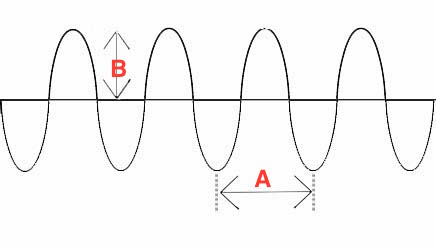
What property of this wave is represented by the letter "A"
a)
amplitude
b)
crest
c)
trough
d)
wavelength
72.
What property of the wave is represented by the letter "B"?
a)
amplitude
b)
crest
c)
trough
d)
wavelength
73.
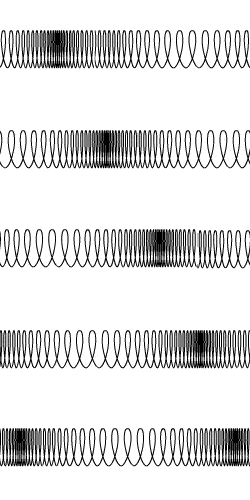
What type of wave is this?
a)
Longitudinal
b)
Transverse
74.

When light waves bounce off a surface we call this:

a)

Reflection

b)

Refraction

c)

Absorption

75.

When light waves bend as they pass through a transparent medium we call this:

a)

Refraction

b)

Reflection

c)

Absorption

76.

When light waves are captured in matter and transferred to a new form of energy we call this:

a)

Absorption

b)

Reflection

c)

Refraction

77.

The colors of the visible light spectrum in order from largest wavelength to smallest wavelength are:

a)

Violet, Indigo, Blue, Green, Yellow, Orange, and Red

b)

Green, Blue, Indigo, Violet, Red, Orange, and Yellow

c)

Red, Orange, Yellow, Green, Blue, Indigo, and Violet

d)

Yellow, Orange, Red, Violet, Indigo, Blue, and Green

78.

Light waves bending through a prism is an example of:

a)

Reflection

b)

Refraction

c)

Absorption

79.

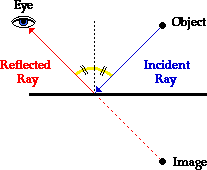
Light waves bouncing off of this mirror is an example of:

a)

Reflection

b)

Refraction

c)

Absorption

80.

A carbon nanotube capturing light is an example of:

a)

Reflection

b)

Refraction

c)

Absorption

81.

What is the angle of reflection equal to?

a)

The angle of refraction

b)

The angle of incidence

c)

The angle of absorption

d)

The angle of light

82.

What is it called when light bends as it moves from one substance to another?

a)

Absorption

b)

Reflection

c)

Refraction

d)

Incidence

83.

What might explain why light travels in a straight line?

a)

If there is nothing to interfere with light waves, they should travel in a straight line.

b)

Light waves will always travel in a straight line, even if they come into contact with another object.

c)

Light waves don't travel in a straight line.

d)

Light waves travel in a straight line because sound waves travel in a straight line.

84.
This is how analog signal looks like.
a)
True
b)
False
85.
Is music playing from a record an analog or digital signal?
a)
Analog
b)
Digital
86.
The string of 1s and 0s that control a computer is called _____ code.
a)
binary
b)
dichotomous
c)
Morse
d)
two-number
87.
Which type(s) of signal(s) can be easily corrected to remove noise?
a)
Analog
b)
Digital
c)
Both
d)
Neither
88.
Analog signals can be converted to digital through a process called _____.
a)
conversion
b)
processing
c)
sampling
d)
translation
89.

_____ signals use 0s and 1s

a)

digital

b)

analog

90.

____ signals are more reliable.

a)

digital

b)

analog

91.

Digital signals are better than analog signals because:

a)

They are more reliable

b)

They take less storage space

c)

They don't degrade over distance

92.

The energy of electrons or electric charges

a)

Chemical

b)

Electric

c)

Mechanical

d)

Kinetic

93.

All of the kinetic energy due to random motion of the particles that make up an object; heat energy

a)

thermal

b)

electric

c)

potential

d)

nuclear

94.

Energy that travels in waves (electric and magnetic properties) - such as sunlight, xrays, and microwaves

a)

Electric

b)

Mechanical

c)

Electromagnetic

d)

Kinetic

95.

Energy that comes from changes in the nucleus of an atom

a)

thermal

b)

mechanical

c)

electric

d)

nuclear

96.

The potential energy of motion PLUS the kinetic energy of motion

a)

kinetic

b)

potential

c)

mechanical

d)

chemical

97.

Stored up energy of motion

a)

kinetic

b)

potential

c)

mechanical

d)

energy

98.

energy of motion

a)

kinetic

b)

potential

c)

mechanical

d)

electromagnetic

99.

What is a quantitative observation that the scientist measured?

a)

The tubes contain Aluminum.

b)

The temperature of one tube is 20 Degrees C.

c)

The mass of one tube is 20 grams.

d)

The tubes are bubbling.

100.

Which is a qualitative observation?

a)

The spider is black

b)

The spider has 8 legs.

c)

The spider is hungry.

d)

The spider is vicious

101.
The part of the experiment that remains the same for the control and experimental group.
a)
constants
b)
control
c)
independent
d)
dependent
102.
Which statement is an inference about this picture?
a)
The van is tan.
b)
The  van ran into KFC. 
c)
The driver was hungry. 
d)
Red and white are part of the KFC building. 
103.
The basic unit of length in the metric system is 
a)
foot
b)
inch
c)
meter
d)
mile
104.
The kilogram is the basic metric unit of
a)
length
b)
weight
c)
mass
d)
volume
105.
The amount of space an object takes up is called
a)
volume
b)
mass
c)
weight
d)
length
106.
Using one or more of your senses to gather information is called
a)
observing
b)
classifying
c)
predicting
d)
inferring
107.
The most important lab safety rule is
a)
Follow teacher's instructions and textbook directions exactly
b)
Always wear a lab apron
c)
Always wear safety goggles
d)
Design & conduct your own experiment without asking your teacher
108.
What is the first thing you should do if a lab accident occurs?
a)
Run out of the room screaming
b)
Tell your teacher
c)
Find the emergency equipment
d)
Go to the nearest hospital
109.
Which of the following happens first?
a)
a.  Make a hypothesis
b)
b.  Ask a question
c)
c.  Share your results
d)
d.  Analyze your data
110.
What is an inference?
a)
What you see, hear, touch, smell, or taste
b)
It's a guess about a situation you can make given your observations.
c)
It's a type of data
d)
None of the above
111.

Make a hypothesis from the following question:

"Does reading a book everyday make you read faster?"

a)

After reading a book everyday, I will be able to read better.

b)

You have to read everyday in order to be a better reader.

c)

If I read a book everyday, then I will be able to read at least 20 more words per minute.

112.

What is used to measure, heat, and mix large amounts of liquids?

a)

Beaker

b)

Flask

c)

Test Tube

d)

Graduated Cylinder

113.
What is used to protect your eyes from chemicals, broken glass, and fire?
a)
Fire blanket
b)
Eye wash
c)
Goggles
d)
Flask
114.
What is used to measure the volume of liquids more precisely in milliliters?
a)
Beaker
b)
Flask
c)
Graduated Cylinder
d)
Test tubes
115.
What is used to hold test tubes?
a)
Test tube rack
b)
Magnifying glass
c)
Petri dish
d)
Funnel
116.
What is used to measure time?
a)
Stopwatch/timer
b)
Thermometer
c)
Meter stick
d)
Test tube clamp
117.

What is used to pick up items?

a)

Clamps

b)

Tongs

c)

Hand lens

d)

Pipette

118.

What is used to transfer small amounts of liquid?

a)

Graduated Cylinder

b)

Medicine Dropper/Pipette

c)

Beaker

d)

Flask

119.

What is used to measure temperature?

a)

Triple Beam Balance

b)

Graduated Cylinder

c)

Stopwatch

d)

Thermometer

120.
True or False: Long hair MUST be tied back during a laboratory investigation.
a)
True
b)
False
121.
A thermometer is used to measure temperature in which metric unit?
a)
Fahrenheit (°F)
b)
Celcius (°C)
c)
Kilometers (km)
d)
Liters (L)
122.
What is scientific notation?
a)
A long way to write really short  numbers
b)
A short way to write really long numbers
c)
I don't know...
d)
None of the above
123.
Write in standard form: 
8 x 10⁴
a)
8,000
b)
80,000
c)
.00008
124.
Which number is correctly written in scientific notation?
a)
5.67 x 10⁵
b)
56.7 x 10³
c)
0.567 x 10⁶
125.
How many students take the bus to school?
a)
35
b)
20
c)
10
d)
15
126.
Theory or Law???  Changes with new observations.
a)
Theory
b)
Law
127.
Scientists call the organized ways they answer questions the _________________________ .
a)
scientific method
b)
scientific explanation
c)
scientific notation
d)
scientific guesses
128.
Another word for prediction or educated guess is: ________________
a)
hypothesis
b)
conclusion
c)
experiment
d)
data
129.
The final results and answers to your big question is shared in your ________________.
a)
conclusion
b)
hypothesis
c)
observation
d)
inquiry
130.
A scientific ____________ is a statement that describes what always happens under certain conditions in nature.
a)
law
b)
theory
c)
method
d)
variable
131.

Before starting an investigation or lab procedure, you should

a)

try an experiment on your own

b)

open all containers and packages

c)

read all directions and make sure you understand them

d)

handle all the equipment to become familiar with it

132.

If you get hurt or injured in any way, you should

a)

tell your teacher immediately

b)

find bandages or a first aid kit

c)

go to the principal's office

d)

get help after you finish the lab

133.

If you have unused liquids after finishing your procedure, you should

a)

mix them together in a bucket

b)

put them back into their original containers

c)

put them away where your teacher tells you to put them

134.

If electrical equipment has a cord or plug that appears damaged, you should

a)

unplug the equipment by pulling on the cord

b)

let the cord hang over the side of a counter or table

c)

tell your teacher about the problem immediately

d)

wrap tape around the cord to repair it

135.

When working with materials that might fly into the air and get into your eyes or someone else's eyes, you should wear

a)

goggles

b)

an apron

c)

gloves

d)

a hat

136.

Before doing experiments involving a heat source, you should know the location of the

a)

door

b)

windows

c)

fire extinguisher

d)

overhead lights

137.

When working with a flame or heat source, you should

a)

tie back long hair that hangs in front of your eyes

b)

heat substances or objects inside a closed container

c)

touch an object with your bare hand and see how hot it is

d)

throw hot objects into the trash when you are done with them

138.

As you cut with a knife or other sharp instrument, you should move the instrument

a)

towards you

b)

away from you

c)

vertically (up and down)

139.

When heating a test tube, it is important to point the test tube

a)

towards your partner

b)

towards yourself

c)

away from you and others

d)

downward

140.

David wears glasses. What does David need to do before a lab with fire and chemicals?

a)

clean his eyeglasses

b)

nothing, the eyeglasses offer enough protection

c)

wear safety goggles over the glasses

d)

wear safety goggles in his hair

141.

Safety goggles should be worn when working with what?

a)

fire and chemicals

b)

glassware

142.

Paula was not careful and knocked over a beaker. She notices a small chip in the glass. What should Paula do?

a)

Ignore the situation. A small chip will not hurt anybody.

b)

Finish what she was working on and then tell the teacher.

c)

Inform the teacher immediately.

143.

Which quantity is measured using this tool?

a)

weight

b)

mass

c)

volume

d)

length

144.

What is this tool used for?

a)

to find the temperature of a substance

b)

used to stir liquids

c)

used to find the mass

d)

used to add drops of liquid

145.
a)
magnifying glass
b)
compass
c)
mirror
d)
tuning fork
146.
a)
safety goggles
b)
microscope
c)
hand lens
d)
metric measuring tape
147.
a)
beaker
b)
graduated cylinder
c)
test tube
d)
eyedropper
148.
a)

beaker

b)

graduated cylinder

c)

test tube

d)

metric ruler

149.

What is this?

a)

graduated cylinder

b)

flask

c)

test tube

d)

beaker

150.

What is this?

a)

A Beaker

b)

An Erlenmeyer Flask

c)

A Test Tube

d)

A Vial

151.
a)

Scissors

b)

tongs

c)

ring stand

d)

buret clamp

152.

A tool used to measure time in minutes and seconds.

a)

Petri Dish

b)

Compass

c)

Thermometer

d)

Stopwatch

153.

Thermal Energy

a)

The total kinetic and potential energy of all the particles in an object.

b)

Energy that is transferred from a warmer object to a cooler object.

c)

A measure of the average kinetic energy of the particles in a substance.

d)

The heating of a substance that causes its particles to move more quickly.

154.

Temperature

a)

The total kinetic and potential energy of all the particles in an object.

b)

Energy that is transferred from a warmer object to a cooler object.

c)

A measure of the average kinetic energy of the particles in a substance.

d)

The heating of a substance that causes its particles to move more quickly.

155.

Heat

a)

The total kinetic and potential energy of all the particles in an object.

b)

Energy that is transferred from a warmer object to a cooler object.

c)

A measure of the average kinetic energy of the particles in a substance.

d)

The heating of a substance that causes its particles to move more quickly.

156.

Conduction

a)

The transfer of energy by electromagnetic waves.

b)

A circular motion of air that causes wind and changes in weather

c)

A type of heat transfer that occurs through the movement of fluids.

d)

The transfer of energy from one particle of matter to another within an object or between two objects that are in direct contact.

157.

Convection

a)

The transfer of energy by electromagnetic waves.

b)

A circular motion of air that causes wind and changes in weather

c)

A type of heat transfer that occurs through the movement of fluids.

d)

The transfer of energy from one particle of matter to another within an object or between two objects that are in direct contact.

158.

Convection Current

a)

A circular motion of air that causes wind and changes in weather

b)

The transfer of energy by electromagnetic waves.

c)

A type of heat transfer that occurs through the movement of fluids.

d)

The transfer of energy from one particle of matter to another within an object or between two objects that are in direct contact.

159.

Radiation

a)

A circular motion of air that causes wind and changes in weather

b)

The transfer of energy by electromagnetic waves.

c)

A type of heat transfer that occurs through the movement of fluids.

d)

The transfer of energy from one particle of matter to another within an object or between two objects that are in direct contact.

160.

Conductor

a)

Materials that do not conduct heat well.

b)

A material that conducts heat well,

c)

The amount of energy required to raise the temperature of 1 kilogram of a material by 1 kelvin.

d)

The expansion of matter when it is heated.

161.

Specific Heat

a)

Materials that do not conduct heat well.

b)

A material that conducts heat well,

c)

The amount of energy required to raise the temperature of 1 kilogram of a material by 1 kelvin.

d)

The expansion of matter when it is heated.

162.

Insulators

a)

Materials that do not conduct heat well.

b)

A material that conducts heat well,

c)

The amount of energy required to raise the temperature of 1 kilogram of a material by 1 kelvin.

d)

The expansion of matter when it is heated.

163.

The diagram above represents a thermometer. Which of the following best explains how the thermometer works?

a)

Liquid changes to a gas when heated.

b)

Gas changes to a liquid when heated.

c)

Liquids expand when heated and contract when cooled.

d)

Liquids contract when heated and expand when cooled.

164.

The three scales used to measure temperature are

a)

metric, American and wrong

b)

Celsius, Fahrenheit, and Calvin

c)

Celsius, Fahrenheit, and Kelvin

165.

This phase of matter has the most thermal energy

a)

gas

b)

liquid

c)

solid

166.

Heat always moves

a)

in convection currents

b)

by radiation

c)

from hot to cold

d)

from cold to hot

167.

The measure of the average kinetic energy of particles in an object is its

a)

temperature

b)

heat

c)

thermal energy

d)

hotness

168.

Temperature scale starting with absolute zero at 0 is the

a)

coldness scale

b)

Farenheit scale

c)

Celcius scale

d)

Kelvin scale

169.

The metric scale of temperature measurement that the world uses is

a)

Farenheit scale

b)

Celcius scale

c)

Kelvin scale

170.

The thermal energy of an object changes when heat is transferred

a)

True

b)

False

171.

The law of conservation of energy applies to everything - even when energy transforms

a)

True

b)

False

172.

Even though thermal energy moves (transfers) from one place to another, it is always conserved within a system

a)

True

b)

False

173.

________ are materials that conduct heat well, like metals and tile flooring.

a)

conductors

b)

insulators

174.

_________ are materials that do not conduct heat well, like wool blankets or wood

a)

conductors

b)

insulators

175.

If the molecules in an object begin to move faster, their average kinetic energy will __________and the object's temp. will ___________.

a)

Increase, rise.

b)

Increase, fall.

c)

decrease, rise.

d)

decrease, fall.

176.

In this state of matter the molecules vibrate in place, but they do not change positions relative to each other.

a)

liquid

b)

solid

c)

plasma

d)

gas

177.

In this state of matter molecules move the slowest.

a)

liquid

b)

solid

c)

plasma

d)

gas

178.

The more kinetic energy ...

a)

the higher the temperature.

b)

the lower the temperature.

c)

the slower the object will move.

d)

the more likely the object will reach absolute zero.

179.
a)
Longitdinal Wave
b)
Transverse Wave
180.
a)
Longitudinal Wave
b)
Transverse Wave
181.
The material through which a wave travel 
a)
trough
b)
medium
c)
crest
d)
vibration
182.
A disturbance that transfers energy from place to place
a)
Energy
b)
Wave
c)
Force
d)
Motion
183.
The distance from trough to trough or crest to crest
a)
Frequency
b)
Wavelength
c)
Distance
d)
Amplitude
184.
The angle of incidence equals the angle of reflection
a)
Law of Conservation of reflection
b)
Law of Reflection
185.
Energy can neither be created or destroyed
a)
Law of conservation of Mass
b)
Law of conservation of Energy
186.
a)
Refraction
b)
Reflection
187.
The lowest part of the wave is?
a)
trough
b)
crest
c)
point of origin
d)
compression point
188.
The highest point of a wave is?
a)
crest
b)
trough
c)
point of origin
d)
comppression point
189.
Amplitude reflects the amount of ____________________ in a wave.
a)
energy
b)
compression
c)
rarefaction
d)
speed
190.
Which wave has a greater frequency?
a)
A
b)
B
191.
Sound is caused by? 
a)
force
b)
vibrations
c)
instruments
d)
medium
192.
This is what you get when sound waves are reflected, or bounce back, off of a hard surface.
a)
Amplitude
b)
Pitch
c)
Volume
d)
Echo
193.
What property of this wave is represented by the letter "A"
a)
amplitude
b)
crest
c)
trough
d)
wavelength
194.
What property of the wave is represented by the letter "B"?
a)
amplitude
b)
crest
c)
trough
d)
wavelength
195.
What type of wave is this?
a)
Longitudinal
b)
Transverse
196.

When light waves bounce off a surface we call this:

a)

Reflection

b)

Refraction

c)

Absorption

197.

When light waves bend as they pass through a transparent medium we call this:

a)

Refraction

b)

Reflection

c)

Absorption

198.

When light waves are captured in matter and transferred to a new form of energy we call this:

a)

Absorption

b)

Reflection

c)

Refraction

199.

The colors of the visible light spectrum in order from largest wavelength to smallest wavelength are:

a)

Violet, Indigo, Blue, Green, Yellow, Orange, and Red

b)

Green, Blue, Indigo, Violet, Red, Orange, and Yellow

c)

Red, Orange, Yellow, Green, Blue, Indigo, and Violet

d)

Yellow, Orange, Red, Violet, Indigo, Blue, and Green

200.

Light waves bending through a prism is an example of:

a)

Reflection

b)

Refraction

c)

Absorption

201.

Light waves bouncing off of this mirror is an example of:

a)

Reflection

b)

Refraction

c)

Absorption

202.

A carbon nanotube capturing light is an example of:

a)

Reflection

b)

Refraction

c)

Absorption

203.

What is the angle of reflection equal to?

a)

The angle of refraction

b)

The angle of incidence

c)

The angle of absorption

d)

The angle of light

204.

What is it called when light bends as it moves from one substance to another?

a)

Absorption

b)

Reflection

c)

Refraction

d)

Incidence

205.

What might explain why light travels in a straight line?

a)

If there is nothing to interfere with light waves, they should travel in a straight line.

b)

Light waves will always travel in a straight line, even if they come into contact with another object.

c)

Light waves don't travel in a straight line.

d)

Light waves travel in a straight line because sound waves travel in a straight line.

206.
This is how analog signal looks like.
a)
True
b)
False
207.
Is music playing from a record an analog or digital signal?
a)
Analog
b)
Digital
208.
The string of 1s and 0s that control a computer is called _____ code.
a)
binary
b)
dichotomous
c)
Morse
d)
two-number
209.
Which type(s) of signal(s) can be easily corrected to remove noise?
a)
Analog
b)
Digital
c)
Both
d)
Neither
210.
Analog signals can be converted to digital through a process called _____.
a)
conversion
b)
processing
c)
sampling
d)
translation
211.

_____ signals use 0s and 1s

a)

digital

b)

analog

212.

____ signals are more reliable.

a)

digital

b)

analog

213.

Digital signals are better than analog signals because:

a)

They are more reliable

b)

They take less storage space

c)

They don't degrade over distance

214.

The energy of electrons or electric charges

a)

Chemical

b)

Electric

c)

Mechanical

d)

Kinetic

215.

All of the kinetic energy due to random motion of the particles that make up an object; heat energy

a)

thermal

b)

electric

c)

potential

d)

nuclear

216.

Energy that travels in waves (electric and magnetic properties) - such as sunlight, xrays, and microwaves

a)

Electric

b)

Mechanical

c)

Electromagnetic

d)

Kinetic

217.

Energy that comes from changes in the nucleus of an atom

a)

thermal

b)

mechanical

c)

electric

d)

nuclear

218.

The potential energy of motion PLUS the kinetic energy of motion

a)

kinetic

b)

potential

c)

mechanical

d)

chemical

219.

Stored up energy of motion

a)

kinetic

b)

potential

c)

mechanical

d)

energy

220.

energy of motion

a)

kinetic

b)

potential

c)

mechanical

d)

electromagnetic