
 Worksheets
Unit 2 Forces of Motion Lessons 5-14 Review
Total questions: 223
Worksheet time: 4hrs 44mins





An Orange falls off a tree and lands on the ground. What force caused the orange to fall?
friction
heat
gravity
wind

The support force exerted upon an object that is in contact with another stable object.
Gravity
Electrical Force
Normal Force

A force exerted by a compressed or stretched spring upon any object that is attached to it.
Spring Force
Tension Force
Elastic Force

The repelling or attracting force between a magnet and a ferromagnetic material (like iron).
Magnetic Force
Electrical Force
Gravity


A force that resists motion between two surfaces that are pressed together.
Spring Force
Normal Force
Friction Force

The force that is transmitted through a string, rope, cable or wire when it is pulled tight.
Spring Force
Tension Force
Elastic Force

Force created between two touching forces is ______ force
gravitational
normal
applied
friction
Force of attraction (pulling) between two objects. (Every object experiences this on earth)
gravitational
normal
applied
friction
Support force exerted up into an object.
gravitational
normal
applied
friction
Force that resists motion between two surfaces.
gravitational
normal
applied
friction

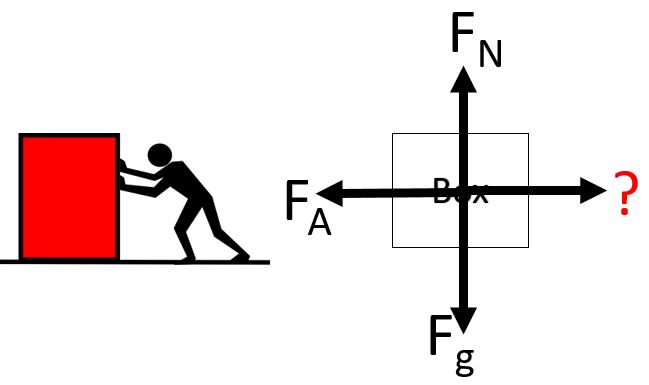
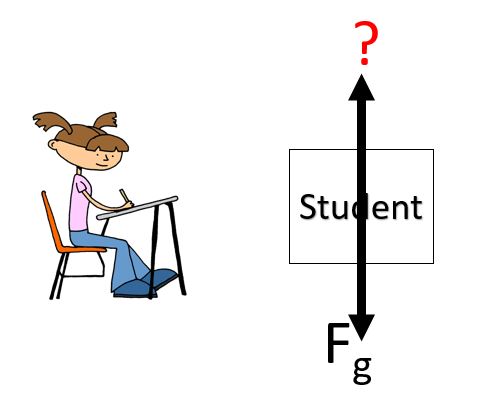
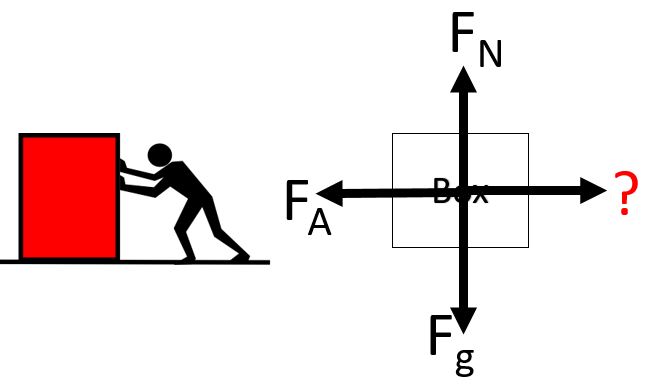
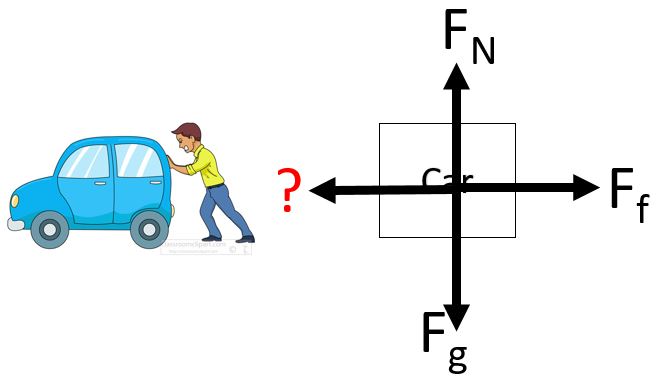
This arrow depicts which kind of force?
gravitational
normal
applied
friction

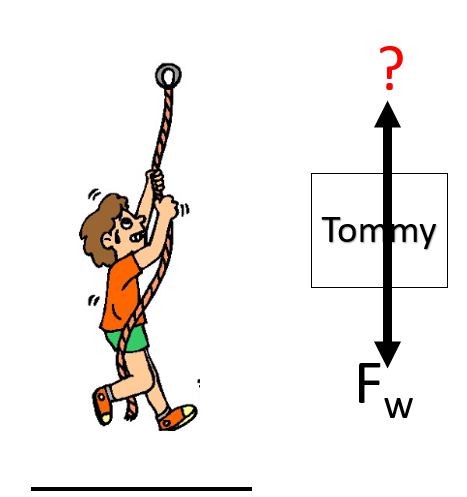
This arrow depicts which kind of force?
gravitational
normal
applied
friction

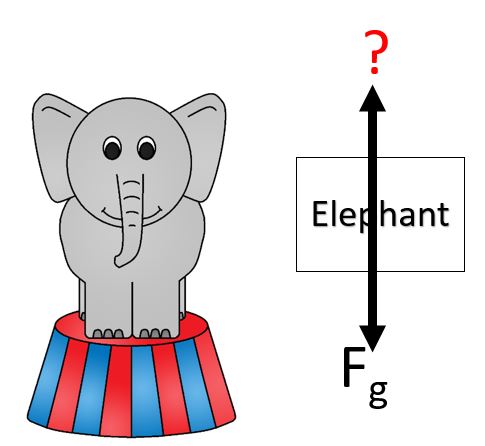
This arrow depicts which kind of force?
gravitational
normal
applied
friction

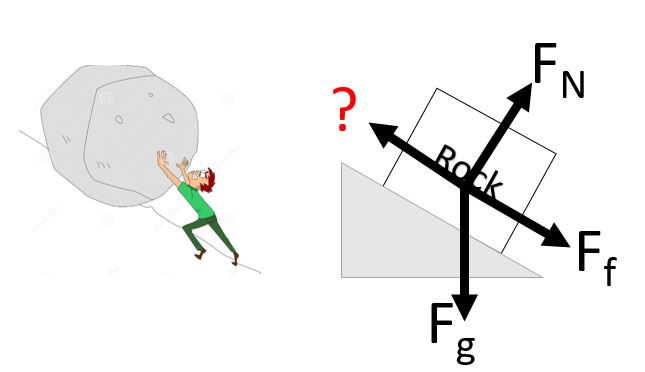
This arrow depicts which kind of force?
gravitational
normal
applied
friction
What force ultimately slows the roller coaster to a stop?
Applied
Normal
Friction
Gravitational
Leanna decided to rearrange her bedroom by moving her dresser to the opposite wall. She tried pushing it, but found that the dresser would not move. What force was Leanne NOT able to overcome?
normal force
gravitational force
tension force
frictional force
Is the force usually exerted by a surface that an object is on
Friction
Normal force
Elasticity
Tension
what is a force?
a push or a pull
change in displacement
change in direction
which of these is an effect of force?(tick mark the correct answers)
force can start a motion
force can stop a motion
force can change the direction of motion
force can change the shape of an object
force can change the speed a moving object

what is the force acting in the ropes of the swing?
tension
normal reaction
friction
gravitation
A diagram which labels the forces acting on an object along with their direction is called _____.
a force diagram
a free body diagram
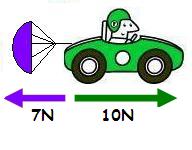

Is this a balanced force?
Yes
No
What is the NET Force?
10 N
5 N
10 N to the right.
5 N to the right.
The unit of force is
Ampere
Tesla
Newton
Joule
What do you call a simple model to show an object due to all the forces acting on it?
Model Diagram
Net Force
Balanced Force
Free Body diagram
The downward force exerted on an object due to its MASS is:
Weight
Applied force
Normal force
Tension
This arrow represents which kind of force?
weight
normal
applied
friction

The forces on this chandelier are...
Gravity only
Gravity and Normal
Gravity and Tension
Gravity and Friction

The cup is resting on a table. What force is missing from the free body diagram?
No forces are missing
Normal force (UP)
Normal force (DOWN)
Frictional force

The car in the picture is moving at a constant velocity. What forces does the car experience?
Gravity
Gravity and Normal
Gravity, Normal, and Friction
Gravity, Normal, Friction, and Applied

The Car in the picture is moving to the right at a constant velocity. Any friction present would be pushing the car to the ...
Up
Right
Down
Left
A leftward force is applied to a crate to push it across the floor at a constant speed. Which is the correct force diagram?


A rightward force is applied to a dresser to accelerate it to the right across the bedroom floor.


A hockey puck glides to the right across the ice at a constant speed. What would the force diagram for this look like?


A downward-moving skydiver who has just opened the parachute is slowing down. Which force diagram shows this sitation?


What is a NON-CONTACT force?
A push or pull force where the objects are not touching
A push force where the objects are touching.
An example would be pulling open a door.
The only type of force that exists in the world.

The three examples pictured are of
Non-contact Forces
Contact Forces

The force between the phone and the mount is a
contact force
non-contact force
Friction is a
Contact Force
Myth
Non-contact Force

Newton said that any two masses will...
combine into a larger mass.
attract each other.
create gravitational fields.
push each other apart.
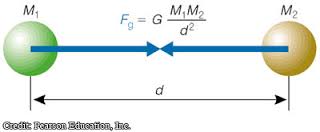
Complete the following statement: The farther away two planets are from each other, the _______ the gravitational attraction force between them will be.
more
same
less
What happens to Gravitational force if I double both of the masses but don't change their distance?
doubles
half as big
4x bigger
4x smaller
If I double the distance between two objects, what happens to their gravitational Force?
4x bigger
4x smaller
2x bigger
2x smaller

The gravitational force between two bodies of masses m1 and m2 separated by distance r is F. State the effect on the gravitational force when m1 increases twice.
2F
1/2 F
4F
4F

The Net Force between the two spheres is 40N.
Scenario: The distance between the two masses is then halved. How much will the numerator be divided by?
2d2=4d
.5d2= .25d
2d
.5d
Two asteroids exert a gravitational force, F, on each other. Some time later, the asteroids are now three times as far from each other as before. Which of the following represents the gravitational force at this distance?
F/3d
F/2d
F/6d
F/9d
Mathematician, Astronomer, & Physicist who discovered gravity, laws of motion, calculus, reflecting telescope.
Isaac Newton
Marie Curie
Stephen Hawkings
AlexanderFleming
What is Newton's First Law known as? The Law of
Friction
Mass
Inertia
Gravity
What is Newton's First Law
F=ma
Every action has an equal and opposite reaction
An object at rest stays at rest, an object in motion stays in motion.
Friction
According to __________, the acceleration of an object is equal to the net force acting on the object divided by the object's mass.
Newton's Second Law
Newton's Third Law
Newton's First Law
"Forces come in pairs" represents
Newton's 1st law
Newton's 2nd law
Newton's 3rd law
Law of conservation of momentum
"For every action, there is an equal and opposite reaction" represents
Newton's 1st law
Newton's 2nd law
Newton's 3rd law
Law of conservation of momentum
F=ma represents
Newton's 1st law
Newton's 2nd law
Newton's 3rd law
Law of conservation of momentum

Before Newton and Galileo, for many centuries natural philosophers had debated the nature of the universe based largely on certain rules of _____ with great weight given to the thoughts of earlier classical philosophers such as Aristotle.
science
logic
guessing
Because of inertia, a moving object will keep ________ unless acted on by an unbalanced force.
at rest
moving
in one spot
inertia

Are the forces in the picture Balanced or unbalanced?
balanced
unbalanced
All objects have inertia
True
False

Find the net force: 15 N to the right, and another 15 N to the right.
0 N Right
0 N Left
30 N Left
30 N Right
You and your friend, are playing tug of war. Your friend pulls with a force of 55 N to the right. You pull with a force of 65 N to the left. What is the net force on the rope?
10 N, to the left
20 N
10 N, to the right
If the net force on an object is zero, the object will:
start moving
stop moving
change direction
there will be no change in the object's motion

Which of Newton's Laws is this an example of?
Newton's First Law
Newton's Second Law
Newton's Third Law

Which of Newton's Laws is this an example of?
Newton's First Law
Newton's Second Law
Newton's Third Law

Which of Newton's Laws is this an example of?
Newton's First Law
Newton's Second Law
Newton's Third Law

Which of Newton's Laws is this an example of?
Newton's First Law
Newton's Second Law
Newton's Third Law
Newton's Second Law is described by which equation below?
m=Fa
a=Fm
F=ma
m=a/F
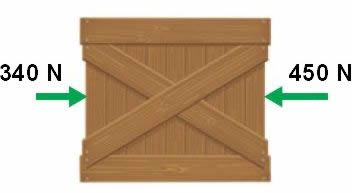
A 20 kg bike accelerates at 10 m/s2. what was the force
25 Newtons
20 Newtons
200 Newtons
10 Newtons
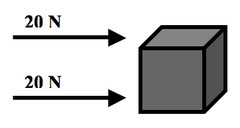
An object of mass 10 kg is accelerated upward at 2 m/s2. What force is required?

F = ma
Forces can change an object's motion by changing its ------, its direction, or both.
Be careful!
Which of Newton's laws best fits with the following statement: More mass means more force needed to accelerate
first
second
third
Which shows the relationship between acceleration, mass, and net force?
acceleration = force x mass
acceleration = force/mass
acceleration = mass/force
Newton's 2nd law states that as an applied force
increases, it's acceleration increases
decreases, its acceleration increases
increases as its acceleration decreases
A car has a mass of 100 kg and accelerates at a rate of 4 m/s/s. What is the Force exerted on the car?
25 N
100 N
250 N
400 N
Johnny has a mass of 75 kg. He sits on a desk. He is pushed with a force of 100 N. How quickly will he accelerate? Neglect friction
1.33 m/s/s
2 m/s/s
7.5 m/s/s
15 m/s/s
T or F: According to Newton's 2nd Law, there is an INDIRECT relationship between force and acceleration
true
false
Which of the following objects would have the LOWEST acceleration
a 50 kg object acted on by a 50 N force
A 36 kg object acted on by a 24 N force
a 100 kg object acted on by a 125 N force
Determine the acceleration of an object with a mass of 50 kg and a force of 100 N
0.5 m/s/s
1 m/s/s
2 m/s/s
2.5 m/s/s
What is the force needed to push something at 4 m/s/s if the object has a mass of 4000 kg
1000 N
0.0001 m/s
16,000 N
16,000 m/s
An object accelerates 12 m/s2 when a force of 6.0 newtons is applied to it. What is the mass of the object?
2 kg
18 kg
0.5 kg
0.05 kg
An object accelerates 5 m/s2 when a force of 20 newtons is applied to it. What is the mass of the object?
4 kg
20 kg
0.5 kg
2 kg
An object with a mass of 2.0 kg has a force of 4.0 newtons applied to it. What is the resulting acceleration of the object?
2 m/s2
8 m/s2
0.5 m/s2
6 m/s2
An object with a mass of 5 kg has a force of 20 newtons applied to it. What is the resulting acceleration of the object?
2 m/s2
8 m/s2
4 m/s2
6 m/s2
Football A has a greater mass than football B. Which football will have greater acceleration when both are thrown with the same force in the same direction?
Football A
Football B
They will have the same acceleration
Mass has no effect on acceleration

If your mass is 75kg, what is your weight?
(g=9.81m/s2 or roughly 10m/s2)
75N
750N
7.5N
.13N
In the english system the "slug" is used to express mass.
What would be your mass if you weighed 160lbs.?
(Gravity is 32.1 ft/s2)
4.98 slugs
5136 slugs
.20 slugs
4.98 kg
Newton's third law of motion describes equal and opposite forces:
between two objects
acting on a single object
acting only when objects are in contact
between solid objects but not liquids or gases
If you lean against a brick wall, the wall:
pushes back with an equal force
pushes back with a smaller force
pushes back with a greater force
does not push back
Newtons third law states that for every action, there is an_________ reaction
unequal and opposite
stronger and opposite
equal and similar
equal and opposite

Force always come in________
waves
triplets
pairs

When a heavy football player and a light one run into each other, who exerts more force
The light one
Their force are equal
The heavy one

The forces in a force pair are in _______ direction
opposite
same
When a small car pushes a big truck, the truck applies an equal and opposite force on the car.
False
True

How is this an example of Newton's Third law
Only the ball is using the head
only the head is pulling the ball
They are both exerting an equal force on each other
The Moon's gravitational pull on the Earth is ____________ the Earth's gravitational pull on the Moon.
Equal to
Less than
Greater than
Giant magnets can be used to lift cars.
The force that the magnet applies to the car is ____________ the force that the car applies to the magnet.
Equal to
Less than
Greater than
A baseball player hits a ball with 400 N of force. How much force does the ball exert on the bat?
300
400
500
Not enough info to tell
Your friend pushes you for making fun of him/her. What is the reaction force?
You pushing back on your friend
You pushing on the ground
There is no reaction force
Your friend pushing on the ground
When you jump up, you push the earth downwards. Why can't you tell that the earth has moved?
The force of you jumping up doesn't actually push the earth down.
The earth has much more mass so it doesn't move at all
The earth is firmly rooted
The earth has much more mass so you can't tell that it moved
In space, rockets move by shooting air backwards. What moves faster the air or the ship?
Neither, they both move at the same speed
The ship because it has more mass
The air because it has less mass
The ship because it is moving forwards
When you hit a tennis ball with a racket...
The ball exerts more force on the racket
The ball and racket exert the same force on each other
The racket exerts more force on the ball
It depends on how hard you hit it
What causes a jet ski to move forward?
The motor pushes the jet ski forward
The water pushes the jet ski forward
The person pushes the jet ski forward
Gravity pushes the jet ski forward
Can you push harder with one hand against the other?
Yes, always
No, never
Yes, but it depends on how hard you push
No, but this one is not the correct answer
Why is it easier to stand up if you push something down?
The thing you push down pushes you up
Your arms push your body up
It helps your legs get proper posture
It actually doesn't help, its just a mental thing
A small bug splats against a car windshield. Which object experiences greater force?
The bug
The windshield
Both experience the same force
Not enough info given
A bug splats onto the windshield of a car. Which object has the greater acceleration?
The bug
The car
Both have the same acceleration
Not enough information to tell
If you push your friend in a shopping cart with 40 N at constant velocity, what is the force of friction on the cart?
40 N
More than 40 N
Less than 40 N
Depends on the surface and type of wheel
When weight lifters raise the bar...
They are exerting less force than the bars weight
They are exerting an equal force to the bars weight
They are exerting more force than the bars weight
It depends on how heavy the bar is
Two classmates play a game of tug of war on ice. Which student would win?
The lighter student because he could slide on the ice easier
The heavier student because he has more mass
Without friction, neither student would win
Both students go backwards because of the force of the rope back onto them
If you weigh 1000 N and hang from a pair of ropes, what is the force of tension in each rope?
1000 N
10 N
500 N
Not enough info to tell
Two students with different masses are sitting in roll-y chairs. The lighter one uses his feet to push the other
The lighter student will move faster because he has less mass
The heavier student will move more because he is being pushed
They will move with the same speed
The heavier student shouldn't move at all
Attach two spring scales together and pull each one apart with a force of 10 N. What is the reading on the scales?
10 N for both
20 N for both
0 N for one and 10 N for the other
10 N for one and 20 N for the other
What is needed to calculate work?
time and distance
speed and distance
force and distance
acceleration and velocity
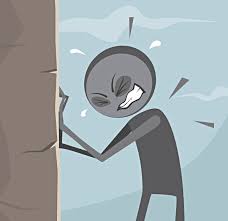
Is this an example of work?
Yes
No
What is the unit of measurement for work?
meters
newtons
m/s
Joules

Is this an example of work?
Yes
No!
You have to push with 15 N of force to move it 10 meters. How much work do you do?
15 Joules
150 Joules
1.5 Joules
.67 Joules
500 J of work is done by a person who uses a force of 50N to move a box, how far does it go?
10 m
0.1 m
25,000 m
10 J
Newtons are the unit for _____________.
Work
Distance
Acceleration
Force
A push or a pull
Work
Force
Acceleration
Speed
For work to be done on an object, the direction and force have to be going the same direction.
True
False
Picking up a box is an example of____________
Work
Not Work
Pushing a box across the floor is an example of
Work
Not Work
You exert 200 J of work by pulling on an object with 20 N of force. What distance is the object moved?
.01 m
10 m
10 J
4,000 m
The unit for energy and work is
meters
joules
newtons
watts
Energy is
stored work
is destroyed when used
can not be changed into another form of energy
measured in newtons
You do work when you hold a 100lb. object in your hand that's not moving.
True
False
Two factors that determine work are...
Force
Mass
Velocity
Distance
Units of force are...
Newtons
Grams
Joules
Meters
Units of work are...
Newtons
Grams
Joules
Meters
If you push a cart with a force of 60 N for 2 m... how much work have you done?
120 J
30 J
120 N
30 N
What is the formula for work?
Force = work × distance
Distance = force × work
Work = force × distance
Work = force × mass
Fred kicks a ball with a force of 20N to George, who is 5M away.
How much work was done to the ball?
25 J
100 J
4 J
75 J
If 40N of force is applied to Rollo Koster's 10 kg cart over a distance of 50 meters, how much work is done?
8000 J
8000 N
4000 J
2000 J

If the mystery machine moves 100 meters how much work is done?
130,000,000 J
70,000 J
100,000 J
30,000 J

If Jay Loppy pushes his van 20 meters how much work is done?
2,000 J
40,000 J
10,000 J
800,000 J
It takes 20 N of force to move a box a distance of 10 m. How much work is done on the box in Joules?
200 J
20.0 J
100 J
10 J
if you push a cart with a force of 60 N for 2 m... how much work have you done?
120 J
30 J
120 N
30 N
Work done = Force x __?__
a. distance
b. acceleration
c. velocity
d. speed
If you do 40 joules of work lifting a 10N box, how high is the shelf you move it to.
400m
40m
50m
4m
You apply a force of 18 N to a dresser and move it 3.0 m. How much work did you do on the dresser?
54 J
6.0 J
21 J
27 J
I do 132 Joules of work on a bookcase. If I apply a force of 6 Newtons, how far have I moved the bookcase?
22 meters
792 meters
17 meters
320 meters
Calculate the work needed to raise a 3 kg cat up to a height of 4 m. (g = 10m/s2)
Hint: kg is a mass, you need to find its force (weight): F=W=mg before finding work
12 J
0 J
120 J
1.22 J
Sue lowers a stack of books with a mass of 20 kg over a distance of 2 meters. Calculate work. (use g = 10m/s2)
Hint: Lifting up is positive energy, objects falling is negative energy
Hint: kg is a mass, you need to find its force/weight: F=W=mg
400 J
-40 J
-400 J
-20 J

With all of his Batgear on, Batman has a mass of 90.7 kg. How much work does he have to do to get to his perch on top of a 1,575 m building?
(use g = 10m/s2 to get the force/weight)
142.9 kN
142.9 kJ
1 kJ = 1000 J
1.429 MN
1.429 MJ
1 MJ = 1,000,000 J
An aircraft is taking a group of skydivers up into the air. Evan is dressed in his parachuting outfit, which brings his mass to a total of 90.0 kg. The aircraft takes the group to a height of 5000.00 m before the jump. How much work is done in getting Evan safely back to the ground? (use g = 10m/s2)
450 kJ
1 kJ = 1000 J
450 kN
1 kN = 1000 N
4.5 MJ
1 MJ = 1,000,000 J
4.5 MN
1 MN = 1,000,000 N
exerting a force on an object that causes the object to move some distance
work
power
mechanical advantage
efficiency
the amount of work you do when you exert one Newton of force to move the object one meter
joule
newton
meter
output force
a device that allows you to do work in a way that is easier
machine
compound machine
work
power
The force you exert on the machine
Effort (input) force
Resistance (output) force
efficiency
mechanical advantage
The force the machine exerts on an object
Effort (input) force
Resistance (output) force
efficiency
mechanical advantage
the ratio of output force to input force
work
mechanical advantage
efficiency
power
the percentage of the input work that is converted to output work
mechanical advantage
efficiency
joule
machine
a simple machine that is a flat, sloped surface
inclined plane
wedge
lever
fulcrum
a device that is thick at one end and tapers to a thin edge at the other end
wedge
inclined plane
lever
fulcrum
a rigid bar that is free to pivot, or rotate, on a fixed point
wedge
inclined plane
lever
fulcrum
the fixed point that a lever pivots around
wedge
inclined plane
lever
fulcrum
a simple machine that acts like an inclined plane wrapped around a cylinder
screw
pulley
fulcrum
compound machine
a simple machine made of two circular or cylindrical objects fastened together that rotate about a common axis
wheel and axle
pulley
screw
compound machine
a simple machine made of a grooved wheel with a rope or cable wrapped around it
pulley
wheel and axle
screw
lever
a machine that utilizes two or more simple machines
compound machine
machine
wedge
screw

