
 Worksheets
Physical Science Master
Total questions: 218
Worksheet time: 2hrs 49mins
Which particle is located in the cloud region of the atom?
electron
neutron
nucleus
proton
Which of the following is not a subatomic particle?
electron
neutron
nucleus
proton

According to the table, which alkaline Earth metal has a mass number greater than 100?
Magnesium
Calcium
Strontium
Barium

According to the table, which element has the LOWEST atomic number?
Magnesium
Calcium
Strontium
Barium

Which element is represented by this Bohr model?
lithium (Li)
neon (Ne)
oxygen (O)
sodium (Na)

The number of neutrons in the nucleus of an atom is equal to the mass number minus the atomic number. According to this definition and the table, how many neutrons are in the nucleus of a strontium atom?
20
38
81
50
A(n) ______ is matter that is composed of one type of atom.
compound
mixture
element
molecule
The smallest piece of an element that still retains the properties of the element is a(n) ______.
atom
molecule
compound
plasma
The nucleus of an atom is ______ charged.
positively
liquid
variably
none of these
Neutrons have ______ charge.
positive
negative
variable
neutral
Electrons have ______ charge.
positive
negative
variable
neutral
Protons have ______ charge.
positive
negative
variable
neutral

Which element, represented by X, would have the valence electron configuration shown in the diagram?
lithium (Li)
boron (B)
sodium (Na)
phosphorus (P)
The number of which type of particle determines the identity of an element?
electrons
neutrons
protons
photons
The element hydrogen has three naturally occurring isotopes. Which of the following describes the relationship of these isotopes?
different mass, different atomic number
same mass, different atomic number
different mass, same atomic number
same mass, same atomic number
An atom containing six positive charges and six negative charges has ______ charge.
a strong negative
a positive
a negative
no net
The ___ of an element is the number of ______ of an atom of that element.
atomic mass, electrons in the nucleus
atomic number, protons in the nucleus
mass number, protons plus neutrons in the outermost energy level
mass number, neutrons in the nucleus
______ are atoms of the same element that have different numbers of neutrons.
Isotopes
Beta particles
Compounds
Alpha particles
The atomic number of Fluorine is 9. How many electrons are on its first energy level?
7
2
9
0
Magnesium has an atomic number of 12. How many valence electrons does it have?
1
2
8
12
Leo is comparing carbon-12 and carbon-14 atoms. Which statement correctly compares the subatomic particles in the carbon atoms?
The carbon-14 atom has the same number of electrons, protons, and neutrons as the carbon-12 atom but has more mass.
The carbon-14 atom has two more electrons than the carbon-12 atom, but they have the same number of protons and neutrons.
The carbon-14 atom has two more electrons and two more protons than the carbon-12 atom, but they have the same number of neutrons.
The carbon-14 atom has two more neutrons than the carbon-12 atom, but they have the same number of electrons and protons.
Holly is examining an isotope of chromium. She determines that each atom has 24 protons, 24 electrons, and 30 neutrons. What is the mass number for this chromium isotope?
24
48
54
78
Selenium-79 has an atomic number of 34 and a mass number of 79 amu. How many electrons does an atom of selenium-79 have?
34
45
79
113
An atom with more electrons than protons is called
an anion.
a cation.
a photon.
an alpha particle.
Which statement correctly describes the valence electron configuration of fluorine (F) and chlorine (CI)?
The number of valence electrons for F and Cl is the same, and the valence electrons are the same distance from the nucleus.
The number of valence electrons for F and Cl is the same, but the valence electrons for Cl are farther away from the nucleus.
The number of valence electrons is greater for Cl than for F, and the valence electrons are the same distance from the nucleus.
The number of valence electrons is greater for Cl than for F, and the valence electrons for F are closer to the nucleus.

Which particle is located in the cloud region of the atom?
electron
neutron
nucleus
proton

The atoms in Group A are different from the atoms in Group B because only the atoms in Group A have ____________.
their outer energy levels filled with electrons
three energy levels of electrons
electron arrangements typical of metals
electron arrangements typical of nonmetals

Alkali metals belong to a group of elements whose atoms have only one electron in their outer energy level. According to this definition, which of these is an atom of an alkali metal?
F
G
H
J

According to this chemical formula, all of the following elements are found in phosphoric acid EXCEPT ______.
hydrogen
oxygen
phosphorus
potassium
Which of the following is not a subatomic particle?
electron
neutron
nucleus
proton

Which of these graphs best represent the data being shown?
A
B
C
D

This chart gives the results of an experiment testing physical and chemical properties of elements. A fifth element also was tested. It did not conduct electricity, it reacted with alkali metals, and it was a gas. This element behaved most similarly to
Element 1
Element 2
Element 3
Element 4
What term describes the Group 2 elements beryllium, magnesium, and calcium?
alkaline earth metals
alkali metals
lanthanides
transition metals

To which major group do these elements belong?
actinides
lanthanides
metalloids
transition metals
Which of the following is the most reactive of all metals?
alkaline earth metals
alkali metals
lanthanides metals
actinide metals
Carbon-14 and carbon-12 have the same number of protons but a different number of neutrons. These different forms of the same element are called
radioactive
isotopes
nuclei
tracers
The mass number of a nucleus is equal to ______.
the number of protons plus the number of neutrons
the number of electrons
the number of protons
the number of neutrons

The illustration shows the upper right section of the periodic table. How are the elements in the lightly shaded region to the right classified?
lanthanides
metalloids
actinides
non-metals

The illustration shows the upper right section of the periodic table. What element is represented by the single box at the top?
hydrogen
helium
neon
zinc

The illustration shows the upper right section of the periodic table. Which section of the table represents the metalloids?
lightly shaded section to the right
medium shaded section to the left
dark shaded section in middle
Metalloids are not located on this part of the table.
Which group of elements on the periodic table is the least reactive?
Group 1
Group 18
Group 2
Group 17

The table lists properties of some elements. Which of these elements belong to the third period of the periodic table?
all of the elements
carbon, oxygen and neon
chlorine only
sodium and chlorine

The table lists properties of some elements. Which element would you expect to be in group 18 of the periodic table?
carbon
neon
chlorine
sodium

According to this information, which solid has an atomic mass greater than 200?
rubidium
cesium
tantalum
thorium
Patients with heart disease and high blood pressure are often placed on a salt-free diet. They are instructed that they may use a salt substitute to season their food. A common salt substitute is potassium chloride (KCl). Its chemical formula is very similar to that of everyday table salt, sodium chloride (NaCl). Based on your knowledge of the periodic table, which statement best explains why potassium chloride probably has properties similar to those of sodium chloride.
Potassium and sodium both belong to Group 1. They have the same number of valence electrons. Therefore, they form similar compounds with other elements.
Potassium and sodium both belong to Period 1. They have the same number of energy levels. Therefore, they form similar compounds with other elements.
Potassium and sodium both belong to Group 1. They have the same number of energy levels. Therefore, they form similar compounds with other elements.
Potassium and sodium both belong to Period 1. They have the same number of valence electrons. Therefore, they form similar compounds with other elements.
The substances that undergo change in a chemical reaction are called
reactants.
products.
coefficients.
elements.
Which of the following does NOT state what the arrow means in a chemical equation?
forms
produces
conserves
yields

Which of the following is a balanced chemical equation for the synthesis of NaBr from Na and Br?
A
B
C
D
Which of the following is NOT always true about a synthesis reaction?
One product is formed.
There is only one reactant.
The general formula is A + B → C.
A reactant might be a compound, or it might be an element.

Aluminum and copper (II) chloride react to form copper and aluminum chloride. Which list correctly identifies the reactants and products of this reaction?
Al, CuCI2, Cu, and AICI3 are all ionic solids
Al and Cu are metals, CuCI2, and AICI3 are ionic solids
AI and CuCl2 are ions, Cu and AICl3 are ionic solids
Al and Cu are ions, CuCl2 and AlCl3 are metals

In aqueous solution, sodium chloride (NaCl) shows that it is made of sodium ions (Na+) and chloride ions (Cl-). Which statement explains the formation of ions when sodium chloride is formed from sodium and chlorine?
The sodium atoms each lose an electron and the chlorine atoms each gain an electron.
The sodium atoms each gain an electron and the chlorine atoms each lose an electron.
Both the sodium atoms and the chlorine atoms gain one electron each.
Both the sodium atoms and the chlorine atoms lose one electron each.

Calcium fluoride (CaF2) is an ionic solid that is a natural source of fluorine for the chemical industry. What is the charge on the calcium ion in calcium fluoride?
-2
-1
+1
+2

DeWayne has these Australian coins in his collection. The penny is composed of pure lead, and the shilling is composed of sterling silver, an alloy of silver and copper. Which statement correctly identifies the type of matter for both coins?
Both coins are compounds because they are both made of metal.
Both coins are mixtures because they are both made of metal.
The penny is made of an element because it is pure lead, and the shilling is a compound because it is made of more than one metal.
The penny is made of an element because it is pure lead, and the shilling is a mixture because it is an alloy.

Which element, represented by X, would have the valence electron configuration shown in the diagram?
lithium (Li)
boron (B)
sodium (Na)
phosphorus (P)

All of these atoms lend electrons and form positive ions EXCEPT
A
B
C
D

Which process is taking place in these chemical combinations?
electron transfer
electron sharing
electron gain
electron loss

The diagram shows the oxidation numbers of certain groups in the periodic table. According to the diagram, which group is LEAST likely to combine with other elements to form compounds?
Group 1
Group 14
Group 17
Group 18
Which statement best describes what happens to sodium (Na) and chlorine (Cl) atoms when they combine to form sodium chloride (NaCl)?
The sodium atom becomes a positive sodium ion, and the chlorine atom becomes a negative chloride ion.
The sodium atom becomes a negative sodium ion, and the chlorine atom becomes a positive chloride ion.
The sodium atom becomes a positive chloride ion, and the chlorine atom becomes a negative sodium ion.
The sodium atom becomes a negative chloride ion, and the chlorine atom becomes a positive sodium ion.

Which of the following is the reason why atoms of sodium and chlorine attract each other in a salt crystal?
Sodium has a positive charge and chlorine has a negative charge.
Sodium has a negative charge and chlorine has a positive charge.
Both have a positive charge.
Both have a negative charge.

Ionic compounds are usually formed by ionic bonding between metals and nonmetals. Which of the following is not an ionic compound?
A
B
C
D
Which statement provides the best description of a covalent bond?
A covalent bond is the attraction between atoms when they share electrons.
A covalent bond is the attraction between opposite charges of ions in a compound.
A covalent bond usually forms between a metal and a nonmetal.
A covalent bond is usually stronger than an ionic bond.
The noble gases rarely combine with other elements to form compounds because
they are gases
their outer energy levels are full
their atoms are much too large
they are nonmetals

Antoine Lavoisier is credited with the discovery of the law of conservation of mass. This law states that in a chemical reaction, matter is not created or destroyed,but preserved. Which of the following equations correctly models this law?
A
B
C
D

The equation is not balanced. In order to balance the equation, a coefficient of 2 needs to be placed directly .
after the symbol for magnesium on the left side of the equation
before the symbol for oxygen on the left side of the equation
after the symbol for oxygen on the left side of the equation
before the symbol for magnesium on the left side of the equation

A coefficient in the formula is _________.
F
G
H
J

The diagram shows an equation representing a chemical reaction. In this equation, which of these are the reactants?
HCl and NaOH
NaCl and H2O
HCl and H2O
NaOH and NaCl

The law of conservation of mass states that in a chemical reaction the mass of the reactants equals the mass of the products. Based on this information, what mass of hydrogen (H2) was produced in this reaction?
2 g
4 g
72 g
144 g

Which of these is a product?
A
B
C
D

How many particles are in one mole of a substance?
A
B
C
D

Which of these is a balanced chemical equation?
A
B
C
D
Which force holds protons and neutrons together in the atom nucleus?
electric force
gravity
strong nuclear force
weak nuclear force
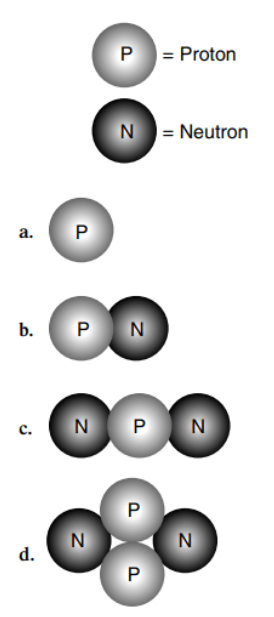
Which of these is an alpha particle?
A
B
C
D
The mass number of a nucleus is equal to ______.
the number of protons plus the number of neutrons
the number of electrons
the number of protons
the number of neutrons
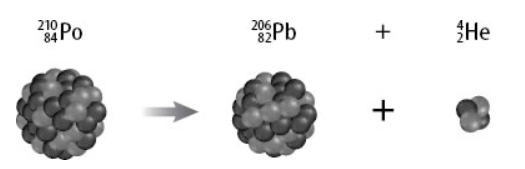
What type of nuclear decay is represented in this illustration?
beta decay
gamma radiation
alpha decay
nuclear fusion
Which happens in a nucleus during gamma decay?
The number of protons increases.
The number of neutrons increases.
The number of protons remains the same.
The total number of neutrons plus neutrons decreases.
When a neutron turns into a proton in a nucleus, what sort of particle is emitted?
alpha
beta
gamma
photon
Gamma rays _________.
have no mass and no charge
have mass but no charge
have no mass but have charge
have mass and charge
What are found in the nucleus of an atom?
protons and electrons
electrons and neutrons
protons, neutrons, and electrons
protons and neutrons
Protons do not repel each other in the nucleus because of the ______.
weak force
electric force
strong force
gravitational force
In a radioactive nucleus, the electric force _____ the strong force.
balances
overpowers
is overpowered by
adds to
Which of these is not a type of nuclear radiation?
alpha particles
beta particles
gamma rays
microwaves
How does the alpha decay of a nucleus cause the nucleus to change?
Only the number of protons decreases.
Only the number of neutrons decreases.
The number of neutrons and the number of protons decrease.
The number of protons increases and the number of neutrons decreases.
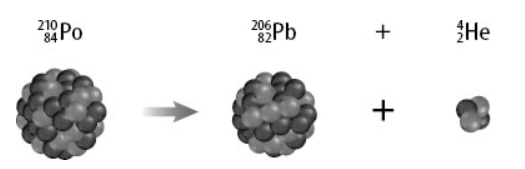
Which of these is a true statement about the products of the decay compared to polonium-210?
The charges are equal but the mass numbers are not equal.
The mass numbers are equal but the charges are not equal.
The mass numbers and charges are equal.
Neither the mass numbers nor the charges are equal.
A hydrogen nucleus has only one proton. How many neutrons are in a hydrogen-3 nucleus?
0
1
2
3
Which force holds protons and neutrons together in the atom nucleus?
electric force
gravity
strong nuclear force
weak nuclear force

Which best represents nuclear fission?
F
G
H
J

Which of these diagrams represents the type of nuclear reaction that produces energy in the Sun?
A
B
C
D
A high temperature is required for which to occur?
alpha decay
beta decay
nuclear fission
nuclear fusion
During nuclear fission, a nucleus _________.
grows
divides
shrinks
combines with another
Only nuclei with _________ atomic numbers can undergo fission.
small
even
odd
large
What is the term for an ongoing series of nuclear reactions?
fission
chain reaction
fusion
nuclear
When two smaller nuclei come together, it is called ________.
nuclear fission
nuclear fusion
chain reaction
critical mass
In the Sun, hydrogen atoms fuse together to form _________.
helium
mercury
oxygen
nitrogen

Nuclear fission of uranium-235 can start a chain reaction by
releasing enough thermal energy to start nuclear fission in neighboring atoms
producing two smaller atoms that can then strike and split neighboring atoms
producing neutrons that can then strike and split neighboring atoms
combining two atoms with low mass to form one large atom

What type of nuclear reaction is shown?
fusion
fission
chain reaction
alpha radiation
What type of relationship did Einstein state there was between energy and mass?
equal
inverse
additional
negative
Force is measure with
Newtons.
Pounds.
Kilograms.
Meters per second per second.
Forces are
a push.
a pull.
a push or a pull.
neither a push or a pull.
Which is a measurement effected by gravity?
Weight
Mass
Displacement
Velocity
Which tool would be the best for measuring the mass of an object?
Digital Scale
Measuring Tape
Thermometer
Laser Level

What is the net force on the box in the diagram?
1 N Right
1 N Left
4 N Right
3 N Left
A car travels along a straight road 100 m east then 50 m west. What is the displacement of the car?
50 m east
0 m
100 m west
150 m east
A runner travels around rectangle track with a length of 50 meters and width of 20 meters. After traveling around the rectangle track two times, the runner back to starting point. What is the distance the runner traveled?
280 m
140 m
200 m
320 m
A car travels at uniform velocity a distance of 100 m in 4 seconds. What is the velocity of the car?
25 m/s
400 m/s
50 m/s
215 m/s
A sailboat is traveling north at 10 km/h, relative to the water. The water is flowing north at 5 km/h. What is the velocity of the boat relative to ground?
15 km/h N
15 km/h S
5 km/h S
5 km/h N
If a sprinter runs 100 m in 10 seconds, what is his average velocity?
10 m/s
100 m/s
1 m/s
1000 m/s
Acceleration describes
the change in speed of a mass.
the change in direction of a mass.
the change in velocity of a mass.
the increase in speed of a mass.

Which line in the diagram shows negative acceleration?
A
B
C
D
A car moving at 80 mph has a speed of 35.8 m/s. What acceleration would it have if it took 5.0 s to come to a complete stop?
-7.16 m/s*s
7.16 m/s*s
8.84 m/s*s
-8.84 m/s*s
A roller coaster car rapidly picks up speed as it rolls down a slope. As it starts down the slope, its speed is 4 m/s. But 3 seconds later, at the bottom of the slope, its speed is 22 m/s. What is its average acceleration in m/s/s? (Round to the nearest tenth)
6.0
7.3
4.75
15.0
Which line shows a mass with no acceleration?
A
B
C
D
Which scientist defined force?
Issac Newton
Galileo Galilei
Albert Einstein
Stephen Hawking
Which formula is defined by the Second Law of Motion?
F = ma
v = d / t
a = (vf-vi) / t
p = mv
Which measurement would NOT be used to calculate the force on an object?
Mass
Initial Velocity
Final Velocity
Volume
What net force is required to accelerate a car at a rate of 2 m/s*s if the car has a mass of 3,000 kg?
6,000 N
1,500 N
3,002 N
2,998 N
A 10 kg bowling ball would require what force to accelerate down an alleyway at a rate of 3 m/s*s?
30 N
3.3 N
7 N
13 N

What is probably being measured in the diagram?
speed
engine temperature
rate of tire wear
gasoline mileage

The horses on this carousel are accelerating because __________________________.
the speed of the horses is constantly increasing
the speed of the horses is constantly decreasing
the direction of the horses’ motion is constantly changing
the travel time is different for every ride
A car travels 15 m east, then 5 m north,then 15 m west. What is the car’s displacement?
35 m north
5 m north
20 m east
10 m west

If the same force is applied to each of these balls, which one will have the LEAST acceleration?
baseball
bowling ball
golf ball
tennis ball
Which of the following is NOT an example of unbalanced forces acting on an object?
an acorn falling from a tree
a car moving at a constant speed of 55 miles per hour
a motorcycle changing speed from 50 miles per hour to 70 miles per hour
a truck slowing down as it approaches a red light
The total amount of energy before and after a chemical reaction is the same. Thus, energy is
created.
destroyed.
conserved.
the same as mass.
The property of matter that resists changes in motion is called
friction.
inertia.
gravity.
weight.
Which statement correctly describes chemical energy?
Chemical energy is energy stored in the bonds between atoms.
Chemical energy is the kinetic energy of moving and vibrating molecules.
Chemical energy is the result of mass converted to energy in the nucleus of an atom.
Chemical energy is energy stored as the result of stressing or stretching a substance.

A pendulum is pulled back and released. Which statement best describes the changes in the weight's potential energy (PE) and kinetic energy (KE) as it swings back and forth?
Except for small losses to friction, there are no changes to the PE or KE of the weight.
At the top of each swing, the weight has the maximum KE and no PE. At the bottom, it has maximum PE and no KE.
At the top of each swing, the weight has the maximum PE and no KE, At the bottom, it has maximum KE and no PE.
The PE and KE both increase as the weight swings down, and both decrease as the weight swings up.
A force of 10 newtons is used to push a 5-kilogram object a distance of 18 meters. What is the amount of work exerted on the object?
50 joules
90 joules
180 joules
900 joules

The objects in Group A are different from the objects in Group B because only the objects in Group A _________.
are electrical appliances
have chemical potential energy
convert electrical energy to mechanical energy
are fossil fuels

In the diagram above, a roller coaster car starts from rest at point A and moves along the track. At which point does the roller coaster car have the greatest kinetic energy?
A
B
C
D

What energy change do these appliances have in common?
They convert electrical energy to thermal energy.
They convert electrical energy to mechanical energy.
They convert mechanical energy to electrical energy.
They convert thermal energy to electrical energy.

The diagram shows a person swinging a golf club from point A to point D. The kinetic energy of the golf club would be greatest at
A
B
C
D

The temperature is higher inside a greenhouse than outside because of the conversion of
radiant energy into thermal energy
thermal energy into light energy
nuclear energy into thermal energy
electrical energy into thermal energy

The work done by the crane was most likely measured in
joules
meters
newtons
watts
Approximately how much work do you do when you lift your 10.0 kg sister to a height of 1.5 m?
150 J
15 J
15 N
15 W
Which sequence describes the energy conversions in a car’s engine?
chemical to thermal to mechanical
mechanical to thermal to chemical
thermal to mechanical to chemical
kinetic to potential to mechanical
The kinetic energy from an object’s motion always changes when which factor changes?
the object’s chemical potential energy
the object’s volume
the object’s direction of motion
the object’s speed
______ energy is the energy an object has because of its motion.
Kinetic
Magnetic
Chemical
Potential
______ energy is stored energy due to position.
Kinetic
Magnetic
Chemical
Potential
Anything that can fall has stored energy called ______.
elastic potential energy
chemical potential energy
kinetic energy
gravitational potential energy

At what point(s) does the pendulum have maximum Gravitational Potential Energy?
A
B
C
D
E

At what point(s) does the pendulum have maximum kinetic energy?
A
B
C
D
E
Which statement best describes a capacitor?
a device used to store an electric charge, consisting of one or more pairs of plates.
a container consisting of one or more cells, in which chemical energy is converted into electricity
a device having a designed resistance to the passage of an electric current
an apparatus for reducing or increasing the voltage of an alternating current
The momentum of an object is the sum of its mass and its velocity.
True
False
When two objects collide, their momentum after the collision is explained by ______.
Newton’s first law of motion
Newton’s second law of motion
Newton’s third law of motion
the conservation of momentum
A real car moving at 10 km/h has more momentum than a toy car moving at the same rate because ______.
its mass is greater
its mass is less
it moves faster
of friction
What do objects increasing in velocity NOT have?
Momentum
Mass
Balanced forces
If an object with a mass of 12 kilograms is moving at 10 meters per second, what is its momentum?
120 kg*m/s
120 kg*m*s
1.2 kg*m/s
1.2 kg*m*s
Newton's Second Law of Motion can be summarized by which equation?
M = F/a
F = ma
F = m/a
Which scenario would most likely occur when a cue ball strikes a pool ball that is at rest?
The cue ball will stop making and also be at rest.
The pool ball will accelerate in the same direction as the cue ball was initially moving.
The cue ball will bounce back from the pool ball around the same velocity.
The pool ball will accelerate to a velocity greater then the cue ball moving.
Determine the momentum of a 0.145 kg baseball thrown at 44.7 m/s.
6.4815 kg*m/s
3.0827 kg*m/s
30.2 kg*m*s
64.82 kg*m*s
A mass has a momentum of 50 kg*m/s, when its velocity doubles what happens to its momentum?
The momentum doubles.
The momentum quadruples.
The momentum is halved.
The momentum stays the same.
A projectile of mass 1 kilogram traveling at 9 meters per second collides with another projectile of mass 2 kilograms traveling at 6 meters per second in the same direction. If the projectiles "stick" together after their collision, what is their velocity after colliding?
7 m/s
8 m/s
7.5 m/s
9 m/s
What must occur for momentum to be transferred?
Interaction between multiple masses.
Interaction between a moving mass and a stationary mass.
Multiple masses must combine to form one mass.
Multiple masses must be moving in opposite directions.

If each object is moving at the same velocity which will have the least momentum?
Baseball
Bowling Ball
Golf Ball
Tennis Ball

The diagram above shows the magnetic field surrounding a bar magnet. The closer together the lines of force, the stronger the magnetic field. According to the diagram,where is the magnetic field strongest?
around the north pole
around the south pole
around both poles
in the center of the magnet
Alexandra was preparing to go on a hike in the woods. She gathered the equipment she would need and placed it on the kitchen counter. By chance, she placed her compass near an electrical outlet. Although the compass was not moving, the compass needle turned because _______________.
the electric current in the outlet produced a magnetic field
the compass could only be used outdoors
the kitchen counter was made of a magnetic substance
the kitchen had a microwave oven
A magnetic field exerts a force on ______.
other magnets
objects made of magnetic materials
other magnets and objects made of magnetic materials
none of these
The generation of a current by a changing magnetic field is called electromagnetic______.
discharge
charge
induction
reduction
Why does the north pole of a compass point toward Earth's geographic north pole?
A compass does not rely on Earth's magnetic field to function.
Like poles attract.
Opposite poles repel.
Earth's geographic north pole is a south magnetic pole.

According to the diagram, which pair could both be north poles?
A and B
B and C
A and C
C and D
The ______ are regions where the magnetic force exerted by a magnet is strongest.
magnetic field lines
anodes
magnetic poles
cathodes

The diagram shows an electric motor and a generator. Which two areas of physical science are closely related to the development of these devices?
sound and light
light and magnetism
electricity and sound
electricity and magnetism
Scientists believe that magnetism is caused by the spin of certain atomic particles called
electrons.
protons.
neutrons.
nuclei.
Which of the following is found in all magnets?
a geographic pole
a transformer
a north pole and a south pole
an electric field
The magnetic field that surrounds a magnet exerts _______.
electric current
the magnetic force
air pressure
resistance

Which pair of magnets would result from cutting this magnet in half?
A
B
C
D
North poles of magnets always attract ________.
south poles
other north poles
negative charges
positive charges
Electric current passing though a wire produces ________.
a magnetic field around the wire
a permanent magnet
geographic poles
a compass
What effect does increasing the current in the wire have on an electromagnet?
It decreases the strength of the magnetic field.
It increases the strength of the magnetic field.
It has no effect on the electromagnet.
It causes it to become a permanent magnet.
Which of the following is a form of electromagnetic induction?
producing electric current by moving a magnet through a wire loop
using an electromagnet to measure electric current
producing mechanical energy by sending electric current through an electromagnet
changing electrical energy to mechanical energy that produces sound
In order for the electromagnetic coil in the motor to keep turning, the current must ________.
continue in one direction
periodically increase in strength
change direction
be through an ammeter
A vibrating electric charge produces a(n) ______.
sound wave
heat wave
compression wave
electromagnetic wave
Electromagnetic waves can behave as particles that are called ______.
photons
protons
electrons
neutrons
Joseph studied whether different materials can block certain electromagnetic waves by testing television reception in different parts of a house. At each part of the house,Joseph used a different antenna. The experiment could have been improved by_________.
testing reception of a different channel during each trial
using the same antenna during each trial
measuring the antenna length in centimeters
measuring the distance to the television station
Rahim heated some leftovers in a microwave oven. He noticed that although the food got hot, the inside of the microwave oven did not. This happens because _______.
the walls of the microwave oven are good heat insulators
there is no air in a microwave oven
the fan in the microwave oven keeps it cool
microwaves heat by interacting with water molecules
What is true of visible light in comparison to other kinds of electromagnetic waves?
Visible light travels faster in a vacuum.
Visible light has a lower frequency than X-rays.
Visible light has a lower frequency than microwaves.
Visible light has only one frequency.
As the frequency of an electromagnetic wave increases, its wavelength
becomes larger
becomes smaller
stays the same
does not change
You can most effectively vibrate the electric fields of water molecules using
radio waves
infrared waves
ultraviolet waves
microwaves
Which of the following uses radio waves?
radar
radiation therapy
X-ray machine
CD-ROM

If you arranged the list of electromagnetic waves shown in order from shortest to longest wavelength, which would be last on the list?
gamma rays
radio waves
ultraviolet rays
visible light
Which electromagnetic waves are most similar in length to microwaves?
gamma rays
infrared waves
ultraviolet waves
visible light
Sunscreen is designed to protect your skin from exposure to too much ___________.
ultraviolet radiation
gamma radiation
infrared radiation
visible light
Electromagnetic waves that can be detected by the human eye are called _________.
visible light
gamma rays
X-rays
infrared waves

Scientific evidence suggests that air pollution from CFCs is damaging our atmosphere that protects us from harmful radiation. Which line on the graph supports the idea that pollution is damaging the ozone layer?
Line 1
Line 2
Line 3
Line 4
The entire range of the electromagnetic wave frequencies is known as _______.
ultraviolet radiation
visible light
the electromagnetic spectrum
magnetism
Which of the following electromagnetic waves can travel through matter and cause damage to cells?
radio waves
microwaves
infrared waves
gamma rays
What is the term for the number of waves that pass a fixed point each second?
wave speed
amplitude
frequency
period

Which of the measurements would be the most helpful in determining the wavelength?
W
X
Y
Z

According to the diagrams, long wavelengths ______________.
travel more slowly than short wavelengths
have a greater frequency than short wavelengths
diffract around objects more easily than do short wavelengths
are able to generate far more power than are short wavelengths

The glass prism is able to bend light because _________.
light is refracted as it enters a different medium
the prism offers destructive interference
energy is diffracted when it encounters an obstacle
the glass and the light’s wavelength create resonance

Which of the following is present in both drawings?
compression waves
diffraction
destructive interference
refraction
Sound is a compression wave with regions of greater and lesser density. The less-dense region of a sound wave is a
crest
rarefaction
diffraction
compression

In 1 second, four crests of a wave pass a certain point. What is the wave’s frequency?
2 Hz
3 Hz
4 Hz
5 Hz
Which statement best explains frequency?
Frequency is the number of wavelengths that pass a point per second.
Frequency is the number of crests that pass a point in total.
Frequency is the number of wavelengths that pass a point in total.
Frequency is the amplitude per second.
When a longitudinal wave travels through a medium, which way does the matter that makes up the medium move?
backward
in all directions
in the same direction the wave travels
at right angles to the direction of the wave

What part of a wave is shown at F?
amplitude
wavelength
crest
trough

What wave property is indicated by the letter J?
wavelength
crest
amplitude
trough
The distance between the rest position and the trough of a transverse wave is its _____.
wave frequency
wave intensity
wavelength
wave amplitude

What type of wave is illustrated?
longitudinal
transverse
seismic
reflected

Describe the motion of the piece of string tied to the coil.
It moves up and down as the wave passes.
It moves in a circular motion.
It moves back and forth as the wave passes.
It does not move as the wave passes.
A _____is a repeating disturbance that transfers energy through matter or a vacuum.
conductor
frequency
wave
medium
Which do all transverse waves have?
rarefactions
amplitude
compressions
ability to travel through space
Which types of waves can travel through a vacuum?
sound
light
seismic
mechanical
Which types of waves can travel through a vacuum?
sound
light
seismic
mechanical

Electromagnetic waves of different wavelengths have been given different names. According to the table, which type of electromagnetic wave can have a wavelength greater than 5 m?
Radio waves
Microwaves
Red light
Blue light

According to the table, which type of electromagnetic wave can have a wavelength of 0.000046 cm?
Radio waves
Microwaves
Red light
Blue light

Which statement about the figure is correct?
Pot A has a higher temperature than Pot B.
Pot B has a higher temperature than Pot A.
Pot A has more thermal energy than Pot B.
Pot B has more thermal energy than Pot A.
Adam placed a heated aluminum cube in a beaker of water and then measured the change in the temperature of the water.The change in temperature he recorded was most likely measured in
calories
degrees Celcius
grams per cubic centimeter
joules
When you measure the temperature of an object, you are measuring _________.
the average chemical energy of its particles
the sum of its kinetic and potential energies
the average kinetic energy of its particles
the specific heat of the object
____ is the thermal energy that is transferred from a material with a higher temperature to one with a lower temperature.
Work
Kinetic energy
Heat
Potential energy
The moving particles that make up an object have _____ energy.
decreasing
increasing
kinetic
potential
If the particles that make up an object begin to move quickly, their average kinetic energy _____ and the object's temperature _____.
increases, falls
increases, rises
decreases, rises
decreases, falls
_____ is the thermal energy that is transformed from a material with a higher temperature to one with a lower temperature.
Heat
Work
Kinetic energy
Potential energy

Which thermometer best represents the temperature 96°?
A
C
E
F
H

Jackson heats a liquid during an experiment. What is the temperature of the liquid?
50.125°C
51.25°C
51.5°C
52.75°C

Which thermometer best represents the temperature 39°?
B
D
F
H
J
Two objects with different temperatures are placed into a system. Which way will heat flow naturally?
From the warmer object to the cooler object.
From the cooler object to the warmer object.
From one object to the other regardless of temperature.
No flow will occur.
Two objects with different temperatures are placed into a system. Which outcome is most likely to occur?
The cooler object will warm to match the object with a higher temperature.
The warmer object will cool to match the object with a lower temperature.
The warmer object will heat the cooler object until both objects are the same temperature.
The environment will absorb heat from the warmer object so it will be room temperature.
What must occur for the natural flow of heat to be reversed?
Work
Kinetic Energy
Temperature Conversion
Create energy

