
 Worksheets
Y10 U1-4 Test Revision
Total questions: 223
Worksheet time: 3hrs 4mins
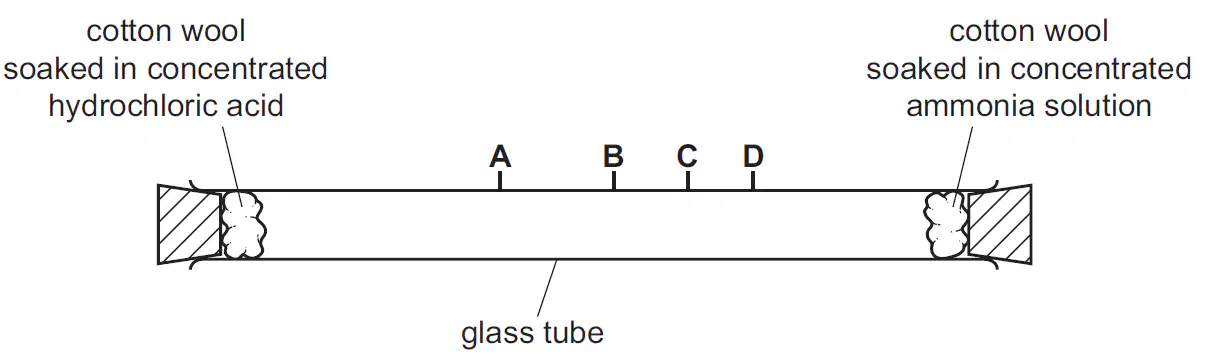
In the diagram, where will the white ring of ammonium chloride form?
A
B
C
D
Why does the ring of ammonium chloride form closer to the hydrochloric acid end?
HCl diffuses faster than NH₃
NH₃ diffuses faster than HCl
NH₃ is heavier than HCl
The gases always react in the centre
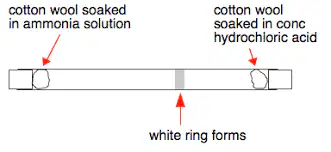
Which two of the following explain why it takes time for ammonium chloride to form? Select TWO
Gas particles move in random directions
Gas particles collide with each other
Gas particles have very weak bonds
Gas particles dissolve in the glass tube
In which state of matter are particles arranged in a regular, fixed pattern?
(a)
Which state of matter has particles that move freely and spread far apart?
(a)
Which state of matter has particles with the least energy?
(a)
In which state of matter can particles flow past one another but still remain close together?
(a)
Which state of matter has a definite volume but no definite shape?
(a)
In which state of matter do particles move by only vibrating around fixed points?
(a)
Which state of matter has particles that are furthest apart?
(a)
Why can gases be compressed but solids cannot?
Gas particles are heavier than solid particles
Gas particles have large spaces between them
Gas particles are arranged in a fixed pattern
Solids have weak forces of attraction
Which state of matter has the strongest forces of attraction between particles?
(a)
Which statement best describes the arrangement of particles in a liquid?
Regular, tightly packed, only vibrating
Random arrangement, close together, sliding past one another
Random arrangement, very far apart, moving freely
Fixed arrangement, widely spaced

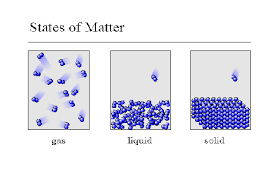
What state of matter is represented in this picture?
solid
liquid
gas

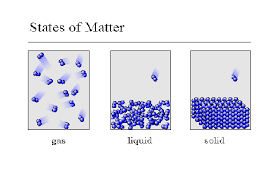
What state of matter is represented in the picture above?
solid
liquid
gas

Freezing
Solid to gas
Liquid to solid
Gas to solid

Boiling
liquid to gas
gas to solid
gas to liquid

What is happening when my ice cream changes from a solid to a liquid?
freezing
melting
burning

Particles of a liquid
are tightly packed together and stay in a fixed position.
are free to move around one another but still touch.
Solid to Gas
Deposition
Sublimation
Evaporation
What is condensation?
gas to solid
gas to liquid
liquid to solid
The slower the particles in a substance move,
the colder it is.
the warmer it is.
the more energy it has.
Liquid to Gas
Condensation
Evaporation
Sublimation
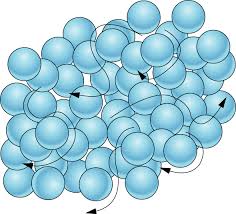
What state of matter?
Solid
Liquid
Gas
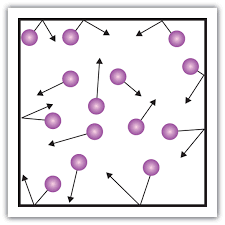
What state of matter?
Solid
Liquid
Gas
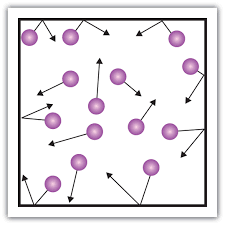
A gas typically consists of:
low energy particles that experience high attractive forces between them.
low energy particles that experience no attractive forces between them.
high energy particles that experience high attractive forces between them.
high energy particles that experience little attractive force between them
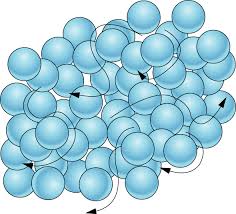
Which of the following statements is true regarding the particle structure of liquids? Particles of a liquid are:
very close together, so the liquid cannot easily change its shape.
fast-moving, so they fill the volume of their container.
relatively close together, so they cannot be easily compressed.
very far apart, so they have plenty of room to move around.
Which process could cause a material to change state from gas to liquid?
Adding heat
Adding energy
Removing particles
Removing energy
If I add heat to a solid, how will the motion of the particles be affected?
They will move slower
They will stop moving
They will move faster
They will move to a different container
How can you stop the movement of particles?
Increase the temperature
Decrease the temperature
You can't.
Hold them still with your hands.


In the picture the red dots represent...
solvent
solute
solution
diffusion
(6A) States of matter are determined by their:
ONLY the amount of energy contained by their molecules
ONLY the arrangement of their molecules
The arrangement AND energy contained by their molecules
Viscosity

(6A) In the image above, which of those phases has the most energy?
Solid
Liquid
Gas
All of the above
Gases are easily compressed because of .......................................
the size of its particles.
the space between the particles in a gas.
the mass of the particles.

solid

liquid

gas
Which of the following is a correct description for solids?
closely arranged and in fixed positions
closely arranged and vibrate in fixed positions
closely arranged and can move around

A
B
C
D

A
B
C
D
A
B
C
D

A
B
C
D

A
B
C
D

A
B
C
D

An ice cube is gently warmed as shown. Which process is taking place?
Decomposition
Dissolving
Boiling
Melting

A man spills ink on his polyester shirt. The table shows the solubility of ink and of polyester in four solvents. Which solvent should be used to remove the ink?
A
B
C
D
A measure of how much solute will dissolve in a solvent
Solubility
Solution
Solvent
Solute
Solubility (g per 100g of solvent) =
(mass of solid/mass of water removed) x 100
(mass of solution/mass of solid removed) x 100
mass of water removed/mass of solution
mass of water removed/mass of solid

How much KNO3 solute is saturated at 40 degrees?
75
55
65
85
How much C12H22O11 solute is saturated at 40 degrees?
240
220
230
250

At what temperature can you fully dissolve 140g of NaNO3?
62
73
81
You cannot determine this
At what temperature can you fully dissolve 60g of KNO3?
27
30
37
You cannot determine this
At what temperature can you fully dissolve 120g of NaBr?
70
20
100
You cannot determine this
Define the term soluble.
Can dissolve in water
Cannot dissolve in water
Partially dissolves in water
Define the term insoluble.
Can dissolve in water.
Cannot dissolve in water.
Partially dissolves in water.

A crystal of purple potassium manganate(VII) was added to each of the beakers shown in the diagram.
One beaker contained hot water and the other beaker contained cold water. In both beakers the purple colour of the potassium manganate(VII) spreads out. Which result and explanation are correct?
result - colour spreads faster in cold water
explanation - particles move faster at a higher temperature
result - colour spreads faster in cold water
explanation - particles move slower at a higher temperature
result - colour spreads faster in hot water
explanation - particles move faster at a higher temperature
result - colour spreads faster in hot water
explanation - particles move slower at a higher temperature

A student uses the apparatus shown to find out how many different pigments are in leaves.
What is this separation method called?
Chromatography
Distillation
Filtration
Evaporation

A plant colour X is a mixture. Chromatography is used to compare X with three other coloured mixtures, P, Q and R. The results are shown in the diagram.
Which other mixtures contain the plant colour X?
P only
P and Q only
R only
P, Q and R
When water is heated to 100°C, it changes to steam. The steam has a larger volume than the water.
Which change on heating explains this increase in volume?
The bonds between hydrogen and oxygen break.
The molecules become lighter.
The spacing between the molecules increases.
The water molecules expand.

Two gas jars are set up as shown.
The lid is removed and the gas jars are left to stand. After some time the contents of both gas jars are brown. Which process causes this to happen?
condensation
diffusion
evaporation
filtration

Kuku just made himself a cup of hot tea.
Which row describes the water particles in the air above the cup compared with the water particles in the cup?
A
B
C
D

Hydrogen chloride gas, HCl, reacts with ammonia gas, NH3, to form solid ammonium chloride. The apparatus is set up as shown. After a few minutes, solid ammonium chloride forms where the two gases meet.
A
B
C
D

The colours in an ink can be separated by chromatography.
Which diagram shows the correct way to set up the apparatus?
A
B
C
D
Which statement about paper chromatography is correct?
A solvent is needed to dissolve the paper.
Paper chromatography separates mixtures of solvents.
The solvent should cover the baseline.
The baseline should be drawn in pencil.
Which of the following best defines solubility?
The mass of solvent that dissolves in 100 g of solute
The mass of solute that dissolves in 100 g of solvent
The time taken for a solute to dissolve in water
The mass of solution after evaporation
A student adds excess salt to water and stirs. Why must excess solid be used?
To speed up the experiment
To make the solution saturated
To keep the temperature constant
To stop evaporation
A student records:
Mass of evaporating dish = 50.0 g
Mass of dish + dry solid after heating = 54.2 g
What is the mass of the solid in grams?
(a)
In a solubility experiment, a student calculates:
Mass of solute = 12.0 g
Mass of water = 20.0 g
What is the solubility in g per 100 g of water?
12.0 g/100 g
20.0 g/100 g
60.0 g/100 g
240.0 g/100 g
If water is not completely evaporated, how will the calculated solubility be affected?
Too high
Too low
No effect
Cannot be measured
If the solid decomposes on heating, how will this affect the result?
The calculated solubility will be too high
The calculated solubility will be too low
No change
It depends on the solvent used
Why must the solution be stirred before pouring into the basin?
To help the solid dissolve evenly
To cool it down
To make the water evaporate faster
To remove impurities
A student forgets to weigh the empty evaporating dish. Which calculation will they NOT be able to do?
Mass of solute
Mass of solution
Mass of water
Solubility in g/100 g
Which experimental error would make the calculated solubility appear higher?
Water not fully evaporated
Heating too strongly so solid decomposes
Using too little solute at the start
Forgetting to stir
Why is solubility usually given at a stated temperature?
Temperature has no effect on solubility
Solubility always decreases with temperature
Solubility depends on temperature
Solubility is constant for all substances
Mass of evaporating dish = 62.5 g
Mass of dish + dry solid after heating = 68.4 g
What is the mass of the solid in grams
(a)
Mass of dish = 41.0 g
Mass of dish + dry solid = 48.6 g
What is the mass of the solid in grams?
(a)
Mass of dish = 55.5 g
Mass of dish + solid = 59.0 g
What is the mass of the solid?
(a)
Mass of solute = 8.0 g
Mass of water = 16.0 g
What is the solubility in g per 100 g water?
25.0 g/100 g
50.0 g/100 g
200.0 g/100 g
12.5 g/100 g
Mass of solute = 15.0 g
Mass of water = 25.0 g
What is the solubility?
15.0 g/100 g
25.0 g/100 g
60.0 g/100 g
150.0 g/100 g
Mass of solute = 7.5 g
Mass of water = 30.0 g
What is the solubility?
20.0 g/100 g
25.0 g/100 g
100.0 g/100 g
200.0 g/100 g
Mass of solution = 32.0 g
Mass of solute = 8.0 g
Step 1: Calculate mass of water.
Step 2: Calculate solubility in g per 100 g water.
25.0 g/100 g
33.3 g/100 g
40.0 g/100 g
400.0 g/100 g
Mass of solution = 50.0 g
Mass of solute = 15.0 g
Step 1: Calculate mass of water.
Step 2: Calculate solubility in g per 100 g water.
30.0 g/100 g
35.0 g/100 g
150.0 g/100 g
Which method is used to separate water from a salt solution?
Chromatography
Crystallisation
Which method would you use to obtain pure crystals of potassium nitrate from a potassium nitrate solution?
Crystallisation
Which method separates sand from salty water?
Which method separates ethanol from water?
Which technique is used to check if a food colouring contains more than one dye?
A student writes: “Filtration can be used to separate salt from salt solution.”
Is this correct?
No, because salt evaporates during filtration
Yes. Salt can be easily filtered out of a salt solution.
Yes. Filtration is the best method to separate salt from salt solution.
No. Filtration cannot be used to separate salt from salt solution.
A student suggests: “Distillation is the best method to separate sand from salty water.”
A student claims: “Filtration can be used to separate copper sulfate crystals from copper sulfate solution.”
Correct
Incorrect, use crystallisation
Incorrect, use chromatography
Incorrect, use distillation


Which compound is best represented by this particle diagram?
NH3
H2O
CH4
HCl

Which compound is best represented by this particle diagram?
C2H6
C6H12O6
CO2
NaCl

This diagram represents a _____.
Element
Compound
Mixture of compound and element
Mixture of two elements
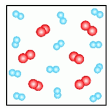

What does this illustrate
Elements
Compunds
Mixture of Elements and Compunds
Mixture of Compounds

This picture represents which of the following?
A single element
Mixture of molecules
mixture of atoms
mixture of compounds

A beaker containing solid carbon dioxide is placed in a fume cupboard at room temperature. The
carbon dioxide becomes gaseous.
Which process describes this change of state?
Boiling
condensation
evaporation
sublimation

The table below shows information about two isotopes of element X.
Calculate the relative atomic mass (Ar) of element X. Give your answer to 1 decimal place
(a)

Which diagram shows a gas?
A
B
C
D
E
The atomic number is the number of (a) ?
Which of these particles has a positive charge?
electron
proton
neutron
Which of these particles does not have an electrical charge?
electron
proton
neutron
What is the relative mass of a proton?
0.0001
0.001
2
1
What is found in the nucleus?
protons and electrons
neutrons and electrons
neutrons and protons
protons, neutrons and electrons


In a neutral atom,
protons = electrons
protons = neutrons
neutrons = electrons
protons = neutrons = electrons

How many protons does Nitrogen have?
7
8
14
14.01
If an element has an atomic number of 11 and a mass number of 23, how many neutrons does it have?
11
12
23
34
An element has 17 protons and 18 neutrons in the nucleus. What is the element's mass number?
17
18
1
35

Which of the labeled structures is an electron?
a
b
c

Which of the labeled structures is a neutron?
a
b
c
How many electrons can the first shell hold?
4
8
2
18
What is an element?
A combination of two or more substances that are chemically combined
A pure substance made of two or more elements chemically combined
A substance made of atoms with different numbers of protons
A substance made of atoms that all contain the same number of protons
What is a compound?
A mixture of elements that can be separated by physical means
A pure substance made of two or more elements chemically combined
A combination of two or more substances that are not chemically combined
A substance made of atoms that all contain the same number of protons
What is the charge of a neutron?
1+
1-
2+
Neutral
What does the atomic number represent?
The number of neutrons in an atom
The mass of an atom
The total number of protons and neutrons in the nucleus
The number of protons in the nucleus of an atom
How many electrons can the first shell hold?
4
8
2
18
What is the electronic configuration of sodium?
2,8,1
2,8
2,1
2,8,2
What are isotopes?
Atoms of different elements with the same number of protons
Different atoms of the same element with different numbers of neutrons
Atoms that have the same mass number
Atoms that are chemically combined
What is the relative atomic mass unit based on?
The mass of a nitrogen atom
The mass of a hydrogen atom
The mass of a carbon-12 atom
The mass of an oxygen atom
Which of the following is a characteristic of noble gases?
They have full outer shells of electrons
They are highly reactive
They have no electrons
They are found in Group I
What is the mass number of an atom?
The total number of protons and electrons
The total number of protons and neutrons
The number of neutrons only
The number of protons only
75% of naturally occurring chlorine is Cl-35. The remaining chlorine is Cl-37. Which of the below equations shows how to calculate the relative atomic mass of chlorine?
(75x37) + (25x35) / 100 = 35.5
(75x35) + (25x37) / 100 = 35.5
(75x37) + (25x35) / 100 = 35
(75x35) + (25x37) / 100 = 37
A solution containing the maximum amount of dissolved solute is referred to as...
Unsaturated
Insaturated
Asaturated
Saturated
If you were using simple evaporation, what would you be trying to separate?
A soluble solid from a liquid
A mixture of two solids
An insoluble solid from a liquid
A mixture of two or more liquids
If you were using distillation, what would you be trying to separate?
A soluble solid from a liquid
A mixture of two solids
An insoluble solid from a liquid
A mixture of two or more liquids

What is the electron configuration of the ion this atom would form?
2,6
2,7
2
2,8
Why are the noble gases so unreactive?
They made a group decision not to react
They have a large number of electrons
They don't like to give up electrons
They have a full outer shell of electrons

What is the correct description of this atom?
It has an atomic number of 3, and an atomic mass of 5
It has an atomic mass of 6, and an atomic number of 6
It has an atomic number of 3, and an atomic mass of 6
It has an atomic mass of 6, and an atomic number of 9
Which of the following is the Bohr Model of Nitrogen?


What is wrong with this Bohr Model of Oxygen?
The nucleus needs should have electrons.
There are not enough electrons in the first orbital.
This is actually correct.
The electron pairing is incorrect.
This is the Bohr Model of Sulfur.
Which of the following is the Bohr Model of Silicon?


What are the three main groups of the periodic table?
groups
metal
nonmetals
metalloids
periods
What do the vertical columns on the periodic table tell us?
The number of orbitals
The number of valence electrons (electrons on the outer most shell)
What do the horizontal rows on the periodic table tell us?
The number of orbitals
The number of valence electrons (the electrons on the outer most shell)
N or C?
Who created the first Periodic Table
Dmitri Mendeleev
Albert Einstein
Planck
Heisenberg
Which of the following elements is in the same period as Phosphorus?
Sodium
Oxygen
Neon
Gold
Most of the elements are in the________________ category.
Noble gases
Metals
Non-metals
metalloids
Which of the following is an alkali metal?
Tin
Carbon
Nitrogen
Lithium
Which of the following elements is a metal?
H
Ar
Zn
B
Li, Cs, and Na belong to
Transition metals
Halogens
Alkali metals
Alkaline Earth metal
Hydrogen can be classified as
Metal
Nonmetal
Alkali metal
Transition metal
As the atomic number increase, ______________ contributes to the increase in atomic size within a group in the periodic table.
a. Electron repulsion
b. More shielding of the nucleus by electrons from inner to outer energy levels
c. The proton number
d. The ionic energy
Elements in the same group of the periodic table always have the same number of _______ as one another.

What type of elements are poor conductors of heat and electricity?
transition metals
inner transition metals
metals
nonmetals
Neutron are a sub-atomic particle that
Is found in the nucleus
flying around the nucleus
have a positive charge
have a negative charge
What property is the same for every atom of an element?
energy
mass number
atomic number
number of neutrons

Rubidium is in Group I of the Periodic Table and bromine is in Group VII. Rubidium reacts with bromine to form an ionic compound. Which row shows the electron change taking place for rubidium and the correct formula of the rubidium ion?
A
B
C
D
The relative atomic mass of chlorine is 35.5. When calculating relative atomic mass, which particle is the mass of a chlorine atom compared to?
a neutron
a proton
An atom of carbon - 12
an atom of hydrogen - 1

Neon is colorless, a poor conductor of heat and is not able to be stretched. How would it be classified?
Nonmetal
Metalloid
Metal
None of the above
Which group of the periodic table is composed of inert (not reactive) gases?
answer choices
alkali metals
alkaline earth metals
halogens
noble gases
Which is a halogen?
Helium
Chlorine
Oxygen
Neptune
Elements in a .................. have similar chemical properties.
period
group
row
I am a nonmetal
I am in period 2
I am in group 16
Ba
Si
O
S
These two elements have similar chemical properties to Barium (Ba).
Ca and Ra, because they are in the same group.
Cs and La, because they are in the same period number.
Ca and Y, because they are 90 degree angle.

What type of oxide do metals typically form?
Amphoteric oxides
Neutral oxides
Basic oxides
Acidic oxides
What type of oxide do metals typically form?
Amphoteric oxides
Neutral oxides
Basic oxides
Acidic oxides
What is an element?
A combination of two or more substances that are chemically combined
A pure substance made of two or more elements chemically combined
A substance made of atoms with different numbers of protons
A substance made of atoms that all contain the same number of protons
What is a compound?
A mixture of elements that can be separated by physical means
A pure substance made of two or more elements chemically combined
A combination of two or more substances that are not chemically combined
A substance made of atoms that all contain the same number of protons

