

wayground logo

Free Printable Worksheets

NEW

Font size

S
M
L
XL
Worksheets

Renaissance and Reformation Quiz

Total questions: 42

Worksheet time: 21mins

Name
Class
Date
1.

Which Italian city-state was the center of the Renaissance?

a)
Venice
b)
Milan
c)
Rome
d)
Florence
2.

What does Renaissance mean?

a)
Stagnation or regression
b)
Modern or contemporary
c)

Rebirth or revival of Greek and Roman arts

d)
Death or decline
3.

Which city-state was around Rome and controlled by the Church?

a)
Florence
b)

Venice

c)

Papal States

d)

Milan

4.

Which city-state lagged behind the other Italian city-states during the Renaissance?

a)
Rome
b)
Venice
c)
Naples
d)
Florence
5.

What Renaissance ideal focused on human potential and achievements?

a)
Individualism
b)
Materialism
c)
Humanism
d)
Relativism
6.

What book describe the ideal Renaissance man and woman?

a)
The Book of the Knight
b)
The Book of the Princess
c)
The Book of the Courtier
d)
The Book of the Peasant
7.

Which of the following is NOT a characteristic of Renaissance art?
a)
Emphasis on religious themes
b)
Flat and two-dimensional representation
c)
Use of bright and vivid colors
d)
Incorporation of perspective
8.

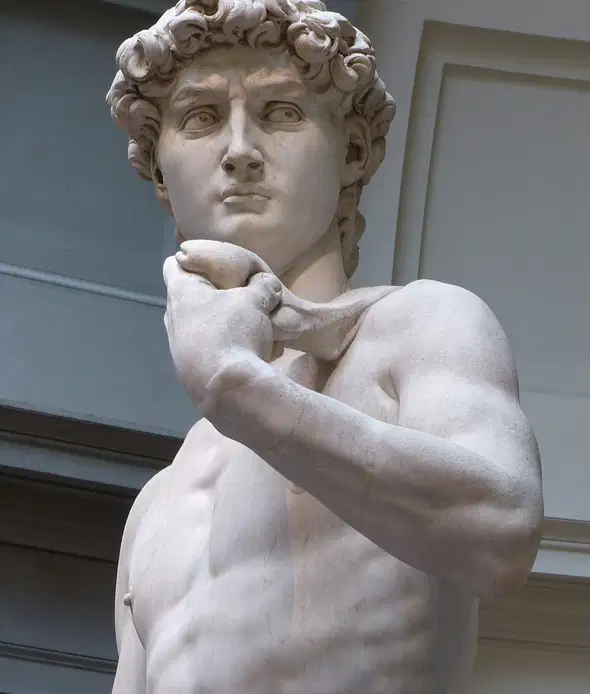
Name the artist.

a)
Vincent van Gogh
b)
Pablo Picasso
c)
Leonardo da Vinci
d)

Michelangelo.

9.

Name the art piece.

a)

Madonna and Child

b)

School of Athens

c)

La Pieta

d)
Mona Lisa
10.

Which piece of Renaissance literature is a book of advice for rulers and leaders?

a)
The King
b)
The Prince
c)
The Emperor's Handbook
d)
The Leader's Guide
11.

Who wrote The Prince?

a)
Leonardo da Vinci
b)
Niccolò Machiavelli
c)
William Shakespeare
d)
Vincent van Gogh
12.

Which family dominated Florence?

a)
Medici
b)
Gonzaga
c)
Sforza
d)
Borgia
13.

The Medici Family was associated with which business?

a)
Agriculture
b)
Technology
c)
Banking and finance
d)
Fashion
14.

Which of the following is a characteristic of paintings from the Northern Renaissance?

a)
Bright and vibrant colors
b)
Abstract shapes and patterns
c)
Detailed landscapes and everyday life
d)
Minimalist and monochromatic
15.

What is the Northern Renaissance principle that combined religion and classical studies?

a)
Greek Humanism
b)
Roman Humanism
c)
Christian Humanism
d)
Islamic Humanism
16.

Who wrote Utopia?

a)
Jane Austen
b)
Sir Thomas More
c)
George Orwell
d)
William Shakespeare
17.

In Praise of Folly was a criticism of what?

a)

Kings and knights

b)

Science and technology

c)

Renaissance art and literature

d)

The Catholic Church and society

18.

Who wrote In Praise of Folly?

a)

Erasmus

b)

Thomas More

c)

Baldassare Castiglione

d)
William Shakespeare
19.

Which British author was known for his plays like Hamlet and Romeo and Juliet?

a)
Jane Austen
b)
Charles Dickens
c)
J.K. Rowling
d)
William Shakespeare
20.

Who invented the printing press?

a)
Isaac Newton
b)
Leonardo da Vinci
c)
Albert Einstein
d)
Johannes Gutenberg
21.

Where was the printing press invented?

a)
Italy
b)
China
c)
France
d)
Germany
22.

During the Renaissance and Reformation, there was a movement in writing to use

a)

Latin

b)

Vernacular

c)

Greek

23.

Who wrote the 95 Theses?

a)
Christopher Columbus
b)
Leonardo da Vinci
c)
Isaac Newton
d)
Martin Luther
24.

What was Luther's main criticism of the Church in the 95 Theses?

a)
Sale of indulgences and corrupt practices
b)
Support for social justice and equality
c)
Advocacy for religious tolerance and diversity
d)
Promotion of education and literacy
25.

Which of the following is NOT part of Luther's theology?

a)

Salvation through faith alone

b)

Supremacy of Scripture

c)

People could interpret the Bible on their own

d)

Indulgences were useful

26.

Who was the political leader that presided at the Diet of Worms?

a)
Cleopatra
b)
Charles V
c)
Napoleon Bonaparte
d)
Henry VIII
27.

What was the agreement that said, "He who rules chooses the faith"?

a)
Peace of Augsburg
b)
Treaty of Tordesillas
c)
Munich Agreement
d)
Treaty of Versailles
28.

Who started the Church of England?

a)
King Henry VIII
b)

John Knox

c)
Queen Elizabeth I
d)

John Calvin

29.

Why did Henry VIII start the Church of England?

a)
He wanted to start a new religion
b)
He was influenced by the Protestant Reformation
c)
He wanted to unite England and Scotland under one church
d)
He wanted to divorce his first wife and the Pope refused to annul their marriage.
30.

Who came up with the idea of predestination?

a)
Pope Francis
b)
Mother Teresa
c)
John Calvin
d)
Martin Luther
31.

What type of government did Calvin institute in Geneva?

a)
Monarchy
b)
Oligarchy
c)
Anarchy
d)
Theocracy
32.

Which religious group believed that only adults should be baptized?

a)
Hindus
b)
Anabaptists
c)
Buddhists
d)
Catholics
33.

Which Dominican friar warned about the vanity of the arts in Renaissance Florence?

a)
Leonardo da Vinci
b)
Michelangelo
c)
Galileo Galilei
d)
Girolamo Savonarola
34.

Who created the Jesuit order?

a)
Ignatius of Loyola
b)
Henry VIII
c)
John Calvin
d)
Martin Luther
35.

One of the main goals of the Jesuits was to

a)

Educate

b)

Reform the church

c)

Expand the arts

d)

Translate Catholic texts into the vernacular

36.

The Catholic Council associated with the Catholic Reformation was

a)
Council of Trent
b)
Council of Nicaea
c)
Council of Florence
d)
Council of Rome
37.

Who created the Ursuline Order?

a)

St. Teresa of Avila

b)
Mother Teresa
c)
St. Angela Merici
d)
St. Francis of Assisi
38.

Which Pope is most associated with the Catholic Reformation?

a)
Pope John XXIII
b)
Pope Benedict XVI
c)
Pope Paul III
d)
Pope Francis
39.

The Spanish Inquisition mainly targeted which groups?

a)
Catholics, Protestants, and Buddhists
b)
Atheists, Agnostics, and Hindus
c)
Vegetarians, Vegans, and Pescatarians
d)

Jews and Muslims

40.

What religious conflict was directly caused by Luther's teachings?

a)

The Thirty Years' War

b)

The German Peasants' Revolt

c)

The French Wars of Religion

d)

The Dutch Revolt

41.

The Thirty Years' War started with which event?

a)
American Revolutionary War
b)
Signing of the Treaty of Versailles
c)
Defenestration of Prague
d)
Battle of Waterloo
42.

Which religious group was targeted in the St. Bartholomew's Day Massacre?

a)

Huguenots

(French Calvinists)

b)
Catholics
c)
Protestants
d)
Jews
