
 Worksheets
Daily Life in the Roman Empire
Total questions: 14
Worksheet time: 7mins
Name
Class
Date
1.
How was the Roman Empire impacted by the poor outnumbering the rich?
a)
Foreigners did not travel to Rome, as they knew about the poverty problem.
b)
Poor living conditions for the masses made crime and disease common.
c)
Since many of the poor lived in the countryside, there were plenty of farmers.
d)
Soldiers avoided walking in the streets for fear of being attacked by angry mobs of poor Romans.
e)
The emperors had to provide free food and entertainment to keep the poor from revolting.
2.
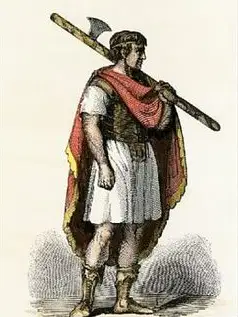
When bodyguards removed the axes from their fasces, what did it represent?
a)
That they could beat any armed man, even without a weapon.
b)
The Roman Empire was interested in promoting peace.
c)
Bodyguards worried that thieves would steal the valuable metal blades.
d)
That Roman citizens could appeal a legal ruling against them.
e)
To encourage citizens around them that the streets of Rome were safe to be in.
3.
The Romans were very invested in honoring their gods. What are some ways they attempted to do so?
a)
It was made clear the emperors were lower status then guards.
b)
They left gifts at the many temples and shrines within Rome.
c)
No new religions were allowed within the Roman empire.
d)
They would sacrifice animals in the name of various gods.
e)
Various “holy days“ to honor the guards were held throughout the year.
4.
How did Romans and Egyptians view their children differently?
a)
Roman children were expected to be the main providers for their families.
b)
Egyptian families generally raised all of their children.
c)
Romans preferred girls to boys, as they could give birth and were therefore more god-like.
d)
In Rome, the eldest son held the same status as paterfamilias.
5.
What were thermopolia?
a)
Massive grills that wealthy families kept in their homes for cooking large meats.
b)
Salty fish sauces that were preserved in clay jars.
c)
Fast-food places where Romans could buy ready-to-eat food.
d)
Animals that merchants kept on display to attract customers.
6.
For wealthy Romans, the fanciest space in their homes was often the
a)
music room.
b)
indoor pool.
c)
atrium.
d)
dining room.
7.
Select the modern-day occupations that a woman in Rome could hold.
a)
dentist
b)
doctor
c)
real estate agent
d)
soldier
8.
Select the forms of recreation that BOTH rich and poor could attend in Rome.
a)
Gladiator Fights
b)
Musical Performance
c)
The Theater
d)
Public Baths
9.
What percent of people in the Roman Empire lived in the city of Rome?
a)
more than 90%
b)
less than 90%
c)
around 30%
d)
less than 10%
10.
the oldest male of a Roman household; his word was law for the family
a)
Circus Maximus
b)
Colosseum
c)
rule of law
d)
paterfamilias
e)
Forum
11.
a large arena in Rome where gladiator contests and other games and sporting events were held
a)
Circus Maximus
b)
Colosseum
c)
rule of law
d)
paterfamilias
e)
Forum
12.
the idea that people should live according to a set of agreed-upon laws
a)
Circus Maximus
b)
Colosseum
c)
rule of law
d)
paterfamilias
e)
Forum
13.
a large Roman stadium primarily used for chariot races
a)
Circus Maximus
b)
Colosseum
c)
rule of law
d)
paterfamilias
e)
Forum
14.
the center of most of the important public activities of the city Rome and its empire
a)
Circus Maximus
b)
Colosseum
c)
rule of law
d)
paterfamilias
e)
Forum
100 %

