
 Worksheets
Final exam geol1340 prep
Total questions: 75
Worksheet time: 43mins
Rocky or rigid outer part of Earth consisting of the brittle crust and the top part of the upper mantle
Lithosphere
Oceanic Crust
Continental Crust
Asthenosphere
Mantle convection is the very slow creeping motion of Earth’s solid silicate mantle caused by convection currents carrying heat from the interior to the planet's surface.
Lithosphere
Earthquake
Convection Currents
Core
Solid, outer layer and is made of both the oceanic and continental crust.
Hydrosphere
Core
Mantle
Crust
Hot fluid or semi-fluid material below or within the earth's crust from which lava and other igneous rock is formed on cooling.
Convection Current
Lithosphere
Core
Magma
The thick part of the earth's crust that forms the large landmasses. It is generally older and more complex than the oceanic crust.
Oceanic Crust
Continental Crust
Magma
Inner Core
In the region where two continental plates collide, what geological feature MOST often forms?
an ocean
a volcano
a river valley
a mountain chain
Crustal plates that pull apart from one another MOST likely form
volcanic island arcs
strike-slip faults
oceanic trenches
rift zones
Which two plates collided with each other to form the Himalayan Mountains?
Nazca and Eurasia
Indo-Australian and Eurasian
North America and Antarctic
South American and Indo-Australian
Which of these tectonic plate boundaries is most likely to form a volcano.
a continental plate colliding with a continental plate
an oceanic plate sliding past a continental plate
a continental plate sliding past a continental plate
an oceanic plate colliding into a continental plate
What causes the tectonic plates to continually to move?
Convection currents
Volcanic and seismic activity
Strong winds and storms
Rotation of the solid core
Which statement best describes why fossils of the same land-dwelling species have been discovered in both South America and Africa?
The organism migrated to two continents
The organisms were separated by the formation of new mountain ranges
The organisms became extinct due to climate change on these continents
These organisms once lived on one large landmass that later split into two continents
A satellite image can help scientist locate the area where two plates have diverged by showing the existence of
Plateaus
Mountains
Rift Valleys
Grassy Plains


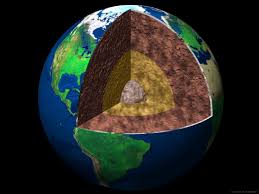
The soft layer of rock that the lithosphere moves on is the _________________________.
core
asthenosphere
lithosphere
crust

Which layer of Earth is characterized by rock that is like plastic, or soft enough to flow?
asthenosphere
crust
lithosphere
inner core
Oceanic crust is _____ than continental crust.
denser
less dense
____ takes place in the mantle.
conduction
convection
radiation
A divergent boundary occurs where plates ....
Pull apart
Come together
Slide past each other
subducting
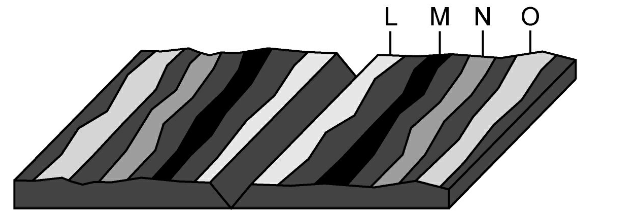
How is it possible for new crust to be formed without increasing the surface area of the Earth?
Crust is recycled in subduction zones at the same time it is created at mid-ocean ridges
New crust is underwater where it sinks
New crust breaks more easily than old crust
The oldest crust just breaks apart as the plates move

The average density of continental crust is 2.8 g/cm3 and the average density of oceanic crusts is 3.2 g/cm3. If these two plates came together, what would happen?
The two plates would push apart and form a rift zone.
The oceanic plate would rise up over the continental plate.
The oceanic plate would sink under the continental plate.
The two plates would meet head on and rise up to form mountains.
Scientists use ______ to map the ocean floor
radar
pulsar
lidar
sonar

At its oldest, ocean crust is about __________ years old
300-350 million
180-200 million
3.5 billion
10-20 million
The OLDEST seafloor is located
closest to the mid-ocean ridge.
farthest from the mid-ocean ridge.
east of Hawaii
west of California
Which of the following supports the theory of seafloor spreading?
Correlation of rock layers
Crustal slab pull
Magnetic reversals recorded in rocks
Continuous mountain chains

Seafloor spreading...
creates new oceanic crust
destroys or recycles crust
creates new continental crust
creates old crust
Rock at the mid ocean ridges...
is the oldest rock on the earth.
is older than continental rock.
is younger than continental rock.
The magnetic pattern of ocean-floor rocks on one side of an ocean ridge is_____________.
a mirror image of that on the other side
younger than other side
much different pattern
at right angles to the ridge
The study of the Earth's magnetic record is called
ridge push
convection
paleomagnetism
subduction
A change in Earth' s magnetic field is called a
magnetic reversal
subduction
paleomagnetism
slab pull

Which of Earth's layers produces its magnetic fields?
asthenosphere
mantle
outer core
inner core
Which of the following does NOT support the theory of seafloor spreading?
pillow shaped rocks show that magma seeps into the ocean at divergent plate boundary
oldest rocks are farthest away from the mid-ocean ridge and youngest rocks are at the ridge
magnetic reversals recorded in the ocean crust match up together on each side of the mid-ocean ridge
the youngest rocks are farthest away from the mid-ocean ridge and the oldest are at the ridge
The Pacific Ocean is shrinking because
water is evaporating quickly near the Equator
ocean crust in the Pacific is getting recycled faster than it's being created
it has less glaciers melting into it than the Atlantic
the plates are converging
What type of plate activity is creating the Himalayas?
divergence of the Indian Ocean and Asia
convergence of India and Asia
strike slip faulting
subduction
Mid-ocean ridges can be found in
the Atlantic and Pacific Oceans
the Pacific and the Indian Oceans
all of Earth's oceans
only the Atlantic Ocean

