
Font size
 Worksheets
Review for semester test Part 2 2024
Total questions: 80
Worksheet time: 3hrs 36mins
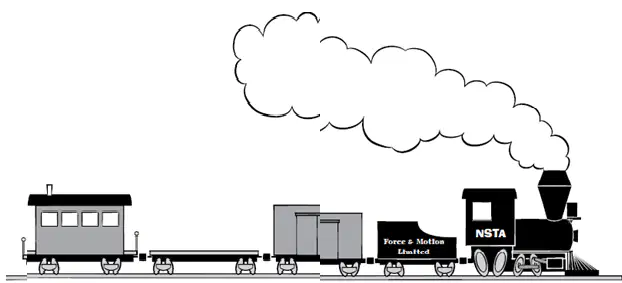
A train is moving along a straight section of track at a constant speed. Which of the following statements about the train are true?
A.If the train is moving at constant speed, there must be no forces at all acting on the train.
B. If the train is moving at a constant speed, then any forces that might be acting on the train must cancel out.
C.There must be an unbalanced force acting on the train to keep it moving at a constant speed.
D.The train must have a force acting on it larger than the train’s inertia in order to keep moving.
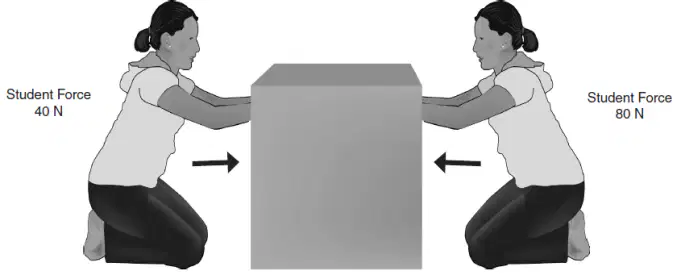
. If the student on the right applies 80 N of force, what is the net force?
A.40 N to the right
B 40 N to the left
C.80 N to the left
D.120 N to the right

Which of the following orders the rock layers accurately from oldest to youngest?
1, 2, 3, 4, 5
5, 4, 3, 2, 1
2, 3, 4, 5, 1
1, 2, 3, 5, 4


Which fossil is considered the oldest in the cross section shown?
armored fish
early horses
trilobites
dinosaurs

What is the average speed of the object at 8 seconds?
10 m/s
80 m/s
100 m/s
8 m/s

The motion of a ball is shown in the graph. Calculate the average speed of the ball represented in the graph.
0.2 m/s
0.1 m/s
0.5 m/s
5.0 m/s
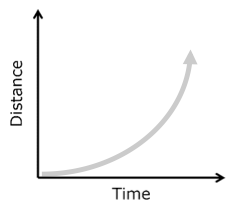
This graph demonstrates an object that is -
Increasing speed
At a constant speed
Slowing down
Stationary

According to the graph how far does the person travel in the first 5 seconds?
2m
0m
10m
5m

Calculate the average speed between 0 and 10 hours.
2 km/h
3 km/h
1 km/h
5 km/h

Calculate the average speed of the object between 1 and 3 seconds.
20 m/s
1 m/s
30 m/s
12 m/s
How does thermal energy move between objects?
It moves from objects of lower mass to objects with higher mass.
It moves from objects of higher mass to objects with lower mass.
It moves from objects of lower temperature to objects with higher temperature.
It moves from objects of higher temperature to objects with lower temperature.

In the image above, which type of heat transfer is represented by the number 1?
conduction
convection
latent heat
radiation


What heat transfer happens when you burn your finger by touching a fire?
Convection
Radiation
Conduction
Gravity

Walking on the warm sand with your bare feet demonstrates this type of heat transfer.
conduction
radiation
convection
insolation



Identify the landform labeled A
mid-ocean ridge
deep ocean trench
sea floor spread
What is the process by which the ocean floor sinks beneath a deep ocean trench and back into the mantle?
continental drift
mid-ocean ridge
faults
subduction


Sunken land surface due to underlying compression of earth material as a result of the removal of groundwater is
subsidence
point source water pollution
groundwater
Dotties water bowl

A student’s model of an area near a city depicts many activities that affect the quality of the water in the area. How does the agricultural activity most likely affect the surface water of the area?
Crops absorb pure water from soil, causing the remaining water to contain more salt.
Crops reduce erosion, increasing the amount of soil entering the river.
Excess crop fertilizer is carried by runoff into the river, causing excess growth of water plants.
Excess crop material accumulates on the riverbanks, slowing the movement of the river water
When runoff crosses the land, it picks up fertilizers that have been used on crops and lawns. These contaminants will eventually enter a lake, river or stream, which may lead to -
the earth’s surface to sink.
the water in an aquifer to drop.
harmful rapid growth of algae.
cleaner water for drinking and bathing.

The proposed law will protect the lake because plant roots between the wetland and the lake will stop pollution from entering the lake.
The proposed law will not protect the lake because animals that live in or near the lake will add pollution to the lake.
The proposed law will not protect the lake because groundwater will carry pollution from the wetland directly into the lake
The proposed law will protect the lake because the high elevation of the water table will block pollution from entering the lake.

What happens when a fertilizer runoff happens?
Algae grow rapidly.
Fish get bigger.
The water becomes very clear.
What is "overfishing"?
Fishing out of season
Catching fish faster than they can replenish
Catching fish from the top of the food chain
Catching more fish than what people eat
Many changes occur in the digestive system. Which process is classifies as a chemical change?
Taking a bit of an apple.
Digestive enzymes breaking down proteins into smaller fragments
Esophagus moving food to the stomach
Teeth grinding an almond into smaller pieces in the mouth


Which student correctly recorded all the changes that took place?

Identify the solvent in salt solution
Water
Salt
Sugar

Which is an example of a solvent?
Salt
Water
Sugar
Powdered ice tea mix

If a spoonful of salt is mixed into a glass of water, what is the water called?
Solute
Solvent
Solution
Element

As part of an investigation, students combined substances in a beaker to observe chemical reactions. They performed two procedures. They measured the mass of each substance before and after each reaction. The table shows their observations.
Assuming the students did not make any careless errors, what likely explains these changes in mass?
Procedure 1: One of the products was a gas that escaped into the air. Procedure 2: A gas from the air reacted with one of the other reactants.
Procedure 1: The reactants were liquids with different densities. Procedure 2: The reactants were combined into only one product.
Procedure 1: One of the reactants was converted to thermal energy. Procedure 2: All the products were liquids.
Procedure 1: All the reactants were liquids that evaporated. Procedure 2: A gas was formed as one product, and it escaped into the air.

Four students were asked to complete a table for a science assignment. Each student selected one chemical element from each of four groups in the periodic table and then classified each element as a metal, a nonmetal, or a metalloid. Which table was completed correctly?


Both the esophagus and the small intestine are involved in the digestion of food. The esophagus squeezes food into the stomach by wave-like muscle contractions. Peptidase enzymes in the small intestine break food molecules into smaller molecules. Which statement best describes changes to food during digestion?
The muscle contractions result in physical changes, while the action of the peptidase results in chemical changes.
The muscle contractions and the action of the peptidase both result only in physical changes.
The muscle contractions result in chemical changes, while the action of the peptidase results in physical changes.
The muscle contractions and the action of the peptidase both result only in chemical changes.

Which statement does NOT correctly compare silicon with another element?
Silicon is a better conductor of electricity than sulfur.
Silicon conducts electricity as well as copper does.
Silicon is a solid at room temperature, but argon is a gas.
Silicon is less malleable than silver.
Which statement correctly describes the location and charge of the electrons in an atom?
The electrons are inside the nucleus and have no charge.
The electrons are outside the nucleus and have no charge.
The electrons are inside the nucleus and have a negative charge.
The electrons are outside the nucleus and have a negative charge.

The table lists some compounds found in foods and their formulas.
Based on this information, which of these statements is NOT true?
A molecule of sorbitol contains three more oxygen atoms than a molecule of glutamine does.
A molecule of lactose contains twice as many atoms as a molecule of fructose does.
A molecule of fructose contains four more atoms than a molecule of glutamine does.
A molecule of lactose contains twice as many carbon atoms as a molecule of sorbitol does.

A chemist made the table below to record some atomic properties of four elements.
Based on the information in the table, which conclusion about the chemical reactivity of these elements is valid?
Boron is the most reactive because it has the most protons.
Fluorine is the most reactive because it has 7 electrons in the outer shell.
Silicon is the most reactive because it has an equal number of protons and neutrons.
Gallium is the most reactive because it has many more neutrons than protons.
A silver ring reacts with compounds containing sulfur in the air to form silver sulfide, a black substance that makes up the tarnish on the surface of silver objects. To remove the tarnish from the ring, students placed it in a pan lined with aluminum foil and added hot water. Baking soda was added to the hot water and stirred. Students made observations about the process. Which observation of this process provides evidence of a chemical reaction?
Hot water heated the aluminum foil.
The liquid solution changed color.
The pan was lined with aluminum foil.
The hot water cooled.

Which pair of properties describes the elements in Group 18?
They are chemically stable and liquid at room temperature.
They have eight valence electrons and are flammable.
They are magnetic and boil at low temperatures.
They are gaseous at room temperature and chemically stable.
What is the total number of protons, neutrons, and electrons in a cadmium, Cd, atom that has a mass number of 112?
(a)

A manufacturer selected a metal to use in producing a lightweight button for clothing. A metal that has a density of 2.71 g/cm3 was selected.
Which of the metals was selected?
Metal 1
Metal 2
Metal 3
Metal 4
What happens to the concentration of a solution when more solvent (water) is added?
It increases
It decreases
It remains the same
It doubles
Which factor does NOT affect the rate of dissolution of a solid solute in an aqueous solution?
Temperature
Surface area
Agitation
Color of the solute
If you increase the temperature of a solution, what generally happens to the rate of dissolution of a solid solute?
It decreases
It increases
It remains the same
It doubles
How does increasing the surface area of a solid solute affect its rate of dissolution?
It increases the rate
It decreases the rate
What is the effect of stirring (agitation) on the rate of dissolution of a solid solute in an aqueous solution?
It decreases the rate
It increases the rate
Which of the following actions would decrease the concentration of a solution?
Adding more solute
Adding more solvent
How does temperature generally affect the solubility of a solid solute in water?
Solubility decreases with increasing temperature
Solubility increases with increasing temperature
Emma is making a sugar solution for her science experiment. What is the substance being dissolved in the solution?
sands
solute
solvent
alloy

A student adds solid NaNO3 to a beaker of water. After stirring, the NaNO3 can no longer be seen. What is the solvent?
water
sodium
nitrate
sodium nitrate
Which of the following is an example of a simple procedure to dilute a concentrated solution?
Adding more solute
Adding more solvent
Heating the solution
Cooling the solution
Explain how surface area affects the rate of dissolution of a solid solute in an aqueous solution.
Larger surface area decreases the rate of dissolution
Larger surface area has no effect on the rate of dissolution
Larger surface area increases the rate of dissolution
Larger surface area makes the solute insoluble
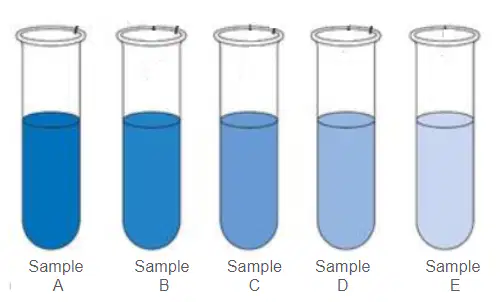
An experiment was conducted in science class involving aqueous solutions. Which sample is the most diluted?
Sample A
Sample B
Sample C
Sample D
Sample E
Label the types of Heat Transfer that all happen in the atmosphere
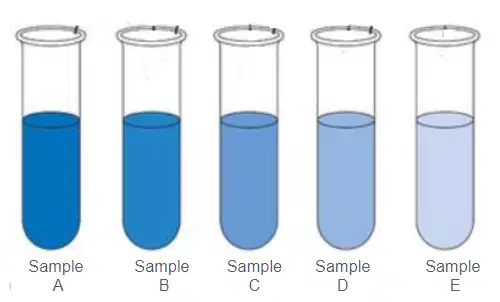
Which sample has the largest amount of solutes?
Sample A
Sample B
Sample C
Sample D
If the temperature of a solvent is decreased, the rate of dissolution will INCREASE / DECREASE because…
Why does the rate of dissolving increase as the temperature increases?
The solute molecules move faster at higher temperatures
The solute particles become smaller at higher temperatures
The solvent molecules become slower at higher temperatures
What is the effect of agitation on the rate of dissolving?
What is the effect of agitation on the rate of dissolving?
It decreases the rate of dissolving
It has no effect on the rate of dissolving
It increases the rate of dissolving
It changes the color of the solute

What is the difference in dissolving time between a sugar cube and a teaspoon of granular sugar?
The sugar cube dissolves faster
The teaspoon of granular sugar dissolves faster
Both dissolve at the same rate
The dissolving time depends on the temperature of the solvent
Which of the following factors affects the rate of dissolution by exposing more solute particles to the solvent?
Surface area
Temperature
Agitation
Pressure
What combination would dissolve a solid solute the fastest?
high temperature, no stirring
no heat, no stirring
sugar cube, no heat
high temperature, stirring
What would dissolve most slowly?
Large crystals in stirred water
Large crystals in unstirred water
Small crystals in stirred water
Small crystals in unstirred water
Jackson is preparing a saltwater solution for his science experiment. Which of the following describes the concentration of the solution?
The amount of solute in a given amount of solvent
The temperature of the solution
The color of the solution
The volume of the solvent
Match these
Heat transfers through waves/rays
Radiation
Liquid (or air) heats up, speeds up and spreads out, becoming less dense. As it rises, it cools, slows, and comes back together. This increases density, making it sink again.
Convection
Heat transfers from objects that are touching.
Conduction
A student mixes two clear liquids together. After a few minutes, a white powdery solid can be seen settling on the bottom of the test tube. Which of the following is a conclusion that the student can draw based on these observations? The two clear liquids-
were pure substances before they were mixed
are toxic and should be handled with extreme caution
have gone through a chemical change in which a new substance called a precipitate was produced
have been stored too long and are no longer good

