
 Worksheets
TCI - Lesson 4 The Great Lakes - Study Guide
Total questions: 55
Worksheet time: 29mins

How many great lakes are there?
4
5
2
8

How were the great lakes formed?
They are the remains of the bathwater of dinosaurs.
They were formed due to cracks in the earth.
They were formed from the remains of glaciers from the last ice age.
They were formed as a result of global warming.

Lake Ontario connects to the Atlantic Ocean through what river?
St. Mississippi River
St. Ohio RIver
St. Guadalupe River
St. Lawrence River

The flow of the great lakes to the Atlantic Ocean goes as follows....
Lake Superior, Michigan, Huron, Erie, Ontario, St. Lawrence River
Lake Erie, Superior, Michigan, Ontario, Huron, Ohio River
Lake Ontario, Michigan, Erie, Superior, Landawanna River
Lake Ontario, Erie, Superior, Eddelston, Michigan, Mississippi River

An invasive species to the great lake system is which of the following......
Sea dragon
Sea turtle
Sea Lamprey
Sea bass

Which one is not a cause of pollution of water?
dumping hot water back into the lakes
filtering the water of the lakes
dumping chemicals into the lakes
placing empty water bottles in the water so fish can make homes from it

Which Great Lake is number 3?
Superior
Michigan
Huron
Ontario

Which Great Lake is number 1?
Huron
Ontario
Michigan
Superior

Which Great Lake is number 4?
Superior
Huron
Erie
Michigan

Which Great Lake is number 5?
Superior
Michigan
Huron
Ontario

Which Great Lake is number 2?
Huron
Michigan
Ontario
Superior
The Great Lakes hold ____________ of the world's freshwater.
nine-tenths
four-fifths
one-fourth
one-fifth
A massive sheet of ice believed to have once moved across North America, shaping the surface.
tectonic plate
ecosystem
glacier
meteor
The great lakes are located in ......
The United States
Canada
Between Canada and Mexico
Between The United States and Canada
Which term is best defined as a geographic area that includes all of the rivers and streams that flow into a lake or sea?
basin
landmass
plateau
watershed

Read the description below. Then decide which of the terms that follows best fits what is being described.
Insects feed on the algae and plants that grow in the Great Lakes. Tiny fish eat the insects. Larger fish feed on the small fish. Eagles and otters eat the larger fish.
Great Lakes habitat
Great Lakes watershed
Great Lakes food chain
Great Lakes freshwater ecosystem

Which of the following suffered most from DDT poisoning in the Great Lakes
fish-eating birds
large fish
small fish
tiny organisms

The sea lamprey and zebra mussel are part of which of these Great Lakes ecosystem problems?
wetland loss
invasive species
algae explosions
point-source pollution

What is the main difference between point-source and non-point-source pollution?
how toxic the pollution is
where the pollution comes from
what time of year the pollution occurs
what animals are harmed by the pollution

Which of these is a major reason for a growing water shortage in many countries?
habitat loss
invasive species
shrinking glaciers
population growth

Why are the Great Lakes often called “the fourth seacoast”?
Because the Great Lakes are filled with salt water, like the ocean
Because the Great Lakes are the world’s largest freshwater ecosystem
Because the Great Lakes are so large that they look and act like oceans
Because the Great Lakes are a watershed

Which of the following is a cause of habitat loss in the Great Lakes?
loss of forests and wetlands to industrial activity
introduction of invasive species
the harm DDT inflicts on birds
how smaller watersheds drain into larger watersheds

Use this diagram to answer question
Which of the following is the best definition of “food chain”?
a community of all the living things and the environment in an area
all of the feeding relationships within an ecosystem
a geographic area that includes all of the land and waterways that drain into a body of water
a series of plants and animals, each of which depends on the one below it for food
How were The Great Lakes formed?
Glaciers
Climate Change
Earthquake
Man Made

This image is an example of______
A food web
Dinner
Ecosystem
Food Chain
Which of The Great Lakes starts with an "H"
Hulan
Huron
Horicon
Harvey
Which of The Great Lakes starts with an E
Eraser
Eskimo
Erie
Enterio
Which of The Great Lakes starts with an "O"
Ontario
Onega
Oulu
Orchard
Which of The Great Lakes start with an M
Manitoba
Minnesota
Michigan
Madison
Which of The Great Lakes starts with an S
Summit
Spencer
Sparta
Superior
What is the Largest and Deepest Great Lake?
Huron
Erie
Michigan
Superior
True or False Zebra Mussels are invasive species
True
False
What species is an example of an invasive species in The Great Lakes?
Smallmouth bass
Walleye
Sea lamprey
perch
What is an example of an Invasive species in The Great Lakes
Alewives
salmon
fried fish
blue gill
Invasive species have no natural _______ (things that eat them)
dinner options
predators
enemies
friends
What river caught on fire in 1969 due to pollution
Mississippi River
Ohio River
Hudson River
Cuyahoga River
What is point-source pollution
Pollution from multiple places
Pollution from run-off
Pollution from a single place
What are invasive species?
Species native to an area
Nonnative species that overtake an ecosystem
Why is habitat loss bad?
When habitats are lost, the plants and animals that live there are often lost as well
It is not bad
There is more room for jobs and houses.
What is a wetland?
An area that is by the ocean
An area where there is no water
The area that connects lakes and rivers
an area where the soil is usually wet or covered with water
True or False: Human recreation (swimming, fishing, boating etc.) do not add to pollution
False
True
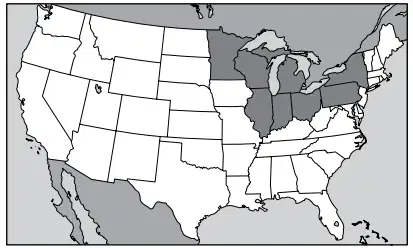
What is the best title for the map based on the shaded area?
The Northeast Region
The Canadian Border
The Great Lakes Region
The Midwest Tribal Lands
What does H.O.M.E.S. stand for?
The five Great Lakes
A place where people live
All the invasive species in The Great Lakes
How were the Great Lakes created?
by the clearing of forests
by the damming of rivers
by the melting of glaciers
by the shrinking of oceans
Which term best defined as a geographic area that includes all of the rivers and streams that flow into a lake or sea?
basin
landmass
plateau
watershed
Insects feed on algae and plants that grow in the Great Lakes. Tiny fish eat insects. Larger fish feed on the small fish. Eagels and others eat the larger fish.
Great Lakes habitat
Great Lakes watershed
Great Lakes food chain
Great Lakes freshwater ecosytem
Which of the following suffered the most from DDT poisoning in the Great Lakes
fish-eating birds
large fish
small fish
tiny organisms
The sea lamprey and zebra mussel are a part of which of these Great Lake ecosystem problems?
wetland loss
invasive species
algae explosions
point-source pollution

Which conclusion about Michigan is best supported by the graph ?
Housing areas are expanding.
Dairy farms are a leading industry
The lumber industry is shrinking.
Wetlands are becoming more polluted.
What is the main difference between point source and non-point source pollution
how toxic the pollution is
where the pollution comes from
what time of the year the pollution occurs
what animals are harmed by the pollution
Which of these is a major reason for a growing water shortage in many countries?
habitat loss
invasive species
shrinking glaciers
population growth
Which of the following is a cause of habitat loss in the Great Lakes
loss of forests and wetlands to industrial activity
introduction of invasive species
the harm DDT inflicts on birds
how smaller watersheds drain into larger watersheds
Which of the following is the best definition of "food chain"?
a community of all the living things and the environment in an area
all of the feeding relationships within and ecosystem
a geographic area that includes all of the land and waterways that drain into a body of water
a series of plants and animals, each of which depends on the one below it for food

Which species in the food chain depends on smelt to survive?
phytoplankton and lake trout
lake trout and herring gulls
only lake trout
only herring gulls
Suppose the water is polluted in such a way that all of the phytoplankton die. How might this affect this food chain?
The smelt would lose their food and die.
The smelt and lake trout would both lose their food sources and die.
The smelt, lake trout, and herring gulls would lose all their food sources.
They would not affect the food chain.

