wayground logo

Free Printable Worksheets

NEW

Font size

S
M
L
XL
Worksheets

Classification, Dichotomous Keys and Cladograms

Total questions: 33

Worksheet time: 1hrs 6mins
Name
Class
Date
1.
The 8 levels of classification, most broad to most specific.
a)
Domain, Genus, Family, Order, Class, Phylum, Kingdom, Species
b)
Domain, Species, Kingdom, Genus, Phylum, Family, Class, Order
c)
Domain, Kingdom, Phylum, Class, Order, Family, Genus, Species
d)
Domain, Kingdom, Species, Phylum, Family, Order, Class, Genus
2.

What is the genus name here:

Canis lupus

a)

Canis

b)

lupus

3.

The science of describing, classifying and naming living things is known as _______.

a)

Biology

b)

Taxonomy

c)

Sortology

d)

Phylogeny

4.
Binomial nomenclature is the ____________ system for naming organisms.
a)
Numerical
b)
Symbolical
c)
two word
d)
alphabetical
5.

Biologist group living things based on ____.

a)

Habitat

b)

Size

c)

Colors

d)

Shared Characteristics

6.
Which characteristics best describe the Kingdom Fungi?
a)
multicellular and unicellular, eukaryote, autotroph
b)
multicellular and unicellular, prokaryote, heterotroph
c)
multicellular, eukaryote, heterotoph
d)
multicellular and unicellular, eukaryote, heterotroph
7.
Which characteristics best describes the Kingdoms Eubacteria and Archaebacteria?
a)
unicellular, prokaryote, heterotroph
b)
unicellular, prokaryote, heterotroph and autotroph
c)
multicellular, eukaryote, autotroph
d)
multicellular, prokaryote, heterotroph and autotroph
8.
This kingdom is multicellular, autotrophic, and has a cell wall made of cellulose.
a)
Fungi
b)
Plant
c)
Animals
d)
Eubacteria
9.
What is an organism called when it is able to produce its own food using light energy?
a)
Heterotroph
b)
Autotroph
c)
Eukaryote
d)
Prokaryote
10.
What is an organism called when it is unable to produce its own food and must find an external source?
a)
Heterotroph
b)
Autotroph
c)
Eukaryote
d)
Prokaryote
11.

Unicellular, prokaryotic, autotroph

a)

bacteria

b)

protist

c)

animal

d)

plant

12.
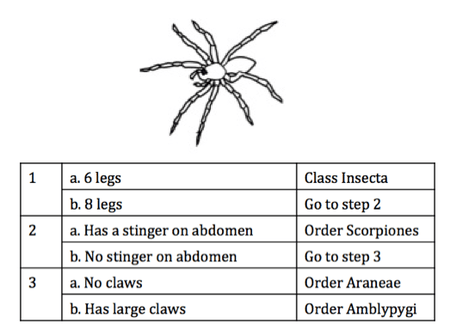
An illustration and a dichotomous key are given. What is the correct classification for this organism?
a)
Class Insecta
b)
Order Amblygygi
c)
Order Araneae
d)
Order Scorpiones
13.
Two organisms that are closely related would have
a)
very similar DNA sequence
b)
exactly the same DNA sequences
c)
no proteins in common
d)
completely different DNA sequence
14.

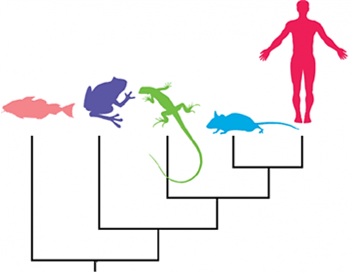
According to this phylogenetic tree, which creature is the least related out of all pictured?

a)

Fish

b)

Frog

c)

Salamander

d)

Human

15.

Which two groups of organisms have the MOST genetic DIFFERENCES?

a)

rotifers and nematodes

b)

mollusks and annelids

c)

mollusks and arthropods

d)

echinoderms and chordates

16.

The diagram shows a cladogram of six species based on amino acid similarities. Which two species are MOST CLOSELY related.

a)

I and II

b)

II and IV

c)

I and V

d)

V and VI

17.
From the table, which two animals are MOST CLOSELY related
a)
House Cate and Red Fox
b)
Red Fox and Dog
c)
Dog and Wolf
d)
Wolf and Gopher
18.
What is the purpose of a dichotomous key?
a)
to find a common ancestor
b)
to show the evolution of organisms
c)
to show relationships between organisms
d)
to identify organisms
19.
What step do we always start with when using dichotomous keys?
a)
1
b)
2
c)
3
d)
4
20.
When using a dichotomous key to identify organisms, what do we look at?
a)
physical features
b)
weather patterns
c)
environment
d)
diet
21.
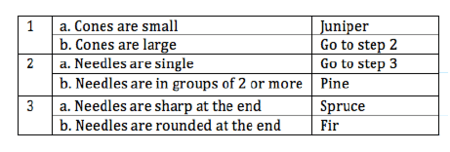
A dichotomous key for trees is provided. Hikers found a tree that has large brown cones and single sharp needles. What species of tree have the hikers found?
a)
Juniper
b)
Pine
c)
Spruce
d)
Fir
22.

How many options should every branch in a dichotomous key have?

a)

1

b)

2

c)

3

d)

4

23.
Using this dichotomous key, identity the name of the circled fish.
a)
band-tail puffer
b)
spotted goat fish
c)
peacock flounder
d)
trumpet fish
24.
Cells that have a true nucleus are called....
a)
eukaryotes
b)
prokaryotes
c)
unicellular
d)
multicellular
25.
What is the name of bird W?
a)
Certhidea
b)
Geospiza
c)
Camarhynchus
d)
Platyspiza
26.
What is the most primitive organism shown on the cladogram?
a)
chimp
b)
perch
c)
hagfish
d)
salamander
27.
A new species of animal is discovered and must be classified. Which would be the most important thing to study to determine its classification?
a)
what it eats
b)
where it lives
c)
how old it is
d)
its skeletal structure
28.
Which domain do humans belong to?
a)
Bacteria
b)
Eukarya
c)
Archae
d)
Eubacteria
29.
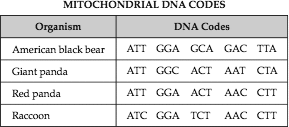
What conclusions can be made based on this table shown?
a)
the American black bear and the giant panda are most closely related
b)
the giant panda and the red panda are most closely related
c)
the red panda and the racoon are the most closely related
30.
Why do we use scientific names?
a)
Because we like to sound smart.
b)
Because they are recognized world wide.
c)
Because organisms only have one common name and it makes it easier.
d)
What? What are scientific names?
31.

What number is the common ancestor of C and D

a)

1

b)

2

c)

3

d)

4

32.

Which characteristics best describe the Kingdom Protista?

a)

unicellular and multicellular, eukaryote, heterotroph and autotroph

b)

unicellular, prokaryote, heterotroph

c)

multicellular, eukaryote, autotroph

d)

multicellular, prokaryote, heterotroph

33.

Which one is not a Domain of life?

a)

Bacteria

b)

Archaea

c)

Eukarya

d)

Animalia