
 Worksheets
Periodical Test - Air Quality
Total questions: 59
Worksheet time: 38mins
Ozone is made up of __________________ oxygen atoms.
3
2
1
5
The atmospheric layer (closest to planet Earth)that humans live in is known as the _____________________.
troposphere.
stratosphere.
exosphere.
thermosphere.
Chlorofluorocarbons is represented by the abbreviation _________________.
CFCs
ChFC
Chl
hydrocarbons
The most common source of carbon monoxide comes from _____________________________.
vehicles
swamp gases
industrial sources
none of these
Which of the following is an adverse health effect from air pollution?
allergic reactions
bronchial inflammation
eye and lung irritants
All of these are correct
"Criteria to be considered an air pollutant" was established by which federal agency?
Environmental Protection Agency (EPA)
Department of the Interior (DI)
Center for Disease Control (CDC)
United Nations (UN)
Which of the following is the most common source of carbon monoxide (CO):
vehicle emissions
swamp gases
industrial sources
solar panels
Chlorofluorocarbons is a chemical that has been banned across the world because it destroys ozone. Why do you think it has been banned?
It was reducing the amount of smog
It was reducing the ability of our atmosphere to protect against solar radiation
The world is trying to boycott the aerosol industry
It was increasing the amount of smog

You can find the AQI on your iPhones / androids weather app... What is AQI?
Air Quality Index - determines the amount of pollutants in your immediate area to see if there are any health risks
Average Quality Independent - determines the amount of pollutants in your immediate area to see if there are any health risks
Air Quality Intervention - determines what color the sunset will be

An AQI of 41 falls into the green category and means...
Safe for all
Unsafe for people in sensitive groups
Unhealthy for all people to spend a lot of time outside
Hazardous for anyone to be outside

An AQI of 188 falls into the red category and means...
safe for all people
safe except for people in sensitive groups
unhealthy for all people to spend a lot of time outside
hazardous for anyone to be outside

Which of the following are sources of primary pollutants? (Select all correct answers)
Airplanes
Cruise ships
Factories
Industrial practices
Agriculture

What is the overall trend of the number of unhealthy AQI days since the year 2000?
Upward trend
Constant trend
Downward trend
Which of the following could be responsible for the downward trend we see in this figure? (Select all correct answers)
Increasing popularity with electric vehicles
Catalytic converters on gas powered vehicles
Wet scrubbers on smokestacks
The burning of fossil fuels
Increased mining and construction operations
A type of pollution found both indoors and outdoors, which includes pollen, dander, soot, carbon, and dust.
Water droplets
Allergens
Particulate matter
Combustibles
Which of the following government agencies is responsible for the Clean Air Act?
the USGS
the USDA
the EPA
the MIHS
What is the major cause for noise & air pollution?
deforestation
oil spills
transportation
factories
Which chemical is mainly responsible for ozone thinning?
nitrites
nitrates
sulfur oxides
chlorofluorocarbons
Which of the following is not an example of a source of particulate matter?
salt from ocean spray
dust from land
ash from meteorites
all are sources of particulate matter
In which atmospheric layer is the ozone layer located?
troposphere
mesosphere
thermosphere
stratosphere
In which layer of the atmosphere does weather occur?
troposphere
stratosphere
mesosphere
thermosphere
What term describes things that result from human activity?
anthropogenic
antimatter
antibiotic
antibody
What gas makes up 78% of air?
oxygen
nitrogen
methane
argon
______ represents safe air quality on the Air Quality Index.
Purple
Yellow
Green
Red
Pollution that comes from a volcano is called
naturogenic
anthropogenic
So what is air?
A mixture of liquids that surrounds us that is invisible and odorless
A mixture of gases that surround us that is invisible, tasteless and colorless.
A mixture of gases and liquids that surround us that is invisible, tasteless and colorless.
Is air always clean and healthy?
Yes
No
Can humans negatively affect the air? (do things to make air change)
Yes
No
What is air pollution?
The contamination of water by smoke and harmful gases
Any material that causes air pollution
The contamination of air by smoke and other harmful gases
Why is air important to plants, animals and humans?
Plants use air in the photosynthesis process to produce food.
Animals and humans breathe air to exchange gases for natural body functions.
Plants, animals and humans would not survive without air.
Air helps keep us hydrated
The contamination of air by smoke and other harmful gases is called:
Air pollution
Air pollutant
Pollution
Water pollution
How can poor air quality affect humans and animals?
It can cause blisters
It can cause respiratory problems
It can cause loss of vision
It can cause digestive problems
Air pollution can cause smog.
True
False
I don't Know
Any material that causes air pollution is called a(n):
Particle Pollution
Air pollutant
Air
Pollution
AQI
Acid rain Quantity Index
measures particulates and ground level ozone
Air Quality Index
measures sulfur dioxide and acid rain
What is particulate matter?
solid airborne particles of soot, ash, pollen
gaseous airborne particles of ozone
airborne particles of oxygen and nitrogen
airborne particles of acid
AQI is used to report daily air quality conditions
True
False
When air quality is considered satisfactory, and air pollution poses little to no risk, it is
Unhealthy
Very Unhealthy
Good
Deadly
An AQI value of over 300 is considered
Good
Fair
Unhealthy
Hazardous
An AQI of 150 is considered:
Unhealthy
Good
Unhealthy for sensitive groups
Hazardous
(Choose all correct answers) Members of "sensitive groups" include:
People with heart disease
People with lung disease
Children
Elderly people
True or false: AQI never goes over 500
True
False
What is the air quality index?
The amount of particulate matter in the air
The level of risk to your health
The measurement of ozone and nitrogen dioxide
The scale of 1 to 10 plus
What does the air quality index number represent?
The amount of particulate matter less than 2.5 micrometers in size
The level of risk to your health
The measurement of ozone and nitrogen dioxide
The scale of 1 to 10 plus
What does an air quality index of 0 to 50 mean?
Good air quality
Moderate air quality
Poor air quality
Very high risk air quality
What does an air quality index of 50 to 150 mean?
Good air quality
Moderate air quality
Poor air quality
Very high risk air quality

If the the air quality index is 30, it is safe for everyone to go outside.
True
False

What is the AQI in Los Angeles, CA?
51
PM2.5
50
Green, Good
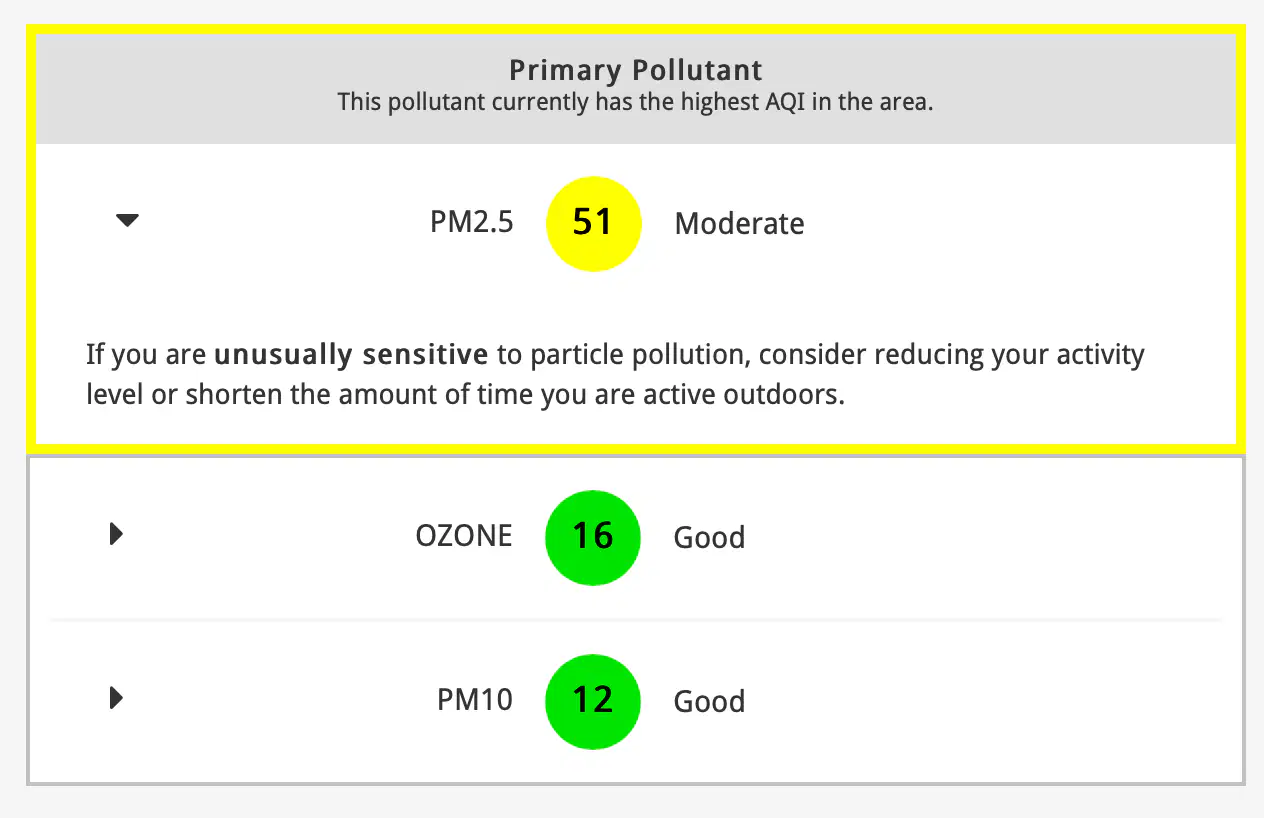
Which pollutant is currently has the highest AQI in the area?
Ozone
PM10
PM2.5
No Pollutant
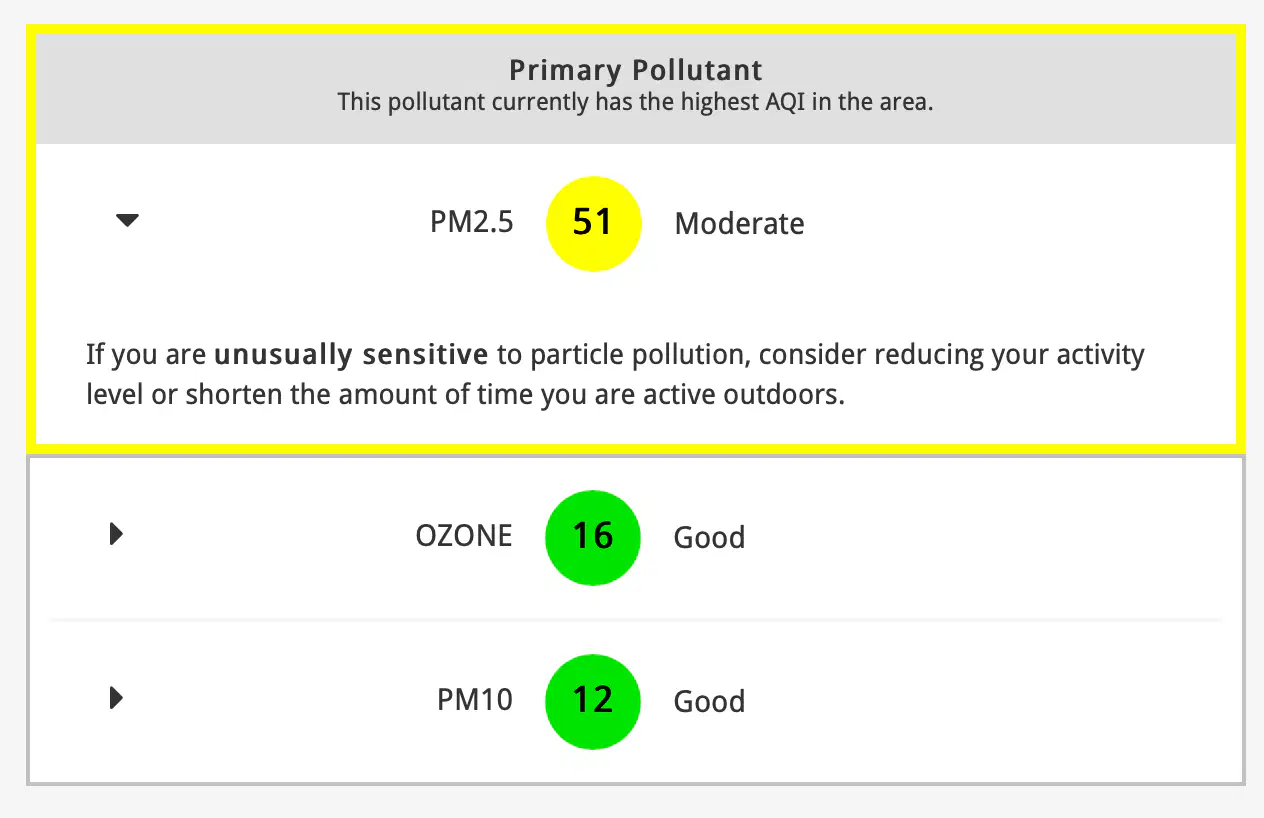
What is the level of particulate matter 10 in this area?
12, Good, Yellow
16, Good, Green
51, Moderate, Yellow
12, Good, Green

Study the air quality forecast. Why is it safe to go outside? Choose all correct answers.
PM2.5 is 29 , Good
NO2, 26, Good
PM10, 19, Good
CO, 6, Good
O3, 30 , Good

Analyze the graph. What day has the lowest AQI?
Dec. 13
Dec. 14
Dec. 15
Dec. 16
Dec. 17

Analyze the graph. What date of the month has the highest AQI?
Dec. 12
Nov. 20
Dec. 3
Dec. 18

Analyze the graph. What date & time has lowest AQI?
Dec. 19, 9 AM
Dec. 19, 4 PM
Dec. 19, 6 PM & Dec. 20, 6 AM
Dec. 19, 10 PM
How can you improve the air quality at home? Choose 3 correct answers.
Keep all windows and doors closed.
When outdoor air is heavily polluted, set air conditioning (HVAC) systems with fresh air intake to recirculate.
Go outside and play.
Call 911 and complain.

What major city of the world is the most polluted?
Sarajevo, Bosnia
Kolkata, India
New Delhi, India
Wuhan, China
Dhaka, Bangladesh

