
 Worksheets
Plate Tectonics
Total questions: 48
Worksheet time: 27mins
Which of the following refers to a region where plates meet?
plate
plate boundary
mountain
volcanic arc

There are three distinct types of plate boundaries. Which of those types
creates a zone of tension by moving the plates apart?
convergent boundary
divergent boundary
transform boundary
none of these

Which of the following diagrams shows a strike slip fault?
A
B
C
D
Convergent plate boundaries create land formations which later become
scenery. Which of the following is one of the best examples of the land
formations due to a convergent plate boundary?
arc
boundary
valley
volcanic arc
Which of the following completes the analogy?
Faults: A fracture or discontinuity in volume of rocks
Folds: ___________________________________.
It forms from subducting plates
It occurs when a flat surface bent
Occur when plates moving alongside and toward to each other.
Occur when plates moving alongside and away from each other.

Which of the following types of plate boundary move alongside?
Convergent
Divergent
Transform
None of these
Which of the following landforms is said to be a low area between hills or
mountains?
arc
valley
ridge
trench

Movement of plate boundaries results to many events or land formations.
Which of the following is the reason behind mountain formations?
converging plates
diverging plates
both a and b
neither a nor b
In response to compression force, the strata may bend and buckle these are called _________.
Stratification
Plate tectonic
Fault
Folds
It is the movement of the plate that results in the deformation of the earth’s crust.
Stratification
Plate tectonic
Fault
Folds

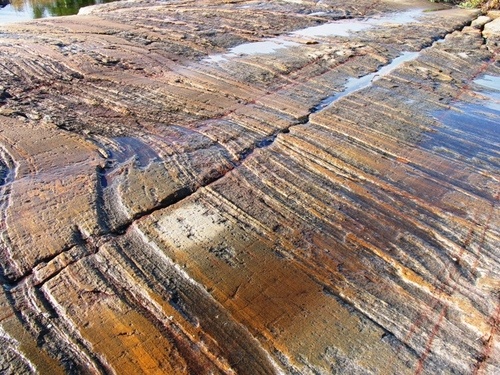
Identify the type of fold.
Anticline
Syncline
Monocline
Recumbent
Overturned

Identify the type of fault.
Reverse fault
Strike-slip fault
Normal fault

Identify the type of fault.
Reverse fault
Strike-slip fault
Normal fault

Identify the type of fault.
Reverse fault
Strike-slip fault
Normal fault
What was Wegener’s continental drift idea?
The continents have moved slowly apart to their current locations.
The continents have always been located at their current locations.
The continents are moving slowly together from their current locations.
None of these
True or False - Similar fossil records across continents was evidence for continental drift.
True
False
True or False - The continents including the continental margins can be pieced together to form a single whole continent.
True
False
Alfred Wegener named his single supercontinent ____________, which means "all Earth" in ancient Greek.
Pandora
Gandowandaland
Pangaea
Percia
The remains or traces of ancient life are called ____________.
bones
remanents
fossils
none of the above

What are the three types of Evidence that supports Alfred Wegener's Theory?
Fossils, Fish, and Land
Sedimentary, Magma, and Climate
Fossils, Land forms, and Climate
Climate, Land forms, and Metamorphic rock

What is the force that moves the continents?
Conduction
Convection
Radiation
Conveyor belts

Originally the Continental drift theory was not well received by other scientist. Why?
There was a competing theory at the time that was more believable.
There was no data showing the continents ever moved.
The scientists did not know the force responsible for moving the continents.
The scientist presenting the data was unreliable.

What evidence did Wegener use to support the theory of Continental Drift?
Continents and fossils fitting together/matching-up like puzzle pieces
glacier scars and other climate evidence from temperature
mountain ranges and rocks line up across continents
all of the above

What does the theory of continental drift state?
The continents were once joined in a super-continent and have moved over time
Continents are stationary and do not move
The Earth is broken into lithospheric plates that move due to convection currents
none of the above

What two specific continents fit together most noticeably?
Africa and North America
South America and Europe
South America and Africa
Antarctica and Africa

How long ago is Pangaea believed to have existed?
200-300 million years ago
1000-2000 years ago
10,000-20,000 years ago
20-30 billion years ago

The continents move very slowly, only a few __________per year.
meters
kilometers
centimeters
miles

Wegener found fossils of land reptiles on two different continents. This was important because
Land reptiles are often found all over the world, showing that they can survive in most climates
Land reptiles cannot swim, so the continents must have been connected for them to get across
Land reptiles are never moved around the Earth by humans, so they must have travels to these continents by themselves
Land reptiles fossilized much better than other animal species
the boundary between two tectonic plates that are moving away from each other
divergent boundary
mid ocean ridge
convergent boundary
sea floor spreading
The movement of the tectonic plates is caused by
the rotation of the Earth.
convection currents in the Asthenosphere
the gravity of the iron-nickel core.
the Moho discontinuity.
In some areas of the world, like California and Japan, earthquakes are a common occurrence. How can this best be explained?
The strong ocean currents are undermining both areas causing earthquakes.
Both areas are located near the edge of the Pacific Ocean, the unstable sand causes earthquakes.
Both areas are subjected to strong ocean wind and waves that causes earthquakes.
Both areas are on the boundary of active plates, the motion of the plates causes earthquakes.
The 2004 Indian Ocean tsunami was caused by a shift in two plates that pushed one section of the sea floor under another section of the sea floor by 5 meters. What type of boundary is this?
divergent
convergent
transform
metamorphic
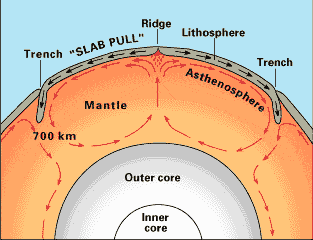
What is the source of energy that drives plate movement?
the subducton of the sea floor
the different densities of the oceanic and crustal plates
convection currents in the asthenosphere
the friction force between the plates that move past each other

Below is a picture of sea-floor spreading. How are the ocean crusts moving?
Converging
Diverging
Sliding
No movement
The San Andreas Fault in California is known as an active earthquake area. What type of
boundary is it?
Converging
Diverging
Transform
Sea Floor Spreading
The rigid section of the earth that move as a unit is called..........
Gravitational Pull
Tectonic plates
Two plates come together or collide at what boundary?
Convergent
Divergent
Transform
Two tectonic plates are moving past each other at what type of boundary?
Convergent
Divergent
Transform
If an earthquake occurs at the bottom of the ocean floor what could form as result?
Volcano
Tsunami
Tidal Wave
Hurricane
Aside from Earthquakes, what is the only thing you will find at transform boundaries?
Volcanoes
Subduction Zones
Folded Mountains
Fault lines
What is the only event associated with ALL plate boundaries?
Volcanoes
Earthquakes
Subduction
Deep Trenches
Huge pieces of lithosphere that slowly move on the asthenosphere and consist of the crust and the rigid, uppermost part of the mantle
tectonic plates
North American Plate
Eurasian Plate
African Plate
A tectonic plate division of the lithosphere that is composed entirely of oceanic crust and lies beneath the Pacific Ocean
Antarctic Plate
Indo-Australian Plate
Pacific Plate
Atlantic Plate
What is the term for the location where two different tectonic plates meet?
Pacific Plate
Mountains
Earthquakes
Plate Boundaries

