
 Worksheets
driver license part 4
Total questions: 50
Worksheet time: 25mins
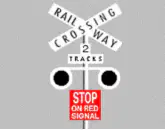
Even if the signal at a railway level crossing does not indicate that a train is coming, you should -
- Slow down, be ready to stop and give way if there is danger of collision.
- Speed up and cross the tracks quickly.
- Stop completely at all times.
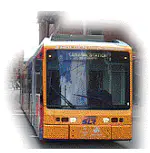
You come to an intersection in Sydney with a Light Rail vehicle about to enter. What should you do?
- Wait until the intersection is clear.
Enter the intersection, but keep away from the Light Rail vehicle.
- Change lanes before crossing the intersection.
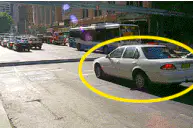
You approach an intersection in busy traffic and want to go straight ahead. The traffic lights turn green. When are you permitted to enter the intersection?
- Only when there is room for your vehicle on the other side.
- Immediately after the traffic lights turn green.
- When the vehicle behind signals you to go.
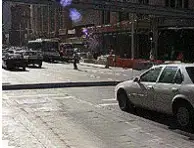
You are at a busy intersection with slow moving traffic and want to go straight ahead. When the traffic lights change to green you should make sure that -
- You do not block the intersection.
- You have the car in the right gear.
- You do not hold up the traffic behind you.
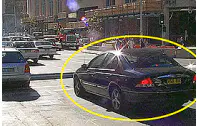
The traffic on the other side of this intersection has stopped. You are in the car shown and want to cross the intersection. The lights are green. What should you do?
Wait until there is enough room for your vehicle to cross the intersection completely
- Drive through the intersection slowly and hope that it will clear before the lights change.
Drive into the intersection and then turn left.
Which statement is correct?
- Red light cameras take photographs of vehicles that enter intersections when the lights are red.
- Red light cameras take photographs of vehicles that speed through intersections.
- Red light cameras take photographs of vehicles that cross intersections when the lights are yellow.
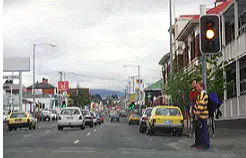
As you drive into an intersection, the lights turn to yellow. You should -
- Continue through the intersection.
- Accelerate as hard as you can.
- Brake immediately to a stop.
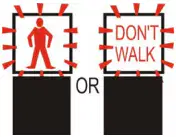
When these lights are flashing it means -
- Pedestrians must not start to cross.
- Pedestrians who have started crossing must go back to the footpath.
- Pedestrians are not allowed in this area at this time.
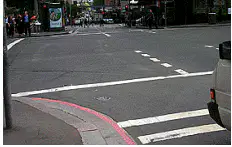
You wish to turn left here. The pedestrian lights are flashing red. You should -
- Give way to pedestrians still crossing.
- Move into the right hand lane.
- Slowly move through the intersection turning left.
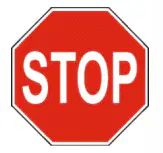
You drive up to an intersection with a stop sign. There is no painted stop line. Where should you stop?
Before coming to and as near to the intersection as possible.
- At least five metres before the intersection
- At the point where you can see clearly in both directions.
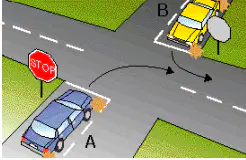
You drive up to an intersection with a stop sign in the car marked A and you wish to turn right. The car marked B facing you also has a stop sign and is indicating to turn left. Who can go first?
- Car B.
- Car A.
- Whoever arrives at the intersection first.
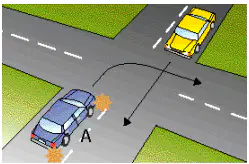
This intersection does not have any traffic lights or signs. You are in car A and want to turn right. When can you go?
- After the car going straight ahead has passed.
- Before the car going straight ahead has passed.
- As soon as you get to the intersection.
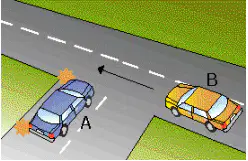
At this intersection there are no signs or traffic lights. You are in the car marked A. You want to turn left. What should you do?
- Slow down and give way to car B on your right.
- Enter the intersection and make the turn.
- Sound the horn to warn the other driver.
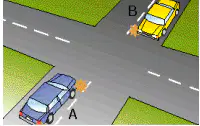
You are in car A and want to turn right at this intersection. Car B facing you is also indicating to turn right. What path should you take?
- Both pass in front of each other.
- Pass behind each other.
- Choose either depending on the traffic.
When police officers are at intersections giving directions you must -
- Always follow any instruction they give you.
- Drive through the intersection as you normally would.
- Wait for the traffic lights to start working again.
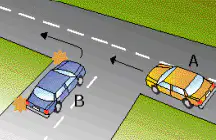
You are in car A and are going straight ahead through the intersection. Who should give way?
- Car B.
- Whoever gets to the intersection first.
- Car A.
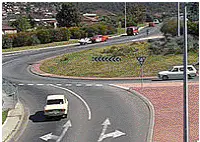
You wish to turn left at this roundabout. Which lane may you use?
- Left lane.
- Right lane.
- Either lane.
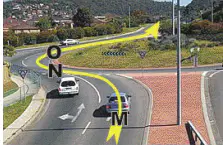
You are in the right hand lane and are planning to go straight ahead through this roundabout. When should you signal left to exit the roundabout?
- After point O.
- After point N.
- After point M.
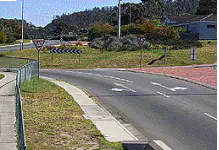
When you wish to turn left at a roundabout you indicate -
- Left from start to finish.
- Only if you think it necessary.
- Left only after you enter the roundabout.
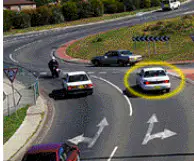
You wish to go straight ahead at this roundabout. Which statement is true?
- You must leave the roundabout in the same lane as you entered.
- You must enter in the right lane and leave in the left.
- You must always leave the roundabout in the left lane.
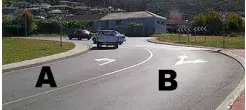
You want to turn left at this roundabout. Which lane must you use?
- Lane A.
- Lane B.
- Either lane.
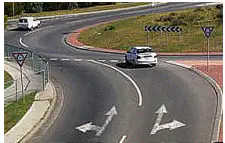
When you wish to drive straight ahead at a roundabout you may enter from either the left or right lane. As you continue around you should -
- Keep in the lane you entered the roundabout.
- Move into another lane with least traffic.
- Change lanes to get through quickly.
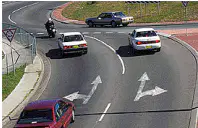
When turning left at a roundabout you should enter and leave the roundabout -
- In the left lane.
- In the right lane.
- In the lane with least traffic.
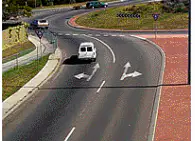
You wish to go straight ahead on this roundabout with two lanes. Which lane may you use?
- Either lane.
- Left lane only.
- Right lane only.
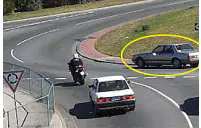
The motorcyclist wants to travel straight ahead through this roundabout. The rider should watch out for the marked car because the car -
- May be leaving the roundabout.
- Could be going too fast.
- May stop suddenly.
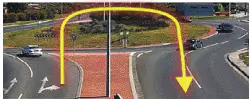
To turn back into the same road from which you joined this roundabout you must -
- Stay in the right lane all the way round.
- Move into the left lane to leave the roundabout.
- Use the left lane all the way round.
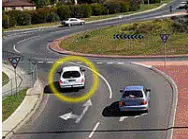
In this roundabout with two lanes, can the marked car turn right?
- No, not at any time.
- Yes, at any time.
- Yes, after changing to the right hand lane.
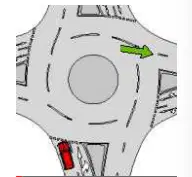
The red car wants to turn right and exit the roundabout in the street indicated by an arrow. Is the car positioned in the correct lane to do this?
- No, the car should enter the roundabout only from the right hand lane.
- Yes, the car can make the turn only from this lane.
- Yes, the car can make the turn from either the left hand or the right hand lane.
If you enter an intersection that is under the control of a traffic controller -
- Follow the directions of the controller.
- Sound your horn at the traffic controller and hope they get out of your way.
- Stop at the intersection and then proceed slowly.
You are at an intersection and see a pedestrian crossing the road into which you are turning. You must -
- Give way to the pedestrian.
- Sound your horn to warn the pedestrian to get out of the way.
- Swerve around the pedestrian to avoid hitting them.
How should you merge with traffic when entering a freeway?
- Watch for a gap and merge with the traffic at the speed it is travelling.
- Speed up and force your way into the traffic.
- Stop, then enter the traffic quickly.
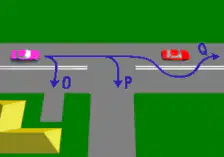
Which movements shown in the diagram can legally be made by the driver of the purple car?
- O and P only.
- P only.
- O, P and Q.
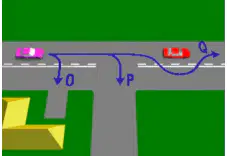
Which movements shown in the diagram can legally be made by the driver of the purple car?
- O, P and Q.
- O and P only.
- P only.
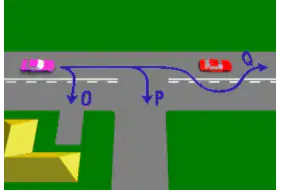
Which movements shown in the diagram can legally be made by the driver of the purple car?
- O and P only.
- P only.
- O, P and Q.
Double unbroken dividing lines are marked on a roadway. You may -
- Cross them to turn into a driveway or property, if it is safe to do so.
- Cross them to overtake a car ahead if it is safe to do so.
- Cross them to make a U turn.
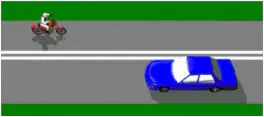
A section of road is marked with double unbroken dividing lines as in the diagram. When is a vehicle allowed to cross these lines?
- To enter or leave a street or driveway
- To overtake a slow vehicle ahead.
- When there is no traffic coming the other way
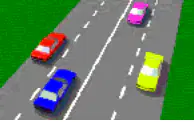
When driving in traffic lanes (as shown in the diagram), you may change your lane -
- Only when it is safe to do so.
- Without looking, provided you use your indicator
- Provided you sound your horn to warn other drivers
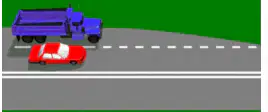
When two lanes merge into one (as shown in the diagram), who should give way?
- The vehicle which has to cross the lane line.
- The faster vehicle.
- The vehicle in the right-hand lane because it is overtaking.

Looking at the diagram, which vehicle must give way?
- Vehicle B.
- Vehicle A.
- Either vehicle, there is no rule on giving way when merging.
You must use your indicator lights when -
- Changing lanes or turning left or right.
- Approaching a curve.
- Double parking.
If you hear the siren of an emergency vehicle, you must -
- Take whatever action is necessary (with safety) to make way for the emergency vehicle.
- Flash your headlights to warn other drivers.
- Increase your speed to avoid the vehicle.
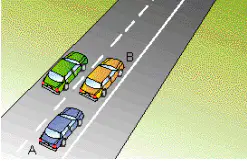
You are in car marked A. You wish to overtake car marked B. You should -
- Wait behind car B until it moves into the left lane.
- Cross the unbroken single line and overtake.
- Cross the line and overtake only if it is safe.
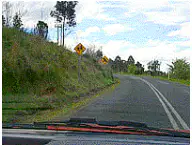
When the road is marked this way are you permitted to cross the lines and overtake?
- No.
- Yes.
- Yes, only if the way ahead is clear.
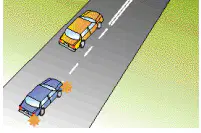
When starting to overtake you see the dividing lines ahead change to double unbroken lines. What should you do?
- Do not overtake because you are not permitted to overtake on double lines.
- Continue to overtake because you started when the line was broken.
- Keep overtaking and cut in in front of the other car as soon as possible.
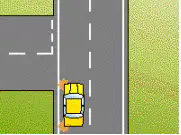
You want to turn left at this intersection. There is an edge line that continues through the intersection. Are you permitted to turn here?
Yes, you can cross an edge line to turn into or out of a street.
- No, not under any circumstances.
- Yes, only if you are in a taxi, hire car, bus or you live in that street.
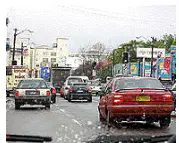
Before changing lanes you should -
Signal in plenty of time, check your mirrors and look over your shoulder for other vehicles.
Speed up so you are going faster than the traffic in the other lane.
- Signal for at least two seconds and quickly change lanes.
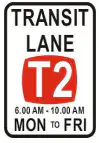
You drive into a transit lane where the T2 rule applies. You have one passenger plus yourself. Are you permitted to remain in the transit lane?
- Yes, you have two people in your car so you can drive in this lane.
- No, because you only have one passenger you must move out of the transit lane immediately
- Yes, you can remain in the transit lane, but only if you are turning left in 250 metres
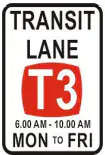
You change lanes and then see you are in a lane where the T3 rule applies. There is no other traffic in this lane. You have one passenger. What should you do?
- Change lanes as soon as it is safe because you are not permitted to travel in a T3 lane with only two people in your car.
- Keep driving in the T3 lane because there is no other traffic in it.
- Immediately pull over to the left and stop. Then wait until it is safe to continue in another lane.
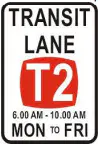
You are approaching the start of a T2 transit lane. You are the only person in the car. You want to turn left at the next intersection 200 metres away. Can you travel in the transit lane at this point?
- No, because you can only travel in the transit lane if the intersection you are turning left at is within 100 metres.
- Yes, because you only have a short distance to drive.
- Yes, if there is no traffic behind you.
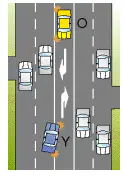
You are in car marked Y and want to turn right using a median turning lane. A car marked O, coming towards you, is already in the median lane; it is slowing down and indicating. Are you permitted to enter and share the median turning lane?
- Yes, but you must be prepared to slow down and stop.
No, if another car is already in the median turning lane you must not use it
- Yes, but only if you race the other car and get to the turning position first.

