
 Worksheets
A Level Chemistry 9701 (Chap 27,28)(Nitrogen Compounds,Polymers)
Total questions: 20
Worksheet time: 27mins
Which one is the weakest base?
Ethylamine
Methylamine
Ammonia
Phenylamine

A student wants to prepare ethylamine (a primary amine) with the help of the given reaction but he risks forming secondary and tertiary amines. Choose the right set of conditions for him to work.
Excess conc. ammonia solution
Excess conc. ethanolic ammonia
Excess conc. ethanolic ammonia with heat
Excess conc. ethanolic ammonia with heat and pressure

A student wants to prepare the compound shown; diethylamine (a secondary amine). Choose the right set of reactants and conditions for him to work.
Ethylamine reacting with ethyl bromide under heat
Ethylamine reacting with ethyl bromide under heat and pressure
Excess conc. ethanolic ammonia with heat reacting with ethyl bromide
Excess conc. ethanolic ammonia with heat and pressure reacting with ethyl bromide
A student wants to make ethylamine with a 2 step process. Choose the correct step 1 and step 2 for a successful process. (This question requires you to choose 2 correct options out of 4)
Step 1: Convert halogenoalkane to Alkane nitrile
Step 1: Convert aldehyde to Alkane nitrile
Step 2: Convert Alkane nitrile to Ehtylamine by the process of reduction
Step 2: Convert Alkane nitrile to Ethylamine by the process of alkaline hydrolysis
How can you convert amides to primary amines?
Reduction with LiAlH4 in dry ether
Reduction with NaBH4 in aqueous conditions
Acidic Hydrolysis
Alkaline Hydrolysis

A student wanted to prepare phenylamine with the given process. He carried out a reduction reaction by heating nitrobenzene under the reflux with Tin (Sn) and concentrated hydrochloric acid. Instead of getting phenylamine, the resulting acidic mixture gave him the ion C6H5N+H3 and he did not know what to do next. Choose the right step for him.
Add HCl and then steam distill
Just steam distill
Just add NaOH
Add NaOH and then steam distill

What is the color of the precipitate in the given example?
Red-brown ppt
Blue-black ppt
White ppt
First yellow then brown after 10-15 minutes
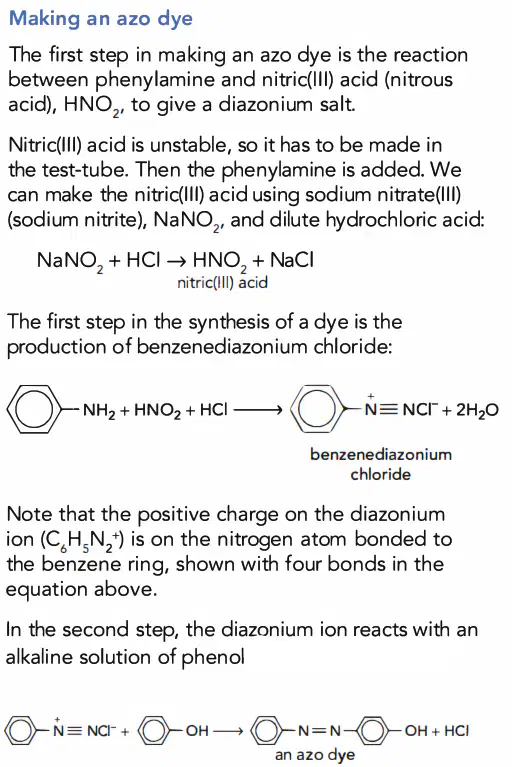
Properly name the steps 1 and 2. (This questions requires you to choose 2 correct options out of 4)
Step 1: Diazotisation
Step 1: Aromatisation
Step 2: Coupling Reaction
Step 2: Diaozotisation

The reaction mixture is supposed to be kept below 10ₒC because:
Nitrous Acid does not react at higher temperatures
The diazonium ion is converted to a diazonium salt
The diazonium ion reacts with the negative nitrate (III) ions in the reaction mixture to form another product
The diazonium ion is unstable and decomposes easily to give off nitrogen gas
What is the correct general structural formula of an amino acid (2-aminocarboxylic acid)?
RCH(NH2)COOH
RCH2(NH)COOH
R1R2C(NH2)COOH
R3C(NH2)COOH
The pH value at which there is no overall charge on a particular amino acid in its aqueous solution is known as _____________.
Neutrality Point
Neutralisation Point
Electric Point
Isoelectric Point
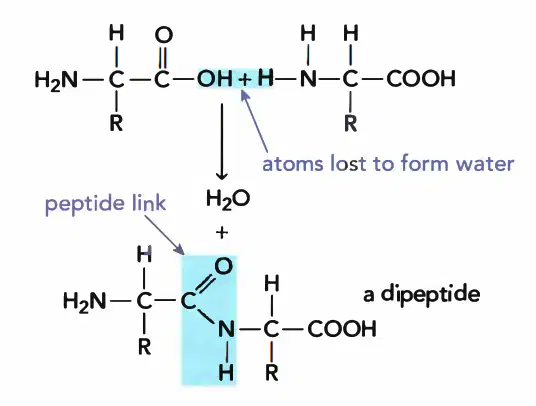
What kind of reaction is the formation of an amide bond (peptide linkage) between two amino acids for a dipeptide formation?
Condensation Reaction
Addition Reaction
Elimination Reaction
Polymerisation Reaction
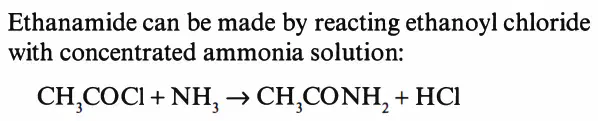
Why are acyl chlorides preferred over carboxylic acids for the formation of amides such as ethanamide?
Carboxylic Acids are more reactive than acyl chlorides and gives too many side products
Carboxylic Acids are more acidic than acyl chlorides and give acidic salts as product instead of the original required product
Acyl chlorides are more reactive than carboxylic acids
Acyl chlorides are cheaper (inexpensive) as compared to carboxylic acids

If excess of acid is taken, then pick the correct set of final products:
Acidic Hydrolysis Products: R1COOH + R2NH3+
Alkaline Hydrolysis Products: R1COO-Na+ + R2NH2
Acidic Hydrolysis Products: R1COOH + R2NH2
Alkaline Hydrolysis Products: R1COO-Na+ + R2NH2

Both of the given polymers come from the same monomer. Choose the monomer correctly.
Ethene
Ethyne
Cis-Ethyne
Trans-Ethyne

How many water molecules does the formation reaction of this tripeptide will give?
Zero
1
2
3
If Nylon 6,6 is prepared from 1,6-diaminohexane [H2N(CH2)6NH2] and hexanedioyl dichloride [ClOC(CH2)4COCl], what other product will one get?
H2O
HCl
NH3
Just the polymer, no other products

Generally Kevlar can be created by reacting the following: (Select all that apply)
An aminobenzene with a benzene based carboxylic acid
A diaminobenzene with a benzene dicarboxylic acid
A diaminobenzene with a benzene dioyl dichloride
An aminobenzene with an acyl chloride
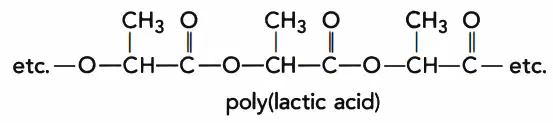
Write the IUPAC name of the monomer that forms this polymer.
2-hydroxypropanoic acid
3-hydroxypropanoic acid
2-methanol propanoic acid
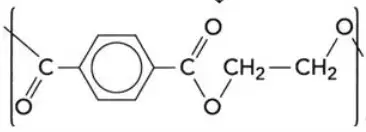
Terylene is a polymer that is usually made from benzene-1,4-dicarboxylic acid and one more organic monomer under specific reaction conditions including catalyst. Name the other organic monomer.
Ethane-1,2-diol
Ethane-1,1-diol
Propane-1,3-diol
Propane-1,2-diol

