
 Worksheets
3.2 MPT Practice
Total questions: 43
Worksheet time: 46mins
Select the four major points supporting the theory of natural selection.
variation is inherited
individuals vary
the smartest survives
only some will survive to breed
successful genes get passed on
There are advantages and disadvantages of asexual reproduction. Select ALL the statements that are considered as an advantage for asexual reproduction.
The organism can reproduce quickly.
Has a greater chance of passing harmful traits to offspring.
The lack of diversity can lead to extinction if the environment changes
Only needs to find one mate using less energy.
Can keep a habitat safe from competitors.
If large ears are dominant (Ee or EE) and small ears are recessive (ee) in rabbits, which could NOT be true of the parents of offspring with small ears?
Both parents are heterozygous (Ee).
Both parents are homozygous recessive (ee).
One parent is homozygous recessive (Ee) and one parent is homozygous recessive (ee).
Both parents are homozygous dominant (EE).
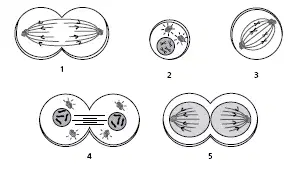
What phase is the diagram labeled 1?
prophase
metaphase
anaphase
telophase
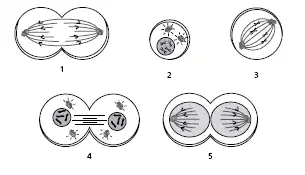
What phase is the diagram labeled 5?
prophase
metaphase
anaphase
telophase
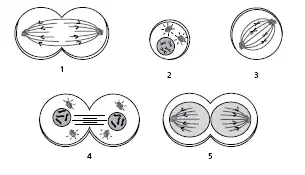
What phase is the diagram labeled 2?
prophase
metaphase
anaphase
telophase
During meiosis, genetic recombination occurs because–
chromosomes assort independently, and crossing-over occurs.
genes from different species can freely mix together.
gene mutations occur more frequently than at other times.
cells divide into only one, resulting in genetically identical cells.
A physical barrier alone, such as a mountain or river, can cause speciation to occur.
True
False
How does speciation occur?
Speciation occurs when an organism is separated from the rest of the species.
Speciation occurs when one factor can not mate with organisms that share the same traits.
Speciation occurs when there are too many species and competition occurs.
Speciation occurs when a factor possibly combined with a physical barrier causes one variation not to mate with any organisms other than those with the same traits.
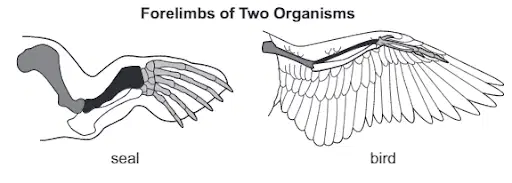
Which statement best describes the relationship of these organisms?
The structures are analogous; the organisms have a common ancestor.
The structures are homologous; the organisms have a common ancestor.
The structures are analogous; the organisms do not have a common ancestor.
The structures are homologous; the organisms do not have a common ancestor.


What is Budding?
A plant reproduces without producing spores or seeds.
An organism grows on the body of another.
Cell splits into new cells.
A cut piece grows into a new organism.
What is binary fission?
A plant reproduces without producing spores or seeds.
An organism grows on the body of another.
Cell splits into new cells.
A cut piece grows into a new organism.
Which is the process that breaks up rock on Earth’s surface?
deposition
melting
compaction
weathering
Geologists have classified rocks into three major groups of rocks which are:
inorganic, organic and chemical rocks
igneous, sedimentary and metamorphic rocks
metamorphic, chemical and non chemical rocks
sedimentary, inorganic and igneous rocks
Any rock that forms from another rock as a result of changes in heat or pressure (or both) is a:
chemical rock
igneous rock
sedimentary rock
metamorphic rock
A rock that forms from many small fragments of other rocks is a(n)
igneous rock
metamorphic rock
sedimentary rock
extrusive rock


The movement of the tectonic plates is caused by
the rotation of the Earth.
convection currents in the Asthenosphere
the gravity of the iron-nickel core.
the Moho discontinuity.
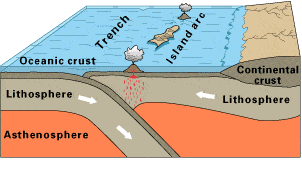
Observe this diagram of a plate boundary. One statement BEST describes what is happening. It is that
the oceanic crust is melting.
the denser ceanic crust is subducting under the less dense oceanic crust
volcanic islands are forming.
the tectonic plates are moving away from each other.

Most geologists think that the movement of Earth’s plates is caused by _______
convection.
continental drift.
subduction.
conduction.
A place where two plates slip past each other, moving in opposite directions, is known as a _______
transform boundary
divergent boundary.
convergent boundary.
rift valley.

The place where two plates come together is known as a _______
transform boundary.
divergent boundary.
convergent boundary.
rift valley.

Below is a picture of sea-floor spreading. How are the ocean crusts moving?
Converging
Diverging
Sliding
No movement

How is it possible for new crust to be formed without increasing the surface area of the Earth?
Crust is destroyed at the same time it is created
New crust is underwater where it sinks
New crust breaks more easily than old crust
Mountains are created when....
Two continental plates collide
Two oceanic plates pull apart
An Oceanic plate subducts under a Continental Plate
Two continental plates pull apart

Why does oceanic crust subduct under continental crust?
Oceanic crust is thin
Oceanic crust is dense
Continental crust is thin
Continental crust is dense

