wayground logo

Free Printable Worksheets

Font size

S
M
L
XL
Worksheets

Chemistry Review

Total questions: 38

Worksheet time: 33mins

Name
Class
Date
1.

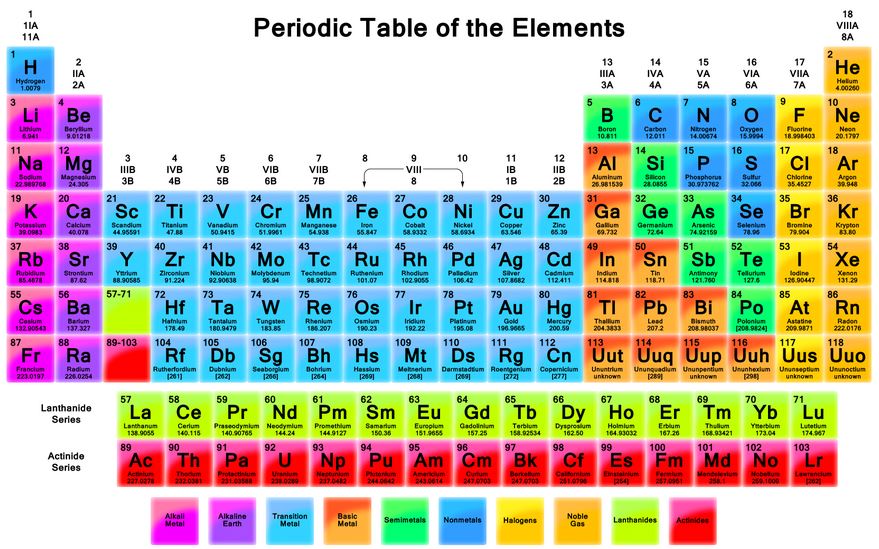
The chemical bond between a Ba and a Br will be a(n) _____ bond.

a)

metal

b)

ionic

c)

covalent

d)

polar

2.

The chemical bond between N and another Br will be a ________ bond.

a)

metal

b)

ionic

c)

covalent

d)

polar

3.
Elements on the LEFT side of the periodic table will most likely form:
a)
Positive ions
b)
Negative ions
c)
Neutral Ions
d)
None of these
4.
Force that holds together atoms in a substance.
a)
compound
b)
ion
c)
chemical bond
d)
ionic bond
5.

What type of bond will conduct electricity in a dissolved state?

a)

ionic

b)

covalent

6.

In metallic bonds electrons:

a)

shared

b)

move around the nuclei randomly

c)

transferred

7.
Predict the bond that will form between Se and Cl.
a)
Ionic
b)
Covalent
8.

Which part of an atom has a positive charge?

a)

Proton

b)

Neutron

c)

Electron

d)

None of them

9.

Which part of an atom has a negative charge?

a)

Proton

b)

Neutron

c)

Electron

d)

None of them

10.

Using the picture from a periodic table, what is the Atomic Number?

a)

26

b)

Fe

c)

55.845

d)

56

11.

Using the picture from a periodic table, how many PROTONS are in Iron?

a)

26

b)

30

c)

55.845

d)

56

12.
Lithium is in Group 1A, Period 2 of the periodic table. Which statement describes the charge of the ion it typically forms?
a)
It forms a cation with +2 charge.
b)
It forms a cation with a +1 charge.
c)
It forms an anion with a +1 charge.
d)
It forms an anion with a −1 charge.
13.
Which pair of words correctly completes the statement? Alkali metals are highly ___ since they ___ easily to form ions.
a)
nonreactive; lose 1 electron
b)
nonreactive; lose 2 electrons
c)
reactive; lose 1 electron
d)
reactive; gain 1 electron
14.
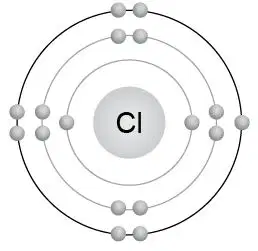
The diagram shows the electron configuration around the chlorine nucleus. Chlorine has 17 protons. Which of the following correctly completes the statement? Chlorine has ____ valence electrons, and the effective nuclear charge for the chlorine atom shown is ______.
a)
7; 7+
b)
7; 7−
c)
10; 7−
d)
17; 7+
15.

Column in the Periodic Table are called

a)

Periods

b)

Groups/Families

c)

Cousins

d)

Metals

16.

Which is NOT an indications that a chemical reaction has occurred?

a)

Temperature Change

b)

Taste change

c)

Color Change

d)

Bubbles

17.

Which of the following are decomposition reactions?

a)

CH4 (g) + O2 (g) → CO2 (g) + H2O (1)

b)

CaO (s) + CO2 (g) → CaCO3 (s)

c)

Mg (s) + O2 (g) → MgO (s)

d)

PbCO3 (s) → PbO (s) + CO2 (g)

18.

When propane is reacted in the presence of oxygen gas, the products of this combustion reaction are:

a)

CO2 + H2

b)

C + H2

c)

CO2 + H2O

d)

CH2 + H2O

19.

The chemical equation, Cr + Fe(NO3)2 → Fe + Cr(NO3)3, is an example of which type of reaction?

a)

combustion

b)

single-replacement

c)

double-replacement

d)

decomposition

20.

The chemical equation 2H2 + O2 → H2O represents a

a)

double-replacement reaction

b)

single-replacement reaction

c)

decomposition reaction

d)

synthesis reaction

21.

The chemical equation Zn + 2HCI → H2 + ZnCl2 represents a​ ​ (a)  

Choose from the below words
single-replacement reaction
decomposition reaction
synthesis reaction
double-replacement reaction
22.

ID the reaction type: H2SO4 + 2KOH → K2SO4 + 2H2O​ (a)  

Choose from the below words
Decomposition
Single Replacement
Combustion
Synthesis
Acid/Base
Double Replacement
23.
What is the right part of a chemical equation called...
2H2 + O2 --> 2H2O
a)
Reactants
b)
Products 
c)
Yields 
d)
Chemical Equation 
24.
What is the left part of a chemical equation called?
2H2 + O2 --> 2H2O
a)
Reactants
b)
Products 
c)
Yields 
d)
Chemical Equation 
25.
The part of the atom that determines the identity of the atom is the ____________.
a)
proton
b)
nucleus
c)
electron
d)
neutron
26.

Ionic bonds are formed between...

a)

Non - metals

b)

A metal and a non-metal

c)

Metals

27.

How is an ionic bond formed?

a)

Sharing of electrons

b)

Delocalised electrons

c)

Transfer of electrons

28.

An example of an ionic compound is Sodium Chloride, which is made from Na+ and Cl- ions. Why do these ions form an ionic bond?

a)

They have like charges

b)

They are from the same group

c)

They are from the same period

d)

They have opposite charges

29.

What is the formula for diphosphorus pentoxide?

a)

P2O5

b)

PO5

c)

P5O2

d)

Po2O5

30.
NaOH
a)
sodium oxide
b)
sodium hydrogen
c)
sodium hydroxide
31.

An ionic bond is formed when

a)

Valence electrons are shared.

b)

Valence electrons surround the cations.

c)

Valence electrons are transferred between atoms.

d)

Valence electrons are completely transferred between two metals.

32.

What is the number of valence electrons of Oxygen?

a)

1

b)

2

c)

6

d)

8

33.

What is the number of valence electrons of Neon?

a)

6

b)

7

c)

8

d)

9

34.
What is the charge on a Hydrogen ion?
a)
+1
b)
1
c)
2
35.
What is the charge on a chloride ion?
a)
-1
b)
1
c)
+2
d)
+1
36.
What two types of atoms make a covalent bond?
a)
2 Nonmetals
b)
1 Nonmetal and 1 Metal
c)
2 Metals
d)
2 Noble Gases
37.
What is a cation
a)
a metal with a negative (-) charge
b)
a non-metal with a negative (-) charge 
c)
a metal with a positive (+) charge 
d)
a non-metal with a positive (+) charge
38.
What is a anion
a)
a metal with a negative (-) charge
b)
a non-metal with a negative (-) charge 
c)
a metal with a positive (+) charge 
d)
a non-metal with a positive (+) charge