
 Worksheets
100124
Total questions: 50
Worksheet time: 1hrs 12mins
What are the key architectural elements of Renaissance architecture?
Minimalism, functionality, simplicity, and contemporary designs
Symmetry, proportion, geometry, and classical orders
Asymmetry, chaos, irregularity, and modern styles
Excess, clutter, disorganization, and non-classical orders
He was an Italian Renaissance architect active in the Republic of Venice. His works show the influences of Roman and Greek architecture
Filippo Brunelleschi
Frank Gehry
Andrea Palladio
Mies Van der Rohe
These are buildings built during the first Industrial Revolution Era.
The Royal Albert Hall, The Eiffel Tower, and The Crystal Palace
Woolworth Building, Villa Savoye and Falling Water
The Austrian Bank, Woolworth Building, and Guggenheim Museum
The Crystal Palace and Guggenheim Museum
How did classical architecture influence Renaissance architecture?
Use of bright and bold colors
Invention of new architectural styles
Emphasis on asymmetry and irregularity
Revival of classical forms and use of symmetry and proportion
Who is a famous Renaissance architect known for their work in Florence?
Donatello
Michelangelo
Filippo Brunelleschi
Leonardo da Vinci
What are some of the innovative architectural techniques developed during the Renaissance?
Gothic arches, stained glass, and flying buttresses
Concrete domes, steel beams, and glass curtain walls
Adobe construction, thatched roofs, and mudbrick walls
Classical orders, perspective, and symmetry
What is the significance of the use of perspective in Renaissance architecture?
It allowed for the creation of realistic and three-dimensional representations in art and architecture
It emphasized the use of bright and bold colors in architectural designs
It led to the invention of new architectural styles and forms
It focused on asymmetry and irregularity in architectural compositions
Who is a renowned Renaissance architect known for their work in Rome?
Donatello
Michelangelo
Gian Lorenzo Bernini
Leonardo da Vinci
How did Renaissance architects incorporate humanism into their designs?
By focusing on the use of bright and bold colors
By emphasizing the revival of classical forms and the use of symmetry and proportion
By inventing new architectural styles and forms
By prioritizing asymmetry and irregularity in architectural compositions
In which period was Gothic Architecture developed?
Ancient Era
Medieval Era
During the Enlightenment
Post-historic Era
What did architects of Gothic Architecture use in their work?
Complex Arches and Coloured Windows
Decorative Brick Columns
Glasses with Sprayed Paint
Concrete Buttress and Domes
State the key function of a gargoyle.
Look cool
Ward off evil spirits
Drain water
Give religious narrative

This image of a ceiling is a_______.
lintel
Groin Vault
ribbed vault
Fan vault

The building of Gothic Cathedrals sometimes required what architectural system be used so that walls could be supported?
Post and Lintel system
Flying Butresses
Round arch
Stained glass windows

What are characteristics of Romanesque Churches
Thick walls, Pointed arches, Rose window, Highly Decorated Outside
Gargoyles, Small windows, Thick walls
Thick Walls, Small windows, Short walls, Plain outside Decoration
High Walls, Pointed Arched Windows, Stained Glass

What is the Name of this type of window which is a characteristic of Roman Catholic Gothic Cathedrals?
Flower Window
Radial Window
Abstract Window
Rose Window
When was the Gothic Architecture Era?
12th-16th Century
12-15th Century
16th-20th Century
11th-15th Century
What are the 5 key design elements found in Gothic Architecture?
Pointed Arches, Flying Buttresses, Gargoyles, Arches, Windows
Pointed Arches, Flying Buttresses, Ribbed Vaults, Highly Ornate Decorations, Stained Glass Windows
Pointed Arches, Flying Buttresses, Ribs, Ornate Decorations, Clear Glass Windows
Flying Buttresses, Ribbed Vaults, Pointed Arches, Clear Glass Windows, Gargoyles
This architect was considered as the first “modern” architect and one of the most influential architects of all time. He was a trained mason and a successor of Alberti.
Raphael Santi
Donato Bramante
Leonardo Da Vinci
Andrea Palladio
Which arch belong to Romanesque Architecture?


This architectural style is a combination of Roman and Byzantine Architecture.
Renaissance Architecture
Baroque Architecture
Romanesque Architecture
Gothic Architecture
A window placed vertically in a sloping roof with a roof on its own.
Bay Window
Oriel Window
Dormer Window
Casement Window
A vault composed of a number of concave conoidal sections, usually four, springing from the corners of the vaulting compartment, and often decorated with ribs.
Fan Vault
Groin Vault
Stilted Vault
Cloister Vault
A compound vault formed by the perpendicular intersection of two vaults, forming arched diagonal arrises.
Fan Vault
Groin Vault
Stilted Vault
Cloister Vault

Name this old French Gothic Church.
Chartres
Rheims
Notre Dame
Salisbury
The external façade of Romanesque churches have the following features, except .............
towers
bulky and massive walls
intricate decoration
small openings

What system of vaulting is this?
Barrel vault
Groin vault
Rib-groin vault
Tunnel vault

This photograph depicts a building constructed with .......
Byzantine Architecture
Gothic Architecture
Renaissance Architecture
Romanesque Architecture
The term Gothic stands for...
The rebirth of humanism in Christianity
The Roman who practiced paganism
The Germanic tribes who sacked Rome in A.D. 410
The Abbasid people who invented construction technology

Name this building.
Abbey Church of Saint-Denis
Pisa Cathedral
Cathedral of Notre-Dame
Dome of Florence Cathedral
Stained glass window is associated with ........
Transparency
Good and Evil
Earth and Sky
Light and Height
The Late Gothic Style is also known as ................
Barbarian Gothic Architecture
Byzantine Gothic Architecture
Flamboyant Gothic Architecture
Splendid Gothic Architecture
Who was Abbot Suger?
A French abbot whose idea was associated with the divine revelation.
A French abbot who supervised the rebuilding of the Abbey church of Saint-Denis
A French abbot who advised King Louis VI to develop Gothic and Renaissance architecture
An French abbot who commissioned the construction of Notre-Dame Cathedral in AD 1312
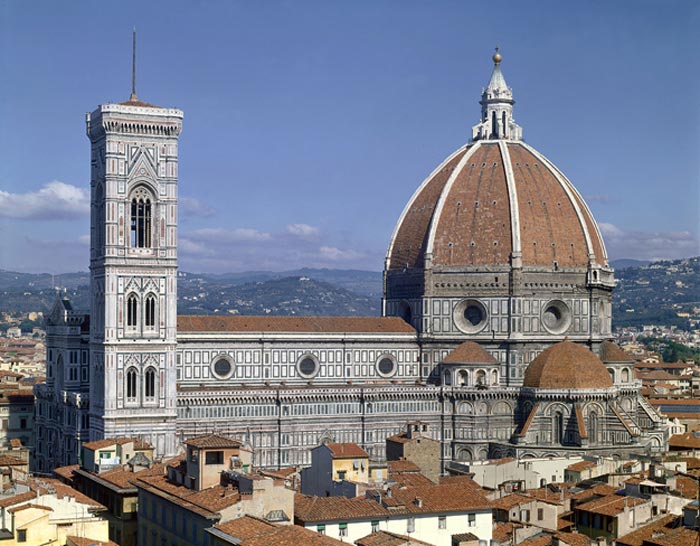
Who was the architect for Duomo?
Da Vinci
Michelangelo
Raphael
Bunelleschi

What is one way that Renaissance artists differ from Medieval?
Renaissance art focuses more on religion
Medieval artists were more realistic
Renaissance artist turned to Roman and Greek works for inspiration
They are the same
Which of these statements describes a change brought about by the Renaissance?
Society was dominated by the church.
Society began to value individualism.
Society was focused on warfare.
Society was dominated by lords.
During the Renaissance era, a new intellectual movement known as humanism evolved. What was the significance of the humanist movement?
Humanists felt formal education was impractical and unnecessary; therefore, many schools were closed.
Humanists spread the teachings of Eastern philosophers such as Confucius throughout Europe.
Humanists were very interested in religious studies and sought to increase the influence of the Church.
Humanists were inspired by classical texts and emphasized the dignity and worth of the individual.
What is it called when an artist paints on wet plaster?
secular
fresco
realism
perspective

Michelangelo created this building as one of his most famous architectural accomplishments.
La Pieta'
Dome of St. Peter's Basilica
The Statue of David
The step of the Laurentian Library

Who developed the technique for linear perspective in art and architecture?
Filippo Brunelleschi
Donato Bramante
Leon Battista Alberti
Andrea Palladio
These are NOT the characteristics of Renaissance Architecture.
Square and symmetrical appearance
Columns, pilasters and entablatures are integrated as the wall system
Pointed and semi-circular Arches decorated the building facades
Domes are used frequently to roof small internal space
What Mies Van De Rohe is famous for?
More is more
Golden Ratio
Golden Triangle
Less is more
Who used cantilevered structure in his building design?
Frank Lloyd Wright
Buckminster Fuller
Frank Gehry
Robert Mills
Which one is NOT the character of De Stilj?
principle of the geometry of the straight line
predominant use of pure primary colors with black and white
relationship between positive and negative elements
Separation of squares and rectangles

Which statement is wrong about Heydar Aliyev Center?
The architect emphasized on relationship between building and its surrounding.
The architect used glass-fibre reinforced polyester panels for the walls
The architect created the harmonious display of space frame structural system
The architect used bio-mimicry concept of a moving snail
This style was considered as a return to the ideas of Greco-Roman period, that also linked to revolutionaries
Rococo
Baroque
Colonial
Neoclassical
He was considered as the father of skyscraper and modernism.
Frank Lloyd Wright
Louis Sullivan
Ludwig Mies van der Rohe
Buckminster Fuller
Joseph Paxton designed The Crystal Palace with these characteristics, except ............
Usage of Large Sheet of Glasses
Prefabricated Structural System
Modular Design System
Glue Laminated Timber Components
What was the philosophy of humanism?
Humanism disregarded the importance of observation, critical analysis, and creativity
Humanism was a term invented in the 17th century to describe the Renaissance idea of heresy
Humanism influenced the eastern civilization in many ways particularly in the way architecture was formed
Humanism was centered on values, interest, and potential of human being.

