
 Worksheets
Intro to Theater Final Aubrey
Total questions: 60
Worksheet time: 30mins
Name
Class
Date
1.
The term audience etiquette refers to ____________________________________________________.
a)
the part of the performance for loud applause.
b)
behaviors expected from a live audience
2.
Which rules listed below are examples of how you should behave in a live production? Multiple should be selected.
a)
Arrive on time. Doors are locked after the show starts.
b)
Avoid food or drink that is distracting.
c)
Take pictures and videos to compliment the actors.
d)
Applaud after songs and at the end of scenes.
e)
Stay seated until intermission.
3.
Designing props and scenery for live productions must consider the audience space. Which two types of theaters allow for large scenery and non-realistic props?
a)
Arena
b)
Proscenium
c)
Thrust
4.
What is the proscenium?
a)
A runway that goes into the audience.
b)
An archway around the stage that frames the action
5.
What are the four ingredients to make live theater?
a)
Actors
b)
Costumes
c)
Audience
d)
Space
e)
Plot
6.
What statement best describes the responsibilities of a producer?
a)
Casting the show, directing rehearsals and planning movement for actors
b)
Providing funding for a production and making financial decisions
c)
Calling the Show and Directing the show opening night
7.
What statement best describes the responsibilities of a director?
a)
Casting the show, directing rehearsals and planning movement for actors
b)
Providing funding for a production and making financial decisions
c)
Calling the Show and Directing the show opening night
8.
What statement best describes the responsibilities of a stage manager?
a)
Casting the show, directing rehearsals and planning movement for actors
b)
Providing funding for a production and making financial decisions
c)
Calling the Show and Directing the show opening night
9.
What type of rehearsal is it where actors are learning their movement?
a)
Blocking
b)
Full Run
c)
Technical Rehearsal
d)
Dress Rehearsal
10.
What type of rehearsal is it when each design element is run and repeated until it is correct, remember this is the rehearsal that only runs one design element at a time?
a)
Blocking
b)
Full Run
c)
Technical Rehearsal
d)
Dress Rehearsal
11.
What type of rehearsal is it when a show is run from the beginning until end without interruption to time the show?
a)
Blocking
b)
Full Run
c)
Technical Rehearsal
d)
Dress Rehearsal
12.
What type of rehearsal is it when a show is run with costumes, lights, sound and prop on a completed stage with a set in front of a select audience?
a)
Blocking
b)
Full Run
c)
Technical Rehearsal
d)
Dress Rehearsal
13.
What are the responsibilities of the house manager?
a)
Draws the materials for their chosen area, choosing what materials will make up the play
b)
Alerts the crew of upcoming cues
c)
Supervises the ushers, make sure programs are available and communicates when the audience is seated
14.
What are the responsibilities of the technical designer?
a)
Draws the materials for their chosen area, choosing what materials will make up the play
b)
Alerts the crew of upcoming cues
c)
Supervises the ushers, make sure programs are available and communicates when the audience is seated
15.
Which statement best describes the responsibilities of crew?
a)
Working as a team to build what the designer has chosen
b)
Choosing the colors that promote the mood of the play
16.
What is the difference between a theme and a moral
a)
A moral is the basic idea that brings purpose in a play and the theme is the lesson taught by the play
b)
A moral is the lesson taught by the play and the theme is basic idea that brings purpose to a play
17.
What is the difference between atmosphere and mood?
a)
Atmosphere is the emotional response to the text of the play; Mood is the environment created by the the staging, lighting, set and costumes.
b)
Mood is the emotional response to the text of the play; Atmosphere is the environment created by the the staging, lighting, set and costumes.
18.
Where do you find the atmosphere of the play?
a)
Dialogue
b)
Stage Directions
19.
What is considered the rising action of a play?
a)
Turning point in the action of the play, where characters are forced to change
b)
The short and important part of the play where the main characters react to the change.
c)
The longest part of the play where important characters are introduced to the conflict.
d)
The beginning of the conflict, what starts the problem.
20.
What is considered the inciting incident of a play?
a)
Turning point in the action of the play, where characters are forced to change
b)
The short and important part of the play where the main characters react to the change.
c)
The longest part of the play where important characters are introduced to the conflict.
d)
The beginning of the conflict, what starts the problem.
21.
What is considered the climax of a play?
a)
Turning point in the action of the play, where characters are forced to change
b)
The short and important part of the play where the main characters react to the change.
c)
The longest part of the play where important characters are introduced to the conflict.
d)
The beginning of the conflict, what starts the problem.
22.
What is considered the falling action of a play?
a)
Turning point in the action of the play, where characters are forced to change
b)
The short and important part of the play where the main characters react to the change.
c)
The longest part of the play where important characters are introduced to the conflict.
d)
The beginning of the conflict, what starts the problem.
23.
How do the protagonist and antagonist relate to the conflict of a play?
a)
The protagonist is the character the audience watches, experiencing the conflict created by the antagonist.
b)
The antagonist is the the character the audience watches, experiencing the conflict caused by the protagonist.
24.
What needs to be included in the exposition of a play? Multiple answers should be selected.
a)
Setting up the world of the play
b)
Design Choices
c)
Characters Background
d)
Plot breakdown of the entire conflict
25.
Which statement best describes a hand prop?
a)
A stationary object that is used to create the set.
b)
A object that is small and used directly by actors.
c)
An object that shows the style and details of the characters and the location.
26.
Which statement best describes a decorative prop?
a)
A stationary object that is used to create the set.
b)
A object that is small and used directly by actors.
c)
An object that shows the style and details of the characters and the location.
27.
Which statement best describes a set prop?
a)
A stationary object that is used to create the set.
b)
A object that is small and used directly by actors.
c)
An object that shows the style and details of the characters and the location.
28.
What are the responsibilities of a prop master? Multiple answers should be selected.
a)
Obtaining and Organizing all props
b)
Pulling a prop from storage, Borrowing props, and Buying props
c)
Sketching the set design that goes with the world of the play
29.
How do placement and preset props relate to each other
a)
Placement considers which props should be preset on stage before the scene begins and placed on tables offstage left and right for the actors to carry on.
b)
Preset props are placed on tables off stage left and right.
30.
Read the following script to determine placement:
Arianna: (Opens up the gold safe hidden under the table) The money is gone.
(Jamar stops and walks to closet next to the door, gets his slim leather brief case out of the closet.)
Arianna: What do you have in there?
Select the answer that best describes the placement, type, and description of the props in this example.
a)
(1) Safe, set prop, gold, located under the table (2) brief case, hand prop, slim/leather, located in the closet
b)
(1) Brief case, set prop, slim brown, under the table (2) Safe, hand prop, leather, located in the closet
31.
Read the following setting and select the correct prop plot for the third prop listed:
The salon is southern and full of charm. On the left there is a full length mirror with pink trim around the edges. Gently taped to the mirror are magazine cut outs of hairstyles. The salon chair is lavender with steel accents, it is located directly in front of the mirror. The silver hot iron is plugged into the wall on the brown table next to the mirror.
Remember you are selecting the third prop listed!
a)
Salon chair, set prop, lavender with steel accents, located in front of the mirror
b)
Hot Iron, hand prop, plugged in and silver, on the table next to the mirror
c)
Mirror, decorative prop, full length/pink trim, located on the left
32.
Read the following script and identify the hand props:
(The Fairy Godmother appears stage left from behind the tall wooden shelf and spins moving a blue wand from her cape)
Fairy Godmother: A ball you say?
(Cinderella drops the small wooden bucket and looks at the giant white carriage)
a)
Carriage and Shelf
b)
Wand and Bucket
33.
Which is not a reason set design is important?
a)
The set tells the audience where the story takes place
b)
The set gives an organized placement of props
c)
The set gives clues about the characters in the story
d)
The design of the set gives the audience an idea of the time period.
34.
When designing the set who accomplishes the process? Multiple choices should be selected.
a)
Set Designer
b)
Prop Master
c)
Master Carpenter
d)
Set Crew
e)
Stage Manager
35.
What is the difference between a box set and a unit set?
a)
A unit set is made in pieces that can be moved on and off stage and a box set is stationary consisting of three walls.
b)
A unit set is stationary consisting of three walls and a box set is made in pieces that can be moved on and off the stage.
36.
Check off the four questions a set designer answers before designing the set.
a)
What locations does the play take place?
b)
What time period in history does the play take place?
c)
What is the mood of the script and what colors and textures represent that mood?
d)
What furniture and set pieces need to be seen?
e)
What time of day does the scene take place?
37.
Fill in the blanks. All stage directions are from _________________ perspective. This is why they are backwards for the _________________.
a)
actor's; audience
b)
audience's; actors
38.
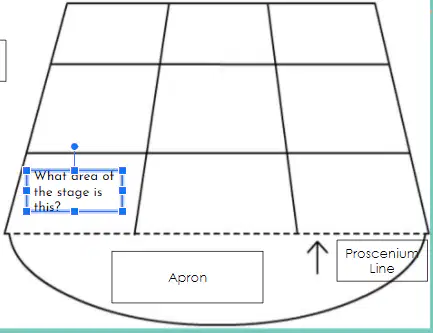
Looking at the picture: Identify what stage area is represented.
a)
Down Right
b)
Down Left
c)
Up Left
d)
Up Right
39.
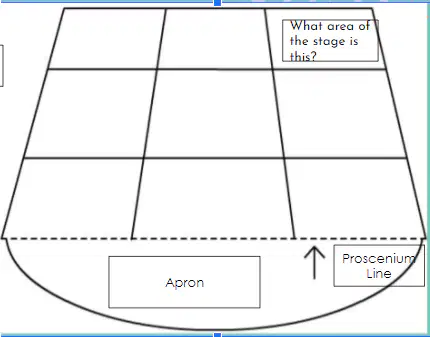
Looking at the picture: Identify what stage area is represented.
a)
Down Right
b)
Down Left
c)
Up Left
d)
Up Right
40.
What should be described in the setting of a play?
a)
All character are given a description of what they are wearing, what the personality is and what props they hold.
b)
A summary of the location is given listing the location of the furniture on stage and where the actors are at the beginning of each scene.
41.
What are the three steps a costume designer should take before building the costumes?
a)
They should complete a color rendering and select multiple swatches.
b)
They should consider the four traits after reading the play, research the time period and draw a preliminary sketch.
42.
What is the difference between a preliminary sketch of a costume and a color rendering?
a)
A preliminary sketch is a quick drawing that may not include shading; a color rendering is the perspective costume with color choices and fabric choices.
b)
A color rendering is a quick drawing that may not include shading; a preliminary sketch is a perspective costume that will include color choices and fabric choices.
43.
What is the small piece of fabric a director chooses called?
a)
swatch
b)
color coding
44.
Which term refers to the designers choice to match a character's allegiance to other characters in the play?
a)
swatch
b)
color coding
45.
What is the difference between trim and texture?
a)
Trim is the quality of fabric that determines how the costume will catch the light; Texture is anything attached to the fabric of the costume.
b)
Texture is the quality of fabric that determines how the costume will catch the light; Trim is anything attached to the fabric of the costume.
46.
Which is the last step in costume construction?
a)
costume parade
b)
fittings
c)
cutting patterns
d)
measurements
e)
sewing pieces together
47.
What is the purpose of lighting design?
a)
To illuminate the actors to set the mood
b)
To design the background of the play
48.
Select the two accessories that are used with lights.
a)
Brackets
b)
Gels
c)
Gobos
d)
Bulbs
49.
Which lighting accessory changes the color of the instrument?
a)
Brackets
b)
Gels
c)
Gobos
d)
Bulbs
50.
Which lighting accessory can project an image?
a)
Brackets
b)
Gels
c)
Gobos
d)
Bulbs
51.
What is the difference between a cue and a cue sheet?
a)
A cue sheet is a signal for action and a cue is the exact order of light and sound changes in a script
b)
A cue is a signal for action and a cue sheet is the exact order of light and sound changes in a script.
52.
When a stage manager calls the show what do they say to make the change in lights or sound happen?
a)
Now
b)
Go
53.
Which type of cue signals the intensity of the light increasing?
a)
Black Out
b)
Fade Up
c)
Fade Down
54.
Which type of cue signals the volume of the sound decreasing?
a)
Black Out
b)
Fade Up
c)
Fade Down
55.
Which type of cue signals all instruments on stage turning off?
a)
Black Out
b)
Fade Up
c)
Fade Down
56.
What is the definition for the word cue point?
a)
The fade time used in transitioning from one cue to the next.
b)
The line or action before a change in lights or sound.
57.
Read the following text and decide what cue abbreviation the first light cue should have:
The lights fade up to sunrise on the George Washington Bridge at curtain. Usnavi opens the bodega as Grafitti Pete enters from stage left holding a boom box. A loud beat is heard coming from the boom box speakers.
Usnavi: Lights up on Washington!
(The beat fades down. As Usnavi begins the rap and unlocks the door, lights fade up stage right on the Bodega)
Remember: you should select the abbreviation for the first light cue you read.
a)
SQ1
b)
SQA
c)
LQ1
d)
LQA
58.
Read the following text and decide what cue point would be accurate for the first sound cue:
The lights fade up to sunrise on the George Washington Bridge at curtain. Usnavi opens the bodega as Grafitti Pete enters from stage left holding a boom box. A loud beat is heard coming from the boom box speakers.
Usnavi: Lights up on Washington!
(The beat fades down. As Usnavi begins the rap and unlocks the door, lights fade up stage right on the Bodega)
Remember: you should select the cue point for the first sound cue.
a)
At curtain
b)
Usnavi: "Lights up on Washington"
c)
Grafitti Pete enters from stage left holding a boom box
d)
Usnavi unlocks the door
59.
Read the following text and decide what cue point would be accurate for the second sound cue:
The lights fade up to sunrise on the George Washington Bridge at curtain. Usnavi opens the bodega as Grafitti Pete enters from stage left holding a boom box. A loud beat is heard coming from the boom box speakers.
Usnavi: Lights up on Washington!
(The beat fades down. As Usnavi begins the rap and unlocks the door, lights fade up stage right on the Bodega)
Remember: you should select the cue point for the second sound cue.
a)
At curtain
b)
Usnavi: "Lights up on Washington"
c)
Grafitti Pete enters from stage left holding a boom box
d)
Usnavi unlocks the door
60.
Read the following text and decide what abbreviation would be accurate for the second light cue:
The lights fade up to sunrise on the George Washington Bridge at curtain. Usnavi opens the bodega as Grafitti Pete enters from stage left holding a boom box. A loud beat is heard coming from the boom box speakers.
Usnavi: Lights up on Washington!
(The beat fades down. As Usnavi begins the rap and unlocks the door, lights fade up stage right on the Bodega)
Remember: you should select the abbreviation for the second light cue!
a)
LQ2
b)
LQB
c)
SQA
d)
SQ2
100 %

