
NEW
Font size
 Worksheets
Unit 2 Test Review
Total questions: 25
Worksheet time: 13mins

The picture or diagram shows the monomer (Subunit) in a DNA and RNA . What is this called ?
sugar
base
Nucleotide
Aminoacid
Which nitrogenous base is replaced by Thymine in RNA ?
Adenine
Uracil
Guanine
Cytosine
Where is the location of DNA in a cell ?
Cytoplasm
Ribosomes
Nucleus
Lysosomes
What is a gene ?
A piece of DNA
Complete set of chromosomes
A long coiled structure
genome

Label the part 'Y' in this picture ?
Hydrogen bond
Deoxyribose sugar
Phosphate
Base
Label the part 'Z' in this picture ?
Hydrogen bond
Deoxyribose sugar
Phosphate
Base
Label the part 'X and W' in this picture ?
Hydrogen bond
Deoxyribose sugar
Phosphate
Bases

Select the correct complementary DNA Base pairing sequence in picture given ?
ATTCCGATAA
TAAGGCTATT
UAAGGCUAUU
UTTGGTATT
What is Transcription ?
the process of making an RNA copy of a gene's DNA sequence
the process of making an gene's DNA sequence from a DNA
the process of making an Protein of a gene's RNA sequence
the process of making an protein of a gene's DNA sequence
Where does transcription process occurs in a cell ?
Nucleus
cytoplasm
Ribosome
cell membrane
Why do our cells need to make mRNA ?
to carry instructions to make a protein from the DNA in a cell's nucleus to the cell's cytoplasm
to carry protein from the DNA in a cell's nucleus to the cell's cytoplasm
to carry whole DNA in a cell's nucleus to the cell's cytoplasm
to carry genes in a cell's nucleus to the cell's cytoplasm
What are the different types of RNA in a cell ?
Transfer RNA (tRNA )
ribosomal RNA (rRNA )
mRNA (messenger RNA )
All of the above
According to the Chargaff's rule, in a DNA molecule Adenine (A) and Thymine (T) together is 60 % , how much Cytosine (C) is present in this DNA?
30 %
60%
40 %
20 %
According to the Chargaff's rule, in a DNA molecule Adenine (A) is 20 % , how much Guanine (G) is present in this DNA?
30 %
60%
40 %
20 %
What is Translation process in gene expression ?
the process that takes the information passed from DNA as messenger RNA and turns it into a series of amino acids bound together to form a protein
the process that takes the information passed from DNA as messenger RNA and turns it into a series of sugars bound together to form a carbohydrate
the process that takes the information passed from DNA as messenger RNA and turns it into a series of fatty acids bound together to form lipids
the process that takes the information passed from DNA as messenger RNA and turns it into a series of nucleotides bound together to form nucleic acids
What is a fact about a codon?
One codon specify for one amino acid
Two codons specify one animoacid
Three codons specify for one aminoacid
5 Codons specify for one aminoacid
Where do you see codons ?
m RNA
t RNA
r RNA
DNA
Which of the following best defines a mutation?
A change in the sequence of DNA.
A change in the physical appearance of an organism.
A sudden adaptation to the environment.
A change in an organism's behavior due to environmental factors.
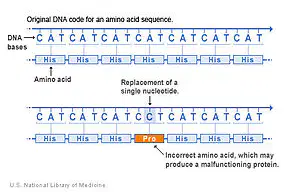
A mutation that alters the amino acid sequence of a protein is known as a
Silent mutation
Missense Mutation
Nonsense mutation
Frameshift mutation
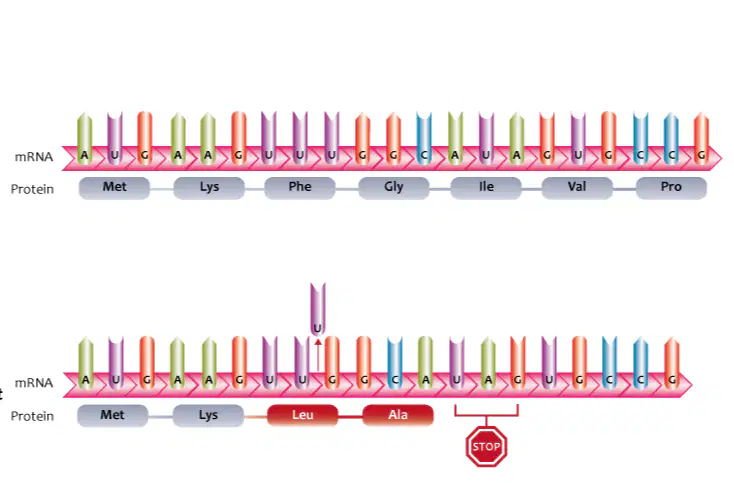
Which mutation involves removal of nucleotide causing a shift in the reading frame?
Misense Mutation
Nonsense Mutation
Frame shift mutation -Insertion
Frame shift mutation - Deletion
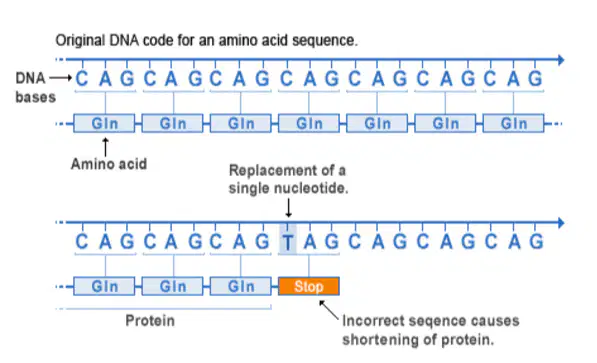
A mutation that changes a codon leading to a short protein formation with a stop codon is called:
Silent Mutation
missense mutation
nonsense mutation
Frameshift mutation
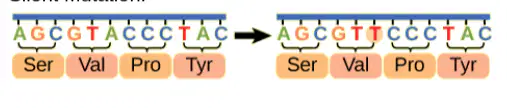
What mutation occurs with a single nitrogenous base change results in a codon that still codes for the same amino acid?
Silent mutation
nonsense mutation
missense mutation
frameshift mutation

Which mutation type causes the deletion of a base resulting in a shift in the reading frame?
Framshift mutation - deletion
missense mutation
Framshift mutation - Insertion
nonsense mutations
What is a GMO?
Organisms modified using genetic engineering techniques.
Organisms found in their natural state.
Organisms developed through mutations
Organisms altered through specific breeding
What is the primary goal of creating genetically modified crops?
To increase crop yield and quality
To eliminate all natural genetic variations.
To reduce the need for pesticides completely.
To prevent any risk of environmental impact.

