
 Worksheets
Property and Energy Changes in Chemical Reactions
Total questions: 10
Worksheet time: 11mins
Liquefied petroleum gas (LPG) is the gas we use in the kitchen. It is a liquid inside the cylinder. It turns into gas as it exits the cylinder (Change A), then it first burns (Change B). The following claims relate to these changes: Select the appropriate option.
Process B is physical change.
Process B is chemical change.
Both processes A and B are chemical change.
Both processes A and B are physical change.
No change will happen to both processes.
When you mix two different substances together, sometimes a chemical reaction occurs that forms a new substance. Which statement best describes what happens during a chemical reaction when two different substances form a new substance?
The atoms in the substances physically combine, but no new substance is formed.
The atoms in the substances lose their individual properties, resulting in a mixture.
The substances break down into simpler components without forming a new substance.
The atoms of the substances rearrange to form new substance/s with different properties.
The atoms substances undergo a change in state but maintain their original chemical composition.
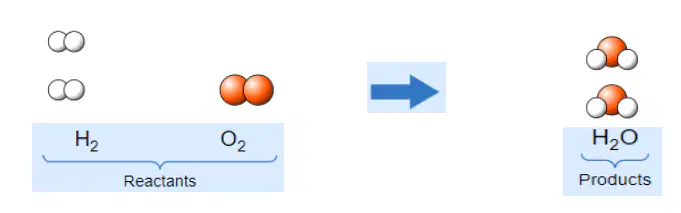
How does the mass of the water molecules compare with the masses of H atoms and O atoms after a chemical reaction? Choose all that applies.
The mass of the water molecules is less than the combined masses of H atoms and O atoms.
The mass of water molecules is greater than the mass of a hydrogen atom or an oxygen atom.
The mass of the water molecules is negligible compared to the masses of H atoms and O atoms.
The mass of water molecules is equal to the total mass of four hydrogen and two oxygen atoms.
The mass of the water molecules is inversely proportional to the combined masses of H atoms and O atoms.
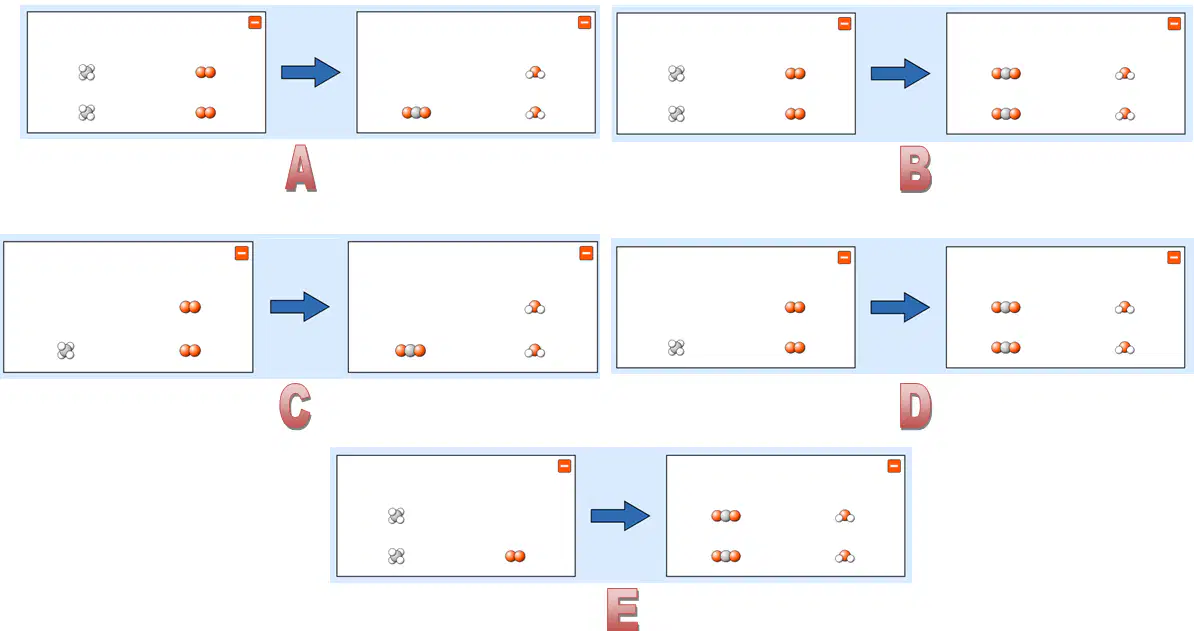
Which of the following equations is balanced?
A
B
C
D
E
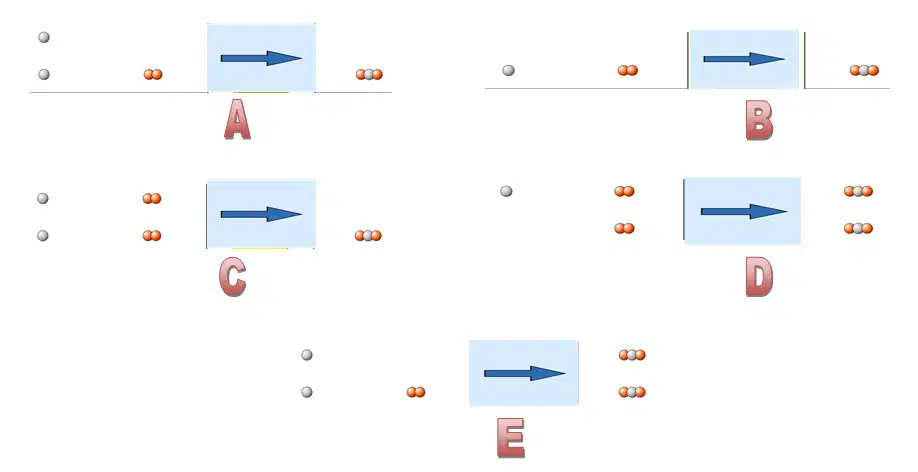
Which of the following chemical equations is balanced?
A
B
C
D
E
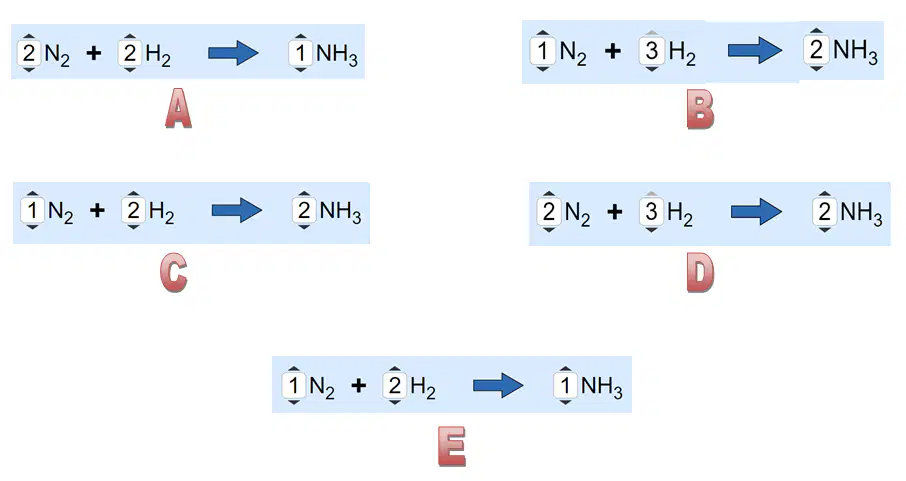
Which of the following chemical equations is balanced?
A
B
C
D
E
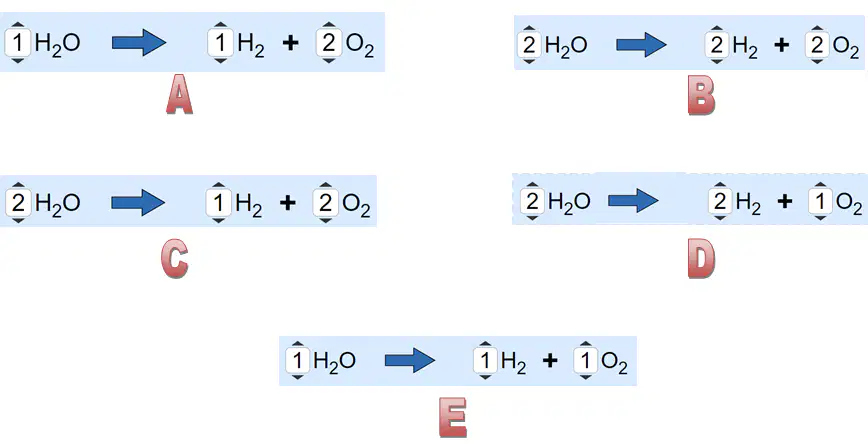
Which of the following chemical equations is balanced?
A
B
C
D
E
Choose the best term to complete the statement below:
Breaking bonds during a chemical reaction requires ________ energy.
releasing
multiplying
converting
adding
none of the above
What type of energy is found in all states of matter?
light and kinetic
gravitational and sound
electrical and light
kinetic and potential
potential and electrical
Choose the best term to complete the statement below:
Making new bonds during a chemical reaction requires ________ energy.
releasing
multiplying
converting
adding
none of the above

