wayground logo

Free Printable Worksheets

NEW

Font size

S
M
L
XL
Worksheets

Magnetism and Electricity

Total questions: 33

Worksheet time: 2hrs 39mins

Name
Class
Date
1.
What will happen when these magnets are brought close together?
a)
They will attract each other.
b)
They will repel each other.
c)
Both magnets will turn to the left
d)
Both magnets will turn to the right
2.

A device that uses a free-moving magnetic needle to show direction is a:

a)

Ruler

b)

magnet

c)

compass

d)

magnetic field

3.
Earth acts like a giant magnet because its center is made up MOSTLY of
a)
granite
b)
limestone
c)
iron
d)
nickel
4.
Where is the force of attraction the strongest on a magnet?
a)
at the poles
b)
in the middle
c)
above the magnet
d)
below the magnet
5.
The magnet's shown will
a)
not move
b)
attract
c)
repel
d)
all of the above
6.
What do the lines around this magnet represent?
a)
North Pole
b)
South Pole
c)
Magnetic Declination
d)
Magnetic Field
7.

Which electromagnet is stronger?

a)

A

b)

B

8.

Which electromagnet is stronger?

a)

A

b)

B

9.
What kind of magnet can be turned on and off?
a)
refridgerator magnet
b)
electromagnet
c)
magnetite
d)
iron
10.
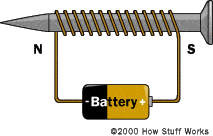
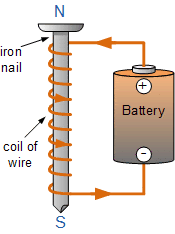
In order for an electromagnet to be formed, an __________ current must pass through a coil of __________ wrapped around an ________ core.
a)
wire, iron, electric
b)
electric, wire, iron
c)
iron, electric, wire
d)
excited, hair, apple
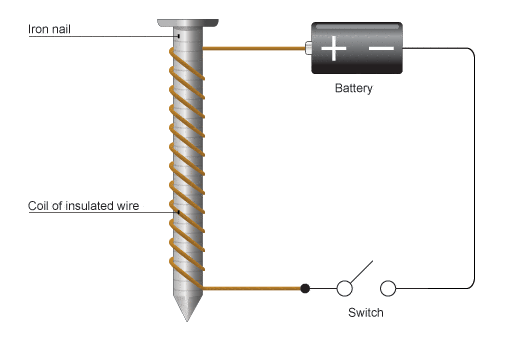
11.
What is most likely to happen when the switch is closed?
a)
A magnetic field should be produced
b)
The nail will rust
c)
The battery will explode
d)
The wire will catch on fire
12.

Which of the following will increase the strength of an electromagnet?

a)

Increase the voltage of the battery

b)

Decrease the voltage of the battery

c)

Wrap the coils around the core less times

13.
The unit for current is the 
a)
Volt
b)
Ohm
c)
Electron
d)
Amp
14.
In a ________ circuit there are multiple paths for the current to take.
a)
Series
b)
Parallel
15.
What is the unit for resistance?
a)
Volts
b)
Amperes
c)
Ohms
16.
In a _________ circuit, if one bulb goes out then the entire circuit doesn't work.
a)
Series
b)
Parallel
17.
What kind of circuit is this?
a)
Series
b)
Consecutive
c)
Parallel
d)
Training
18.
What voltage is needed to cause a 2A current flow through a 10Ω resistor?
a)
5V
b)
0.2V
c)
20V
d)
200V
19.
What resistance is needed to cause a 20A current flow because of a 100V battery?
a)
0.2Ώ
b)
2000Ώ
c)
120Ώ
d)
20.
Lightning is an example of _________.
a)
static electricity
b)
current electricity
c)
watts
d)
voltage
21.
What is a closed path for electrons to flow through?
a)
static electricity
b)
circuit
c)
amperes
22.
Which type of current comes from a battery?
a)
alternating current (AC)
b)
direct current (DC)
23.
A circuit made of wires, a lamp, a switch, and a cell is shown at the right. What change is needed for the lamp to glow? 
a)
The switch needs to be opened.
b)
The switch needs to be closed.
c)
The cell needs an insulator.
d)
The wire needs to be connected to the bottom of the cell.
24.
Which statement best explains why the lamp does not glow? 
a)
Circuit 1 is an open circuit.
b)
 Circuit 1 is a closed circuit.
c)
 The negative terminal of Circuit 1 is connected to the cell.
d)
The positive terminal of Circuit 1 is connected to the cell.
25.

Is a metal fork a conductor or insulator?

a)

conductor

b)

insulator

26.

Is rubber a conductor or insulator?

a)

conductor

b)

insulator

27.

Which of the following best describes what is being created in the picture?

a)

static electricity

b)

potential energy

c)

magnetic field

28.

What type of circuit is shown in the image?

a)

series

b)

parallel

29.

What type of circuit is shown in the image?

a)

series

b)

parallel

30.

What voltage is needed to cause a 50A current flow through a 10Ω resistor?

a)

15V

b)

500V

c)

500 kV

d)

0.2V

31.

AC stands for __________ current.

a)

alternating

b)

Adjusting

c)

Alarmed

d)

Additional

32.

DC stands for __________ current.

a)

deviating

b)

default

c)

diverging

d)

direct

33.

The following are applications of Direct current, except:

a)

refrigerator

b)

battery

c)

flashlight

d)

cellphone