
 Worksheets
Poetry Review
Total questions: 50
Worksheet time: 50mins
Poetry is organized in ___________ and ___________.
Syllables, Rhyme
Tone, Mood
Lines, Stanzas
A group of lines in a poem is called a _________.
Rhyme
Stanza
Line
A group of words arranged in a row.
Line
Syllables
Stanza
Repetition
Lines resemble a ____________.
sentence
paragraph
Stanzas resemble a ____________.
sentence
paragraph
A line in a poem must be a complete sentence.
True
False
How many sounds are in a word.
Repetition
Syllables
Rhyme Scheme
Rhyme
The poem’s message or life lesson
Symbolism
Imagery
Theme
Rhyme
An object representing a bigger idea
Symbolism
Imagery
Theme
Rhyme
Words that have the same ending sound
Repetition
Syllables
Rhyme Scheme
Rhyme
•The pattern of rhyme at the end of the line in a poem
Repetition
Syllables
Rhyme Scheme
Rhyme
•The repeating of words, phrases, lines, or stanzas
Repetition
Syllables
Rhyme Scheme
Rhyme
The way a piece of writing makes the reader (you) feel.
Mood
Tone
The author’s attitude about the topic
Mood
Tone
The “voice” of the poem — not always the poet
Character
Protagonist
Speaker
Antagonist
Today is Tim’s birthday. He could barely sleep last night because he was
so excited. He jumped out of bed and ran downstairs to the smell of
pancakes on his birthday.
What is the mood?
Joyful
Nervous
Crazy
Fearful
Dear Paul,
I know I told you that I would go bungee jumping with you next week. However, I changed my mind. I am not brave enough to jump off the platform. I keep having nightmares about my harness breaking.
-Brady
What is the tone of this letter?
Sarcastic
Frightened
Jealous
Confused
We have cheerleading tryouts at my school next week. I’m pretty sure I’ll make the team. I have been practicing my jumps, and my ten years of gymnastics classes should help me stand out. Plus, you know me and my loud voice!
Which word best describes the tone?
nervous
serious
relieved
confident
Congratulations on completing your first marathon! I know you set this goal a long time ago, and you worked hard to achieve it. You have shown me that if I work hard, I can achieve my goals, too!
What is the tone?
Proud
Excited
Worried
Confused
Select all the examples of MOOD
I feel happy reading this
The story made me feel scared
The author wrote the story to make it scary
"The author wrote that the character says setting was "bone-chilling"."
Is this an example of Mood or Tone?
Mood
Tone
"The author described the setting as "dark and gloomy"."
Is this an example of Mood or Tone?
Mood
Tone
"I felt happy after reading this story."
Is this an example of Mood or Tone?
Mood
Tone
Used to create a mental image
(a)
Haikus are poems usually about ____________________.
Nature
Love
Rhyme
Emotions
Haiku poems have (a) lines.
Haiku poems have (a) syllables.
Which is the correct syllable pattern for a haiku poem?
7-5-7
5-5-7
5-7-5
7-7-5
Limericks are poems that are usually ____________.
Serious
Funny
Emotional
Romantic
What is the rhyme scheme of a limerick?
AABBB
ABABA
AAABB
AABBA
Limerick poems have (a) lines.
Which of the following applies to a free verse poem?
Has a clear rhyme scheme
Has no rules
Has a certain number of lines
Shows a pattern
Tells a story with characters, setting, conflict, and plot.
Free Verse
Haiku
Narrative
Lyric
Focuses on that given moment rather than telling a story.
Free Verse
Haiku
Narrative
Lyric
An extreme exaggeration is a ______________.
Hyperbole
Simile
Metaphor
Onomatopoeia
A comparison between two things by using “like” or “as”
Hyperbole
Simile
Metaphor
Onomatopoeia
A comparison between two things without using “like” or “as”
Hyperbole
Simile
Metaphor
Onomatopoeia
Words that are the sound of the object or action it refers to
Hyperbole
Simile
Metaphor
Onomatopoeia
Two or more words begin with the same letter and/or sound and are used repeatedly in a phrase or sentence
Alliteration
Simile
Personification
Onomatopoeia
Giving human characteristics to something that is not human
Alliteration
Simile
Personification
Onomatopoeia
The sky was painted pink like cotton candy.
Simile
Metaphor
Personification
Hyperbole
The ball hit the bat with a loud crack.
Alliteration
Onomatopoeia
Simile
Metaphor
Her voice was music that calmed the crowd.
Alliteration
Onomatopoeia
Simile
Metaphor
"Coop colors cats with crayons.” is an example of _________________.
Hyperbole
Alliteration
Personification
Onomatopoeia
The wind whispered secrets through the trees.
Hyperbole
Personification
Alliteration
Onomatopoeia
My brain is going to explode if I study any more tonight.
Simile
Alliteration
Hyperbole
Metaphor
What is the RHYME SCHEME of this poem?
--
Roses are red,
We have the flu.
I can't smell anything
And neither can you
A, C, A, B
A, B, C, B
A, B, C, C
A, B, A, B
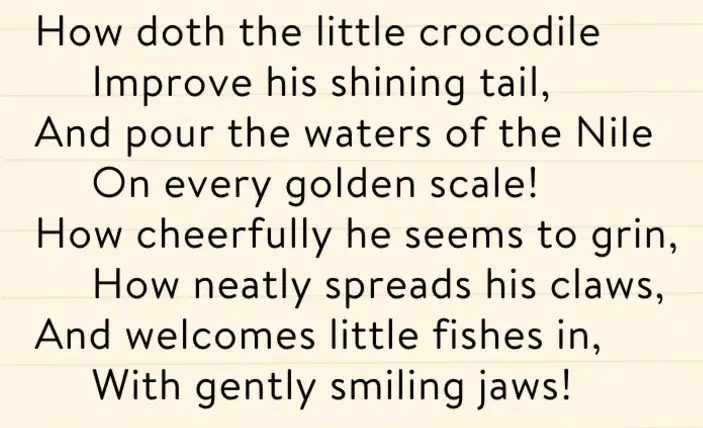
What is the rhyme scheme of this poem?
ABABCCCD
ABCBCDCD
ABABCDCD
ABABCDCC
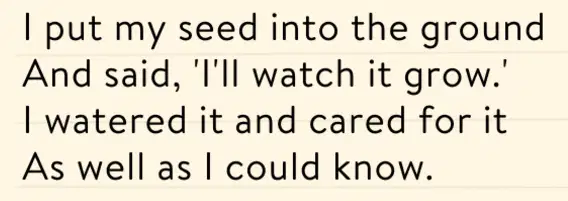
What is the rhyme scheme of this poem?
ABAB
ABCB
ABAA
ABBB
Language that appeals to the senses (sight, sound, taste, touch, smell)
Theme
Imagery
Symbolism
Repetition

