
 Worksheets
Grade Repair January 24
Total questions: 101
Worksheet time: 3hrs 57mins


Frederick Douglass
Escaped slave who became a noted abolitionalist leader
Elizabeth Cady Stanton
Leader in the abolitionist and women's rights movement
Seneca Falls Convention
Convention held in 1848 to argue for women's rights

investors
Northeast
fertile soil
Midwest
John Deere steel plow
turned prarie land in farmland
Cyrus McCormick's reaper
harvest grain
Cotton and Tobacco
The South
Confederacy
“Confederate States of America,” formed in 1861 by the southern states that seceded from the Union
Jefferson Davis
President of the Confederate States of America
Abraham Lincoln
President during the Civil War
Why were the Fourteenth and Fifteenth Amendments passed?
to make sure that the rights of African Americans were protected
to not recognize state governments created under Lincoln and Johnson’s plan.
to give food and clothing to former slaves and set up hospitals and schools.
to allow landowners divide land and assign each worker a few acres.
Three groups made up the South’s Republican Party. Carpetbaggers were northerners who had moved to the South after the war. Scalawags were white southerners who joined the Republican Party for political opportunities. Many were small farmers who did not want wealthy planters to regain power. The third group was African Americans eager to vote and take part in politics.
QUESTION: Which group was NOT part of the South's Republican Party?
Carpetbaggers
Scalawags
African Americans
Radical Republicans

Great Plains
The grassland region of the United States
Treaty of Fort Laramie
1868 treaty in which the Sioux agreed to live on a reservation
Battle of Wounded Knee
U.S. massacre of Sioux at Wounded Knee Creek, South Dakota
Dawes Act
Law that broke up Native American reservations
assimilation
Name of plan to make Native Americans part of white culture
Great Plains
The grassland region of the United States
Treaty of Fort Laramie
1868 treaty in which the Sioux agreed to live on a reservation
Battle of Wounded Knee
U.S. massacre of Sioux at Wounded Knee Creek, South Dakota
Dawes Act
Law that broke up Native American reservations
assimilation
Name of plan to make Native Americans part of white culture
Many Chinese came to California for which reason?
seek their fortunes after the discovery of gold in 1848 started the California gold rush.
build the nation’s railroads
farming, mining, and domestic service
Identify Ellis Island.
an island in New York Harbor that was the chief immigration station in the United States from 1892 to 1924.
proof of immigrants' mental competence
use of passports to control the number of professionals and young men of military age who left the country
Identify Angel Island.
an island in the San Francisco Bay that was an entry point for many Asian immigrants to the United States beginning in 1910.
Processing at Angel Island was different from the procedure at Ellis Island.
Immigrants endured harsh questioning. They were kept in dirty, run-down buildings while they waited to find out whether they would be admitted or rejected.
What agency created African American universities during this time period?
The Freedman's Bureau
The National Collegiate Athletic Association
The American Council on Education
The United States Department of Education
Becoming President
Making Sandwiches
Women's Suffrage Movement
Being a Nurse in the Civil War

This gave all men regardless of race the right to vote.
13th Amendment
14th Amendment
15th Amendment
16th Amendment


Jacksonian Democracy
an informal group of trusted advisers who sometimes met in the White House kitchen
The practice of giving government jobs to political backers
The period of expanding democracy that gave voting rights to all white males
The Court ruled that the national bank was constitutional

During the early to mid-1700s, the British policy of salutary neglect toward the American colonies contributed to
a decline in colonial maufacturing
the decline of slavery in the northern colonies
a decrease in French and Spanish influence in North America
the development of independent colonial trade practices
Prohibited (stopped) settlers from moving west of the Appalachian Mnts. in hope that it would stop conflict with Native Americans.
FRENCH & INDIAN WAR (1754 – 1763)
PROCLAMATION LINE OF 1763
BOSTON MASSACRE (1770)
THE ENGLISH BILL OF RIGHTS (1689)

Sherman and Grant used this strategy, which the goal was make the Confederacy give up or lose the will to win?
Anaconda Plan Warfare
Trench Warfare
Guerrilla Warfare
Total War

Mercantilism can BEST be described as
economic trade policy in which a country exports more than it imports in order to create a favorable balance of trade
religious policy in which European countries established missions in the New World
alliance system used by European nations to maintain peace with the Native Americans of the New World
political structure implemented by European nations that divided society into a very rigid class system of haves and have nots
The 1763 Treaty of Paris concluded a conflict between which two colonial powers?
SSUSH3
England and Spain
France and England
Spain and Portugal
Portugal and France
Stated that no colonists could settle in lands to the west of the Appalachian mountains-- made the colonists very upset.
SSUSH3
Proclamation of 1763
Stamp Act
Townshend Act
Quartering Act
A series of laws to punish colonist actions at the Boston Tea Party
SSUSH3
Intolerable Acts
Townshend Acts
Quartering Act
Sugar Act
Treaty Between England and the Colonies , formally ended the American Revolutionary War
SSUSH4
Treaty of Paris (1763)
Treaty of Paris (1783)
Olive Branch Petition
Declaration of Independence
Last major battle of the American Revolution that forced the British to surrender
SSUSH4
Battle of Charleston
Battle of Cowpens
Battle of Yorktown
Battle of Saratoga
Law that taxed printed goods, including: Dice, playing cards, documents, newspapers, etc.
SSUSH3
Townshend Act
Sugar Act
Stamp Act
Tea Act
This document would sever ties with colonies and England, ultimately leading to the American Revolution.
SSUSH4
Declaration of Independence
Treaty of Paris (1783)
Olive Branch Petition
Treaty of Paris (1763)
Continental Army victory over British troops considered the turning point of the American Revolution.
SSUSH4
Battle of Saratoga
Battle of Trenton
Battle of Bunker's Hill
Battle of Yorktown
Why were the committees of correspondence important?
SSUSH4
They presented an alternative to violent resistance to the laws so that colonists could claim the moral advantage in their disputes with Britain
They allowed colonial loyalist to communicate with each other quickly in order to avert crises following the passage of new laws
They controlled the newspapers and therefore how acts of resistance and the British response to such acts were reported to the public
They unified colonists who were dissatisfied with the political situation into more effective groups of resistance
What was the MOST significant contribution of the Marquis de Lafayette during the American Revolution?
He identified Benedict Arnold as a traitor
He was the most important general during the war
He was a great writer
He gained military and naval support from France at the battle of Yorktown
Relaxed enforcement on trade laws imposed on colonies
Burgesses
Joint Stock Company
Charter
Salutary Neglect
The trade pattern between the colonies, Africa, and Europe was called what?
Middle Passage
Navigation Acts
Triangular Trade
Columbian Exchange
Ministers of The Great Awakening preached ___________
God was kind and forgiving
people were not equal
colonists should not be independent
colonists could save themselves

How were the conditions of the slave boats during the Middle Passage?
The lodgings were clean and sanitary for the slaves
The slaves were well fed and clothed
The conditions were dirty and unsanitary for the slaves
All of the above
Which compromise addressed slave representation?
Great Compromise
Commerce Compromise
3/5th Compromise
States Compromise
This law made it possible for the President to kick immigrants out of the country.
Alien Act
Sedition Act
Neutrality Act
Jay's Treaty
conduct or speech inciting people to rebel against the government
alien
sedition
amendment
freedom of expression
(a) wanted war with Britain.
(b) did not want war with Britain
(c) Is the act of forcing some one into military service
circle the Louisiana Purchase on the map


(a) as the first stop on the Expedition
What did James Monroe consider dangerous to the peace and safety of the United States?
European interference in the affairs of Latin America and South America
The spread of democracy in Europe
The independence movements in South America
The British Navy
Match the following
William T. Sherman
Union General "March to the Sea" destroyed much of Georgia
Andrew Jackson
7th President of US associated with the spoils system
Napoleon Bonaparte
Sold Louisiana Purchase to the US in 1803 for $15 million
Nat Turner
Led failed rebellion in 1831, led to strict slave codes
Andrew Johnson
17th Pres. first to be impeached due to political tensions
Horace Mann
Reformer of public education
William Lloyd Garrison
abolitionists publisher of "The Liberator"
Dred Scott
slave who sued in 1857 based on living in a free state
Stonewall Jackson
Confederate general killed at the battle of Chancellorsville
Jefferson Davis
first and only Pres. of the Confederacy
Henry Clay
Proposed Missouri Compromise
Elizabeth Cady Stanton
Led the Seneca falls convention for women's right to vote
Robert E. Lee
Confederate general, surrendered at Appomattox
Eli Whitney
Invented the cotton gin and interchangeable parts
Frederick Douglass
former slave, abolitionist, publisher of the "North Star"
Determine the terms MOST relevant to the American System. There are three (3).
Canal & Road Improvements
Suffrage & Property Ownership
Tariffs
The Spoils System
Federal Authority
Match the following info to the correct colonial region.
New England
cold & short summers, rocky soil
Middle Colonies
deep rivers, fertile farmland
South
Long growing season
Which of the following was NOT a provision of the Compromise of 1850?
A stricter fugitive slave act was enacted
California was allowed to enter the Union as a free state
Slavery was prohibited in all territories gained by the Mexican Cession
The southwest territories would determine their free vs slave status via popular sovereignty
The Mexican American War can be considered an example of
Imperialism
Nationalsim
Manifest Destiny
Federalism

Which is the Texas Annexation?
5
6
7
8
What belief was justified by Manifest Destiny?
The need to limit the number of immigrants entering the country
The need to control the area located east of the Appalachian Mountains
The need to expand the United States to the Pacific Ocean
The need to warn European countries against colonizing Latin America

How did the Kansas-Nebraska Act nullify the Missouri Compromise?
It changed the borders of Missouri.
It required that all of Missouri be free.
It allowed slavery in new Northern territories.
It established new interstate trade rules.

All of these were reasons the Fugitive Slave Law failed except
many slaves moved to Canada.
Northerners refused to obey the law.
hounded slave catchers returned to the South.
plantation owners did not want returned slaves.

1857- legalized slavery in the territories and declared the Missouri Compromise unconstitutional
Who led the unsuccessful 1859 raid on Harpers Ferry, Virginia in an attempt to arm the slaves and begin a revolt?
Jefferson Davis
Abraham Lincoln
John Brown
Robert E. Lee
Ulysses S. Grant
Which THREE of the following were advantages that the North had over the South leading into the Civil War? Select all that apply.
larger farms
more factories
larger population
extensive railroad system
more well-trained officers
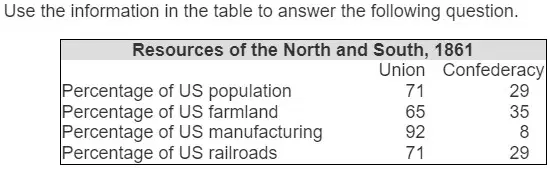
Which statement BEST explains the importance of the information presented in the table?
It shows the disparity between the Union and the Confederacy at the end of the Civil War in population, railroads, farmland, and manufacturing, indicating the problems caused by the lack of European support for the South.
It shows the disparity between the Union and the Confederacy during the Civil War in population, railroads, farmland, and manufacturing, indicating the great success of the blockade of Confederate ports.
It shows the disparity between the Union and the Confederacy at the outset of the Civil War in population, railroads, farmland, and manufacturing, indicating the great advantage the Union would have in the war.
It shows the disparity between the Union and the Confederacy at the outset of the Civil War in population, railroads, farmland, and manufacturing, indicating the slight advantage the Confederacy would have in the war.
Which statement correctly describes General William Sherman's victorious strategy in the Battle for Atlanta?
With a surprise frontal attack on Confederate troops, he forced them to abandon the city.
With a surprise rear attack on Confederate troops, he forced them to abandon the city.
By cutting off all railroad supply lines, he forced Confederate troops to abandon the city.
By burning down much of Atlanta, he forced Confederate troops to abandon the city.
Which THREE of the following were advantages that the North had over the South leading into the Civil War? Select all that apply.
larger farms
more factories
larger population
extensive railroad system
more well-trained officers
Though many immigrants came to the United States during the Antebellum Period, few of them settled in the South. Why?
There were few available jobs in the South due to the availability of slaves.
Most immigrants were opposed to slavery and wanted nothing to do with the South.
The Nativist movement was strong in the South and locals treated immigrants poorly.
Immigrants preferred the pastoral landscapes of the North to the industry of the South.
Which of the following statements about the impact of tariffs on the Northern and Southern economies is correct?
Tariffs benefited the North but harmed the South.
Tariffs harmed the North but benefited the South.
Tariffs benefited both the North and the South.
Tariffs harmed both the North and the South.
Which statement BEST explains the importance of the information presented in the table?
It shows the disparity between the Union and the Confederacy at the end of the Civil War in population, railroads, farmland, and manufacturing, indicating the problems caused by the lack of European support for the South.
It shows the disparity between the Union and the Confederacy during the Civil War in population, railroads, farmland, and manufacturing, indicating the great success of the blockade of Confederate ports.
It shows the disparity between the Union and the Confederacy at the outset of the Civil War in population, railroads, farmland, and manufacturing, indicating the great advantage the Union would have in the war.
It shows the disparity between the Union and the Confederacy at the outset of the Civil War in population, railroads, farmland, and manufacturing, indicating the slight advantage the Confederacy would have in the war.
Which of the following was a primary goal of President Abraham Lincoln at the outset of the Civil War?
A
B
C
D
to abolish slavery in both Union and Confederate states
to restore the Confederate states to the Union
to punish the Confederate states for secession
to prevent slavery from spreading to western territories
During the Civil War, President Abraham Lincoln suspended the right of habeas corpus for which MAIN reason?
to conscript citizens into the Union Army
to free slaves throughout the Confederacy
to prevent British interference in the conflict
to keep Confederate sympathizers imprisoned
The Emancipation Proclamation freed
all slaves in the United Slates.
all slaves born in the United States.
all slaves who were living in rebelling states.
all slaves living in states under Union control.
Read the quotation below and then answer the question that follows.
"A house divided against itself cannot stand."
— Abraham Lincoln, June 16, 1858
What meaning did Lincoln wish to convey in this quotation?
Abolitionists and slavery supporters must seek a compromise.
Division over the issue of slavery was a significant threat to the Union.
Slavery was driving the world's powers to avoid engaging with the United States.
The nation's reliance on slavery threatened its economic stability and stood in the way of progress.
What is the significance of the events at Appomattox Courthouse, Virginia, on April 9, 1865?
President Abraham Lincoln issued the Emancipation Proclamation, declaring the freedom of all slaves throughout the Confederacy.
Confederate General Robert E. Lee surrendered to Union General Ulysses S. Grant, thus bringing an end to the Civil War.
Union forces under the command of General George Meade defeated a much larger Confederate army, preventing Southern troops from invading the North.
Confederate troops fired on Union soldiers camped outside the town, thus beginning the Civil War.
Which statement correctly describes General William Sherman's victorious strategy in the Battle for Atlanta?
With a surprise frontal attack on Confederate troops, he forced them to abandon the city.
With a surprise rear attack on Confederate troops, he forced them to abandon the city.
By cutting off all railroad supply lines, he forced Confederate troops to abandon the city.
By burning down much of Atlanta, he forced Confederate troops to abandon the city.
How did the actions of General Ulysses S. Grant during the siege of Vicksburg affect the civilian population?
Grant ordered that anyone not in the military be expelled from the region.
Many starved as Grant and his troops took food and supplies from area farms.
Grant paid civilians in the area who were willing to house and feed his soldiers.
Many died because Grant forced civilians to camp with his army discourage attacks.
How did Sherman's "March to the Sea" MOST directly impact the civilian populace of the South?
Thousands of civilians lost their lives as a result of Sherman's campaign.
Many Southerners were forced to join the Union army as a result of Sherman's campaign.
Large numbers of civilians lost property as a result of Sherman's campaign.
Southerners' resolve was strengthened against the Union as a result of Sherman's campaign.
What was historically significant about the Battle of Gettysburg?
It was the bloodiest battle of the Civil War.
It was the first large-scale battle of the Civil War.
It inspired a surge of enlistment in the Confederate Army.
It allowed the Confederacy to gain control of Pennsylvania.
The Confederate bombardment of which fort on April 12-13, 1861, marked the beginning of the American Civil War?
Fort Pickens
Fort Sumter
Fort McHenry
Fort Donelson
Which of the following geographic features made the city of Atlanta an essential target for Union forces, leading to the Battle for Atlanta in 1864?
the city's location on a ridge above the Chattahoochee River
the city's location in the foothills of the Appalachian Mountains
the city's location as a hub of railroads carrying military supplies
the city's location as a hub of canals carrying military supplies
Read the text. Then answer the question that follows.
In May of 1863, General Robert E. Lee led the Army of Northern Virginia into Union territory. His goal was to advance into the North and pressure the government there to end the war. In early July, Lee engaged his enemy with the intention of crippling the opposing army and gaining foreign recognition for the Confederacy. The battle raged for three days, and when it ended, it had claimed more casualties than any other battle of the war.
Which battle is described in the text?
The Battle of Appomattox Court House, in which the Union crushed the rebellion and forced Lee's surrender.
The Battle of Gettysburg, which ended Lee's aggressive ambition and drove his army back into the South.
The Battle of Chancellorsville, which routed the Union forces and opened the way toward Washington, DC.
The Battle of the Antietam, in which neither the Union nor Confederate forces won a decisive victory.
Which of the following geographic features made the city of Atlanta an essential target for Union forces, leading to the Battle for Atlanta in 1864?
the city's location on a ridge above the Chattahoochee River
the city's location in the foothills of the Appalachian Mountains
the city's location as a hub of railroads carrying military supplies
the city's location as a hub of canals carrying military supplies
Read the text. Then answer the question that follows.
In May of 1863, General Robert E. Lee led the Army of Northern Virginia into Union territory. His goal was to advance into the North and pressure the government there to end the war. In early July, Lee engaged his enemy with the intention of crippling the opposing army and gaining foreign recognition for the Confederacy. The battle raged for three days, and when it ended, it had claimed more casualties than any other battle of the war.
Which battle is described in the text?
The Battle of Appomattox Court House, in which the Union crushed the rebellion and forced Lee's surrender.
The Battle of Gettysburg, which ended Lee's aggressive ambition and drove his army back into the South.
The Battle of Chancellorsville, which routed the Union forces and opened the way toward Washington, DC.
The Battle of the Antietam, in which neither the Union nor Confederate forces won a decisive victory.
The Confederate army received a terrible and perhaps mortal blow to its leadership with the accidental death of what general in 1863?
Robert E. Leed
J.E.B. Stuart
George Pickett
Thomas "Stonewall" Jackson
What was the Congressional (radical republican) Plan for Reconstruction?
Put southern states under military governments until the 14th and 15th Amendments were ratified.
Southern states could re-enter into the Union immediately
All males had to take a loyalty oath
No southern states could re-enter the Union.

Which of the following best defines the term Reconstruction?
The amendment that outlawed slavery
The time period (1865-1877) when former confederate states were reintegrated into the country.
The amendment that guaranteed citizenship to newly freed enslaved people and gave them equal protection.
Strict states laws passed after the Civil War.
On May 10, 1869, in Promontory, Utah, the East and the West became connected by the completion of
a telegraph line reaching from New York to San Francisco.
the Transcontinental Railroad.
the Oregon Trail system.
the stations that served the Pony Express.
Why were business owners in the late 1800s and early 1900s able to convince many people that labor-organizing efforts were ¨un-American¨?
A large proportion of the industrial workers in the United States were foreign-born.
Wages in the United States were generally higher than they were in Europe.
Labor-organizing efforts were strongest outside the South.
Labor organizers generally supported United States intervention in foreign wars.

