
 Worksheets
Seg One 8 Periodic Table, Acids and Bases, Compounds and Mixture
Total questions: 40
Worksheet time: 26mins
Based on Dalton's atomic theory, is each statement true about atoms of the same element? (Highlight)
They have identical mass.
They have different masses.
They have identical properties.
They have different properties.
What did Ernest Rutherford conclude about the atom from his gold foil experiment?
Most alpha particles went right through.
Most alpha particles were deflected.
Most alpha particles were absorbed.
Most alpha particles disappeared.
Which of the group of elements are human-made and do not occur in nature?
Actinides
Halogens
Noble gases
Nonmetals
Identify what happens to chemical reactivity of metals as we move down a column on the periodic table?
The chemical reactivity increases.
The chemical reactivity decreases.
The chemical reactivity remains the same.
The chemical reactivity fluctuates.
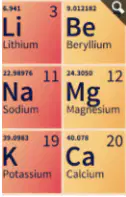
Determine the number of protons, electrons, and neutrons present in an atom of magnesium (Mg)? Explain how you determined your answer using complete sentences.
Which of the following is a property of salts?
Conduct electricity as solids.
Do not conduct electricity as solids.
Are highly reactive.
Are non-reactive.
A substance with a pH of 11.4 is a(n)
Acid
Base
Neutral substance
Alkaline substance
Explain the difference between acids and bases on the basis of touch. Give an example of each. Use complete sentences.
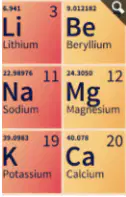
Which is the most reactive metal shown on the portion of
the periodic table to the left?
Li
Be
K
Ca
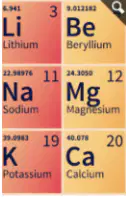
Which is the least reactive element shown on the
periodic table to the left?
Ca
Na
Be
K
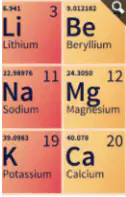
How many protons does magnesium have?
12
19
3
24

Which element has the same properties as sodium?
Select all that apply
Li
Be
Mg
K
How does the concentration of H+ and OH- ions change when a substance with a pH of 11.0
is added to water?
H+ increases, OH- decreases
H+ decreases, OH- increases
No change in H+
No change in OH-
According to Dalton's atomic theory, which of the following best describes an atom?
Can be destroyed
Present in all matter
Composed of elements
Does not contain particle
When positively charged particles were radiated onto a gold atom, most of the particles went straight past. What is most likely the reason for this?
Dense area inside the atom
Empty space around the nucleus
Scattered positively charged particles in the atom
Electrons and neutrons inside the nucleus
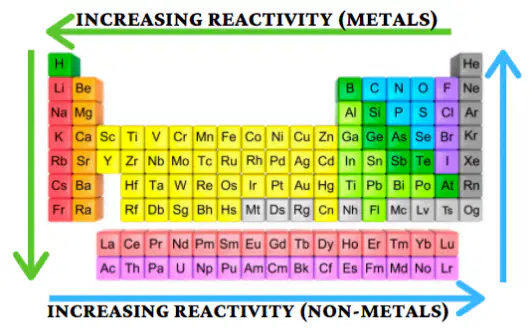
What elemental trend exists as we move down a column on the periodic table?
Chemical reactivity of metals increases
Chemical reactivity of nonmetals increases
Chemical reactivity of metals remains unchanged
Chemical reactivity of nonmetals remains unchanged
What is the name of the group of elements that are a good conductor of heat?
Alkali metals
Halogens
Noble gases
Nonmetals
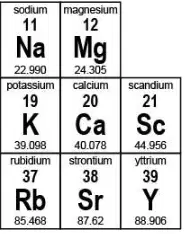
Use the portion of the periodic table shown below to answer the questions.
Part 1: Name two elements that have the same properties as magnesium (Mg). Use the names of the elements for your answer.
(a)
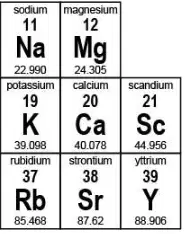
Part 2: Determine the number of protons, electrons, and neutrons present in an atom of potassium (K).
Protons ___________________
Electrons __________________
Neutrons __________________
(a)
What is formed when atoms of one type react with atoms of other types?
Compound
Electrons
Element
Protons
Which of these is true about the possible number of compounds that can be formed?
There is an infinite number of possible compounds because some compounds are not reactive.
There is an infinite number of possible compounds because the number of elements is unlimited.
There is a finite number of possible compounds because the number of elements is limited.
There is a finite number of possible compounds because all compounds are reactive.
Which of the following is a property of salts?
Undergo combustion
Do not make ionic bonds easily
Do not conduct electricity as solids
Formed due to reaction of acid with water
Which type of substance can be separated using a centrifuge?
A homogeneous mixture with components of same density
A compound with elements of same density
A homogeneous mixture with components of varying density
A compound with elements of varying density
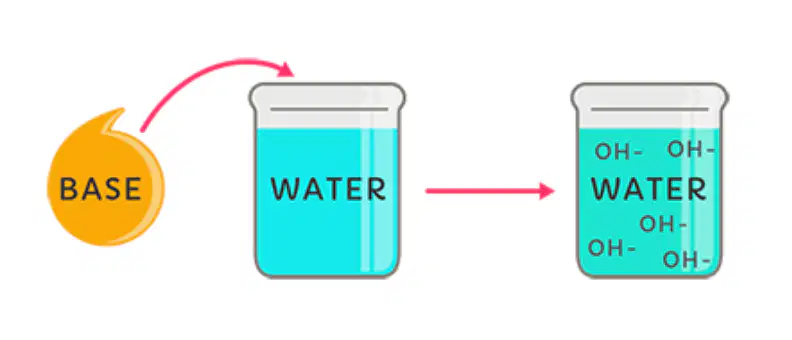
How will the concentration of H+ and OH− ions change when a substance with a pH 11.4 is added to water?
Both H+ and OH− will increase
Both H+ and OH− will decrease
H+ will increase and OH− will decrease
H+ will decrease and OH− will increase
Which of the following is not a subatomic particle?
Electron
Neutron
Nucleus
Proton
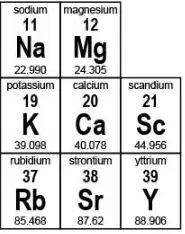
A part of the periodic table is shown.
Which of the following elements is more reactive than the others?
Calcium (Ca)
Magnesium (Mg)
Potassium (K)
Sodium (Na)
Because of the structure of the electron cloud, as particles were radiated onto a gold atom, what was observed during Rutherford's experiment?
Electron cloud absorbed the particles
Particles that struck the nucleus went straight
Particles that struck the nucleus are absorbed
Electron cloud allowed the particles to pass through
What is the name of the group of elements that are human-made and do not occur in nature?
Actinides
Halogens
Noble gases
Nonmetals
Which of the following is formed when an acid reacts with a base?
Alkaline
Hydrogen ion
Hydroxide ion
Salt
When positively charged particles were radiated onto a gold atom, a few of the particles bounced back. Which of the following caused this?
Positively charged protons in the nucleus of the gold atom
Positively charged electrons in the nucleus of the gold atom
Negatively charged protons around the nucleus of the gold atom
Negatively charged electrons around the nucleus of the gold atom
Which of the following is created when solids, liquids, or gases mix with one another?
Mixture
Element
Compound
Pure substance
Which type of mixture can be separated using magnetism?
Heterogeneous mixture whose components are attracted differently to a magnet
Heterogeneous mixture whose components are attracted equally to a magnet
Homogeneous mixture whose components are attracted differently to a magnet
Homogeneous mixture whose components are attracted equally to a magnet
What elemental trend exists in each row as we move from left to right on the periodic table?
Number of protons decreases
Number of protons increases
Chemical reactivity of metals increases
Chemical reactivity of nonmetals decreases
Which of the following explains how all compounds are created?
By the combination of an unlimited number of elements
By creating and destroying protons of different atoms
By the combinations of many atoms of the same element
By losing, gaining, or sharing electrons between other atoms
According to Dalton's atomic theory, which statement is true about atoms of the same element?
They can be destroyed.
They have identical mass.
They have different properties.
They can be divided into elements.
Which of the following is a method used by atoms to form a chemical bond?
Merging electrons
Merging protons
Sharing electrons
Sharing protons
Which type of ions are formed when an acid is dissolved in water?
Hydrogen ions
Hydroxide ions
Oxide ions
Sodium ions
Which of the following methods can be used to separate salt and iron?
Question 13Select one:
a.
b.
c.
d.
Distillation
Evaporation
Filtration
Magnetism
What is the name of the group of elements that have properties of both metals and nonmetals?
Alkaline earth metals
Alkali metals
Metalloids
Noble gases
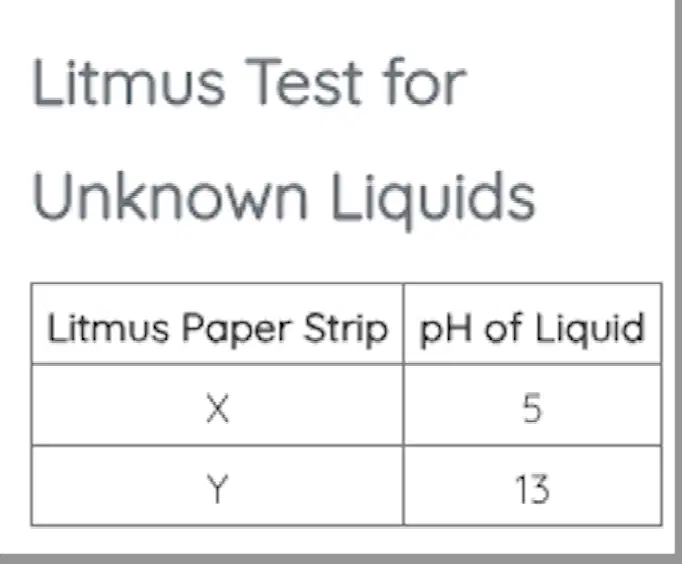
Litmus paper strips were dipped in two different unknown liquids. The table below shows the pH of the two liquids:
What will happen to the litmus strips?
Both will turn red
Both will turn blue
X will turn red and Y will turn blue
X will turn blue and Y will turn red

