
 Worksheets
Chapter 2 Review Geo
Total questions: 91
Worksheet time: 3hrs 48mins
The product of any two odd numbers is _____________
A, D, G, J, _____

23, 33, ___, 53, ___, 73


12, 15, ___, 21, ____, 27
12, 17, 22, 27, ___, ___
All numbers that are divisible by 2 are divisible by 4
Given the following observation--Each day, you get to school before your friend--what conjecture can you make?
You arrived at school before your friend yesterday.
You will get home before your friend.
You will arrive at school before your friend tomorrow.
You need a new friend.
Which of the following is a counterexample to the conjecture that the product of two positive numbers is always greater than either number?
1 x 5 = 5; 5 is not greater than 5
2 x 3 = 6; 6 is greater than 2 and 3
-3 x 4 = -12; -12 is not greater than -3 or 4
-1 x -2 = 2; two is greater than -1 and -2

According to the graph, which is a reasonable conjecture?
More girls will participate in high school lacrosse in Year 8 than those who participated in Year 7.
The number of girls participating in high school lacrosse will exceed the number of boys participating in high school lacrosse in Year 9.
There were more girls participating in high school lacrosse in Year 5 than in Year 1.
More girls will participate in lacrosse in the United States during Year 8 than in Sweden.

Which of the following is true about the conditional statement below?
If a man is 7 feet tall, then he plays basketball.
Hypothesis: a man is 7 feet tall
Conclusion: he plays basketball
Hypothesis: IF a man is 7 feet tall
Conclusion: THEN he plays basketball
Hypothesis: THEN he plays basketball
Conclusion: IF a man is 7 feet tall
Hypothesis: he plays basketball
Conclusion: a man is 7 feet tall
Which of the following is true about the conditional statement below?
If you are flying, then you are in a
jet.
Hypothesis: you are flying
Conclusion: you are in a
jet
Hypothesis: IF you are flying
Conclusion: THEN you are in a
jet
Hypothesis: THEN you are in a
jet
Conclusion: IF you are flying
Hypothesis: you are in a
jet
Conclusion: you are flying

Which of the following is true about the conditional statement below?
If you are in Alaska, then you are
cold.
Hypothesis: you are in Alaska
Conclusion: you are
cold
Hypothesis: IF you are in Alaska
Conclusion: THEN you are
cold
Hypothesis: THEN you are
cold
Conclusion: IF you are in Alaska
Hypothesis: you are
cold
Conclusion: you are in Alaska
Which of the following is the CONVERSE of the statement below?
If an object is a ring, then it is
made of gold.
If an object is made of gold, then it is a ring.
If an object is not a ring, then it is not made of god.
If an object is not made of gold, then it is not a ring.
There is no converse of the statement.

Which of the following is the CONVERSE of the statement below?
If an object is a bird, then it can fly.
If an object can fly, then it is a bird.
If an object is not a bird, then it cannot fly
If an object cannot fly, then it is not a bird
There is no converse of the statement
Which of the following is the CONVERSE of the statement below?
If your grade is a 96, then you are
making an A.
If you are making an A, then your grade is a 96.
If you are not making an A, then your grade is not a 96.
If your grade is not a 96, then you are not making an A.
There is no converse of the statement.

Which of the following is the CONVERSE of the statement below?
If you play football, then you wear
a uniform.
If you wear a uniform, then you play football.
If you do not play football, then you do not wear a uniform.
If you do not wear a uniform, then you do not play football.
There is no converse of the statement.
Which of the following is the INVERSE of the statement below?
If an object is a computer, then it
has a hard drive.
If an object is not a computer, then it does not have a hard drive.
If an object does not have a hard drive, then it is not a computer.
If an object has a hard drive, then it is a computer.
There is no inverse of the statement.

Which of the following is the INVERSE of the statement below?
If an object is a battery, then it is
rechargeable.
If an object is not a battery, then it is not
rechargeable.
If an object is rechargeable, then it is not a battery.
If an object is not rechargeable, then it is not a battery.
There is no inverse of the statement.
Which of the following is the INVERSE of the statement below?
If an animal is black and white,
then it is a penguin.
If an animal is not black and white, then it is not a penguin
If an animal is a penguin, then it is black and white.
If an animal is not a penguin, then it is not black and white.
There is no inverse of the statement.

Which of the following is the CONTRAPOSITIVE of the statement below?
If a species walks on two feet, then
it is human.
If a species is not human, then it does not walk on two feet.
If a species is human, then it walks on two feet.
If a species does not walk on two feet, then it is not human.
There is no contrapositive of the statement.
Which of the following is the CONTRAPOSITIVE of the statement below?
If a gem is a ruby, then it is red.
If a gem is not red, then it is not a ruby.
If a gem is not a ruby, then it is not red.
If a gem is red, then it is a ruby.
There is no contrapositive statement.

Which of the following is the CONTRAPOSITIVE of the statement below?
If a species is a fish, then it lives in
water.
If a species does not live in water, then it is not a fish.
If a species is not a fish, then it does not live in water.
If a species lives in water, then it is a fish.
There is not contrapositive of the statement.
Which of the following is a valid conditional statement for the following phrase:
An acute angle has a measure less than 90°.
If an angle is acute, then it has a measure less than 90°.
If an angle is not acute, then it does not have a measure less than 90°.
If an angle is acute, then it is acute.
If an angle does not measure less than 90°, then it is not acute.
If the conditional statement was "If an angle is acute, then it has a measure less than 90°.", which type of statement is the following?
If an angle does not have a measure less than 90°, then it is not acute.
Contrapositive
Converse
Biconditional
Inverse
If the conditional statement was "If an angle is acute, then it has a measure less than 90°.", which type of statement is the following?
If an angle has a measure less than 90°, then it is acute.
Converse
Contrapositive
Biconditional
Inverse
If the conditional statement was "If an angle is acute, then it has a measure less than 90°.", which type of statement is the following?
If an angle is not acute, then it does not have a measure less than 90°.
Inverse
Contrapositive
Biconditional
Converse
Write the converse of
If 3x = 15, then x = 5.
If x =5, then 3x =15.
If x = 5, then 2x = 10.
If 3x =15, then x=5.
If x = 5, then 3x = 15.
Write the inverse of
If 3x = 15, then x = 5.
If x =5, then 3x =15.
If x = 5, then 2x = 10.
If 3x =15, then x=5.
If x = 5, then 3x = 15.
Write the contrapositive of
If 3x = 15, then x = 5.
If x =5, then 3x =15.
If x = 5, then 2x = 10.
If 3x =15, then x=5.
If x = 5, then 3x = 15.
Rewrite the statement as a conditional statement.
"The sum of the angles of a triangle is 180."
If the sum of the angles of a triangle, then 180.
If a figure is a triangle, then the sum of the angles is 180.
If a figure sums angles, then the triangle is 180.
Write the converse of the following statement.
"If a figure is a triangle, then the angles add to 180.
If a figure is not a triangle, then the angles do not add to 180.
If the angles of a figure do not add to 180, then it is not a triangle.
If a figure has angles that add to 180, then it is a triangle.

Which reason justifies the statement?
Subtraction Property of Equality
Combine Like Terms
Division Property of Equality
Addition Property of Equality

Which reason justifies the statement?
Addition Property of Equality
Multiplication Property of Equality
Subtraction Property of Equality
Division Property of Equality

Which reason justifies the statement?
Division Property of Equality
Addition Property of Equality
Multiplication Property of Equality
Subtraction Property of Equality

Which reason justifies the statement?
Combine Like Terms
Multiplication Property of Equality
Division Property of Equality
Addition Property of Equality

Which reason justifies the statement?
Combine Like Terms
Distributive Property of Equality
Multiplication Property of Equality
Division Property of Equality

Which reason justifies the statement?
Reflexive Property of Equality
Division Property of Equality
Symmetric Property of Equality
Commutative Property of Equality

Which reason justifies the statement?
Subtraction Property of Equality
Combine Like Terms
Addition Property of Equality
Substitution Property of Equality


What is step 2?
Distributive Property
Multiplication property of equality
Division property of equality
Substitution property

What is step 6?
Subtraction property of equality
Division property of equality
Addition property of equality
Given

What is step 2?
Given
Subtraction Property of Equality
Division Property of Equality
Multiplication Property of Equality
Addition Property of Equality


If 80 = m∠A, then m∠A = 80
Reflexive PoE
Symmetric PoE
Transitive PoE
Distributive Property
What is always the 1st reason of a proof?
Given
Reason
Prove
Statement

What should be the reason for step 4?
Reflexive Property of Equality
Subtraction
Division
Substitution
Which of the following can be proved true by the Addition Property of Equality.


Which of the following can be proved true by the Subtraction Property of Equality.
Which of the following can be proved true by the Multiplication Property of Equality.
Which of the following can be proved true by the Division Property of Equality.
Which of the following can be proved true by the Substitution Property of Equality.


Which of the following can be proved true by the Transitive Property of Equality.
Which of the following can be proved true by the Distributive Property of Equality.
Which of the following can be proved true by the Symmetric Property of Equality.


Which of the following can be proved true by the Commutative Property of Equality.
Which of the following can be proved true by the Reflexive Property of Equality.
Which of the following can be proved true by the Associative Property of Equality.

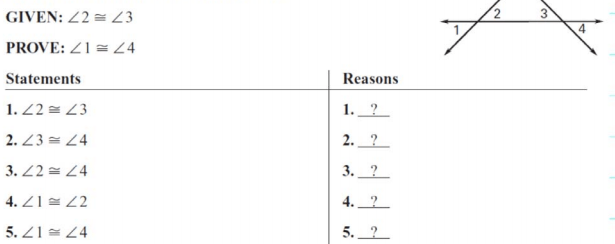
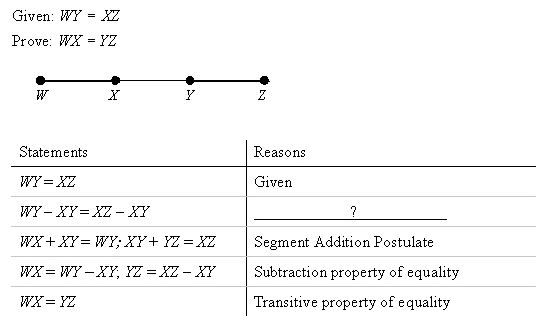
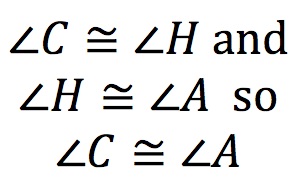
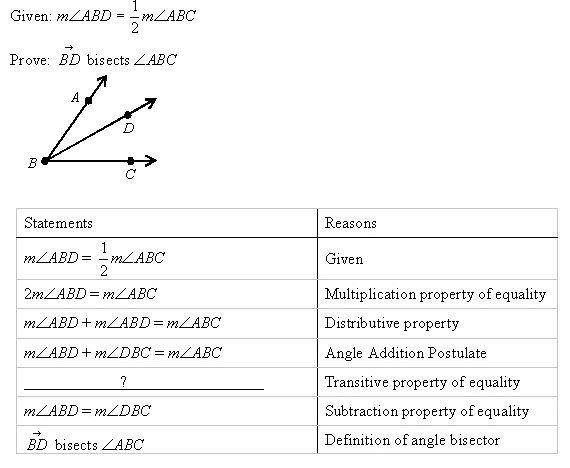
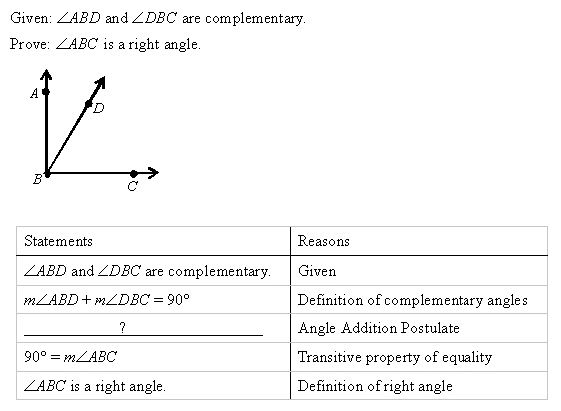
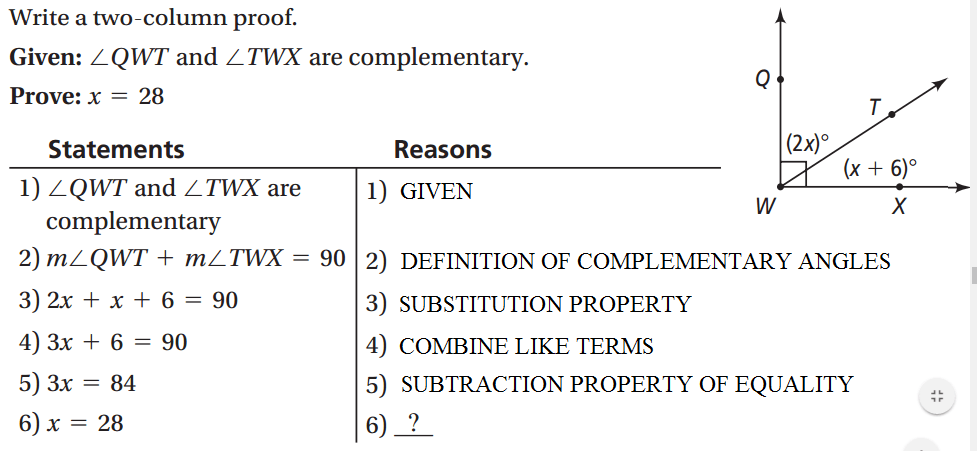
What is the REASON for Statement #6?
Addition Property of Equality
Subtraction Property of Equality
Multiplication Property of Equality
Division Property of Equality

Which property is being used above?
Symmetric Property
Substitution Property
Subtraction Property
Addition Property

What is the justification?
Definition of congruence
Reflexive Property of Congruence
Segment Addition Postulate
Definition of Midpoint

What is the justification?
Congruent Supplements Theorem
Vertical Angles Theorem
Definition of Supplementary Angles
Definition of Complementary Angles
A proof is finished when...
the last reason matches what you are trying to prove
the last statement matches what you are trying to prove
your brain says your finished
you get tired


