wayground logo

Free Printable Worksheets

Font size

S
M
L
XL
Worksheets

Honors Math 2 FINAL EXAM REVIEW

Total questions: 146

Worksheet time: 12hrs 10mins

Name
Class
Date
1.
Flipping a figures is a ...
a)
Rotation
b)
Reflection
c)
Dilation
d)
Translation
2.
Which answer shows a reflection across the x-axis?
a)
d
b)
c
c)
b
d)
a
3.
Translation are always _______
a)
Congruent
b)
Bigger
c)
Smaller
d)
Rotated
4.
Identify the transformation from C to D.
a)
90o Counter Clockwise Rotation
b)
180o Rotation
c)
270o Counter clockwise Rotation
d)
360o Rotation
5.
G(-4,1),.....After a translation of 3 units down and 5 units right
a)
G’(-1,6)
b)
G’(1, -2)
6.
Triangle C is rotated 180° counterclockwise with the origin as the center of rotation to create a new figure. Which rule describes this transformation?
a)
(x,y)→(y, -x) 
b)
(x,y)→(-x,-y)
c)
(x,y)→(x,y)
d)
(x,y)→(-y,x)
7.

Write a rule for the translation.

a)

(x -1, y + 2)

b)

(x -2, y + 1)

c)

(x +2, y - 1)

d)

(x +1, y - 2)

8.
Which rule would result in a translation of 2 units left and 3 units up?
a)
(x, y) → (2x, 3y)
b)
(x, y) → (x - 2, y + 3)
c)
(x, y) → (-x, -y)
d)
(x, y) → (x + 2, y - 3)
9.
Point (7,2) is translated vertically 2 units and horizontally -5 units.  Where is the new point located?
a)
(9,-3)
b)
(2,4)
c)
(2,0)
d)
12,4)
10.
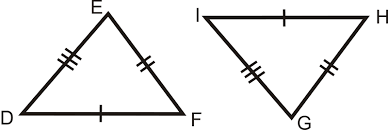
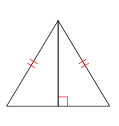
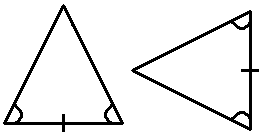
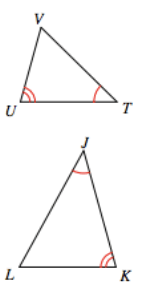
Which triangle congruence theorem can be used to prove the triangles are congruent?
a)
SAS
b)
SSS
c)
ASA
d)
HL
11.
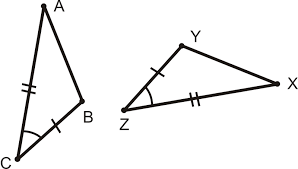
Which triangle congruence theorem can be used to prove the triangles are congruent?
a)
SSS
b)
ASA
c)
AAS
d)
SAS
12.
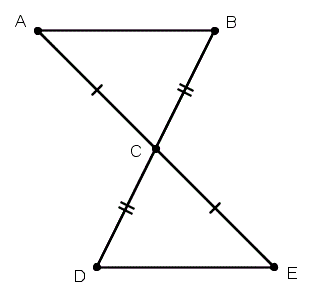
Which triangle congruence theorem can be used to prove the triangles are congruent?
a)
AAS
b)
SSS
c)
SAS
d)
SSA
13.

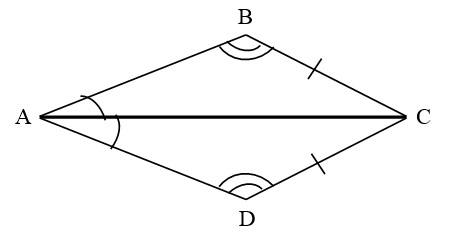
Which triangle congruence theorem can be used to prove the triangles are congruent?

a)

SSS

b)

SAS

c)

ASA

d)

NONE

14.
Name the postulate, if possible, that makes the triangles congruent.
a)
SAS
b)
ASA
c)
AAS
d)
Not Possible
15.
How are the triangles congruent?
a)
HL
b)
SSS
c)
SAS
d)
AAS
16.

ΔBIGΔLAD\Delta BIG\cong\Delta LAD  , which side is congruent to BG\overline{BG}  ?

a)

BI\overline{BI}  

b)

LA\overline{LA}  

c)

AD\overline{AD}  

d)

LD\overline{LD}  

17.

If ΔGAMΔERS\Delta GAM\cong\Delta ERS  , what angle is congruent to RES\angle RES  ?

a)

GAM\angle GAM  

b)

AGM\angle AGM  

c)

GMA\angle GMA  

d)

MAG\angle MAG  

18.

ΔGAMΔERS\Delta GAM\cong\Delta ERS , GA=11\overline{GA}=11  , GM=8\overline{GM}=8 , and AM=7\overline{AM}=7   . What is the length of ER\overline{ER}  ?

a)

7

b)

8

c)

11

d)

26

19.

Given that ΔSTAΔBLE\Delta STA\cong\Delta BLE  . If mS=97°m\angle S=97\degree  and mT=43°m\angle T=43\degree  ? What is the measure of angle L?

a)

40°40\degree  

b)

43°43\degree  

c)

90°90\degree  

d)

97°97\degree  

20.
a)
Congruent by ASA
b)
Congruent by SAS
c)
Congruent by SSS
d)
Not Necessarily Congruent
21.
a)
Congruent by HL
b)
Congruent by SAS
c)
Congruent by SSS
d)
Not Necessarily Congruent
22.
Which triangle congruence theorem can be used to prove the triangles are congruent?
a)
SAS
b)
Not enough information
c)
SSS
d)
AAS
23.
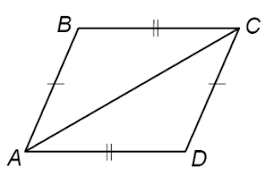
State if the two triangles are congruent.  If they are, state how you know.
a)
A
b)
B
c)
C
d)
D
24.

Identify the function.

a)

Linear

b)

Quadratic

c)

Exponential

d)

None of the Above

25.

Identify the function.

a)

Linear

b)

Quadratic

c)

Exponential

d)

None of the Above

26.

Identify the function.

a)

Linear

b)

Quadratic

c)

Exponential

d)

None of the Above

27.

Identify the function.

a)

Linear

b)

Quadratic

c)

Exponential

d)

None of the Above

28.

What is the vertex form of a quadratic function?

a)

f(x) = 2a(x-h)2 + k

b)

f(x) = a(x-h)2 + k

c)

f(x) = (x+h)2 + k

d)

f(x) = a(x-h) - k

29.

Identify the vertex of f(x) = -2(x+1)2 + 3

a)

(h,k)

b)

(3, 1)

c)

(-1,-3)

d)

(-1,3)

30.

What steps transform the graph y = x2 to y = 2(x+2)2 - 5?

a)

Compress by 2, shifted 2 units left and 5 down

b)

Stretch by 5, shifted 5 units left and 2 down

c)

Stretch by 2, shifted 2 units left and 5 down

d)

Compress by 5, shifted 2 units left and 2 down

31.

What steps transform the graph y = x2 to y = -1/2(x-4)2 + 1?

a)

Compressed by 1/2, shifted 4 units right and 1 unit up

b)

Reflected across x-axis, compressed by 1/2, shifted 4 units right and 1 unit up

c)

Reflected across x-axis, stretched by 1/2, shifted 4 units left and 1 unit up

d)

Stretched by 1/2, shifted 4 units right and 1 unit down

32.
Which transformation maps the graph of
f(x) = x2 to the graph of g(x) = (x + 4)2?
a)
a reflection across the line x = -4
b)
a reflection across the line y = -4
c)
a translation shifting f(x) 4 units to the left
d)
a translation shifting f(x) 4 units to the right
33.

Match the equation to its description.

a)

Reflected over x-axis and shifted up 4

b)

Reflected over x-axis and shifted down 4

c)

Reflected over x-axis and shifted right 4

d)

Reflected over x-axis and shifted left 4

34.

What steps transform the graph y = x2 to y = 2(x+2)2 - 5?

a)

Compress by 2, shifted 2 units left and 5 down

b)

Stretch by 5, shifted 5 units left and 2 down

c)

Stretch by 2, shifted 2 units left and 5 down

d)

Compress by 5, shifted 2 units left and 2 down

35.
Use the picture to find  the vertex and axis of symmetry
a)
 Vertex (3,8) Axis x=3
b)
Vertex (3,8) Axis y=3
c)
Vertex (8,3) Axis x=3
d)
Vertex (8,3) Axis y=3
36.

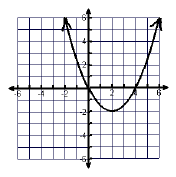
Identify the y-intercept.

a)

(0,3)

b)

(3,0)

c)

(1,0)

d)

(2,-1)

37.

What is the decreasing interval on the function shown?

a)

(, 1)\left(-\infty,\ 1\right)

b)

(, 2)\left(-\infty,\ 2\right)

c)

(2, )\left(2,\ \infty\right)

d)

(1, )\left(1,\ \infty\right)

38.
What is the range of this function?
a)
(- ∞,+∞)
b)
[0, +∞)
c)
[-2, +∞)
d)
[2, +∞)
39.

Name the vertex to the given quadratic graph

a)

(2,3)

b)

(3,2)

c)

(0,-1)

d)

(4,-1)

40.

The vertex of the given quadratic function is at its minimum.

a)

True

b)

False

41.

Use the graph to determine the X-intercepts

a)

(-1,0) and (-3,0)

b)

(1,0) and (3,0)

c)

(0,1) and (0,3)

d)

(0,-1) and (0,-3)

42.

What is the increasing interval on the function shown?

a)

(, 1)\left(-\infty,\ 1\right)

b)

(, 2)\left(-\infty,\ 2\right)

c)

(2, )\left(2,\ \infty\right)

d)

(1, )\left(1,\ \infty\right)

43.
What are the x- intercepts?
a)
x= 0 and x= -4
b)
x= 0 and x= 4
c)
y= 0
d)
x= 2
44.
What is the range of this function?
a)
(- ∞,+∞)
b)
[0, +∞)
c)
[-2, +∞)
d)
[2, +∞)
45.
Factor
x+ 9x - 36
a)
(x + 12)(x - 3)
b)
(x + 9)(x - 4)
c)
(x - 12)(x + 3)
d)
(x - 9)(x - 4)
46.
Factor: x2 + 2x – 3
a)
(x - 2)(x + 1)
b)
(x + 1)(x - 3)
c)
(x + 2)(x - 1)
d)
(x - 1)(x + 3)
47.

Factor:

5x3 - 7x2

a)

x2(5x - 7)

b)

x(5x2 - 7x)

c)

x3(5 - 7x)

d)

Prime

48.

Factor: 25x2 - 9

a)

(5x + 3)(5x - 3)

b)

(x + 5)(x - 3)

c)

(x - 3)(x + 5)

d)

(5x + 3)(3x + 5)

49.
Factor:
x2 + 5x - 24
a)
(x - 8)(x + 3)
b)
(x + 8)(x - 3)
c)
(x + 6)(x - 4)
d)
(x + 12)(x - 2)
50.
Factor:
x2 - 10x + 24
a)
(x - 6)(x - 4)
b)
(x + 6)(x + 4)
c)
(x - 12)(x + 2)
d)
(x - 8)(x - 3)
51.
What are the factors of x2+3x-40
a)
(x+10)(x-4)
b)
(x+8)(x-5)
c)
(x+20)(x-2)
d)
(x+1)(x-3)
52.
Factor:
24c5 - 12c3
a)
6(4c5 - 2c3)
b)
12c3(2c2)
c)
12c3(2c2 - 1)
d)
12c3(2c2 - 0)
53.
Factor: 49x2 - 100
a)
(49x + 100)(x - 1)
b)
(7x - 10)(7x + 10)
c)
(49x - 10)(x + 10)
d)
(7x -10)(7x - 10)
54.

Factor

4x24x34x^2-4x-3  


(a)  

55.

Factor

6x211x106x^2-11x-10  


(a)  

56.

How would the equation of this graph look in factored form?

a)

y = (x – 4)2

b)

y = (x + 4)2

c)

y = x(x – 4)

d)

y = x(x + 4)

57.

How would the equation of this graph look in factored form?

a)

y = (x – 5)2

b)

y = (x + 5)2

c)

y = x(x – 5)

d)

y = x(x + 5)

58.

How would this equation look in standard form?

a)

y = x2 – 2x + 3

b)

y = x2 – 2x – 3

c)

y = x2 + 2x + 3

d)

y = x2 + 2x – 3

59.
Convert to vertex form.
a)
y=3(x+1)2 - 8
b)
y=3(x-1) 2 - 8
c)
y=3(x+2)2 - 8
d)
y=3(x-2)2 - 8
60.
Convert to vertex form.
a)
y=4(x+4)2 - 62
b)
y=4(x-4)2 - 62
c)
y=4(x-8)2 - 62
d)
y=4(x+8)2 - 62
61.

Write the following quadratic function in vertex form:

f(x)=x210x+3f\left(x\right)=x^2-10x+3  

a)

f(x)=(x5)222f\left(x\right)=\left(x-5\right)^2-22  

b)

f(x)=(x5)2+3f\left(x\right)=\left(x-5\right)^2+3  

c)

f(x)=(x5)2f\left(x\right)=\left(x-5\right)^2   

d)

f(x)=(x+5)222f\left(x\right)=\left(x+5\right)^2-22  

62.

Write the following quadratic function in vertex form:

f(x)=x2+16x+71f\left(x\right)=x^2+16x+71  

a)

f(x)=(x8)2+71f\left(x\right)=\left(x-8\right)^2+71  

b)

f(x)=x(x+16)64f\left(x\right)=x\left(x+16\right)-64  

c)

f(x)=(x8)2f\left(x\right)=\left(x-8\right)^2   

d)

f(x)=(x+8)2+7f\left(x\right)=\left(x+8\right)^2+7  

63.

What do we need to add to the following expression to make it a perfect square trinomial?

x2+6x+?x^2+6x+?  

a)

36

b)

6

c)

3

d)

9

64.

The process we used to transform a quadratic standard to vertex form is called

a)

The quadratic formula

b)

Completing the square

c)

Factoring

d)

Foil

65.

Write the given equation in vertex form:

y=x2-10x+10

a)

y=(x-10)2+10

b)

y=(x+5)2+35

c)

y=(x-5)2+15

d)

y=(x-5)2-15

66.

w2+7w+4=0w^2+7w+4=0  

a)

7±332\frac{-7\pm\sqrt{33}}{2}  

b)

7±652\frac{-7\pm\sqrt{65}}{2}  

c)

7±332\frac{7\pm\sqrt{33}}{2}  

d)

7±3112\frac{-7\pm3\sqrt{11}}{2}  

67.

x26x+4=0x^2-6x+4=0  

a)

3±53\pm\sqrt{5}  

b)

6±202\frac{6\pm\sqrt{20}}{2}  

c)

3±203\pm\sqrt{20}  

d)

3±i133\pm i\sqrt{13}  

68.

t2+4t=2t^2+4t=2  

a)

4±242\frac{-4\pm\sqrt{24}}{2}  

b)

4±264\pm2\sqrt{6}  

c)

2±6-2\pm\sqrt{6}  

d)

4±382\frac{4\pm3\sqrt{8}}{2}  

69.

y2=99yy^2=-9-9y  

a)

9±1172\frac{-9\pm\sqrt{117}}{2}  

b)

9±452\frac{9\pm\sqrt{45}}{2}  

c)

9±352\frac{-9\pm3\sqrt{5}}{2}  

d)

9±532\frac{9\pm5\sqrt{3}}{2}  

70.

2d2+4=5d2d^2+4=5d  

a)

5±i74\frac{5\pm i\sqrt{7}}{4}  

b)

5±74\frac{-5\pm\sqrt{7}}{4}  

c)

5±i574\frac{5\pm i\sqrt{57}}{4}  

d)

5±572\frac{-5\pm\sqrt{57}}{2}  

71.

3n28n+3=43n^2-8n+3=-4  

a)

8±206\frac{8\pm\sqrt{20}}{6}  

b)

4±i53\frac{4\pm i\sqrt{5}}{3}  

c)

8±5i26\frac{8\pm5i\sqrt{2}}{6}  

d)

4±203\frac{4\pm\sqrt{-20}}{3}  

72.

2x2+2x+5=02x^2+2x+5=0  

a)

1±3i2\frac{-1\pm3i}{2}  

b)

1±i112\frac{-1\pm i\sqrt{11}}{2}  

c)

2±404\frac{2\pm\sqrt{40}}{4}  

d)

1±i62\frac{-1\pm i\sqrt{6}}{2}  

73.

x2+4x+3=0x^2+4x+3=0  

a)

x = 1 and -3

b)

x = -1 and -3

c)

x = -1 and 3

d)

x = 1 and 3

74.

m25m14=0m^2-5m-14=0  

a)

x = 7 and -2

b)

x = 7 and 2

c)

x = -7 and -2

d)

x = -7 and 2

75.
Simplify the following radical: √24
a)
2√6
b)
4√6
c)
2√12
d)
3√8
76.
Simplify the following radical: √300
a)
3√10
b)
2√150
c)
100√3
d)
10√3
77.
Simplify the following radical: √150
a)
5√15
b)
5√2
c)
5√6
d)
15√5
78.

Simplify:

√72

a)

√72

b)

2√2

c)

6√2

d)

4√18

79.
Simplify:
√96
a)
16√6
b)
6√16
c)
9√6
d)
4√6
80.

Which TWO are equivalent to the above expression?

a)
b)
c)
d)
81.

Write the above expression in exponential form.

a)
b)
c)
d)
82.

Write the above expression in exponential form.

a)
b)
c)
d)
83.
Write the following expression in radical form:
a)
a.)
b)
b.)
c)
c.)
d)
d.)
84.
Write in exponential form
√x⁵
a)
X1/5
b)
X2/5
c)
X5/2
d)
X5
85.
Rewrite in Exponential Form.
a)
A
b)
B
c)
C
d)
D
86.

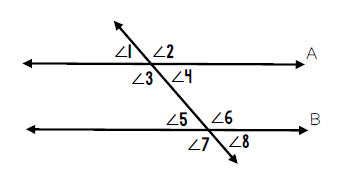
Angle 3 and Angle 6 are examples of which type of angle pair?

a)

Alternate exterior angles

b)

Alternate interior angles

c)

Vertical angles

d)

Corresponding angles

87.

Angle 1 and Angle 5 are examples of which type of angle pair?

a)

Alternate exterior angles

b)

Alternate interior angles

c)

Vertical angles

d)

Corresponding angles

88.

Angle 6 and Angle 7 are examples of which type of angle pair?

a)

Alternate exterior angles

b)

Alternate interior angles

c)

Vertical angles

d)

Corresponding angles

89.

Which of the following angles would NOT be congruent to the measure of 7\angle7 ?

a)

2\angle2  

b)

3\angle3  

c)

6\angle6  

d)

8\angle8  

90.

If the  m7 = 115°,m\angle7\ =\ 115\degree,  find the measure of  2.\angle2.  

a)

115°115\degree  

b)

65°65\degree  

c)

180°180\degree  

d)

Cannot be determined

91.

If the  m5 = 63°,m\angle5\ =\ 63\degree,  find the measure of  3.\angle3.  

a)

63°63\degree  

b)

117°117\degree  

c)

180°180\degree  

d)

Cannot be determined

92.

If lines are parallel with a transversal, then these two angles are...

a)

Supplementary Angles

b)

Corresponding Angles

c)

Alternate Exterior Angles

d)

Parallel Angles

93.

If lines are parallel with a transversal, then these two angles are?

a)

Corresponding Angles

b)

Exterior Alternate Angles

c)

Interior Alternate Angles

d)

Vertical Angles

94.

Classify angles 4 and 5.

a)

Corresponding Angles

b)

Alternate Interior Angles

c)

Alternate Exterior Angles

d)

Consecutive Interior Angles

95.

Solve for y.

a)

18.2

b)

23

c)

27

d)

47

96.

Solve for x.

a)

4

b)

14

c)

16

d)

46

97.

Solve for x.

a)

6.75

b)

8

c)

13

d)

15.5

98.

Solve for x.

a)

5

b)

-5

c)

25

d)

55

99.
What are the five ways to prove triangles congruent?
a)
SSS, ASA, AAS, SAS, HL
b)
SSS, SSA, HL, AAS, SAS
c)
SAS, SSA, HL, AAS, SSS
d)
HL, SAS, SSA, SSS, ASA
100.

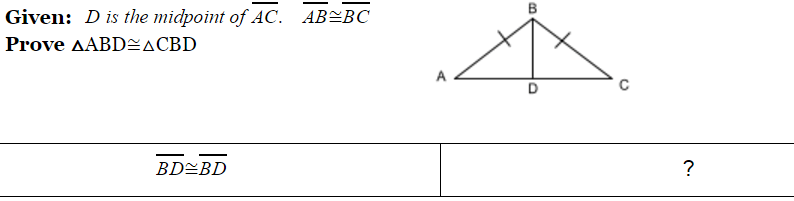
Identify the missing statement or reason

a)

Reflexive Property

b)

Definition of Midpoint

c)

Given

d)

Vertical Angles Theorem

101.
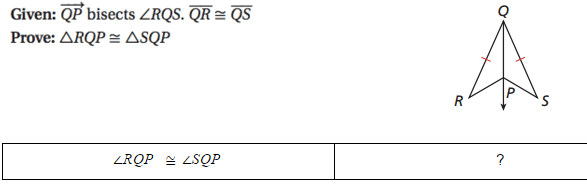
Identify the  missing statement or reason
a)
Given
b)
Vertical Angles Theorem
c)
Definition of Angle Bisector
d)
Alternate Interior Angles Theorem
102.
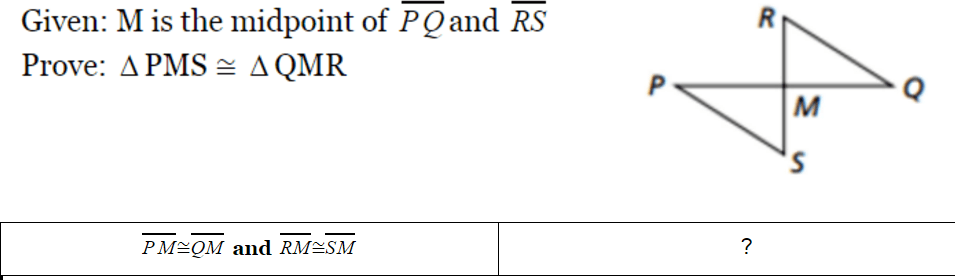
Identify the  missing statement or reason
a)
Definition of Angle Bisector
b)
Alternate Interior Angles Theorem
c)
Reflexive Property
d)
Definition of Midpoint
103.
If DA bisects IE, then
a)
ID=ED
b)
IA=EA
c)
<IDA=<EDA
d)
<IAD and <EAD are right angles
104.
If two figures are similar, the corresponding sides are ______________.
a)
equal
b)
congruent
c)
proportional
d)
none of these
105.

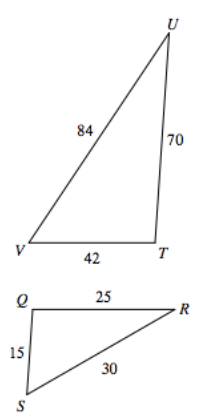
Are these two triangles similar? Which similarity criterion do you use to prove it?

a)

Yes, AA

b)

Yes, SAS

c)

Yes, SSS

d)

Not Similar

106.

Are these two triangles similar? Which similarity criterion do you use to prove it?

a)

Yes, AA

b)

Yes, SAS

c)

Yes, SSS

d)

Not Similar

107.

Are these two triangles similar? Which similarity criterion do you use to prove it?

a)

Yes, AA

b)

Yes, SAS

c)

Yes, SSS

d)

Not Similar

108.
The pair of figures is similar. Find the missing side.
a)
x = 20
b)
x = 12
c)
x = 5
d)
x = 4
109.

ΔPQR is similar to ΔCIA. Which of the following is true?\Delta PQR\ is\ similar\ to\ \Delta CIA.\ Which\ of\ the\ following\ is\ true?

a)

PQCI=QRIA=PRCA\frac{PQ}{CI}=\frac{QR}{IA}=\frac{PR}{CA}

b)

PQQR=CIIA=PRCI\frac{PQ}{QR}=\frac{CI}{IA}=\frac{PR}{CI}  

110.

If the triangles are similar, state how.

a)

SSS

b)

SAS

c)

AA

d)

Not similar

111.
What is the height of the Tree?
a)
20
b)
15
c)
30
d)
10
112.
What is the measure of x?
a)
12
b)
15
c)
6
d)
9
113.
What type of special triangle is this?
a)
45°-45°-90°
b)
30°-60°-90°
c)
Equiangular
d)
Equilateral
114.
What type of special triangle is this?
a)
45°-45°-90°
b)
30°-60°-90°
c)
Isosceles
d)
Obtuse
115.
Find x.
a)
30°
b)
60°
c)
90°
d)
180°
116.
Find x.
a)
10
b)
√3
c)
5
d)
10√3
117.
Find x.
a)
4
b)
2
c)
√3
d)
2√2
118.
Find x.
a)
10
b)
20
c)
10√3
d)
√3
119.
Find x.
a)
12
b)
√2
c)
√3
d)
6
120.

What is the measure of side c?

a)

7

b)

72\frac{7}{\sqrt{2}}

c)

7√2

d)

14

121.
What is the measure of side c?
a)
6
b)
6√2
c)
6√3
d)
12
122.

What is the measure of side b?

a)

5

b)

10√2

c)

5√2

d)

102\frac{10}{\sqrt{2}}

123.

The Pythagorean Theorem is _________

a)

a + b = c

b)

a2 + b2 = c2

c)

a2 + b2 + c2

d)

A = LW

124.
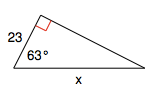
Find the missing side
a)
9
b)
41
c)
6.4
d)
6.2
125.
Find the length of the missing side. 
a)
48 in.
b)
52 in.
c)
16 in.
d)
24 in.
126.

Find the length of side y.

a)

22.32 cm

b)

36.5 cm

c)

76.34 cm

d)

87.76 cm

127.
What is the length of side x?
a)
6.57 cm
b)
7 cm
c)
7.44 cm
d)
26.33 cm
128.
Find the length of side w.
a)
21.4 cm
b)
18.0 cm
c)
36.5 cm
d)
43.6 cm
129.

Find the measure of the indicated angle (?) round to the nearest tenth.

a)

9.4

b)

55.2

c)

20.15

d)

19.4

130.

Choose the correct set up to find the length of the side x.

a)

sin(37)=x/14

b)

cos(37)=x/14

c)

tan(37)=x/14

d)

sin(37)=14/x

131.
Find the ratio for sinA. (Reduce the fraction)
a)
36/27
b)
4/5
c)
36/45
d)
3/5
132.

What is the correct set up for the problem to find the measure of the indicated angle?

a)

sin X = 41/28

b)

tan X = 41/28

c)

cos X = 28/41

d)

sin X = 28/41

133.

Find the length of side x.

a)

10

b)

11.3

c)

12.0

d)

15.0

134.

Find the length of side x.

a)

50.7

b)

50.1

c)

60.7

d)

61.0

135.

Find the measure of the indicated angle. Round to the nearest tenth.

a)

35.8°

b)

43.8°

c)

46.2°

d)

54.2°

136.

Find the measure of the indicated angle. Round to the nearest tenth.

a)

48.9°

b)

60.7°

c)

29.3°

d)

41.1°

137.
Give the Ratio for SIN X
a)
opp/adj
b)
Adj/hyp
c)
Opp/hyp
d)
adj/opp
138.
Give the Ratio for TAN X
a)
Adj/Opp
b)
Opp/Adj
c)
Adj/Hyp
d)
Opp/Hyp
139.
Give the Ratio for COS X
a)
Adj/Hyp
b)
Opp/Adj
c)
Adj/Opp
d)
Opp/Hyp
140.

Which trigonometric function would you use to find "h", the height of the tree?

a)

sine

b)

cosine

c)

tangent

d)

none of these

141.
a)
x = 49
b)
x = 53
c)
x = 45
d)
x = 18
142.
a)
x = 2
b)
x = 4
c)
x = 7
d)
x = 9
143.

The extraneous solution of the equation is...

a)

−3

b)

−5

c)

−6

d)

−10

144.
a)

{ 1 }

b)

{ 1, 9 }

c)

{ 9 }

d)

No Solution

145.
Solve.
a)
8
b)
-8
c)
0
d)
no solution
146.
Solve the radical equation
a)
25
b)
50
c)
125
d)
5