
 Worksheets
LP A - W8 L1 Early Development
Total questions: 18
Worksheet time: 18mins
Development (Ontogeny/Ontogenesis) is the process by which.. organisms grow and.. tissues and organs
--> Starts with undifferentiated cell embryo (zygote)
--> Ends with mature adults with multiple.. cells
--> Includes regeneration, asexual reproduction, metamorphosis (physical development) & stem cells
(a)
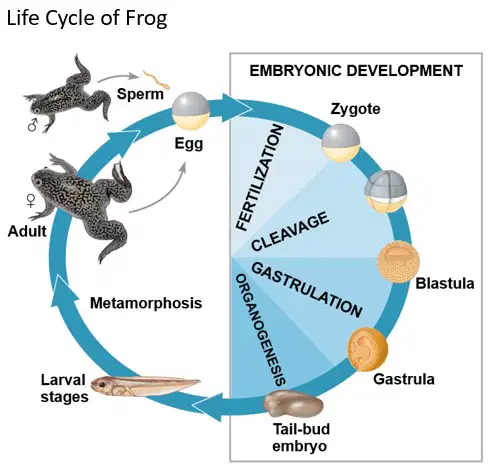
4 Different Stages in Embryonic Development:
1-
2-
3-
4-
In early development, we will discuss.. , ... and..
(a)
Fertilisation
- Formation of a diploid.. from haploid egg and sperm. Molecules involved:
--> Sperm penetrate protective layer around egg
--> R.. on egg surface bind to molecules on.. surface
--> Change at egg surface prevents p.. (entry of multiple sperm nuclei)
(a)
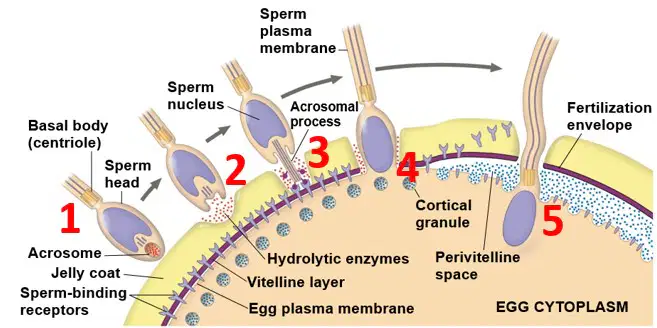
Acrosomal (tip of sperm) and cortical (granules) reactions during sea urchin fertilisation
1- ... reactions trigger when sperm meets egg
2- Acrosome at tip of sperm released.. enzymes that digest material around egg
3- ... bridge forms between sperm and egg
(a)
Acrosomal (tip of sperm) and cortical (granules) reactions during sea urchin fertilisation
4- Membrane f.. between sperm and egg
5- The sperm.. enters egg
(a)
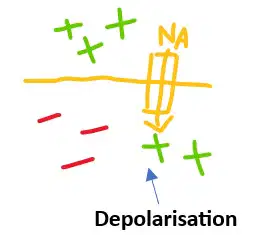
WAYS EGG STOPS POLYSPERMY: Fast Block to Polyspermy (not in mammals)
- Seconds after sperm binds, ... channels open in egg plasma membrane
- ... ion influx causes.. of egg membrane (as NA+2 are +ive)
(a)
WAYS EGG STOPS POLYSPERMY: Cortical Reaction
- Reaction initiated by sperm..
- Seconds after, ... in egg open and release calcium ions and form a fertilisation..
- This acts as a s.. block to polyspermy
--> IMPORTANT as it forms a calcium ions wave that.. from one side to the other, forming impermeable layer
(a)
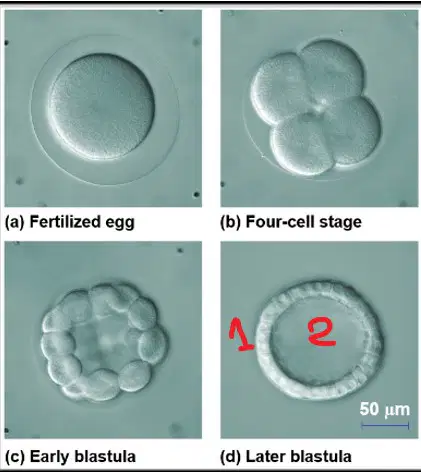
Cleavage
- Fertilisation is followed by cleavage, a period of rapid cell.. without growth
- Cleavage partitions embryo into smaller cells called b..
- b.. is a ball of cells (1) with fluid-filled cavity called b.. (2)
(a)
Cleavage
Overlapping Process: Cell.. (mitosis): from one cell, division produces many cells
(a)
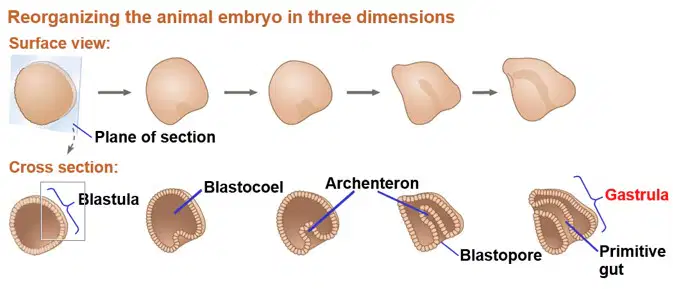
Gastrulation: Rearranges cells of the.. into layered embryo called the..
--> Blastocoel: the.. in the blastula
--> Invagination: On one side, pushing cells inwards/outwards
--> First initial stage of cell.. as inner layer will be different from outer layer (outer becomes skin, inner becomes.. system)
(a)
Gastrulation: Rearranges cells of the Blastula into layers embryo called the Gastrula
Overlapping Process: Cell.. (cells become specialised)
(a)
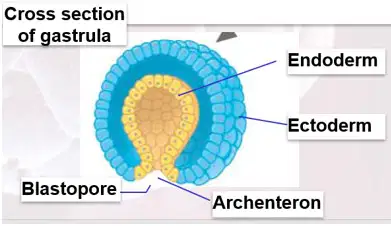
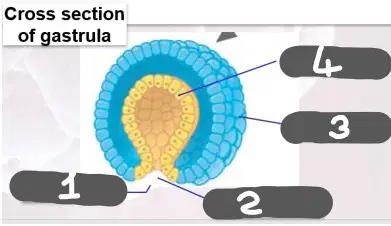
Embryonic Layers
- Germ Layer: Embryonic tissue (collection of specialised cells)
- Ectoderm: Germ layer covering embryo's.. (skin)
- Endoderm: Innermost germ layer and lines developing.. tube, called the a.. (gut)
(a)
(a)
Embryonic Layers
Diploblastic: Animals have an e.. and e.. , and includes non-bilaterians (no bilateral)
Triploblastic: Animals have intervening 3rd layer, a m.. , this includes all bilaterians
(a)
Endoderm: d.. tract and organs derived from it as well as s.. organs
Ectoderm: e.. and n.. system, as well as hair, cornea, etc
Mesoderm: Coelom, notochord, (in chordates), m.. , bones, c.. system, spleen, kidneys, reproductive system, etc
(a)
Overlapping Process
- M.. : Tissue formation, Differentiated cells form generalised tissues and organs
(a)
Overlapping Process
- Morphogenesis: Tissue formation, Differentiated cells form generalised tissues and organs
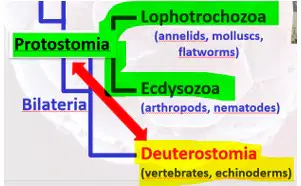
Blastopore fate
- In Protostomes, Blastopore becomes mouth/anus
- In Deuterostomes, Blastopore becomes mouth/anus
(a)
Summary:
1- Fertilisation: Formation of a diploid.. from haploid egg and sperm.
2- Cleavage: period of rapid cell.. without growth
3- Gastrulation: Rearranges cells of the.. into layered embryo called the.. . (First stage of cell.. )
(a)

