wayground logo

Free Printable Worksheets

Font size

S
M
L
XL
Worksheets

Business Management-Revision

Total questions: 115

Worksheet time: 19mins

Name
Class
Date
1.

What is the triple bottom line approach?

a)
  • Measuring profits, treatment of employees, and impact on society.

b)
  • Measuring profits, treatment of customers, and impact on the economy.

c)
  • Measuring profits, treatment of people, and impact on the planet.

2.

 What is corporate social responsibility (CSR)?

a)
  • An approach under which businesses consider the interests of employees only.

  • .

b)
  • An approach under which businesses consider the interests of all groups in society in decision-making.

c)
  • An approach under which businesses consider the interests of customers only

3.

How do businesses aim to satisfy the needs and wants of individuals and organizations? 

a)
  • Creating a product/service

b)
  • Extracting raw materials 

c)
  • All of the options

4.

Why do businesses prefer a public limited company?

a)
  • To have more control in the market.

b)
  • To easily sell equity on a stock exchange

c)
  • To obtain debt from a bank

5.

Nestlé, a major food and beverage company, acquiring a cocoa plantation to secure its raw material supply is an example of which integration technique?

a)
  • Horizontal Integration

b)
  • Vertical Backward Integration

c)
  • Vertical Forward Integration

6.

Which of the following occurs when a business achieves lower average cost of the production due  to the decision to hire specialists in supervisory roles thereby raising the level of productivity?

a)
  • Managerial economies of scale

b)
  • Purchasing economies of scale

c)
  • Marketing economies of scale

7.

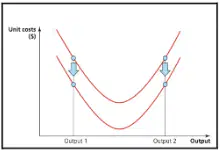
The following figure represents:

a)
  • Diseconomies of scale

b)
  • Economies of scale

c)
  • Inefficiency of scale

8.

The potential implication of stakeholders caused due to mergers and acquisitions is :

a)
  • Managers:A may have a marketing manager and so might B

b)
  • Lessee:More control

c)
  • Investors: bid higher returns

9.

 ____________is essential for business to achieve their desired aims. Example: growth may be necessary to gain the necessary cost advantages for survival.

a)
  • Change

b)
  • Creativity

c)
  • Sustainability

10.

What is ‘globalisation’?

a)
  • process through which people are able to travel to different parts of the world


b)
  • process through which ideas and activities in different parts of the world become interconnected

c)
  • process through which companies are able to dominate different markets

11.
How do businesses aim to satisfy the needs and wants of individuals and organizations?
a)
Providing a service
b)
Extracting raw materials
c)
All of the options
d)
Creating a product
12.
Tertiary and Quaternary sectors are different from each other.
a)
True
b)
It depends on the country
c)
False
d)
They are the same
13.
STEEPLE analysis stands for.
a)
An acronym standing for social, technological, economic, environmental, political, legal and ethical external factors that impact business; it refers to a framework for analysing the external environmental factors affecting business objectives and strategies.
b)
An acronym standing for social, technological, economic, environmental, political, legal and ethical external factors that impact business; it refers to a framework for analysing the internal environmental factors affecting business objectives and strategies.
c)
An acronym standing for social, terminal, economic, environmental, profit, loss and ethical external factors that impact business; it refers to a framework for analysing the internal environmental factors affecting business objectives and strategies.
d)
An acronym standing for social, technological, economic, environmental, profit, loss and ethical external factors that impact business; it refers to a framework for analysing the external environmental factors affecting business objectives and strategies.
14.
(a) Define the term adding value. [2 marks]
a)
Adding value (in the production process) is about creating value for customers. It can be measured by the difference between a product’s selling price and the material or direct costs of production (output).
b)
Adding value (in the production process) is about creating value for customers. It can be measured by the difference between a product’s selling price and the material or direct costs of production (input).
c)
Adding value (in the production process) is about creating value for customers. It can be measured by the difference between a product’s selling price and the material or direct costs of production (loss).
d)
Adding value (in the production process) is about creating value for customers. It can be measured by the difference between a product’s selling price and the material or direct costs of production (profit).
15.
Business Consulting, Research and Development and Information gathering falls under _________________.
a)
Quaternary sector
b)
Primary sector
c)
Tertiary sector
d)
Secondary sector
16.
Which of the following is the best definition of a ‘business’?
a)
Any organisation involved in the production of a good or the provision of a service
b)
Any organisation that employs workers
c)
A company that strives to earn profit for its owners
d)
Any organisation that undertakes the selling of goods
17.
Tertiary sector.
a)
The service sector of the economy; produces intangibles, for example, insurance.
b)
None of the options
c)
The first stage of production, for example, farming.
d)
The sector focused on skills such as research and development.
18.
_______________is the process of producing a particular good or service that is worth more than the cost of the resources used to produce it.
a)
Business
b)
Adding value
c)
Profit
d)
Loss
19.
Which of the following is NOT a factor included in STEEPLE analysis?
a)
Economic
b)
Technological
c)
Social
d)
Profit
20.
Which sector of the economy involves the production of goods through processing and manufacturing?
a)
Primary sector
b)
Secondary sector
c)
Tertiary sector
d)
Quaternary sector
21.
Which sector of the economy involves extraction of raw materials, farming, fishing, forestry and mining?
a)
Tertiary sector
b)
Secondary sector
c)
Primary sector
d)
Quaternary sector
22.
Which of the following is NOT a way in which businesses aim to satisfy the needs and wants of individuals and organizations?
a)
Creating a product
b)
Providing a service
c)
Maximizing profit
d)
Extracting raw materials
23.
Goods are:
a)
Both intangible and physical products.
b)
None of the options
c)
Intangible products, e.g. haircuts, tourism, public transport, banking, insurance education, and healthcare.
d)
Physical products, e.g. food, clothes, furniture, cars and smartphones.
24.
Bahrain's dominant sector is _______________.
a)
Primary sector
b)
Secondary sector
c)
Tertiary sector
d)
Quaternary sector
25.
Which sector of the economy involves manufacturing and construction?
a)
Quaternary sector
b)
Secondary sector
c)
Primary sector
d)
Tertiary sector
26.
Which of the following is NOT a characteristic of the tertiary sector?
a)
Produces intangible products
b)
Provides services
c)
Focuses on skills such as research and development
d)
Involves extraction of raw materials
27.
Which form of ownership maintains the most privacy?
a)
Sole proprietorship
b)
Partnership
c)
Publicly held company
d)
Cooperative
28.
Indigenous population of Maori community is found in:
a)
Bahrain
b)
Australia
c)
USA
d)
New Zealand
29.
To change the structure from any form to a privately held company, the former should.
a)
Have its accounts checked by an internal auditor.
b)
Have its accounts checked by an independent auditor.
c)
Have its accounts checked by a dependent auditor.
d)
Have its accounts checked by an accountant
30.
What is the trade-off between privacy and public disclosure in a company?
a)
Privacy allows for more control over the company's information
b)
Privacy can lead to legal and accounting expenses
c)
Public disclosure can lead to loss of competitive advantage
d)
Public disclosure allows for more transparency and trust
31.
Raising finance through the sale of shares is applicable to which form of business.
a)
Partnership
b)
Sole trader
c)
Publicly held company
d)
Cooperative
32.
Which type of business entity incurs more legal and accounting expenses?
a)
Private sector company
b)
Public sector company
c)
Publicly held company
d)
Privately held company
33.
What are dividends?
a)
A portion of profits reinvested in the company
b)
A portion of profits paid out to shareholders
c)
A portion of profits paid to employees
d)
A portion of profits paid to creditors
34.
You need to bear more legal accounting bills. Which type of business entity is it?
a)
Publicly held company
b)
Public sector company
c)
Privately held company
d)
Private sector company
35.
What is the concept of limited liability in a company?
a)
Shareholders are only liable for a portion of the company's debts
b)
Shareholders are fully responsible for the company's debts
c)
Shareholders have no liability in the company
d)
Shareholders are liable for all of the company's debts
36.
What is the process for changing a business entity to a privately held company?
a)
Hire an independent auditor
b)
Hire an accountant
c)
Hire an internal auditor
d)
Hire a dependent auditor
37.
__________________ are persons or organizations that own a part of a company. Each share represents part ownership of the business.
a)
Public holders
b)
Manager
c)
Owner
d)
Shareholders
38.
Why does a business entity majorly change its form to a limited company?
a)
To gain customers
b)
To gain fame
c)
To expand its operations
d)
To gain equity
39.
Privacy is maintained in which form of ownership.
a)
Cooperative
b)
Publicly held company
c)
Partnership
d)
Sole trader
40.
In which country would you find the indigenous population of Maori community?
a)
Australia
b)
USA
c)
Bahrain
d)
New Zealand
41.
The part of profits paid out to shareholders is called ______________.
a)
Interest
b)
Instalments
c)
Profit
d)
Dividends
42.
How does share ownership affect voting power in a company?
a)
The more shares owned, the more voting power
b)
The less shares owned, the more voting power
c)
Share ownership does not affect voting power
d)
Voting power is determined by the CEO
43.
Which document is required to set up a company?
a)
Employee handbook
b)
Marketing strategy
c)
Incorporation deed
d)
Business plan
44.
Which form of business ownership is most applicable to raising finance through the sale of shares?
a)
Publicly held company
b)
Partnership
c)
Sole proprietorship
d)
Cooperative
45.
What is the role of shareholders in a company?
a)
To manage day-to-day operations
b)
To provide funding
c)
To make strategic decisions
d)
To own part of the business
46.
What is the process of determining dividends in a company?
a)
Based on the CEO's decision
b)
Based on the company's expenses
c)
Based on the number of shares owned
d)
Based on the company's profits
47.
Which of the following statements about implementing strategy is true?
a)
Implementing strategy is not important for a business.
b)
Implementing strategy is important for achieving business objectives.
c)
Implementing strategy is only important for long-term goals.
d)
Implementing strategy is only important for short-term goals.
48.
Which of the following statements about mission and vision statements is true?
a)
Every business has a mission and vision statement.
b)
MV statements are determined by senior management.
c)
MV statements are determined by customers.
d)
MV statements are determined by shareholders.
49.
Which of the following statements about mission and vision statements is false?
a)
Every business has a mission and vision statement.
b)
MV statements are determined by customers.
c)
MV statements are determined by senior management.
d)
MV statements are determined by shareholders.
50.
Which of the following statements about ownership of businesses in the public sector is true?
a)
Businesses in the public sector are owned by the community.
b)
Businesses in the public sector are owned by shareholders.
c)
Businesses in the public sector are owned by the government.
d)
Businesses in the public sector are owned by private individuals.
51.
Which of the following statements about ownership of businesses in the public sector is false?
a)
Businesses in the public sector are owned by private individuals.
b)
Businesses in the public sector are owned by the government.
c)
Businesses in the public sector are owned by the community.
d)
Businesses in the public sector are owned by shareholders.
52.
Which of the following statements about government ownership and operation of transport systems is false?
a)
If a transport system is owned by the government, it will operate bus services in all regions.
b)
If a transport system is owned by the government, it may not operate bus services to remote parts of the country.
c)
If a transport system is owned by the government, it will operate bus services to remote parts of the country.
d)
If a transport system is owned by the government, it may not operate bus services at all.
53.
In which regions do public sector companies operate?
a)
Medium income regions
b)
High income regions
c)
Low income regions
d)
All of the above
54.
Which of the following statements about ownership of public sector businesses is true?
a)
Public sector businesses are owned by private individuals.
b)
Public sector businesses are owned by the government.
c)
Public sector businesses are owned by the community.
d)
Public sector businesses are owned by shareholders.
55.
Which of the following statements about strategy is true?
a)
Strategy is the approach used to achieve business objective(s).
b)
Strategy is useless if not put into action.
c)
Strategy is the short term plan to achieve business objective(s).
d)
Strategy is the long-term plan to achieve business objective(s).
56.
Which of the following statements about government ownership and operation of transport systems is true?
a)
If a transport system is owned by the government, it may not operate bus services to remote parts of the country.
b)
If a transport system is owned by the government, it will operate bus services to remote parts of the country.
c)
If a transport system is owned by the government, it may not operate bus services at all.
d)
If a transport system is owned by the government, it will operate bus services in all regions.
57.
In which country is the Maori community primarily located?
a)
USA
b)
Australia
c)
Bahrain
d)
New Zealand
58.
Which of the following statements about strategy is false?
a)
Strategy is the long-term plan to achieve business objective(s).
b)
Strategy is the approach used to achieve business objective(s).
c)
Strategy is useless if not put into action.
d)
Strategy is the short term plan to achieve business objective(s).
59.
Which of the following is NOT an internal stakeholder?
a)
Managers
b)
Shareholders
c)
Suppliers
d)
Employees
60.
Which of the following statements about implementing strategy is false?
a)
Implementing strategy is not important for a business.
b)
Implementing strategy is only important for long-term goals.
c)
Implementing strategy is important for achieving business objectives.
d)
Implementing strategy is only important for short-term goals.
61.
Which of the following is an example of an external stakeholder?
a)
Employees
b)
Customers
c)
Shareholders
d)
Managers
62.
Which of the following statements about MV statements is true?
a)
MV statements are usually general in nature.
b)
MV statements are determined by customers.
c)
MV statements are determined by senior management.
d)
MV statements are determined by shareholders.
63.
Which of the following is a responsibility of the local community as stakeholders?
a)
To receive a share of profits
b)
To cooperate with the business in its daily activities
c)
To be paid on time
d)
To be treated fairly
64.
Which of the following is a possible responsibility of employees?
a)
To receive a share of profits
b)
To cooperate with the business in its daily activities
c)
To be paid on time
d)
To be treated fairly
65.
Which of the following is an example of an external stakeholder?
a)
Pressure groups
b)
Managers
c)
Shareholders
d)

Employees

66.
Are all stakeholders entitled to legal rights?
a)
It is constantly changing
b)
It depends on the stakeholders
c)
Yes
d)
No
67.
Are businesses in a one-way relationship with their stakeholders?
a)
It depends on the stakeholders
b)
It is constantly changing
c)
No
d)
Yes
68.
Which of the following is most likely to be an internal stakeholder of a private limited company?
a)
Shareholders
b)
Pressure groups
c)
Managers
d)
Local community
69.
Which of the following is NOT a legal right of stakeholders?
a)
To have a say in decisions which impact the local community
b)
To be treated fairly
c)
To be paid on time
d)
To receive a share of profits
70.
Which tool allows an organization to analyse the level of power and interest of its various stakeholder groups?
a)
Decision trees
b)
STEEPLE analysis
c)
Stakeholders mapping
d)
Ansoff’s Matrix
71.
Which stakeholder group’s main interest is the organization’s level of productivity and profits?
a)
Local community
b)
Shareholders
c)
Managers
d)
Pressure groups
72.
Which internal stakeholder group is employed by a business?
a)
Managers
b)
Shareholders
c)
Local community
d)
Pressure groups
73.
What is an expectation of banks and other lenders as stakeholders?
a)
To be paid taxes
b)
To be treated fairly
c)
To be repaid promptly and on time
d)
To receive a share of profits
74.
What is an expectation of suppliers as stakeholders?
a)
To be paid taxes
b)
To receive a share of profits
c)
To be paid on time
d)
To be treated fairly
75.
Is the stakeholder concept concerned with the well-being of shareholders?
a)
It is constantly changing
b)
It depends on the stakeholders
c)
Yes
d)
No
76.
Is the relationship between businesses and stakeholders one-way or two-way?
a)
One-way
b)
Two-way
c)
It depends on the stakeholders
d)
It is constantly changing
77.
Which of the following is NOT an expectation of banks and other lenders as stakeholders?
a)
To receive a share of profits
b)
To be repaid promptly and on time
c)
To be treated fairly
d)
To be paid taxes
78.
What is a responsibility of the government as a stakeholder?
a)
To have a say in decisions which impact the local community
b)
To have businesses obey the law
c)
To be kept informed
d)
To receive a share of profits
79.
What is a right of owners/shareholders as stakeholders?
a)
To have a say in decisions which impact the local community
b)
To receive a share of profits
c)
To be paid fairly
d)
To be paid on time
80.
Which management tool helps an organization to manage the interests of as many stakeholder groups as possible?
a)
Ansoff’s Matrix
b)
Stakeholders map
c)
STEEPLE analysis
d)
Decision trees
81.
Which stakeholder group is most likely to be interested in changing government policies?
a)
Local community
b)
Managers
c)
Suppliers
d)
Shareholders
82.
Under which of the following concepts is CSR an approach?
a)
Stakeholder concept
b)
Shareholders concept
c)
Managers’ concept
d)
Employees’ concept
83.
Which of the following is an example of vertical integration?
a)
A company buying a controlling interest in another company
b)
A company expanding into new markets with new products
c)
A company merging with a supplier
d)
A company investing in more efficient machinery and equipment
84.
When a business grows very large, the production costs per unit can increase. What is this known as?
a)
Diseconomies of Scale
b)
Inefficiencies
c)
Miscommunications
d)
Economies of scale
85.
The ability of a business to use its larger size to negotiate lower rates of interest on loans and overdrafts with banks is an example of which type of economies?
a)
Managerial economies of scale
b)
Financial economies of scale
c)
Purchasing economies of scale
d)
Marketing economies of scale
86.
Which of the following is an example of managerial economies of scale?
a)
A business expanding into new markets with new products
b)
A business using its larger size to negotiate better terms with suppliers
c)
A business hiring specialists in supervisory roles to increase productivity
d)
A business investing in more efficient machinery and equipment
87.
Which method of external growth involves one company buying a controlling interest in another company?
a)
External Growth
b)
Conglomerate
c)
Franchise
d)
Acquisition
88.
Which of the following is an example of horizontal integration?
a)
A company buying a controlling interest in another company
b)
A company expanding into new markets with new products
c)
A company merging with a supplier
d)
A company investing in more efficient machinery and equipment
89.
Which of the following is NOT a potential advantage of operating a business on a large scale?
a)
Economies of scale
b)
Managerial economies of scale
c)
Lower average costs of production
d)
Higher unit costs
90.
Which term describes the factors within the control of a firm that account for an increase in the average costs of production as a result of an increase in output (production)?
a)
Internal diseconomies of scale
b)
Internal economies of scale
c)
External diseconomies of scale
d)
External economies of scale
91.
Which of the following is an example of external diseconomies of scale?
a)
A business experiencing higher average costs of production due to increased competition in the market
b)
A business investing in more efficient machinery and equipment
c)
A business using its larger size to negotiate better terms with suppliers
d)
A business expanding into new markets with new products
92.
The ability of a business to use its larger size to negotiate better terms with suppliers is an example of which type of economies?
a)
Financial economies of scale
b)
Managerial economies of scale
c)
Purchasing economies of scale
d)
Marketing economies of scale
93.
When a business increases the size of its operations and becomes more efficient, what does it achieve?
a)
Economies of scale
b)
External Growth
c)
Higher unit cost
d)
Diseconomies of scale
94.
Which of the following occurs when a business achieves lower average cost of the production due to the management decision to invest in more efficient machinery and equipment?
a)
Marketing economies of scale
b)
Purchasing economies of scale
c)
Managerial economies of scale
d)
Financial economies of scale
95.
Which of the following is an example of financial economies of scale?
a)
A business using its larger size to negotiate better terms with suppliers
b)
A business investing in more efficient machinery and equipment
c)
A business achieving lower average cost of production through investment in more efficient machinery and equipment
d)
A business expanding into new markets with new products
96.
Which of the following is an example of technical economies of scale?
a)
A business expanding into new markets with new products
b)
A business achieving lower average cost of production through investment in more efficient machinery and equipment
c)
A business investing in more efficient machinery and equipment
d)
A business using its larger size to negotiate better terms with suppliers
97.
Which of the following is an example of internal economies of scale?
a)
A business investing in more efficient machinery and equipment
b)
A business using its larger size to negotiate better terms with suppliers
c)
A business expanding into new markets with new products
d)
A business hiring specialists in supervisory roles to increase productivity
98.
Which of the following is NOT a type of economies of scale?
a)
Marketing economies of scale
b)
Financial economies of scale
c)
Purchasing economies of scale
d)
Managerial economies of scale
99.
Which of the following occurs when a business achieves lower average cost of the production due to the decision to hire specialists in supervisory roles thereby raising the level of productivity?
a)
Managerial economies of scale
b)
Financial economies of scale
c)
Purchasing economies of scale
d)
Marketing economies of scale
100.
Which method of growth involves expanding into new markets with new products?
a)
Integration
b)
Outsourcing
c)
Diversification
d)
External Growth
101.
Which of the following is NOT a potential disadvantage of operating a business on a large scale?
a)
Diseconomies of scale
b)
Higher unit costs
c)
Economies of scale
d)
Inefficiencies
102.
The ability of a business to use production techniques that smaller firms cannot use and to invest more in research are examples of which type of economies?
a)
Technical economies of scale
b)
Financial economies of scale
c)
Purchasing economies of scale
d)
Marketing economies of scale
103.
What is the best-selling product in McDonald's?
a)
Burger
b)
French Fries
c)
Softdrinks
d)
Icecreams
104.
What is 'globalisation'?
a)
Process through which ideas and activities in different parts of the world become interconnected
b)
Process through which people are able to travel to different parts of the world
c)
Process through which companies are able to dominate different markets
d)
Process through which transportation becomes more efficient
105.
What are some reasons for the growth of MNCs?
a)
Decrease in global trade
b)
Increase in protectionist policies
c)
Advancements in technology
d)
Decrease in global competition
106.
What is a strategic alliance?
a)
A hostile takeover of a company
b)
A partnership between two companies to share resources and expertise
c)
A merger between two companies
d)
A joint venture between two companies
107.
One of the positive impacts of MNCs are ___________
a)
Tax advantages
b)
Loss of cultural identity
c)
Employment opportunities
d)
Exploitative business practices
108.
How can MNCs impact the host country's government?
a)
By providing financial support to the government
b)
By influencing government policies
c)
By not paying taxes
d)
By not creating any jobs
109.
How can MNCs impact local diversity?
a)
By limiting job opportunities for locals
b)
By enforcing their own cultural norms and practices
c)
By creating a homogenous global culture
d)
By promoting cultural exchange and understanding
110.
What are MNCs?
a)
Businesses that are well known
b)
Businesses which are supported by their governments
c)
Businesses with economic activities in one country
d)
A business that operates in two or more countries or is legally registered in more than one country.
111.
What are 'Free Trade Agreements'?
a)
Agreement to allow trade between 2 countries
b)
No tax on goods moving between 2 countries
c)
Agreement to allow all goods to move freely between 2 countries
d)
Treaties which make trade and investment between 2 or more countries easier
112.
What is 'Foreign Direct Investment'?
a)
Is an investment made by a firm or individual in one country into business interests located in another country
b)
Is an investment made by a firm or individual in one country into business interests located within their country
c)
Is an investment made by a firm or individual in one country into a sports team of another country
d)
This refers to cross-border investment in which a foreign company establishes an ongoing and significant stake (financial interest and degree of influence) in its operations in another economy.
113.
What do 'MNCs' stand for?
a)
Mega National Corporations
b)
Multiple Nations Companies
c)
Multinational Corporations
d)
Multinational Companies
114.
What role do MNCs play in creating job opportunities?
a)
They create jobs only in their home country
b)
They create jobs only in the host country
c)
They create jobs in both their home and host countries
d)
They do not create any jobs
115.
What are some benefits of MNCs for the host country's government?
a)
Decreased cultural diversity
b)
Decreased competition
c)
Decreased job opportunities
d)
Increased tax revenue