wayground logo

Free Printable Worksheets

Font size

S
M
L
XL
Worksheets

Midterm Review #3

Total questions: 25

Worksheet time: 22mins
Name
Class
Date
1.
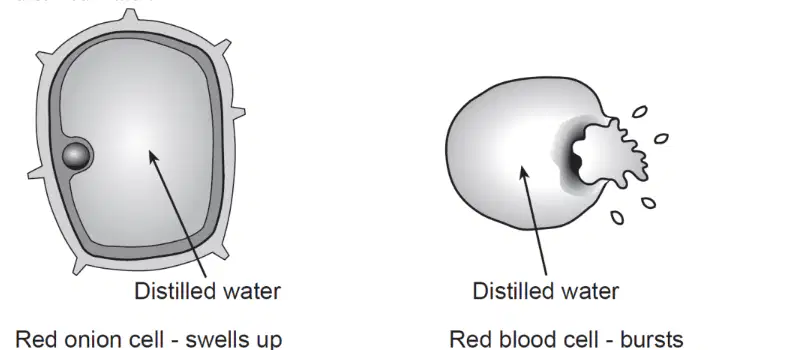
The diagram below represents what occurred when an onion cell and a red blood cell were placed in distilled water. The best explanation for why the onion cells do not burst, while red blood cells often do, is that
a)
the red blood cells have only a cell membrane, which does not protect them from bursting
b)
the onion cells do not have a cell wall that could protect them from bursting
c)
the onion cells have a cell membrane, which can protect them from bursting
d)
the red blood cells have a cell wall, which does not protect them from bursting
2.
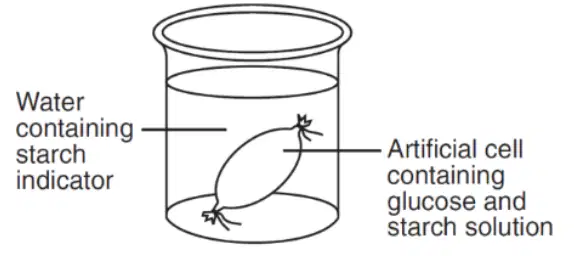
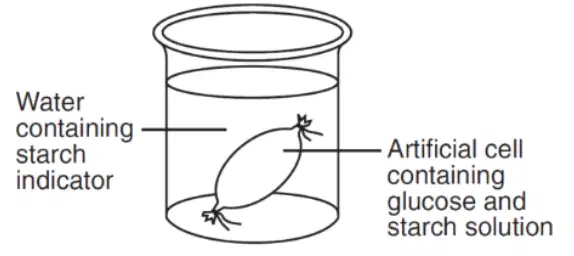
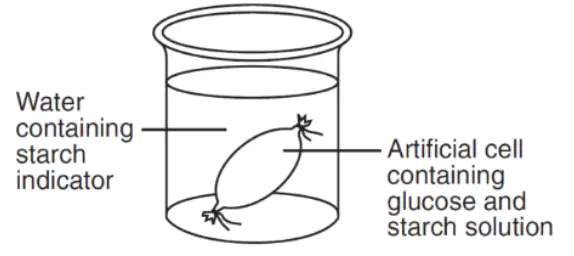
After two hours, the color of the liquid in the beaker did not change. This shows that
a)
glucose moved from the artificial cell into the beaker
b)
starch did not pass out of the artificial cell
c)
starch was digested to glucose in the artificial cell
d)
glucose molecules combined to produce starch in the artificial cell
3.
Identify the color of the contents of the artificial cell after two hours.
a)
Amber brown
b)
Blue/black
c)
Clear
d)
White
4.
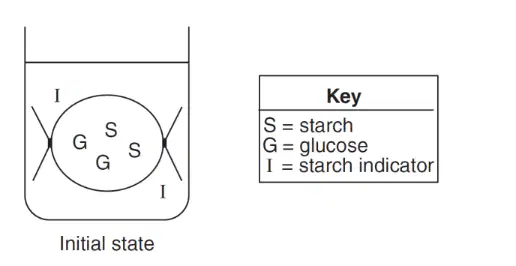
A model cell setup is represented in the "Initial State" diagram below. Which diagram indicates the area where each of these substances would be located after 20 minutes?
a)
A
b)
B
c)
C
d)
D
e)
5.
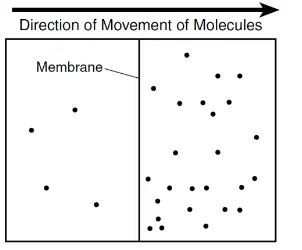
This laboratory setup would most likely be used to demonstrate
a)
carbohydrate synthesis
b)
active transport
c)
diffusion
d)
dehydration
6.
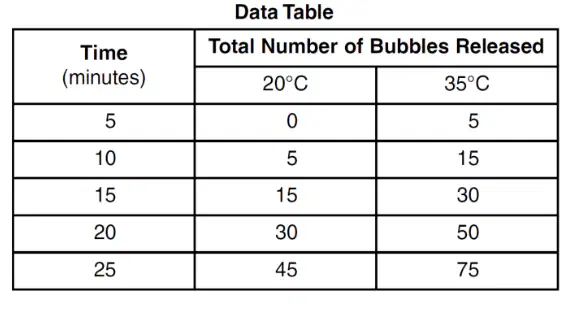
What is one relationship between temperature and the rate of bubbles released in yeast, that is supported by the table?
a)
The higher the temperature, the less bubbles released.
b)
There is no relationship between temperature and number of bubbles released.
c)
The lower the temperature, the less bubbles released.
d)
The lower the temperature, the more bubbles released.
7.
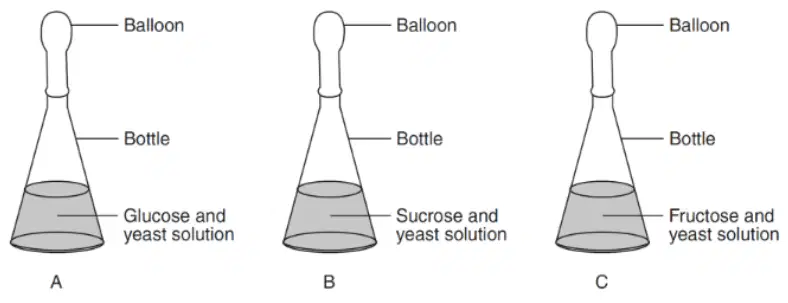
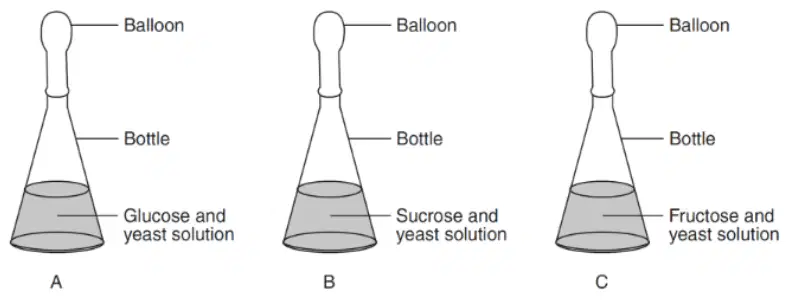
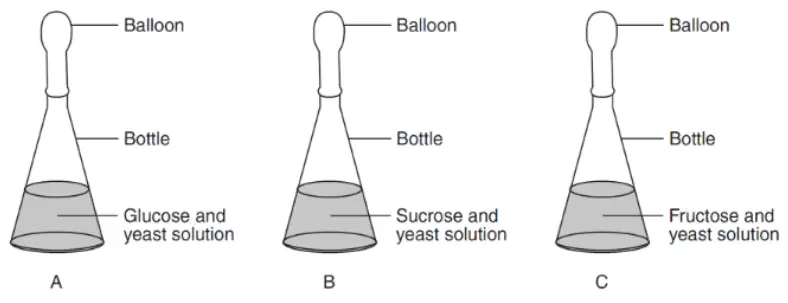
A student wants to bake the biggest loaf of bread in the local baking contest. Each contestant must use the same amounts of flour, sugar, and yeast, but is allowed to vary the type of sugar. Yeast is a microorganism that carries out cellular respiration, which produces carbon dioxide, making the bread rise. The student designs an experiment using the setup below to determine which sugar source (glucose, sucrose, or fructose) will cause the yeast to produce the most carbon dioxide and therefore,the biggest loaf of bread. What is a possible hypothesis for this experiment?
a)
If glucose is the sugar that is used, it will produce the most carbon dioxide.
b)
Which sugar will produce the most carbon dioxide?
c)
Glucose and fructose both produced a balloon circumference of 10 cm.
d)
The dependent variable is the amount of carbon dioxide produced.
8.
A student wants to bake the biggest loaf of bread in the local baking contest. Each contestant must use the same amounts of flour, sugar, and yeast, but is allowed to vary the type of sugar. Yeast is a microorganism that carries out cellular respiration, which produces carbon dioxide, making the bread rise. The student designs an experiment using the setup below to determine which sugar source(glucose, sucrose, or fructose) will cause the yeast to produce the most carbon dioxide and therefore,the biggest loaf of bread. What group is missing from this experimental setup?
a)
An experimental group with double the amount of glucose.
b)
An experimental group with glucose, sucrose, and fructose.
c)
A control group with glucose, sucrose, and fructose.
d)

A control group with just water and yeast solution.
9.
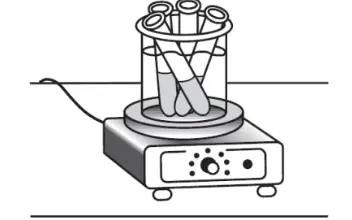
Part of a laboratory procedure is shown in the diagram below. This setup would most likely be involved in a procedure to
a)
stain specimens while making a wet mount
b)
test for the presence of glucose using an indicator
c)
separate pigments in a mixture
d)
determine the pH of solution
10.
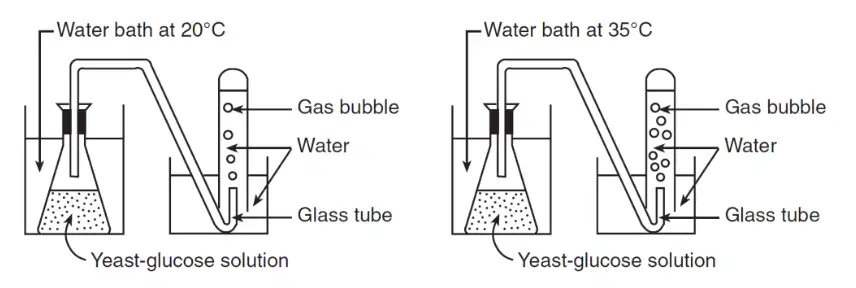
The laboratory setups represented below were used to investigate the effect of temperature on cellular respiration in yeast (a single celled organism). Identify the gas that would be produced by the process taking place in both laboratory setups.
a)
Oxygen
b)
Carbon Dioxide
c)
Nitrogen
d)
Helium
11.
Which indicator should be used to help identify glucose, a simple sugar?
a)
Lugol's iodine
b)
pH paper
c)
Benedict's solution
d)
Bromothymol blue
12.
A student wants to bake the biggest loaf of bread in the local baking contest. Each contestant must use the same amounts of flour, sugar, and yeast, but is allowed to vary the type of sugar. Yeast is a microorganism that carries out cellular respiration, which produces carbon dioxide, making the bread rise. The student designs an experiment using the setup below to determine which sugar source(glucose, sucrose, or fructose) will cause the yeast to produce the most carbon dioxide and therefore,the biggest loaf of bread. What is the specific type of data to be collected?
a)
Amount of sugar
b)
Amount of water
c)
Size of the balloon
d)
Size of the bottle
13.
Which substance is a suitable indicator for detecting the presence of starch in a plant cell?
a)
Fehling's solution
b)
pH paper
c)
bromthymol blue
d)
iodine solution
14.

Some organs in the human body, such as the kidney, help to carry out the function of excretion. Where do these organs get the cellular energy that is directly necessary to carry out these functions?

a)

water that is eliminated by the organs

b)

ATP that is produced in the mitochondria during cellular respiration

c)

glucose that is produced in the chloroplasts during photosynthesis

d)

blood flowing through the organs

15.

During the process of cellular respiration, energy is released from

a)

carbon dioxide

b)

oxygen atoms

c)

water molecules

d)

chemical bonds

16.

Which of the following is unable to diffuse through the cell membrane?

a)

Water, because it is too small

b)

Glucose, because it is too big

c)

Starch, because it is too big

d)

Oxygen, because it is too small

17.

How can we best describe the nature of science, and the discoveries made by different scientists throughout history?

a)

Science remains static, unaffected by new discoveries.

b)

Science adapts slowly to new information.

c)

Science is a dynamic process, constantly evolving as new discoveries are made.

d)

Science only changes when a groundbreaking discovery is made.

18.

In an appropriately designed experiment, a scientist is able to test the effect of

a)

a single variable

b)

multiple variables

c)

the hypothesis

d)

scientific observations

19.

Which process is represented by the diagram below?

a)

diffusion

b)

passive transport

c)

active transport

d)

cellular respiration

20.

How are single celled organisms able to carry out the same complex processes as multicellular organisms?

a)

They are not, because single celled organisms are not actually living.

b)

Single celled organisms contain structures called organelles that carry out functions similar to organs in multicellular organisms.

c)

Single celled organisms contain structures called organs that carry out functions similar to organelles in multicellular organisms.

d)

Single celled organisms are as complex as multicellular organisms

21.

What are the building blocks of this molecule?

a)

Amino Acids

b)

Nucleic Acids

c)

Simple Sugars

d)

Fatty Acids

22.

How does the body respond when more oxygen is required?

a)

Decreasing heart rate

b)

Increasing heart rate

c)

Decreasing blood pressure

d)

Increasing blood pressure

23.

According to the model, what would happen if the pancreas did NOT detect rising blood glucose (sugar) level?

a)

Glucagon would be released in order to maintain homeostasis

b)

Blood sugar would still decrease because pancreas function is not necessary

c)

Blood sugar would stay above normal, resulting in an imbalance in homeostasis

d)

Blood sugar would stay above normal, resulting in maintenance of homeostasis

24.

Which organelle does aerobic cellular respiration happen in?

a)

Nucleus

b)

Mitochondria

c)

Chlorophyll

d)

Chloroplast

25.
A student is planning an experiment to find out how the height from which he drops a ball affects how high the ball bounces. The dependent variable is the _____.
a)
Diameter of the ball
b)
Force acting on the ball
c)
Height that the ball bounces
d)
Height from which the ball is dropped