
 Worksheets
Ocean Topography and Currents
Total questions: 16
Worksheet time: 1hrs 20mins
Name
Class
Date
1.
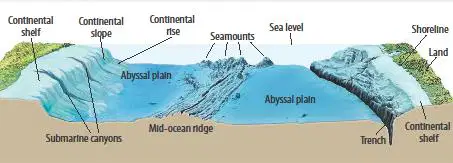
1. From the diagram, which under sea feature extends across most of the ocean floor?
a)
submarine canyons
b)
continental shelf
c)
abyssal plain
d)
continental slope
2.
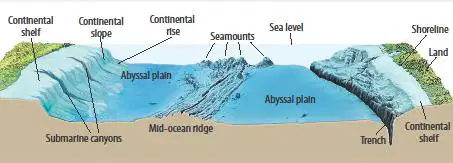
2. Which feature of the ocean floor could be described as an underwater mountain range?
a)
abyssal plain
b)
continental shelf
c)
continental slope
d)
mid-ocean ridge
3.
3. Water currents in the ocean curve because of __________.
a)
wind
b)
the Coriolis effect
c)
the Sun
d)
upwellings
4.
4. The portion of a landmass that extends out from the coast under the ocean is called a continental _____.
a)
edge
b)
slope
c)
shelf
d)
plate
5.
5. Ocean water differs from freshwater in that it has __________
a)
a lower temperature
b)
a higher temperature
c)
a higher concentration of silicon dioxide(quartz)
d)
a higher concentration of sodium chloride(saline)
6.
6. The salts in the sea come from _____.
a)
acid rain
b)
particles falling from space
c)
organisms that live in the sea
d)
weathering and erosion of rocks
7.
7. Which of these decreases as a submarine dives deeper into the ocean?
a)
The water temperature
b)
The freshness of the water
c)
The number of plants in the water
8.
8. Which natural force creates surface ocean currents?
a)
wind
b)
gravity
c)
sunlight
d)
earthquakes
9.
9. What is the difference between a volcanic island & a seamount?
a)
A volcanic island rises above the water & a seamount does not
b)
A seamount rises above the water & a volcanic island does not
c)
Both the seamount & volcanic island are underwater
d)
Both the seamount & the volcanic island rise above the water
10.
10. The continental slope is located at the end of the...
a)
continental shelf
b)
shoreline
c)
mid ocean ridge
d)
abyssal plain
11.
11 Cold water is more dense than warm water
a)
True
b)
False
12.
12. Three reasons it's hard to study ocean floor
a)
extreme pressure, very dark, very cold
b)
very warm, no pressure, light
c)
very dark, little density, marine life dangers
d)
too hot, extreme pressure, very dark
13.
13. What are deep ocean currents?
a)
Currents caused by the differences in temperature and salinity.
b)
Currents caused by the power of the winds.
c)
Currents caused by the power of rivers flowing downhill.
d)
Currents caused by the differences in condensation rates.
14.
14. When the deep ocean currents travel toward the poles, the temperature decreases(get colder), what else happens?
a)
the salinity of the water increases
b)
the salinity of the water decreases
c)
the water gets bluer
d)
the water stops moving
15.
When plastic trash flows into the ocean, this pollution may get in the large circular currents called
a)
an upwelling
b)
a gyre
c)
a force
d)
Atlantic Ocean
16.
Bonus: What is the other name for Deep Water Currents? *Spelling will not count but it needs to be close--sound it out!
*Hint: one part means heat/temperature and the other part means salinity
(a)
100 %

